What to See in Évora, Portugal: Free Audio Guide
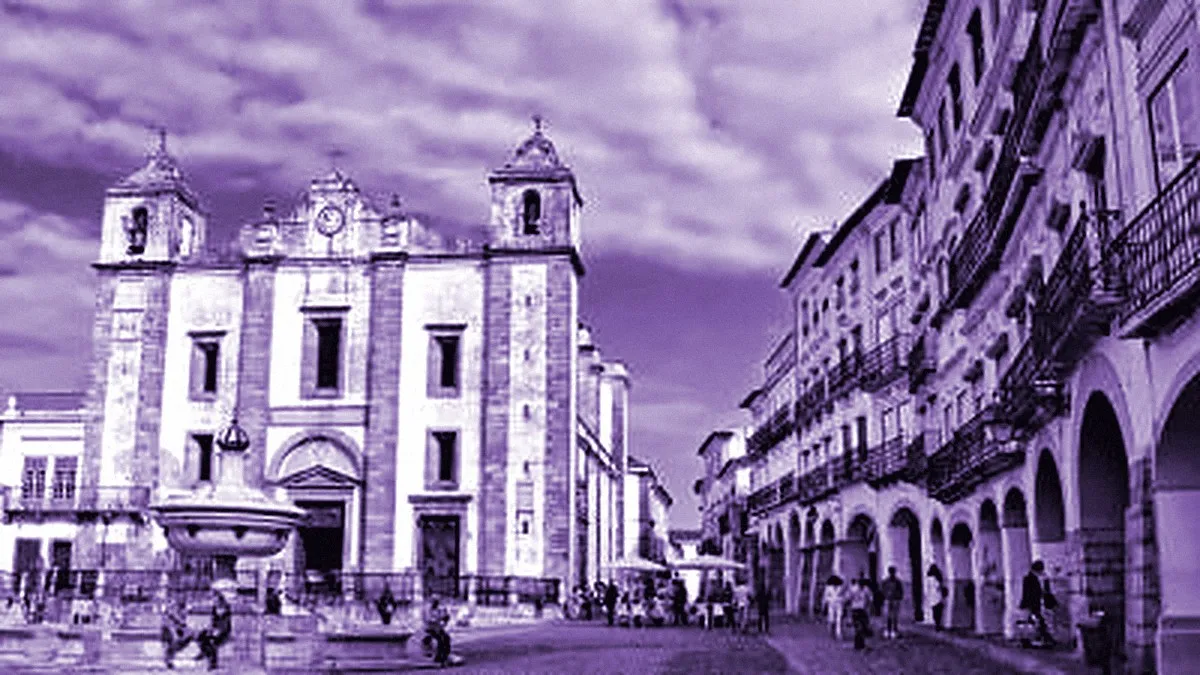
Things to do in Évora: a self-guided journey through history
Évora is a historic city in Portugal’s Alentejo region, where Roman, medieval and Renaissance landmarks stand within a UNESCO World Heritage-listed centre. The compact old town is particularly rewarding on foot, with monumental buildings, elegant fountains and quieter streets revealing the city’s long history. Neywo’s free audio guide for Évora includes 81 narrated places.
What to see in Évora
The city’s main landmarks are close enough to connect in a natural walking route. These are some of the most important places to include when deciding what to do in Évora.
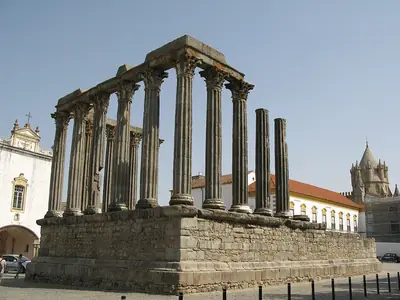
Roman Temple of Évora
The Roman Temple is one of the clearest symbols of Roman presence in Portugal. Although it is often called the Temple of Diana, that name is considered incorrect. The monument is associated with Augustus, the Roman emperor, and is believed to have been built around the first century of the Common Era for his worship.
In Roman times, it stood in the main public square of Liberalitas Iulia, at what was then the highest point of Évora’s acropolis. The surviving ruins still convey the scale of the original building, despite later changes and the end of its original function in the fifth century.
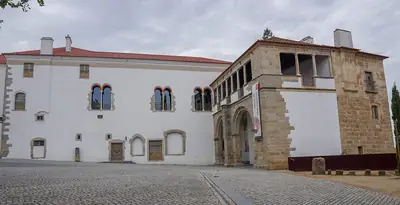
Convento dos Lóios
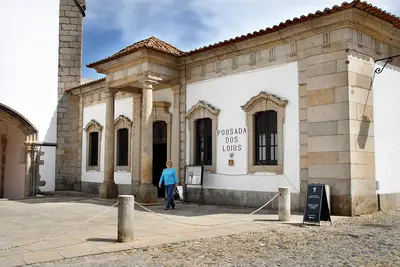
The former Convento dos Lóios, also known as the Convento de São João Evangelista and Pousada dos Lóios, occupies the remains of a medieval castle. Built in the fifteenth century, it was badly damaged by the earthquake of 1755 and is now home to the Pousada dos Lóios.
Its Church of São João Evangelista was founded in 1485 and consecrated in 1491. The church and convent reflect Évora’s religious history as well as the influence of noble patronage.
Cathedral of Évora
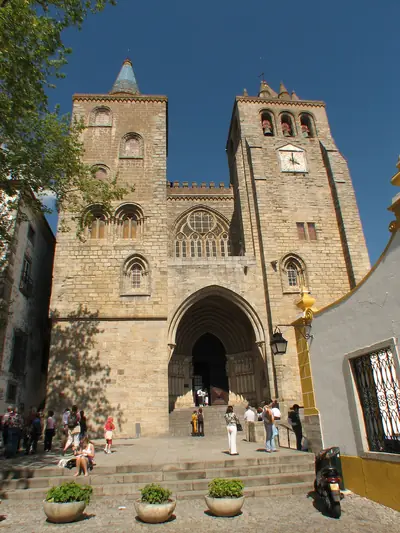
Known in Portuguese as the Sé de Évora, the Cathedral of Évora stands at the highest point of the city. Construction began in 1186, the cathedral was consecrated in 1204, and the granite building was completed in 1250.
Its three naves show the transition from Romanesque solidity to early Gothic design. The Gothic cloisters date from the fourteenth century, while later additions include the upper choir, pulpit and baptistery. The Esporão Chapel, dating from 1529, is a distinctive example of hybrid Plateresque architecture.
Chafariz das Portas de Moura
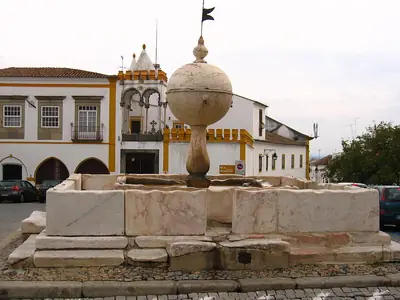
At Largo das Portas de Moura, the Chafariz das Portas de Moura provides an elegant example of sixteenth-century civic architecture. Commissioned in 1556 by Cardinal D. Henrique, then Archbishop of Évora, it was designed by Diogo de Torralva, who was also working on the Água de Prata Aqueduct.
The fountain has two rectangular basins, with the main basin raised above the lower one. A marble sphere decorated with high-relief seraphim stands at its centre, representing the four fountains that supply the basins.
Palácio dos antigos Condes de Basto
The Palácio dos antigos Condes de Basto, also called the Paço de São Miguel, occupies a site connected with Évora’s Muslim period. It formed part of the city’s alcáçova, the fortified area corresponding to the Roman and medieval enclosure.
The palace has remained closely tied to the city’s history and is known for the exceptional number of traditions associated with it. Its setting at Pátio de São Miguel makes it a natural stop between the Roman Temple and the cathedral.
Chafariz da Praça do Giraldo
Praça do Giraldo is one of Évora’s central meeting places, and its marble fountain is one of the square’s defining features. Built in 1571 by architect Afonso Álvares, the Chafariz da Praça do Giraldo is made of white marble and crowned with bronze.
Its eight carved faces, or carrancas, are traditionally said to represent the eight streets leading into the square. The fountain also carries a royal tradition: in 1619, King Philip the Third of Spain is said to have considered it worthy of a coronation.
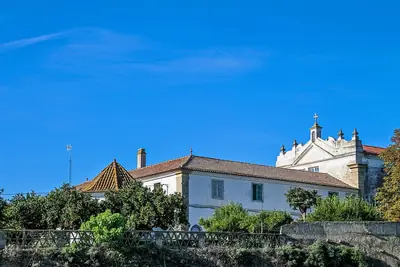
Convento do Monte Calvário
Beside Évora’s outer walls, the Convento do Monte Calvário has a long, sober façade strengthened by sturdy buttresses. Its restrained appearance reflects the directives of the Council of Trent.
The convent has preserved almost all of its original architecture, without major alterations. Since 2024, it has been cared for by the Sementes do Verbo Community, which has opened the space to perpetual adoration, spiritual retreats and Christian hospitality.
Casas Pintadas
Casas Pintadas, also known as the Jardim das Casas Pintadas, is a cultural heritage monument within Évora’s historic streets. It is included among the central landmarks on the city’s Roman Temple-to-cathedral route.
Convento de Santo António da Piedade and Forte de Santo António
In Bacelo, the Convento de Santo António da Piedade brings together a sixteenth-century religious foundation and a later defensive stronghold. Cardinal-Infante Dom Henrique founded the convent for the Capuchin order in 1576, and it was completed under his successor as Archbishop of Évora, Dom Teotónio de Bragança.
The convent later passed through several uses, including a brief period as a public cemetery after the abolition of religious orders in 1834. The Forte de Santo António was built within the convent’s enclosure during the Restoration period.
Places to visit beyond Évora
The Évora area also contains significant sites outside the compact historic centre.
Almendres Cromlech
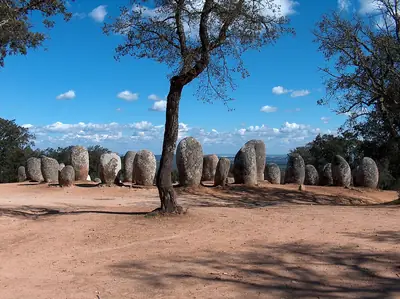
The Almendres Cromlech is a prehistoric stone circle made up of 95 monoliths. It is considered the most important cromlech of its kind on the Iberian Peninsula and one of the most significant in Europe, both for its size and its state of preservation. A nearby Almendres menhir is also classified as a Property of Public Interest.
Convento de São Bento de Cástris
The Convento de São Bento de Cástris, in the parishes of Malagueira and Horta das Figueiras, offers a quieter stop beyond the city. The national monument was home to Cistercian nuns from 1274 until 1890.
Castelo de Geraldo
Near Valverde, the ruins of Castelo de Geraldo are associated with Geraldo Sem Pavor, the warrior linked to the conquest of Évora from Muslim rule in 1165. The fortified settlement may have begun in the Bronze Age or even the Chalcolithic period, while the visible wall is thought to belong to a medieval occupation.
The roughly circular site has an outer perimeter of about 114 metres and represents an unusually long sequence of occupation in the Alentejo.
Quinta do Paço de Valverde
Near the Valverde stream, the Quinta do Paço de Valverde combines an episcopal palace, chapel, gardens and the remains of a complex shaped over several centuries. The estate was created by the Archdiocese of Évora in the early sixteenth century, around twelve kilometres from Évora.
Its palace chapel of Saint John the Baptist preserves its original Manueline structure. The estate also contains the Casas Pintadas, a masonry aqueduct and the Jardim de Jericó, including its large circular lake.
Other castles in the Évora area
Several other historic fortifications add depth to the surrounding landscape. Castelo de Torre de Coelheiros, also known as Solar dos Cogominhos, was built in the mid-fourteenth century. The Castle of Valongo, or Castelo Real de Montoito, is a well-preserved medieval castle near Nossa Senhora de Machede and has been classified as a National Monument since 1910.
Explore Évora with Neywo
Neywo offers an Évora self-guided walking tour experience through three walking tours and one bus route. Together, they cover narrated stops across the historic centre and beyond:
- Roman Temple to Gothic Cathedral: Évora’s Acropolis — 1.65 km, 119 minutes and 12 stops
- Fountains, Squares and the Chapel of Bones — 1.86 km, 98 minutes and 12 stops
- Convents, Gates and the Quiet West — 3.25 km, 101 minutes and 10 stops
- Linha Azul Sul: A Ride Through Évora’s Historic Centre — 5.2 km, 22 minutes and 7 stops
The app tells the story of each place as you reach it, at your own pace, with no group and no schedule. Narration is available in 11 languages.
Évora is a natural starting point for exploring more of Portugal, while nearby destinations such as Beja and Elvas offer further ways to discover the country’s historic interior. Download Neywo and explore Évora with a free audio guide that keeps pace with your walk.
Places with an audio guide in Évora
8 places in Évora with a Neywo audio guide. Each one starts telling its story as you reach it.
Self-guided tours in Évora
4 tours in Évora, free in the Neywo app. Each stop tells its story as you reach it.
- Bus ride
Linha Azul Sul: A Ride Through Évora's Historic Centre
TREVO's blue minibus circuit loops the southern half of the walled city. Ride it past the Moura fountain, the Church of São Francisco and Praça do Giraldo, out to the Remédios convent and the Raimundo gate.
Ermida de São Brás · Chafariz das Portas de Moura · Church of Senhor Jesus da Pobreza · Igreja de São Francisco · Chafariz da Praça do Giraldo · Igreja e Convento de Nossa Senhora dos Remédios …
Open this tour: Linha Azul Sul: A Ride Through Évora's Historic Centre - Walk
Roman Temple to Gothic Cathedral: Évora's Acropolis
Climb to the highest point of Évora, where a first-century Roman temple, a medieval cathedral and a Renaissance fountain stand within a few hundred metres. Walk past the Tower of the Five Corners, the Lóios convent and the Baroque tiles of the Misericórdia, and end at the old Jesuit university.
Roman Temple of Évora · Jardim Diana · Casas Pintadas · Palace of the Dukes of Cadaval · Convento dos Lóios · Church of the Lóios …
Open this tour: Roman Temple to Gothic Cathedral: Évora's Acropolis - Walk
Fountains, Squares and the Chapel of Bones
Start in Praça do Giraldo, the living room of Évora, where eight carved faces watch over the marble fountain. Then wander south past medieval towers and Manueline churches to São Francisco, famous for its Chapel of Bones, and finish in the quiet public garden.
Igreja Paroquial de Santiago · Torre quadrangular (medieval) · Igreja de Santo Antão (Évora) · Chafariz da Praça do Giraldo · Praça do Giraldo · Igreja de São Francisco …
Open this tour: Fountains, Squares and the Chapel of Bones - Walk
Convents, Gates and the Quiet West
Leave the busy centre for Évora's calmer western side: whitewashed convents, old city gates and a historic theatre. It is a slow walk through the monastic city that once surrounded the university town.
Convento de Santa Mónica · Igreja de São Mamede · Convento do Salvador · Cerca romana e árabe · Porta de Avis · Convento de São José …
Open this tour: Convents, Gates and the Quiet West
Walk Évora with Neywo
Neywo turns Évora into a self-guided audio tour. Stories arrive as you reach the place they belong to, and the route reshapes when you wander off it.

