Visiting Norwich, United Kingdom: Top Sights on Foot
Things to Do in Norwich: Historic Streets, Churches and Museums
Norwich is a historic city in England, known for its medieval castle, remarkable churches, merchant buildings and museums. The city centre brings together Norman, medieval, Victorian and modern architecture, making it rewarding to explore on foot. Neywo has a free audio guide for Norwich with 100 narrated places.
What to See in Norwich
Norwich Castle
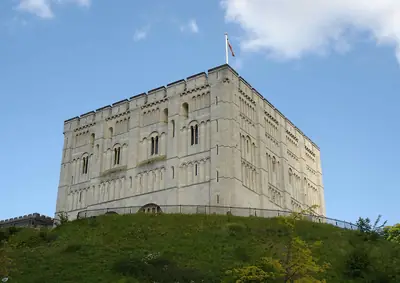
Norwich Castle is a medieval royal fortification that began after the Norman Conquest, when William the Conqueror ordered its construction as part of his campaign to subjugate East Anglia. The original motte-and-bailey fort was made of wood, and creating space for it required the demolition of about one hundred Saxon homes.
The stone keep visible today was begun in 1094 by William the Conqueror’s son, King William the Second, known as William the Red. King Henry the First completed it in 1121. The complex also includes a Gothic-style gatehouse and former prison wings.
For much of its later history, the castle was used as a prison. Parts of it served as a gaol from 1220 until 1887. Since 1894, it has housed Norwich Castle Museum, whose collections include art, archaeological finds and natural history specimens connected especially with the region.
Bridewell Museum and St Andrew’s Church
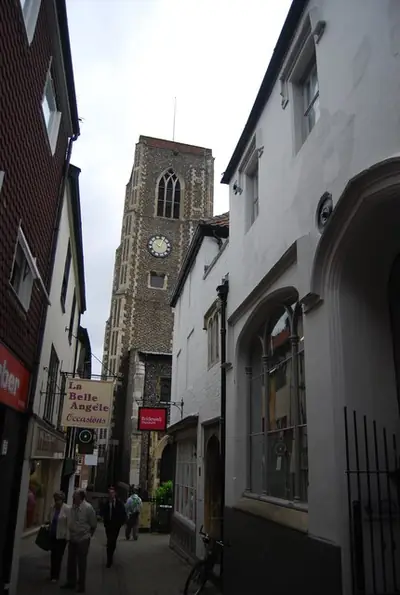
The Museum of Norwich at the Bridewell stands beside St Andrew’s Church in a Grade I listed building. Its history reflects the changing life of the city: it began in the fourteenth century as a grand medieval residence, opened as a house of correction known as the Bridewell in 1585, became a factory from 1828, and was eventually donated to the city in 1923 before becoming a museum.
Next door, St Andrew’s Church is the only church in Norwich dedicated to Andrew the Apostle. Built mainly between 1499 and 1518, it is a late Perpendicular Gothic hall church, with an uninterrupted flow from the nave to the chancel.
Strangers’ Hall
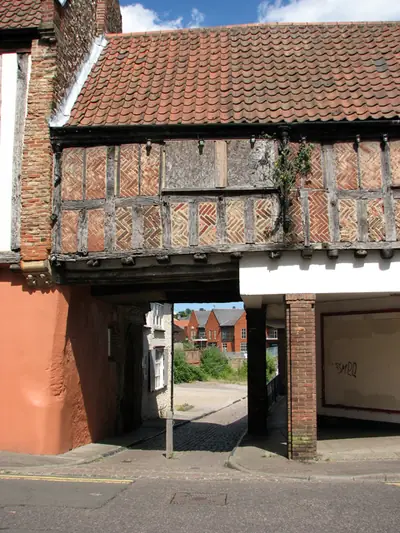
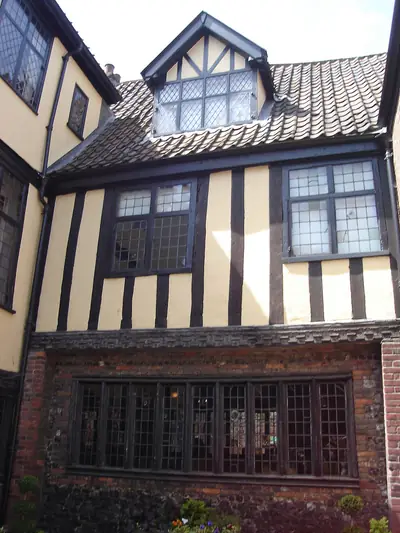
Strangers’ Hall is a historic house and museum of domestic history. Its oldest surviving section is a fourteenth-century undercroft, while the building developed around a courtyard through later additions.
The house served domestic and commercial purposes and was home to several Mayors of Norwich, as well as lawyers, dancing masters and merchants. Its features include a crown-post roof, mullioned bay window, vaulted porch and Great Hall. The Great Hall was built in the fifteenth century by William Barley, a cloth merchant, and a Georgian dining room was added in 1748.
Dragon Hall
Dragon Hall is a Grade One listed medieval merchant’s trading hall close to the River Wensum. The fifteenth-century great hall occupies the first floor and has a timber structure of seven bays with a crown-post roof. Fourteen carved dragons decorate the spandrels.
The hall was built from English oak, using about one thousand trees. A warehouse beneath it supported the building’s commercial role, while a rear yard provided access to the river for imports and exports. Archaeological research has also uncovered evidence of an Anglo-Saxon hut beneath the site, dating from around the year 1000. Since 2018, Dragon Hall has been home to the National Centre for Writing.
St John the Baptist Cathedral
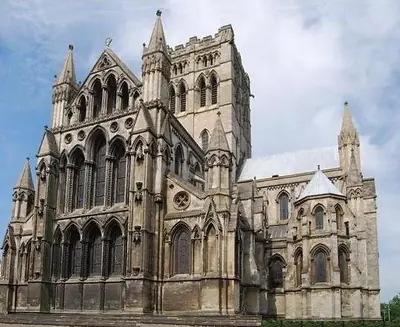
St John the Baptist Cathedral is the Roman Catholic cathedral of Norwich and the mother church of the Diocese of East Anglia. The building was constructed between 1882 and 1910 and became a cathedral in 1976, when the diocese was established.
It is a striking example of Victorian Gothic Revival architecture. George Gilbert Scott Junior designed it, and his brother John Oldrid Scott completed the work after George’s early death. The stonework combines Frosterley Marble with Jurassic limestone, whose fossils include crinoids and rugose corals. Inside, the stained-glass windows are among the cathedral’s notable features.
The South Asia Collection
The South Asia Collection is a museum devoted to the decorative arts and crafts of South Asia. It adds a distinctive cultural dimension to Norwich’s museums and sits among the city’s western attractions.
Remains of St Benedict’s Church
Only the round tower of St Benedict’s Church survives. The church was dedicated to Saint Benedict and probably dates from the eleventh century. After several phases of construction and refurbishment, it was badly damaged in an air raid in 1942. The medieval round tower is now the only remaining part of the former parish church and is a Grade I listed building.
Norwich War Memorial
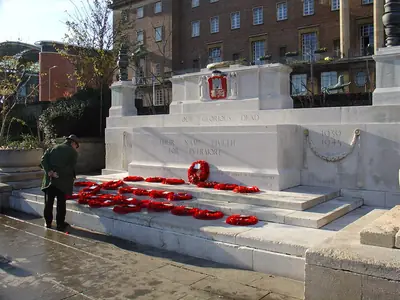
Also known as Norwich City War Memorial or Norwich Cenotaph, this First World War memorial was designed by Sir Edwin Lutyens. It was the last of the eight cenotaphs he designed to be erected in England.
The memorial takes the form of an empty tomb above a low screen wall, with a Stone of Remembrance projecting from it. Bronze flambeaux stand at either end. In 1938, it was moved to a memorial garden between the market and City Hall, where it became the centrepiece of the space. Restoration was completed in 2011.
Sainsbury Centre
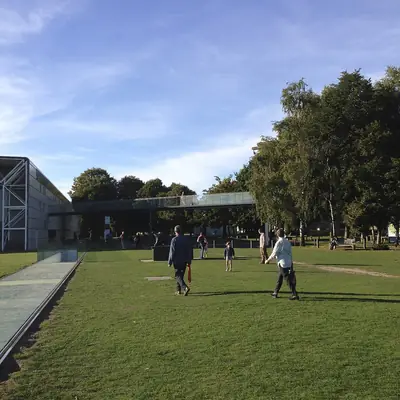
The Sainsbury Centre is an art museum on the University of East Anglia campus. Its collection spans more than 5,000 years of human history and includes objects from Africa, Asia, the Pacific and the ancient Mediterranean, alongside works by artists including Henry Moore and Alberto Giacometti. Notable objects include a Nigerian Head of an Oba and a Gabonese Fang Reliquary Head.
The building is an attraction in its own right. Designed by Norman Foster and Wendy Cheesman, it opened in 1978 as one of Foster’s early landmark projects. Its sleek steel cuboid form was designed as a flexible universal space, with extensive glazing and a carefully balanced combination of natural and artificial light. The building became Grade II* listed in December 2012.
Carrow Abbey and Norwich’s Historic Churches
Carrow Abbey is a Grade I listed former Benedictine priory in Bracondale, in the southeast of the city. It was founded around 1146 under a charter granted by King Stephen.
Norwich also preserves reminders of churches that have disappeared or changed function. St Clement Conesford, also known as Saint Clement at the Well, once stood near Abbey Lane on the east side of King Street. Its parish was united with St Julian’s in 1482, and the church was demolished sometime after 1744. The site is now occupied by the Waterfront, although traces of the churchyard remained and human bones were recovered during construction work in 1962.
The city’s historic buildings also include the Church of Christ Scientist, together with its adjoining walls, gate piers and gates, and the small building at 19–21 Bedford Street, home to Fairhurt Gallery and Framers.
Explore Norwich with a Self-Guided Walking Tour
A Norwich self-guided walking tour is a practical way to connect the city’s buildings and stories without following a group. Neywo’s six walking tours range from 1.51 to 2.79 km and take between 51 and 93 minutes:
- Normans, Mayors and Ghosts: From Castle Keep to Cow Tower — 2.51 km, 93 minutes, 11 stops
- Market, Guildhall and Art Deco: The Civic Heart of Norwich — 1.51 km, 76 minutes, 12 stops
- Over the Water: Weavers’ Churches and the Wensum Lanes — 2.23 km, 86 minutes, 11 stops
- Julian’s Norwich: King Street, Dragon Hall and the Round-Tower Churches — 2.79 km, 86 minutes, 10 stops
- Gardens, Cathedral and Redundant Churches: Norwich West of the Market — 1.8 km, 69 minutes, 9 stops
- Tombland to the Great Hospital: Norwich’s Eastern Lanes — 1.51 km, 51 minutes, 6 stops
There is also one 7 km bus route, Orange Line 21A: Cathedral, Castle and Cavell by Bus, which takes 30 minutes and has 11 narrated stops. Together, the tours cover places including Norwich Castle, Norwich Cathedral, Dragon Hall, Strangers’ Hall, Norwich War Memorial, Plantation Garden, the city’s medieval churches and the University of East Anglia area.
Download Neywo for Norwich
Download Neywo to explore Norwich with 6 walking tours and 1 bus route, covering routes from 1.51 to 7 km and lasting from 30 to 93 minutes. The city guide includes 100 narrated places, and narration is available in 11 languages.
The app tells the story of each place as you reach it, at your own pace, with no group and no schedule. It is a free walking tour Norwich experience designed for independent exploration: choose a route, walk through the city and let the stories begin at the places themselves.
Places with an audio guide in Norwich
8 places in Norwich with a Neywo audio guide. Each one starts telling its story as you reach it.
Self-guided tours in Norwich
7 tours in Norwich, free in the Neywo app. Each stop tells its story as you reach it.
- Bus ride
Orange Line 21A: Cathedral, Castle and Cavell by Bus
A regular First Norwich city bus that threads the whole centre. Ride from the Victorian Catholic cathedral past the Theatre Royal and Norman castle, then on through the medieval churches north of the river, the Octagon Chapel and St Andrew's Hall, past Edith Cavell's memorial to the Anteros arts foundation.
St John the Baptist Cathedral · Theatre Royal, Norwich · Norwich Castle · Church of St Michael At Plea · St Augustine's Church, Norwich · CityGates Church …
Open this tour: Orange Line 21A: Cathedral, Castle and Cavell by Bus - Walk
Normans, Mayors and Ghosts: From Castle Keep to Cow Tower
Norwich was once the second city of England, and the proof is in the stone. Climb from William the Conqueror's castle past the Bridewell, the Dominican friars' halls and crooked Elm Hill, then enter the Norman cathedral with its soaring spire and finish by the river at the gunpowder-age Cow Tower and the old Pull's Ferry watergate.
Norwich Castle · Bridewell Museum · St Andrew's Hall · Church of St Michael At Plea · St Peter Hungate, Norwich · 28 And 30, Elm Hill …
Open this tour: Normans, Mayors and Ghosts: From Castle Keep to Cow Tower - Walk
Market, Guildhall and Art Deco: The Civic Heart of Norwich
For over 900 years Norwich Market has been the beating heart of the city. Start in the peacock-tiled Royal Arcade, wander through the stalls beneath the medieval Guildhall, then meet the madder dyers' lane at St John Maddermarket and Strangers' Hall before the 1930s Art Deco City Hall, the glassy Forum and the grand Georgian theatre and assembly rooms.
Royal Arcade · Norwich Market · Norwich Guildhall · Colman's Mustard Shop & Museum · Church of St John Maddermarket, Norwich · Strangers' Hall …
Open this tour: Market, Guildhall and Art Deco: The Civic Heart of Norwich - Walk
Over the Water: Weavers' Churches and the Wensum Lanes
North of the river lay the medieval weavers' quarter, known as Norwich-over-the-Water. Follow narrow lanes between flint churches with round towers and flushwork, an octagonal Unitarian chapel and a converted maltings theatre, cross the oldest bridge site in the city and end at a puppet theatre hidden inside a medieval church.
St Augustine's Church, Norwich · CityGates Church · Church of St Mary Coslany · St Michael Coslany, Norwich · Church of St George · Octagon Chapel …
Open this tour: Over the Water: Weavers' Churches and the Wensum Lanes - Walk
Julian's Norwich: King Street, Dragon Hall and the Round-Tower Churches
South of the cathedral, King Street was a merchants' road to the sea. Walk from Skipper's marble-lined Surrey House through quiet churches to Dragon Hall with its fourteen carved dragons, visit the church where Julian of Norwich wrote the first book in English by a woman, and finish at the Victorian bridge and railway station.
Surrey House · All Saints Church · Church of St John Baptist · St Peter Parmentergate · Church of St Julian, Norwich · Dragon Hall …
Open this tour: Julian's Norwich: King Street, Dragon Hall and the Round-Tower Churches - Walk
Gardens, Cathedral and Redundant Churches: Norwich West of the Market
Leave the market behind for the quieter western side of the city. Start in the sunken Plantation Garden, climb to the Victorian Catholic cathedral and cross Chapelfield Gardens, where a stretch of the medieval city wall once stood, then follow St Benedict's Street past a bombed church tower and a string of redundant medieval churches that are now cared for as heritage.
Plantation Garden · St John the Baptist Cathedral · Chapelfield Gardens · The South Asia Collection · Church of St Giles · Remains Of St Benedict's Church …
Open this tour: Gardens, Cathedral and Redundant Churches: Norwich West of the Market - Walk
Tombland to the Great Hospital: Norwich's Eastern Lanes
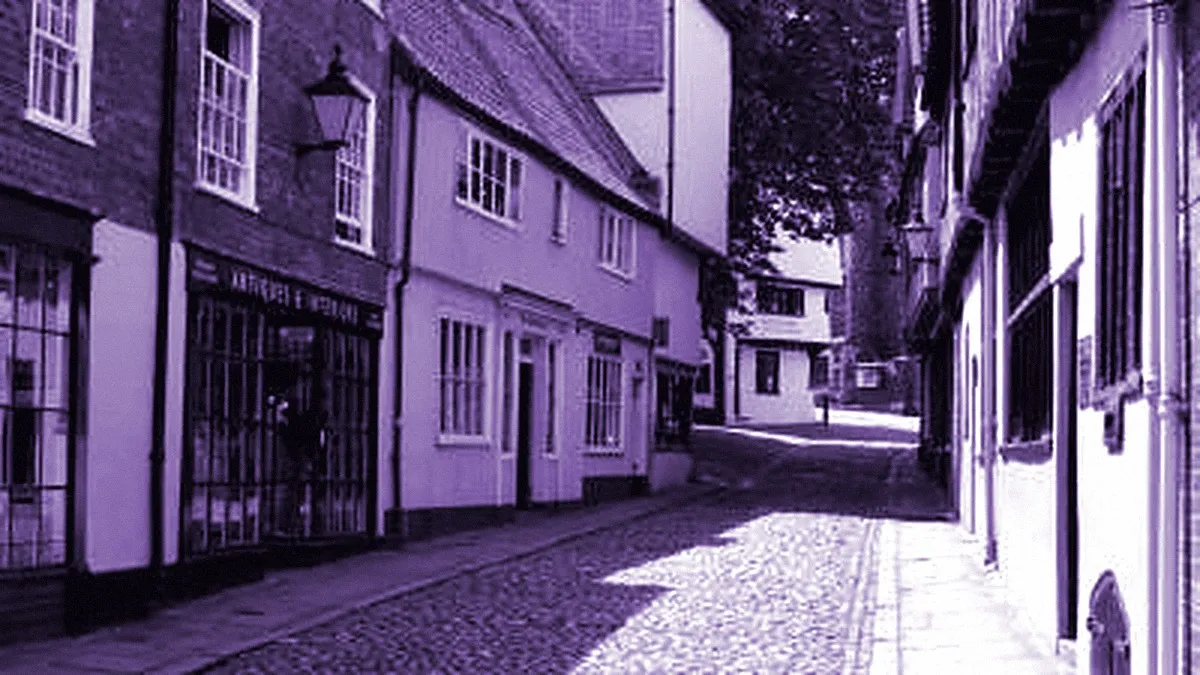
A short, quiet walk through the Tombland end of the city. See the cobbled front of Elm Hill, the Grade I churches of St Mary the Less and St George Tombland, then pass under the cathedral close's shadow to St Mary in the Marsh, St Martin at Palace and St Helen's beside the Great Hospital.
34 And 36, Elm Hill · St Mary the Less, Norwich · Church of St George · St Mary in the Marsh, Norwich · Church of St Martin at Palace · Church of St Helen
Open this tour: Tombland to the Great Hospital: Norwich's Eastern Lanes
Walk Norwich with Neywo
Neywo turns Norwich into a self-guided audio tour. Stories arrive as you reach the place they belong to, and the route reshapes when you wander off it.

