Belfast, United Kingdom: Self-Guided Walking Tour
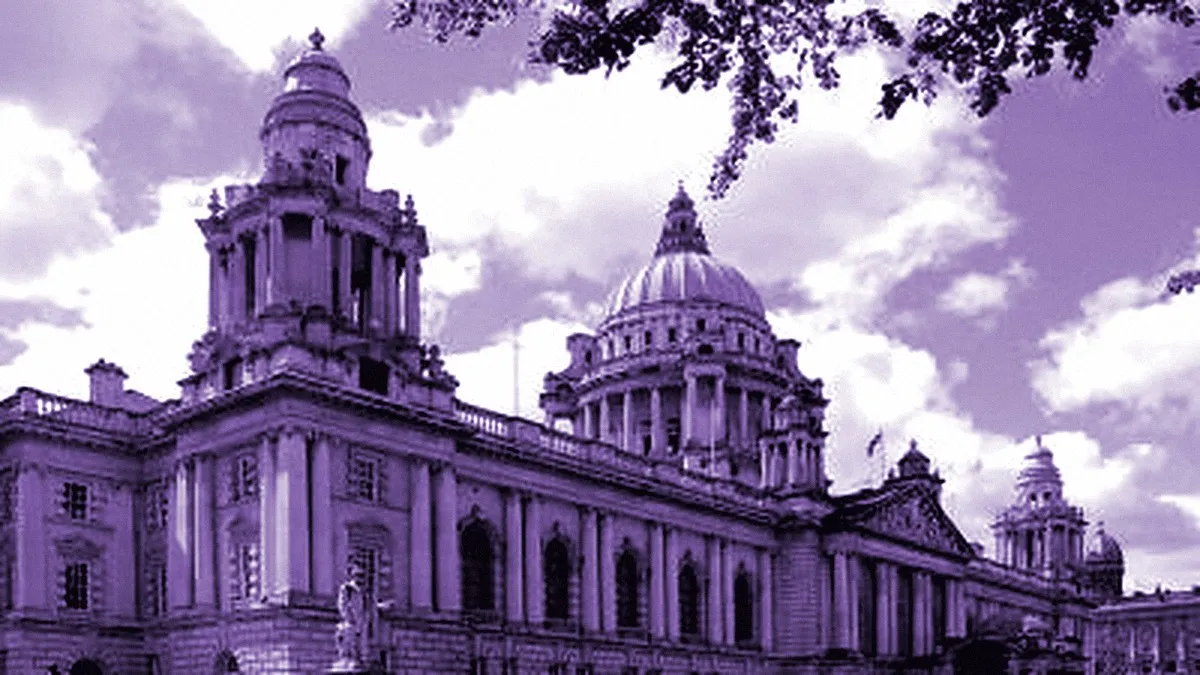
Things to Do in Belfast: What to See in Northern Ireland’s Capital
Belfast is a city shaped by shipbuilding, industry, architecture, culture, and a complex modern history. The best things to do in Belfast range from exploring the Titanic Quarter and historic ships to visiting museums, churches, theatres, and places that help explain the city’s past. Neywo has a free audio guide for Belfast with 52 narrated places, so you can discover the city while walking at your own pace.
What to See in Belfast
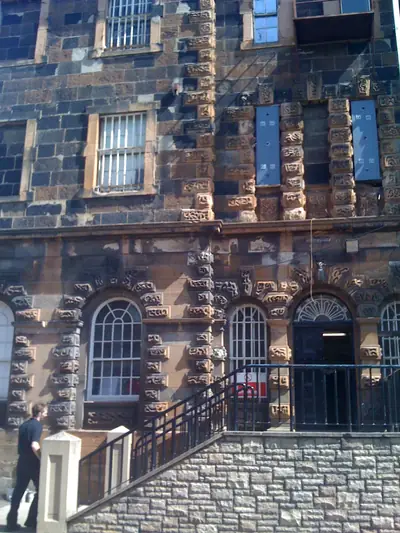
HM Prison Crumlin Road
HM Prison Crumlin Road is one of Belfast’s most compelling historical landmarks. Built between 1843 and 1845, Crumlin Road Gaol operated for more than 150 years and held men, women, and children. Its history includes the imprisonment of suffragettes and political prisoners during the Irish War of Independence, as well as the detention of people during the Troubles.
The prison also carried out public executions, including the last hanging there in 1961. Designed by Sir Charles Lanyon in a radial layout intended to improve surveillance, the site now preserves restored cells and the execution chamber. An underground tunnel once connected the gaol to the derelict Crumlin Road Courthouse opposite it.
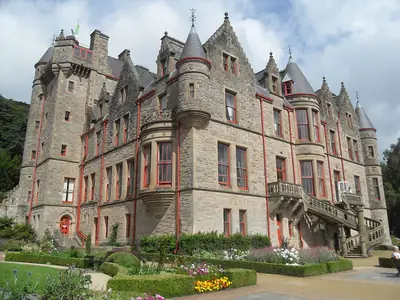
Belfast Castle
On the slopes of Cave Hill, Belfast Castle provides wide views over the city and Belfast Lough. The current building is a Scottish Baronial-style Victorian mansion constructed between 1867 and 1870 for the 3rd Marquess of Donegall, after the earlier city-centre castle was destroyed by fire.
The Grade A listed building stands about 400 feet, or 120 metres, above sea level. Turrets, gables, and ornate stonework define its exterior, while the gardens include cat-themed sculptures linked to a local legend about white cats and good fortune.
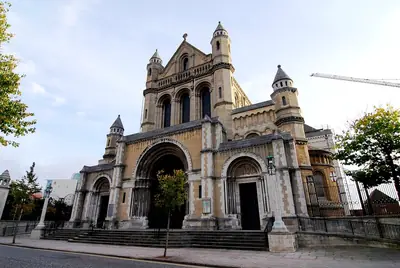
St Anne’s Cathedral
St Anne’s Cathedral is the architectural and spiritual centre of Belfast’s Cathedral Quarter. Construction began in 1899, and the Romanesque-style Anglican cathedral was completed in 1904.
Inside, stained glass fills the building with colour and light. The Chapel of the Holy Spirit is dedicated to those who died in the First World War. Above the cathedral, the modern stainless-steel Spire of Hope rises 40 metres and is illuminated at night.
Ulster Museum
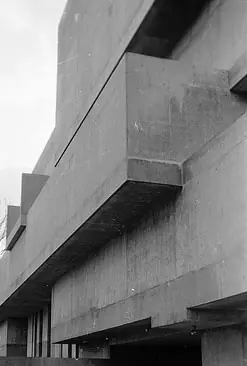
Located beside the Botanic Gardens, the Ulster Museum is Northern Ireland’s largest museum, with around 8,000 square metres of public display space. Its collections cover natural history, art, and heritage, including botany, zoology, geology, Irish fauna, minerals, rocks, and fossils.
The museum began with the Belfast Natural History Society, founded in 1821, and opened to the public in 1833. It moved to its current site in 1929, where a Brutalist extension was added in the 1960s. A later renovation reopened the museum in October 2009, combining the earlier building with a light-filled contemporary atrium. Among its notable collections are Ireland’s only known dinosaur fossil bones.
Northern Ireland War Memorial
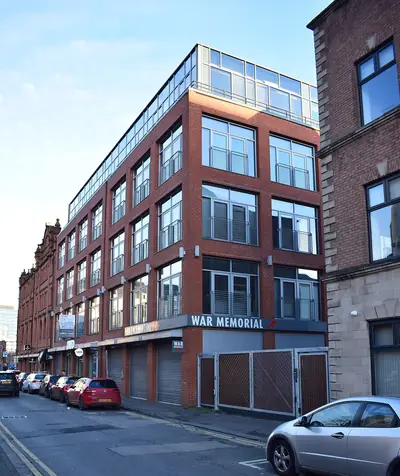
The Northern Ireland War Memorial on Talbot Street combines remembrance, exhibitions, and community space. It opened in 2007, replacing Memorial House, an earlier building on Waring Street that was bombed during the Belfast Blitz in 1941.
The Memorial includes the Home Front Exhibition and the first national memorial to the hundreds killed in the Belfast Blitz, created by sculptor Carolyn Mulholland. Its exhibitions explore the social and cultural impact of the Second World War in Northern Ireland, while the institution commemorates those from Northern Ireland who served in both World Wars.
Irish Republican History Museum
The Eileen Hickey Irish Republican History Museum preserves the experiences of republican communities in Belfast and a difficult chapter of Ireland’s past. Established in 2007 after years of campaigning by Eileen Hickey, the museum opened in February of that year, shortly after her death, and is administered by volunteers.
The collection includes donated objects from hundreds of individuals and families. Prisoners’ handicrafts, weapons, photographs, artwork, posters, and material connected with the conflict are displayed alongside objects reaching back to the United Irishmen’s rebellion of 1798. Highlights include a jacket worn in prison by IRA volunteer Mairéad Farrell and a cell door and bed removed from Armagh Women’s Prison.
Royal Ulster Rifles Museum
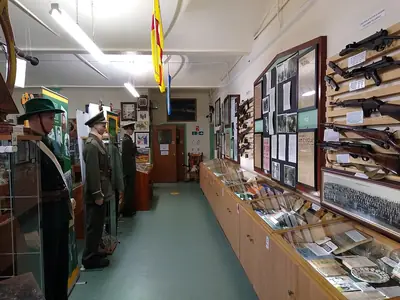
The Royal Ulster Rifles Museum, also in the Cathedral Quarter, traces the regiment’s story through uniforms, weapons, medals, photographs, and personal belongings. The narrative begins with the 83rd and 86th Foot in 1793 and continues through the regiment’s renaming as the Royal Ulster Rifles in 1921, the First and Second World Wars, Korea, Cyprus, and Borneo.
World War I trench artefacts, D-Day and Korean War memorabilia, and interactive displays add personal detail to the history of the regiment.
Albert Memorial Clock
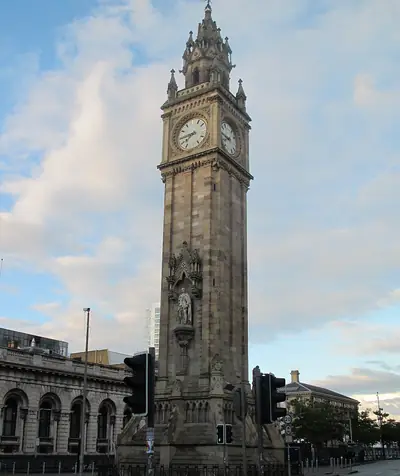
The Albert Memorial Clock is one of Belfast’s most recognisable landmarks. Built between 1865 and 1869, the Gothic Revival tower was designed by W. J. Barre and constructed from pinkish Scrabo sandstone, combining French and Italian Gothic influences.
The tower features flying buttresses, heraldic lions, angels, gargoyles, floral decoration, and an octagonal belfry. A life-size statue of Prince Albert stands on the west face. The clock is also known for its noticeable eastward tilt, caused by the reclaimed, marshy ground near the River Farset on which it was built.
St Patrick’s Church
St Patrick’s Church in Donegall Street is a Roman Catholic church with a Romanesque Revival exterior. The parish began with a modest church opened on the site in 1815, while the current building opened in 1877 after Belfast’s growing population made the earlier structure too small.
Designed by Timothy Hevey and Mortimer Thomson, the church has a four-stage tower and spire, an ornate rose window, and a sandstone façade. Inside, stained glass is among its notable features. The church also houses a small relic of Saint Patrick, said to come from his traditional burial site in Downpatrick.
Grand Opera House
The Grand Opera House opened on 23 December 1895, designed by theatre architect Frank Matcham. Originally known as the “New Grand Opera House and Cirque,” it is particularly notable for its main auditorium, considered the best surviving United Kingdom example of the oriental style in theatre architecture.
The building survived wartime repurposing, bomb damage during the Troubles, and the threat of demolition. It became Northern Ireland’s first protected building in the 1970s, followed by renovations in 1980 and 2006 and a major restoration in 2020–21. Today, the venue includes a 1,058-seat main auditorium and the Baby Grand studio.
HMS Caroline
HMS Caroline is a decommissioned Royal Navy light cruiser preserved as a museum ship in Alexandra Dock, in the Titanic Quarter. Completed in 1914, it served in the First World War and later became an administrative centre and a static headquarters and training ship for the Royal Naval Reserve.
Caroline was decommissioned in 2011 as the second-oldest ship in Royal Navy service after HMS Victory. It is also the last remaining British First World War light cruiser in service and the last survivor of the Battle of Jutland still afloat. The ship opened to the public as a museum on 1 July 2017, after restoration and repairs at Harland and Wolff.
The Big Fish
The Big Fish, also called the Salmon of Knowledge, is a ceramic mosaic sculpture by artist John Kindness. Created in 1999 and installed on Donegall Quay, the sculpture is covered with blue tiles printed with maps, images, texts, and headlines that tell the story of Belfast.
The imagery ranges from Tudor-era maps to twentieth-century news. A time capsule inside the fish contains images, poetry, and documents connected with the city.
SS Nomadic
SS Nomadic is a restored White Star Line tender berthed in Hamilton Dock. Launched in Belfast on 25 April 1911, it transferred passengers and mail to and from RMS Olympic and RMS Titanic, earning its nickname as Titanic’s “little sister.”
After returning to Belfast in 2006, the ship underwent extensive restoration that was completed in 2013. Its Edwardian character remains visible in the first-class lounges, original brass portholes, and separate third-class quarters.
W5
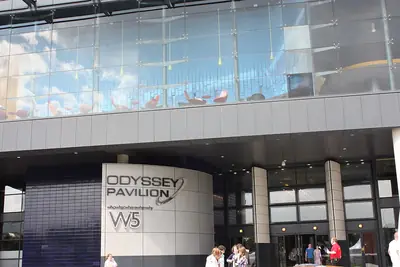
W5 is a science and discovery centre inside Belfast’s Odyssey complex in the Titanic Quarter. Its hands-on zones include The Marvellous Machine, In Our Nature, Energise, The Lost Planet, Skull Cave, Climbit, and MED-Lab. Climbit is described as Europe’s largest indoor climbing structure.
W5 also presents daily science demonstrations at the Science Bar and rotating exhibitions. It is designed for visitors who want an interactive, family-friendly experience rather than a traditional museum.
The MAC
The MAC brings visual art, theatre, dance, and live performance together in Belfast’s Cathedral Quarter. Opened in 2012 and designed by Belfast firm Hackett Hall McKnight, its building combines intersecting brick volumes with a basalt and glass tower.
The centre contains two theatres, three galleries, a dance studio, rehearsal spaces, and an artist-in-residence studio. Its main foyer includes The Permanent Present, a permanent installation by Mark Garry made with 400 colourful strands.
Explore Belfast with a Self-Guided Audio Guide
Neywo makes it easy to turn these sights into a Belfast self-guided walking tour. The app offers four walking tours, one bus route, and one bike route, covering 52 narrated places in total. Each story plays as you reach the place, at your own pace, with no group and no schedule. Narration is available in 11 languages.
The available routes include:
- The Cathedral Quarter: a 1.96 km walk lasting 87 minutes, with 12 narrated stops.
- City Hall and the Linen Hall Library: a 0.6 km walk lasting 28 minutes, with 4 stops.
- The Opera House and the Crown bar: a 0.47 km walk lasting 25 minutes, with 4 stops.
- The Ultimate Belfast: the river, the Cathedral Quarter, Crumlin Road: a 3.53 km walk lasting 131 minutes, with 15 stops.
- Glider G1: Belfast’s Landmarks by Rapid Bus: a 4.7 km route lasting 20 minutes, with 7 stops.
- Lagan and Titanic Quarter by Bike: a 2.7 km route lasting 14 minutes, with 5 stops.
Download Neywo’s free Belfast audio guide and explore the city independently. Whether you choose a short walk through the centre, a longer route linking the river with Crumlin Road, or a bike ride through the Titanic Quarter, the app tells the story of each place as you reach it—at your own pace, with no group and no schedule.
Belfast is part of Northern Ireland in the United Kingdom. For another nearby destination, explore Downpatrick or Londonderry.
Places with an audio guide in Belfast
8 places in Belfast with a Neywo audio guide. Each one starts telling its story as you reach it.
Self-guided tours in Belfast
6 tours in Belfast, free in the Neywo app. Each stop tells its story as you reach it.
- Bike ride
Lagan and Titanic Quarter by Bike
Cycle the signed NCN 93 and EuroVelo 1 path along the Lagan, from the Beacon of Hope on the waterfront to the Odyssey's W5, the restored tender SS Nomadic, Titanic Belfast and HMS Caroline, the last survivor of the Battle of Jutland. Flat, car-free for much of the way and full of shipbuilding history.
Beacon of Hope · W5 · SS Nomadic · Titanic Belfast · HMS Caroline
Open this tour: Lagan and Titanic Quarter by Bike - Bus ride
Glider G1: Belfast's Landmarks by Rapid Bus
Translink's Glider G1 cuts across the city from west to east. Start on the Falls Road with its political murals, then ride into the centre past the Linen Hall Library, the Victorian Old Town Hall, the leaning Albert Clock and the Big Fish on the Lagan. Hop off at the Beacon of Hope or at St George's Market on a Friday to Sunday.
Belfast Falls · The Linen Hall · Old Town Hall, Belfast · Albert Memorial Clock · The Big Fish · Beacon of Hope …
Open this tour: Glider G1: Belfast's Landmarks by Rapid Bus - Walk
The Cathedral Quarter
Belfast's warehouse district, now its bar and gallery district. St Anne's Cathedral with its stainless-steel Spire of Hope, the Albert Memorial Clock leaning over the road it was built on, the Big Fish at the river, and the MAC for whatever is on.
Kitchen Bar · St George's Church, Belfast · Albert Memorial Clock · The Big Fish · Merchant Hotel · Royal Ulster Rifles Museum …
Open this tour: The Cathedral Quarter - Walk
City Hall and the Linen Hall Library
Six hundred metres in Donegall Square: the Portland-stone city hall with the Titanic memorial in its grounds, the subscription library that has been collecting since 1788, and the Victorian Queen's Arcade.
Belfast City Hall · The Linen Hall · Queen's Arcade, Belfast · St. Mary's Church, Belfast
Open this tour: City Hall and the Linen Hall Library - Walk
The Opera House and the Crown bar
Four hundred metres and four buildings: Frank Matcham's opera house, the Europa Hotel — once the most bombed hotel in Europe — the Victorian gin palace across the road with its snugs and tiles, and the Ulster Hall.
Grand Opera House · Europa Hotel, Belfast · Crown Liquor Saloon · Ulster Hall
Open this tour: The Opera House and the Crown bar - Walk
The Ultimate Belfast: the river, the Cathedral Quarter, Crumlin Road
Three and a half kilometres across the centre from the Big Fish and the Beacon of Hope through the Cathedral Quarter and up to Crumlin Road Gaol, the Victorian prison you can now tour.
The Big Fish · Beacon of Hope · Kitchen Bar · St George's Church, Belfast · Albert Memorial Clock · Merchant Hotel …
Open this tour: The Ultimate Belfast: the river, the Cathedral Quarter, Crumlin Road
Walk Belfast with Neywo
Neywo turns Belfast into a self-guided audio tour. Stories arrive as you reach the place they belong to, and the route reshapes when you wander off it.