Visiting Largs, United Kingdom: Top Sights on Foot
Things to Do in Largs: Castles, Museums and Viking Heritage
Looking for things to do in Largs? This coastal town in North Ayrshire offers a mix of historic buildings, museums, maritime heritage and access to the landscapes of the Firth of Clyde. Its position between Fairlie and the coast also makes it a useful base for discovering nearby castles and the Isle of Arran.
Neywo has a free audio guide for Largs with 78 narrated places, available in 11 languages.
What to See in Largs and Nearby
The most interesting places to visit are spread across Largs and the neighbouring communities of North Ayrshire. Together, they reveal the area’s medieval history, family estates, industrial past and maritime identity.
Brisbane Aisle and Largs Old Kirk
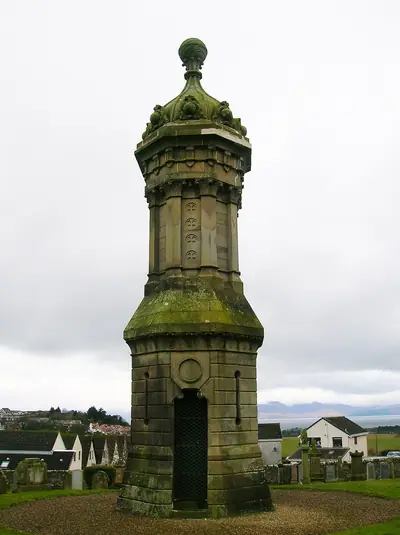
In the grounds of Largs Old Kirk, the Brisbane Aisle is a small, free-standing burial vault built in the seventeenth century for the Shaws of Kelsoland, also known as the Brisbane family. Its modest size contrasts with its importance: the structure was added to Scotland’s highest category of listed buildings in 1991.
Nearby, the Skelmorlie Aisle forms a companion memorial structure. It is a mausoleum and surviving part of a church in Largs, and was added to Scotland’s highest listing category in 1971.
Largs Museum
Largs Museum is a local museum devoted to stories and objects connected with the town. It is a natural stop for anyone interested in understanding Largs beyond its coastal setting and Viking associations.
Brisbane Observatory
Brisbane Observatory is a historic site in North Ayrshire. It adds another layer to a visit around Largs Old Kirk and the town’s historic buildings.
Kelburn Castle
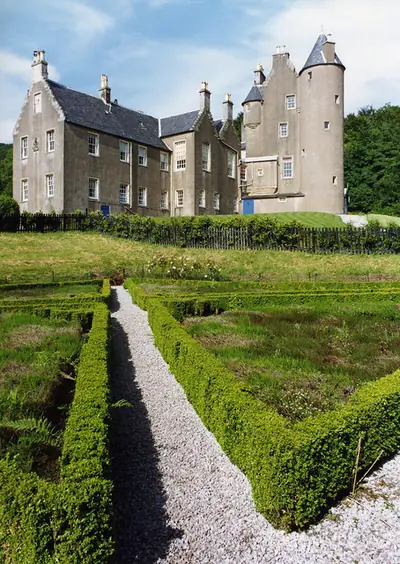
Between Fairlie and Largs, close to the southern shore of the Firth of Clyde, Kelburn Castle combines a long family history with an unmistakable modern exterior. Its origins reach back to the thirteenth century, and the original keep remains at the heart of the house. The building was remodelled in the sixteenth century and extended in 1700 by the first Earl of Glasgow, giving it the appearance of a French château.
Kelburn is especially known for its colourful graffiti-covered walls. In 2007, Lord Glasgow invited four Brazilian graffiti artists to decorate the castle when its concrete facing needed replacement. The work was still in place in 2011, when permission was sought to preserve it permanently.
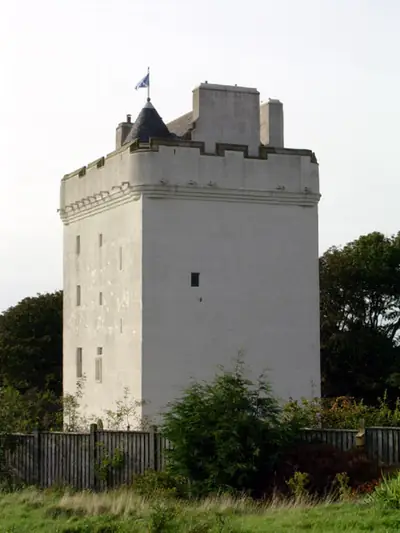
Law Castle
On the edge of West Kilbride, Law Castle is a compact historic tower house with a dramatic past. It was built in 1467 as a wedding gift for Princess Mary, sister of King James III, when she married Thomas Boyd, Earl of Arran.
The marriage soon unravelled. In 1469, Thomas Boyd and his father, Lord Boyd, were attainted for treason. Thomas remained abroad after travelling to Denmark, the marriage was annulled, and he died a few years later, possibly in Antwerp.
The castle itself is a simple rectangle with a sloped roof and several large chimneys. It is recognised as a Category A listed building, Scotland’s highest listing category. After a long period of disuse and decline, apartments were created in the building.
Hunterston Castle
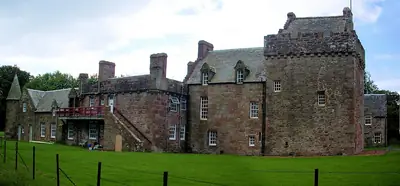
Hunterston Castle, near Fairlie, was the historic home of the lairds of Hunterston and the chiefs of Clan Hunter. According to the historical account, David the First of Scotland granted the estate to the Hunters in the twelfth century, and the heads of the clan have lived there ever since.
The site brings together two distinct periods of architecture. The fortified keep dates from the late twelfth or early thirteenth century, while the attached manor house was added in the eighteenth century.
Portencross Castle
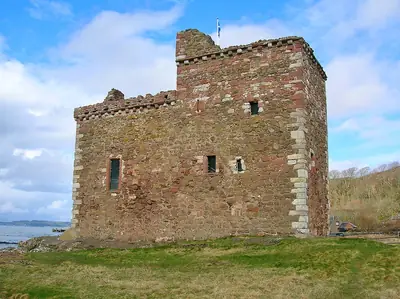
Portencross Castle stands on Scotland’s west coast at a site that had been fortified since the eleventh century. The tower visible today is thought to date from the middle of the fourteenth century, with later alterations added over time.
The castle remained in use until a great storm unroofed it in 1739. It then gradually fell into ruin and was designated a scheduled monument in 1955. Its story continued into the modern era when it appeared in the BBC programme Restoration in 2004. A local community group subsequently became involved in efforts connected with the future of the site.
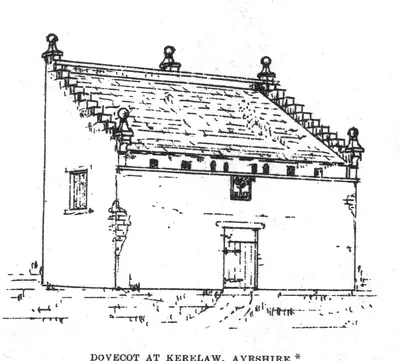
Kerelaw Castle
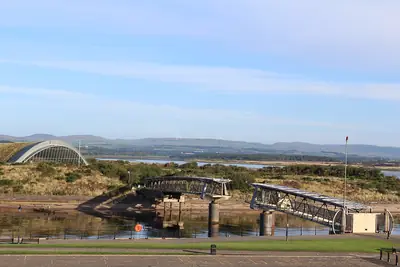
Kerelaw Castle is a coastal ruin in Stevenston, North Ayrshire. The remains are protected as a Scheduled Monument, while the nearby bridge over Stevenston Burn is recognised as a Category B listed monument.
The site is a reminder that the historic landscape around Largs extends beyond the town itself, with castle ruins and protected structures distributed along the coast.
The Big Idea
On the Ardeer Peninsula, The Big Idea was a former hands-on science centre about invention and inventors. It opened in 2000 as part of the millennium celebrations, on the former Nobel Explosives manufacturing site. Around fourteen million pounds was spent on its exhibition, and the centre attracted 120,000 visitors during its first year.
Visitor numbers later declined sharply, and the museum closed permanently in 2003 after three years of operation. As of 2024, the abandoned former museum had no redevelopment plans.
Museums Around North Ayrshire
Several museums nearby broaden the picture of the region:
- The North Ayrshire Heritage Centre combines a museum and public library.
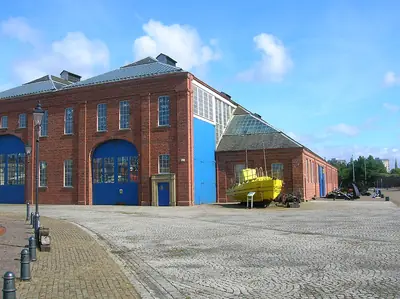
- The Scottish Maritime Museum focuses on Scotland’s shipbuilding heritage, with a collection recognised as nationally significant.
- The Wellwood Burns Centre and Museum is in Irvine.
- West Kilbride Museum explores the history of West Kilbride.
These places make the area particularly interesting for visitors who want to combine local history with Scotland’s industrial, literary and maritime past.
Isle of Arran
The Isle of Arran is the largest island in the Firth of Clyde. Its landscape includes coastal paths, beaches, forests, rivers, small lochs, hills and mountains, earning it the description “Scotland in Miniature.”
Among its outdoor landscapes are the valleys of Glen Rosa and Glen Sannox, lochs such as Loch Iorsa and Loch Tanna, and mountains including Goatfell, Beinn Bharrain, Beinn Tarsuinn and Cioch na h-Oighe. Beaches include those at Brodick, Whiting Bay, Kildonan, Sannox and Blackwaterfoot.
Arran has been continuously inhabited since the early Neolithic period, and prehistoric remains can still be found across the island. It later became a centre of religious activity, part of the Norwegian crown during the Viking Age, and was formally absorbed into the kingdom of Scotland in the thirteenth century.
Explore Largs with a Self-Guided Walking Tour
For a Largs self-guided walking tour, Neywo’s “Largs: Vikings and Kirkyard Secrets” covers 5.29 km in 114 minutes and includes seven narrated stops. The route includes Barrfields Pavilion, Magnus the Viking, St Columba’s Parish Church, Gallowgate Street, Largs, Brisbane Aisle, Clark Memorial Church and Kelburn Castle.
The app tells the story of each place as you reach it, at your own pace, with no group and no schedule. Download Neywo and explore Largs with its free audio guide, or continue discovering Scotland and the wider United Kingdom.
Places with an audio guide in Largs
8 places in Largs with a Neywo audio guide. Each one starts telling its story as you reach it.
Self-guided tours in Largs
1 tour in Largs, free in the Neywo app. Each stop tells its story as you reach it.
- Walk
Largs: Vikings and Kirkyard Secrets
Start at the Barrfields Pavilion on the north seafront, meet the Vikings who fought here in 1263 and wander the old kirkyard with its 17th-century burial aisles. Pass two grand churches, reach the pier, then follow the coast south to Kelburn Castle, famous for its graffiti-covered walls.
Barrfields Pavilion · Magnus the Viking · St Columba's Parish Church, Gallowgate Street, Largs · Brisbane Aisle · Clark Memorial Church · Largs …
Open this tour: Largs: Vikings and Kirkyard Secrets
Walk Largs with Neywo
Neywo turns Largs into a self-guided audio tour. Stories arrive as you reach the place they belong to, and the route reshapes when you wander off it.

