Visiting Callander, United Kingdom: Top Sights on Foot
Things to Do in Callander: Castles, Ruins and Scottish Heritage
Callander is a town on the River Teith and a gateway to the Highlands, with historic sites and dramatic landscapes across the surrounding part of Scotland. It is a rewarding base for discovering castles, religious ruins, bridges and monuments around Stirling, Doune and the Lake of Menteith. Neywo also has a free audio guide for Callander, with 89 narrated places.
What to See in Callander and Around It
The area around Callander brings together medieval strongholds, royal history, ruined religious buildings and distinctive landmarks. These are some of the most important places to include when exploring the town and its wider surroundings.
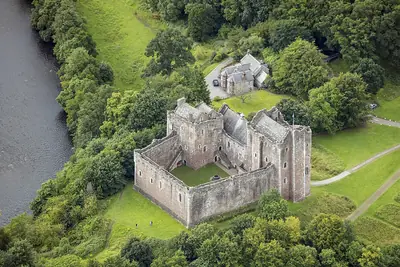
Doune Castle
Near the village of Doune, Doune Castle is a remarkably complete medieval stronghold beside the River Teith. It began in the thirteenth century and was probably damaged during the Scottish Wars of Independence before being rebuilt in its present form in the late fourteenth century by Robert Stewart, Duke of Albany.
The castle later became a royal hunting lodge and dower house, passed to the Earls of Moray, and saw military action during the Wars of the Three Kingdoms and the Jacobite risings. By 1800 it was ruined; restoration in the 1880s replaced its timber roofs, interior floors and fittings. Its courtyard plan is still particularly revealing: buildings were intended to stand along each side, although only the northern and northwestern ranges were completed.
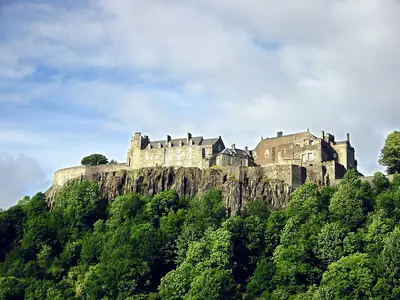
Stirling Castle
Built on a rocky crag with steep cliffs on three sides, Stirling Castle was both a fortress and a royal palace. Much of the surviving complex dates from the fifteenth and sixteenth centuries, including work associated with James the Fourth, James the Fifth, James the Sixth and Mary of Guise.
Before the union with England, it was one of Scotland’s most frequently used royal residences. Mary, Queen of Scots, was crowned here in 1542, and other Scottish monarchs were born or died at the castle. Its military history continued into the eighteenth century: the final siege took place in 1746, when Bonnie Prince Charlie unsuccessfully tried to capture it.
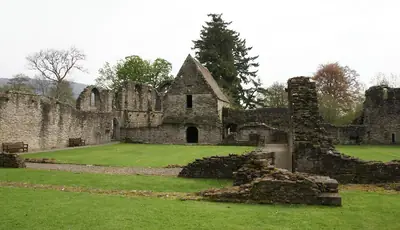
Inchmahome Priory
A boat ride across the Lake of Menteith leads to Inchmahome Priory, on Inchmahome, the largest of the lake’s three islands. The Augustinian community was founded in 1238 by Walter Comyn, Earl of Menteith. The name comes from the Gaelic Innis MoCholmaig, meaning the island of Saint Colmaig.
Much of the priory is now ruined, but substantial parts of the original thirteenth-century structure remain. The island also has strong connections with Scottish history. Robert the Bruce visited three times, in 1306, 1308 and 1310, while the future King Robert the Second stayed at the priory in 1358. In 1547, the island provided refuge for the four-year-old Queen Mary after the Scottish defeat at the Battle of Pinkie.
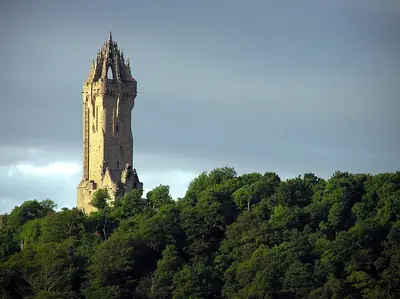
Wallace Monument
The Wallace Monument rises above Stirling from the summit of Abbey Craig. The 67-metre tower commemorates Sir William Wallace, the Scottish hero of the thirteenth and fourteenth centuries, and overlooks the city.
Visitors reach it on foot from the base of the crag. Inside, 246 steps lead to the final observation platform, passing three exhibition rooms on the way. Its hilltop position makes the monument an especially prominent landmark in the landscape around Stirling.
Buchanan Castle
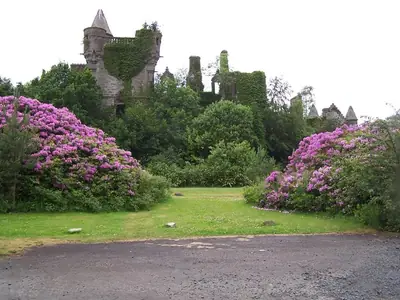
West of the village of Drymen, Buchanan Castle is a ruined country house built for the Montrose family rather than a medieval fortress. James Graham, the fourth Duke of Montrose, commissioned it between 1852 and 1858, and it remained the Montrose family home until 1925.
The house replaced Buchanan Auld House, which was destroyed by fire in 1852. Its roof was removed in 1954, and the building has deteriorated since then. Even as a ruin, Buchanan Castle remains the seat of Clan Graham.
Sir John de Graham’s Castle
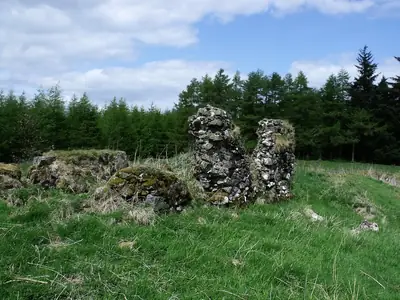
Near Carron Valley Reservoir, Sir John de Graham’s Castle—also known as Dundaff Castle—is a secluded and unusually well-preserved medieval motte in central Scotland. An almost square ditch surrounds the mound, while a surviving wall in its north-east corner marks the remains of a building.
The site was the principal seat of the Barony of Dundaff. Sir David de Graham was recorded as holding the barony in 1237, and the castle is also associated with the peel tower of Sir John de Graham, who died at the Battle of Falkirk in 1298. Its exact date remains uncertain because the motte has not been excavated.
Talla Castle
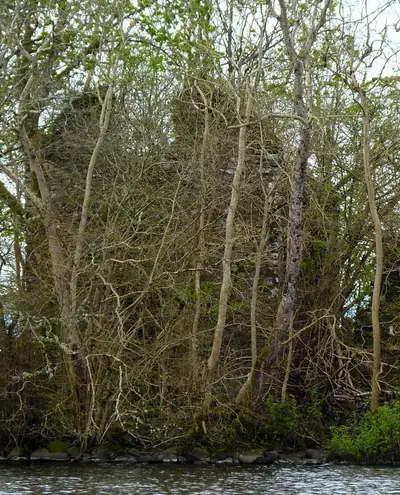
Talla Castle, also known as Inch Talla or Inchtalla Castle, stands in ruins on Inchtalla in the Lake of Menteith. Construction began in 1427 under Malise Graham, Earl of Mentieth, and the castle dates from the fifteenth century.
Cambuskenneth Abbey
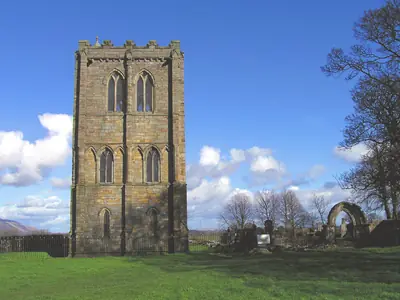
Near Stirling, Cambuskenneth Abbey occupies land enclosed by a bend in the River Forth. The Abbey of St Mary of Cambuskenneth was a provostry of Canons Regular, associated first with the Arrouaise order and later with the Augustinian order.
The abbey is now largely reduced to foundations, but its free-standing bell tower survives, along with remnants of a portal and a residential or service building beside the river. The combination of open landscape and fragmentary ruins gives the site a strong sense of place.
Albert Halls, Stirling
On Dumbarton Road in Stirling, the Albert Halls are a concert and conference venue with an important place in the city’s built heritage. William Simpson designed the building in 1881, and it opened in October 1883. It became a Category B Listed Building in 1978.
Churches and Historic Buildings
Several churches add to the heritage of the area. Balquhidder Parish Church is a church building in Balquhidder, while Holy Trinity Episcopal Church on Dumbarton Road is an Anglican church in Stirling. Holy Trinity was first added to Scotland’s listed buildings in 1965 and upgraded to Category A, the highest level of listing, in 1997.
Plean Castle
Plean Castle is a compact tower house with an adjoining manor house. It is also known by several historic names, including Plean Tower, Cock-a-bendy Castle, Mengie Castle, Menzies Castle and Plane Castle.
Its structure shows two building periods: the small oblong tower house probably dates from the fifteenth century, while the attached manor house was added in the sixteenth century.
Bridges and Viaducts
The area’s bridges and railway structures offer smaller but distinctive sights. The Allan Water Viaduct in Dunblane carries the Glasgow to Dundee railway line across the Allan Water. Dunblane Bridge carries the B8033 over the same waterway, linking its two sides.
Allt An Deabhtaich Bridge is another notable crossing, where the A85 road passes over Allt an Dèabhtaich in Stirling.
Explore Callander with Neywo
There are no scheduled Neywo tours listed for Callander, but the app’s free audio guide covers 89 narrated places. Each story plays as you reach the place, at your own pace, with no group and no schedule. Narration is available in 11 languages, making Neywo a practical companion for a self-guided visit.
Download Neywo and explore Callander by following the stories from one place to the next. You can also continue discovering Scotland with the guides to Dunblane, Glasgow or Edinburgh.
Places with an audio guide in Callander
8 places in Callander with a Neywo audio guide. Each one starts telling its story as you reach it.
Walk Callander with Neywo
Neywo turns Callander into a self-guided audio tour. Stories arrive as you reach the place they belong to, and the route reshapes when you wander off it.

