Visiting Skye, United Kingdom: Top Sights on Foot
Things to Do in Skye: What to See on Scotland’s Island
The Isle of Skye is a Scottish island known for historic castles, ruined fortifications, traditional cottages, religious sites and dramatic coastal landscapes. The best things to do in Skye include exploring its long connection with Highland clans, discovering archaeological remains and visiting places where history meets the island’s scenery. Neywo has a free audio guide for Skye with 46 narrated places, available in 11 languages.
What to See in Skye
From castle ruins and museums to ancient forts and a whisky distillery, these are some of the most distinctive places to discover across Skye.
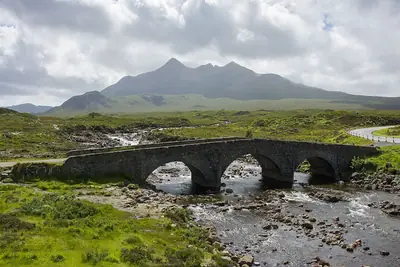
Sligachan Old Bridge
Sligachan Old Bridge crosses the River Sligachan and now carries a footpath. Its simple stone structure offers a quiet introduction to Skye’s Highland setting, where a former road crossing has become part of the island’s walking landscape.
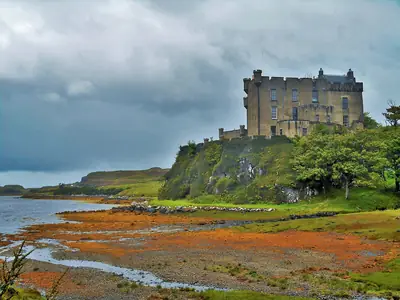
Dunvegan Castle
Dunvegan Castle rises above an inlet on the eastern shore of Loch Dunvegan. It is the historic seat of the MacLeod of MacLeod, chief of Clan MacLeod, and one of the Isle of Skye’s best-known attractions.
A fortified site probably existed here from the earliest times, while the castle itself was first built in the thirteenth century and expanded over many centuries. Its present appearance largely reflects a nineteenth-century remodelling in mock-medieval style. Inside, a museum explores the castle’s history, while the surrounding five-acre garden includes plants, trees, bridges and waterfalls.
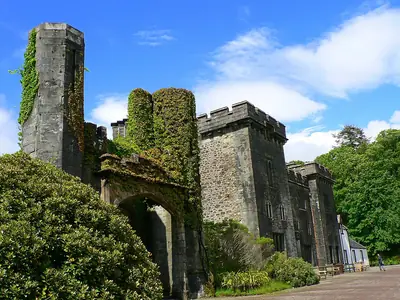
Armadale Castle
The ruins of Armadale Castle stand in Sleat and were once the home of the MacDonalds. The remains offer a glimpse of the country house and of the history connected with one of Skye’s notable Highland families.
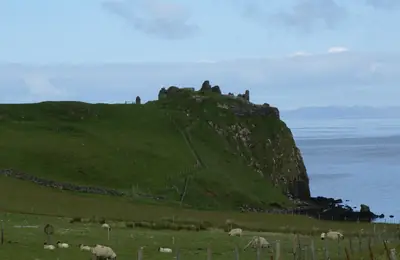
Duntulm Castle
On the northern coast of Trotternish, Duntulm Castle occupies a headland near the hamlet of Duntulm. The ruins became the seat of the chiefs of Clan MacDonald of Sleat during the seventeenth century and are now protected as a scheduled monument.
Parts of the surviving castle date from the fifteenth and seventeenth centuries. The headland setting makes its former defensive purpose easy to understand, with the ruins looking out from the northern end of Skye.
Knock Castle
Also known as Castle Camus or Caisteal Chamuis, Knock Castle stands beside Knock Bay on the east coast of Sleat. The site was first associated with Clan MacLeod and later with Clan MacDonald, and ownership passed between the two clans several times.
The MacDonalds remodelled the castle in 1596, but it had been abandoned and was decaying by 1689. The remains include part of a fifteenth-century keep and traces of later buildings. Most of the castle’s stones were reused in nearby buildings, leaving fragments of the original stronghold. Local tradition also connects the site with a Green Lady, or glaistig.
Museum of the Isles
The Museum of the Isles is in Ardvasar. It provides a local place to learn more about Skye and the island’s history while exploring the southern part of the island.
Skye Museum of Island Life
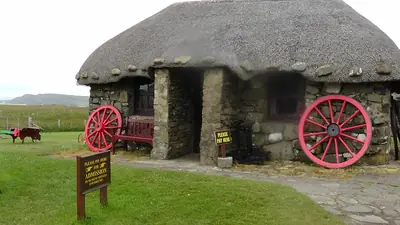
In Kilmuir, the Skye Museum of Island Life preserves a township of thatched cottages. The buildings offer a glimpse of island life at the end of the eighteenth century, showing how a traditional Skye community was organised around its homes.
Tigh Talamhain Souterrain
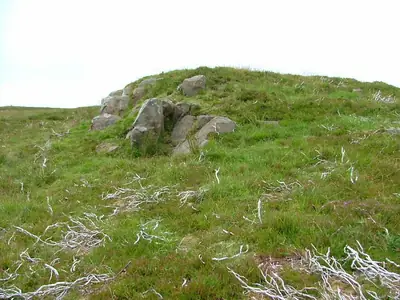
Tigh Talamhain Souterrain, also known simply as Tigh Talamhain, is an archaeological site in Highland. This underground structure adds another layer to Skye’s long history, alongside its castles, churches and ancient forts.
Snizort Cathedral
The ruined Snizort Cathedral stands on St Columba’s Isle, a small island in the River Snizort near the head of Loch Snizort. It was also known as the Church of St Columba and as Skeabost.
The cathedral was founded under the authority of the Archbishop of Nidaros, in present-day Trondheim, Norway. Its island setting gives the remains a distinctive sense of separation. The site is also associated with Wimund, one of Snizort’s bishops, who according to the historian William of Newburgh became a seafaring warlord and adventurer sometime after 1147.
Caisteal Maol
Above the harbour at Kyleakin, the weathered ruins of Caisteal Maol—also called Castle Maol—offer a compact glimpse into Skye’s past. The castle dates from the fifteenth century and was owned by the MacKinnons. It was abandoned at the beginning of the seventeenth century and gradually fell into ruin.
Dun Ringill
Dun Ringill is an ancient fortified site on the Strathaird peninsula, beside the west shore of Loch Slapin. It began as an Iron Age hill fort and was strengthened again in the Middle Ages.
Tradition says that Dun Ringill was the seat of Clan MacKinnon for several centuries. Its Gaelic name, Dùn Ringill, combines the word for fort with a name meaning the point of the ravine.
Dùn Skudiburgh
Near Uig, Dùn Skudiburgh is a prehistoric fort set above Loch Snizort. It occupies a steep-sided knoll about sixty metres above the shore, on the west coast of Trotternish. The elevated position makes the relationship between Skye’s ancient settlements and its landscape especially clear.
Dunscaith Castle
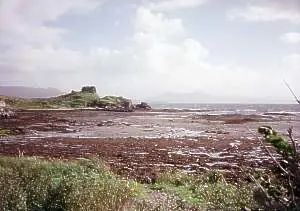
Dunscaith Castle, also known as Dùn Sgàthaich, is a ruined coastal castle in Sleat. Its alternative name, the Fortress of Shadows, reflects the legends surrounding the site.
According to tradition, the castle was home to the warrior maiden Scáthach. That legendary connection gives the weathered ruins an especially dramatic character, adding mythology to the history of Skye’s fortified places.
Cill Chriosd
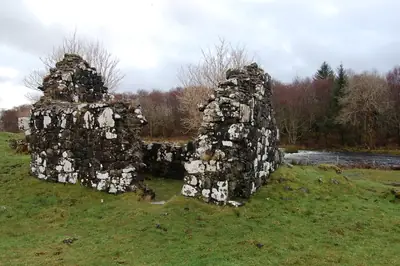
Cill Chriosd, also known as Kilchrist Church, is the ruined former parish church of Strathaird. Its name means Christ’s Church. The building was constructed around the sixteenth century, replacing an earlier medieval church on the same site.
It served the parish of Strath until 1840, when the parish church moved to Broadford. Today, the remains provide a quiet religious landmark in the Skye landscape.
Talisker Distillery
At Carbost on the Minginish Peninsula, Talisker Distillery is the only whisky distillery on the Isle of Skye. It produces Talisker, an island single malt Scotch whisky.
Hugh and Kenneth MacAskill established the distillery in 1830 after Hugh MacAskill leased the site from the MacLeods. He named it after his estate, Talisker, rather than after the village where it was built. The distillery is now operated by Diageo, and Talisker is included in the Classic Malts of Scotland series.
Explore Skye with Neywo
Looking for a Skye self-guided walking tour or a free walking tour in Skye without joining a group? Neywo’s free Skye audio guide includes 46 narrated places, with stories available in 11 languages.
The app tells the story of each place as you reach it, at your own pace. There is no group and no schedule: simply explore Skye independently and listen when you arrive at each location.
Download Neywo and discover Skye with an audio guide that accompanies your visit.
Places with an audio guide in Skye
8 places in Skye with a Neywo audio guide. Each one starts telling its story as you reach it.
Walk Skye with Neywo
Neywo turns Skye into a self-guided audio tour. Stories arrive as you reach the place they belong to, and the route reshapes when you wander off it.

