What to See in Glasgow, United Kingdom: Free Audio Guide
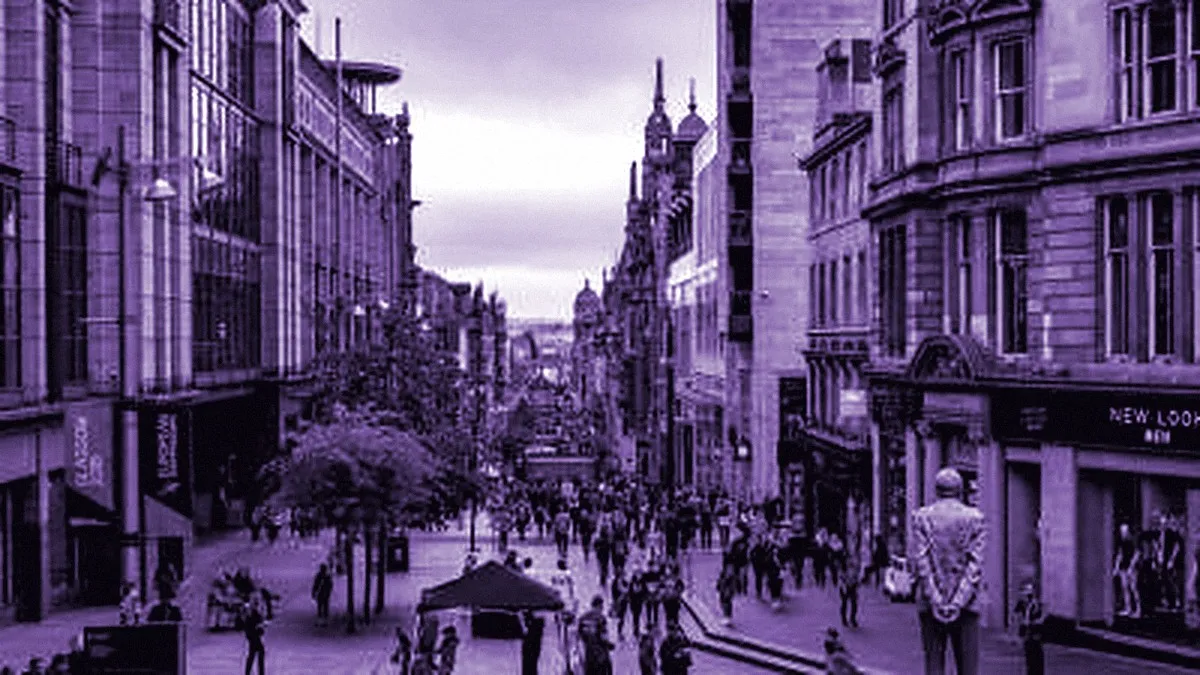
Things to Do in Glasgow: What to See in Scotland’s Creative City
Glasgow is a lively Scottish city shaped by medieval religion, Victorian civic ambition, industrial heritage and a strong cultural scene. The best things to do in Glasgow range from exploring one of Scotland’s oldest cathedrals to discovering world-class museums, football history, modern architecture and the story of the River Clyde. Neywo has a free Glasgow audio guide with 296 narrated places to help you explore the city as you walk.
Part of Scotland and the United Kingdom, Glasgow is a rewarding destination for anyone interested in history, art, architecture and urban life. Its neighbourhoods each offer a different view of the city, from the medieval heart around the cathedral to the West End and the riverside museums.
What to see in Glasgow
Glasgow Cathedral and the medieval heart
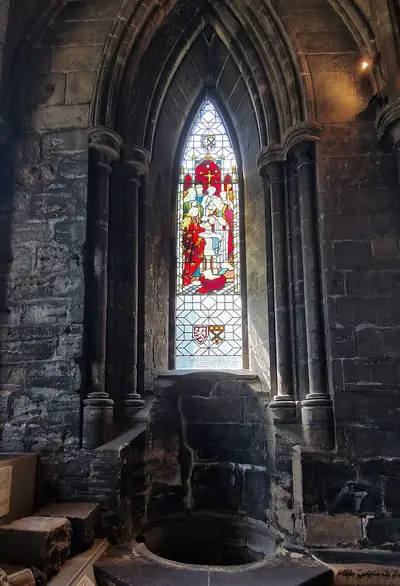
Glasgow Cathedral is the oldest building in Glasgow and the oldest cathedral on mainland Scotland. Dedicated to Saint Mungo, also known as Kentigern, the city’s patron saint, its history reaches back to the twelfth century. A stone cathedral was dedicated here in 1136, while the present cathedral was dedicated in 1197 and largely rebuilt during the thirteenth century.
Its medieval interior survived the Reformation virtually intact, making it one of only two medieval cathedrals in Scotland to do so, alongside St Magnus Cathedral in Orkney. The cathedral also played a role in the early history of the University of Glasgow: after the university was founded in 1451, its first classes took place in the chapter house.
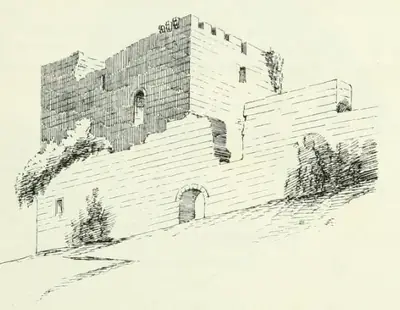
Nearby, Cathcart Castle offers a very different glimpse of the past. The fifteenth-century castle once stood in the Cathcart area, but it was abandoned in the eighteenth century and the remaining ruins were pulled down in 1980. Today, only the foundations can be seen in Linn Park.
Kelvingrove Art Gallery and Museum
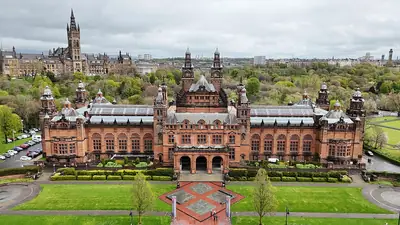
One of the best places to visit in Glasgow, Kelvingrove Art Gallery and Museum stands in a grand red sandstone building in Kelvingrove Park. Its ornate Spanish Baroque design makes the building itself part of the experience. It opened fully to the public on 1 October 1902, after first being built for the Glasgow International Exhibition of 1901.
Inside, more than 8,000 objects are displayed across 22 galleries. The collections cover fine art and design, natural history, Egyptian antiquities, medieval arms and armour, Scottish history and the history of Glasgow. The art collection includes Scottish and European works, as well as art from Africa, Asia and Oceania.
Highlights include Salvador Dalí’s Christ of Saint John of the Cross, paintings by the Glasgow Boys and the Scottish Colourists, and works by important European masters. The museum is also one of Scotland’s most popular free visitor attractions.
The University of Glasgow and the Hunterian
The Hunterian Museum and Art Gallery is part of the University of Glasgow’s historic campus. Founded in 1807 through the bequest of Dr. William Hunter, it is Scotland’s oldest public museum.
Its collections bring together art, archaeology, natural history and scientific discovery. Roman artefacts from the Antonine Wall tell the story of the frontier that once marked the northern edge of the Roman Empire, while fossils, minerals and zoological specimens explore the natural world. The anatomy collection reflects Hunter’s medical research.
The Hunterian Art Gallery adds works by Rembrandt, Whistler and the Glasgow Boys. It also holds the world’s largest collection of works by Charles Rennie Mackintosh, the Scottish architect and designer. The university, its galleries and the surrounding West End form one of the most rewarding areas for a Glasgow self-guided walking tour.
Riverside Museum and the River Clyde
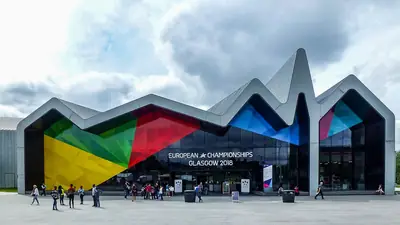
The Riverside Museum brings Glasgow’s industrial and maritime heritage to life beside the River Clyde. Designed by Zaha Hadid Architects, its wave-like form reflects the movement of the river. The museum opened in 2011 as the new home for Glasgow’s transport collection and won the European Museum of the Year Award in 2013.
Inside are vintage cars, bicycles, trams, steam locomotives and other vehicles and machines. Displays recall Glasgow’s engineering, shipbuilding and global trade. A recreated Cobbled Street evokes an early twentieth-century Glasgow through period shops and signs, while vintage automobiles appear on a dramatic vertical wall.
The riverside also leads to Glasgow Science Centre, a modern complex with a Science Mall, Glasgow Tower and an IMAX cinema. Its hands-on galleries explore light, sound, energy and the human body. Glasgow Tower is a 127-metre rotating structure and holds the Guinness World Record as the tallest fully rotating freestanding structure on earth. When weather permits, its observation deck offers views across the city, the River Clyde and the surrounding hills.
Gallery of Modern Art
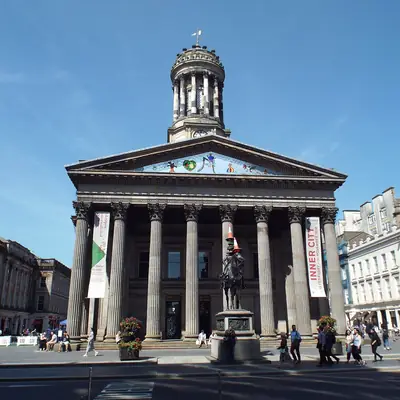
In Royal Exchange Square, the Gallery of Modern Art, or GoMA, is Glasgow’s main gallery of contemporary art. Opened in 1996, it presents work by local and international artists through exhibitions, workshops and major projects.
The neoclassical building has had several lives. It was once a private home, then a bank and a library, before becoming the Royal Exchange after substantial renovation between 1827 and 1832. David Hamilton added Corinthian pillars to the entrance on Queen Street, a cupola and a spacious hall at the rear.
The collection includes works by David Hockney, Andy Warhol, Sebastião Salgado, Ken Currie and John Bellamy. The gallery’s programme often addresses contemporary social issues, giving the building and its exhibitions a connection to life beyond the museum.
The People’s Palace and Glasgow Green
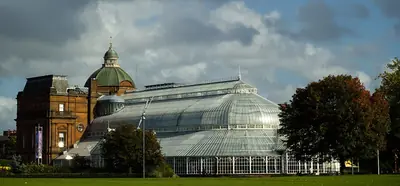
The People’s Palace and Winter Gardens stand in Glasgow Green, the city’s oldest public park. Opened on 22 January 1898, the building was created as a museum and cultural centre for Glasgow’s working-class citizens, offering education, recreation and a place to explore local heritage.
Its exhibitions trace the story of Glasgow and its people from the eighteenth century to the present. Personal objects, photographs and film explore housing, work, leisure, political activism, dance halls, strikes and campaigns for social reform. Recreated tenement interiors offer a particularly vivid view of everyday life.
The red sandstone exterior and classical lines reflect the ambition behind its name: a palace for the people. In 1970, the People’s Palace was placed in Scotland’s highest category of listed buildings.
St Andrew’s Cathedral and Glasgow’s civic memorials
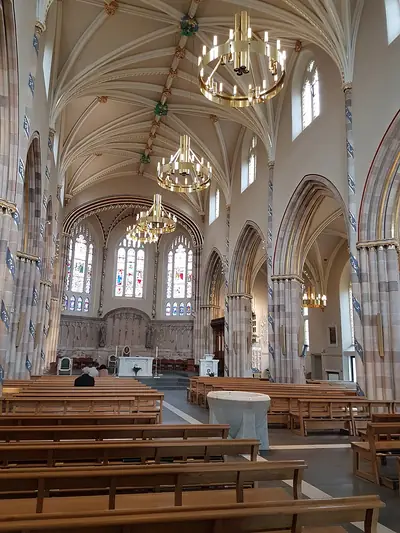
St Andrew’s Cathedral stands on Clyde Street on the north bank of the River Clyde. Glasgow’s Roman Catholic cathedral was designed in the Neo-Gothic style by James Gillespie Graham and completed in 1814.
Its façade is distinctive because it has no steeple or bell tower. Large buttresses frame the ornate entrance, while an enormous arched central window dominates the front, with a statue of Saint Andrew above it. Restoration work in 2009 renewed its gold-leaf decoration, added bronze doors and modernised the lighting and heating.
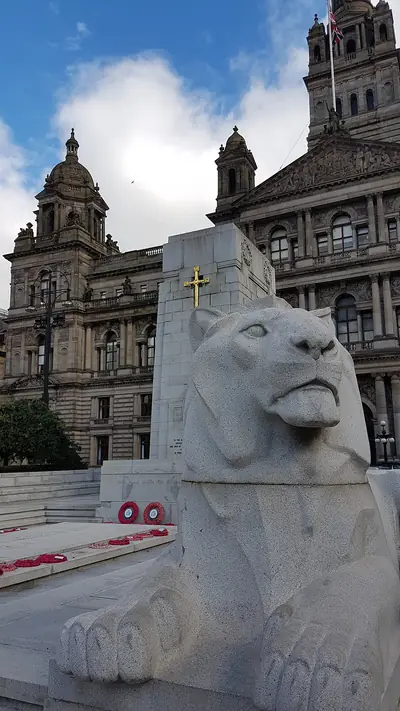
In the city centre, the Glasgow Cenotaph stands on the east side of George Square, in front of Glasgow City Chambers. Originally created to commemorate Glaswegians killed during the First World War, it was unveiled in 1924. Further inscriptions were added after the Second World War.
The Burrell Collection
The Burrell Collection is one of Glasgow’s major art museums. It houses a collection assembled by Sir William Burrell and Constance, Lady Burrell, including tapestries, glass, ceramics, sculptures and paintings from Europe and the Far East.
Sir William Burrell gave the collection to Glasgow in 1944. It contains more than 8,500 objects and first opened as a museum in 1983. Following a major refurbishment, it reopened on 29 March 2022, and in July 2023 it was announced as the winner of the Art Fund Museum of the Year award.
Merchant City and the Glasgow Police Museum
Merchant City offers a different perspective on Glasgow’s history, with former warehouses, public spaces and cultural venues. The Glasgow Police Museum explores the City of Glasgow Police, established in 1800 as the United Kingdom’s first modern-style municipal police force.
Uniforms, equipment, photographs, documents and personal stories reveal more than two centuries of policing. The museum also examines famous cases involving robbery, murder and smuggling, as well as changing detective methods. It opened in 2002 and moved to Merchant City in 2009, occupying a historic building once associated with the force.
Hampden Park
Hampden Park is Scotland’s national football stadium and the home of the Scotland national team. The stadium’s history is defined by remarkable crowds. A stadium opened on the site on 31 October 1903, and its capacity grew to 150,000 between 1927 and 1937. A Scotland versus England match in 1937 drew 149,415 spectators, a European record for an international football match.
Hampden has hosted six European finals, including the 1960 European Cup final between Real Madrid and Eintracht Frankfurt. It has also hosted three European Cup or Champions League finals, two Cup Winners’ Cup finals and a UEFA Cup final.
Holmwood House and Glasgow’s design heritage
In Cathcart, Holmwood House offers a chance to see one of Scotland’s notable Victorian villas. Designed by Alexander Thomson, known as Alexander “Greek” Thomson, it is regarded as his finest and most elaborate residential villa and is recognised as a Category A listed building.
Much of its original interior decoration has survived. Its design was published in 1868 in Villa and Cottage Architecture, and that published version may have influenced Frank Lloyd Wright and other early modernist architects.
Explore Glasgow with Neywo
Neywo offers seven walking tours, one bus route and one bike route in Glasgow, with 296 narrated places in total. The walks range from the 1.11-kilometre, 58-minute route through Glasgow’s medieval heart to the 3.75-kilometre, 103-minute walk around Glasgow Green and the Gorbals. Other routes cover George Square, Mackintosh’s Glasgow, the West End, Merchant City and the Clyde.
The 6.5-kilometre bus route takes 28 minutes and has five narrated stops. The 2.7-kilometre bike route takes 14 minutes and has three stops, linking the Riverside Museum with Kelvingrove Art Gallery and Museum.
Download Neywo and explore Glasgow at your own pace. The app tells the story of each place as you reach it, with no group and no schedule. Narration is available in 11 languages, so you can turn a visit into your own self-guided walking tour of Glasgow.
Places with an audio guide in Glasgow
8 places in Glasgow with a Neywo audio guide. Each one starts telling its story as you reach it.
Self-guided tours in Glasgow
9 tours in Glasgow, free in the Neywo app. Each stop tells its story as you reach it.
- Bike ride
Clyde to Kelvingrove: Riverside Museum to the Art Gallery
Leave the Clyde at the wave-roofed Riverside Museum, pass the site of Partick Castle and follow the cycle path along the Kelvin to the red sandstone Kelvingrove Art Gallery.
Riverside Museum · Partick Castle · Kelvingrove Art Gallery and Museum
Open this tour: Clyde to Kelvingrove: Riverside Museum to the Art Gallery - Bus ride
First Glasgow Line 7: Pavilion to Gorbals via the Argyll Arcade
A public First Glasgow bus that runs south through the city centre and over the Clyde. Pass the Pavilion Theatre on Renfield Street, Scotland's oldest covered shopping street in the Argyll Arcade, the Gallery of Modern Art, the Victorian Citizens Theatre in the Gorbals and Govanhill Church.
Pavilion Theatre · Sloan's Restaurant, 61 Argyll Arcade, Glasgow · Gallery of Modern Art · Citizens Theatre · Govanhill Church, 12-24 Daisy Street, Glasgow
Open this tour: First Glasgow Line 7: Pavilion to Gorbals via the Argyll Arcade - Walk
Mungo's Hill: Cathedral, Necropolis and Glasgow's Medieval Heart
Glasgow began here, where Saint Mungo built his church. Start at the University of Strathclyde, then visit the oldest house in the city, the cathedral that survived the Reformation, a museum of world faiths and the Victorian hilltop cemetery that overlooks it all.
University of Strathclyde · Barony Parish Church, Castle Street, Glasgow · Provand's Lordship · Statue Of David Livingstone, Cathedral Square · Statue of James Lumsden, Cathedral Square, Glasgow · St Mungo Museum of Religious Life and Art …
Open this tour: Mungo's Hill: Cathedral, Necropolis and Glasgow's Medieval Heart - Walk
George Square and the Traffic Cone Duke
Glasgow's Victorian pride packed into a few blocks: the lavish City Chambers, the Cenotaph and the monuments of George Square, then the neoclassical Gallery of Modern Art with its famously coned Duke of Wellington. Finish through the Argyll Arcade and Princes Square to the steeple of St George's Tron at the top of Buchanan Street.
Bust of Nelson Mandela, Glasgow City Chambers · Glasgow Cenotaph · Glasgow · Statue of Colin Campbell, 1st Baron Clyde · Equestrian statue of Prince Albert · Equestrian statue of the Duke of Wellington …
Open this tour: George Square and the Traffic Cone Duke - Walk
Mackintosh's Glasgow: Lighthouse, Tearooms and the School of Art
Follow Charles Rennie Mackintosh uphill from his first public commission, The Lighthouse, to the Willow Tearooms and the Glasgow School of Art. Along Sauchiehall Street you will pass galleries, a 1939 cinema and a Jesuit church, then a Victorian synagogue, a perfectly preserved tenement flat, the Cameron fountain and the copper dome of the Mitchell Library.
The Lighthouse · Willow Tearooms · Glasgow Film Theatre · St Aloysius Church · McLellan Galleries · Glasgow School of Art …
Open this tour: Mackintosh's Glasgow: Lighthouse, Tearooms and the School of Art - Walk
The West End: Kelvingrove, the University and Kelvin's Park
From Victorian fountains and a statue of Lord Kelvin to a red sandstone palace of art with Dali and a Spitfire, then Scotland's oldest public museum and a university founded in 1451. Finish through the lanes and church spires of Byres Road and the gates of the Botanic Gardens.
Stewart Memorial Fountain · Statue of William Thomson, 1st Baron Kelvin · Kelvingrove Art Gallery and Museum · Hunterian Museum and Art Gallery · University of Glasgow · Wellington Church …
Open this tour: The West End: Kelvingrove, the University and Kelvin's Park - Walk
Merchant City and the Trongate: Music Halls, Churches and Cheese
Wander Glasgow's old trading quarter from St Enoch Square along Argyle Street to the Trongate. Pass one of the oldest surviving music halls in Britain, a kinetic gallery, the old Tron Kirk, the police museum, a former cheese market that became the first cafe of the Merchant City, and finish at the grand eighteenth-century church in St Andrew's Square.
St Enoch Square · 16-18 Argyle Street · Britannia Music Hall · Sharmanka Kinetic Gallery · Collegiate Church of the Blessed Virgin Mary and St Anne, Glasgow · Tron Theatre …
Open this tour: Merchant City and the Trongate: Music Halls, Churches and Cheese - Walk
Glasgow Green and the Gorbals: Cathedral, Mosque and Carpet Palace
Cross the Clyde from the Catholic cathedral to the Gorbals, home of the Citizens Theatre and Scotland's first purpose-built mosque. Then follow Glasgow Green, the city's oldest park, past the Nelson Monument, the largest terracotta fountain in the world, the People's Palace and a carpet factory built like a Venetian palace, and end at the Barrowland Ballroom.
St Andrew's Cathedral · Citizens Theatre · Glasgow Central Mosque · Blessed John Duns Scotus Church, Glasgow · Nelson Monument · Doulton Fountain, Glasgow Green, Glasgow …
Open this tour: Glasgow Green and the Gorbals: Cathedral, Mosque and Carpet Palace - Walk
Clydeside: Cranes, Tall Ships and Govan Stones
Follow the River Clyde from the Finnieston Crane and the Science Centre to Zaha Hadid's wave-roofed Riverside Museum and the Tall Ship Glenlee. Cross the Govan-Partick Bridge to Govan Old Parish Church, where early medieval carved stones stand.
Finnieston Crane · Glasgow Science Centre · Riverside Museum · Tall Ship Glenlee · River Kelvin · Govan Old Parish Church …
Open this tour: Clydeside: Cranes, Tall Ships and Govan Stones
Walk Glasgow with Neywo
Neywo turns Glasgow into a self-guided audio tour. Stories arrive as you reach the place they belong to, and the route reshapes when you wander off it.

