Visiting Inverness, United Kingdom: Top Sights on Foot
Things to Do in Inverness: Historic Streets, Castles and Highland Stories
Looking for things to do in Inverness? The Highland capital brings together a historic city centre, the River Ness, important churches and a castle above the water, while the surrounding region is filled with castles, bridges, cathedrals and Jacobite history. It is a rewarding place to explore on foot and a useful base for discovering the wider Highlands. Neywo offers a free audio guide for Inverness with 437 narrated places.
What to See in Inverness City Centre
The best way to begin is in the compact centre, where historic buildings, riverside paths and pedestrian streets make walking easy. Inverness’s story includes royal conflict, Celtic Christianity, the Jacobite rising and the legends surrounding Macbeth.
Inverness Castle
Inverness Castle stands above the River Ness on a site occupied by a succession of castles since 1057. The red sandstone building visible today dates from 1836 and was designed by William Burn, with later work by Thomas Brown II.
Its symmetrical façade, castellated towers and bastioned walls give it the appearance of a fortress. In reality, the building originally served as the sheriff court and administrative centre for Inverness-shire. The southern block contained the County Buildings and Sheriff Court, while the northern block, added in 1848, served as a prison and courthouse.
The site has passed between military and civic roles over the centuries. One of its dramatic earlier episodes was the Siege of Inverness in 1429, involving the Lord of the Isles. The modern building is a Category A listed building. Court functions moved elsewhere in 2020, and the castle closed for extensive renovations in 2021.
Inverness Museum and Art Gallery
The Inverness Museum and Art Gallery provides context for the city and the surrounding Highlands. Its collections help explain the region’s history, including the aftermath of the Battle of Culloden.
The museum is also a useful place to deepen the stories encountered while walking through the centre, from Jacobite history to the cultural traditions of northern Scotland.
Inverness Town Steeple and the High Street
The Inverness Town Steeple is one of the city centre’s distinctive landmarks. Nearby, the High Street brings together traditional buildings, shops and everyday city life.
The historic centre also includes the Victorian Market, a lively commercial space, and smaller landmarks such as Abertarff House and Dunbar’s Hospital. These buildings reveal how the city’s history is woven into ordinary streets rather than confined to a single monument.
Churches along the Ness
Inverness has several important churches. The Old High Church reflects the city’s religious heritage, while Inverness Cathedral stands beside the River Ness and forms one of the city’s most notable landmarks.
A second riverside walk leads to St Mary’s Roman Catholic Church, the Free North Church of Scotland and St Columba’s High Church. The route also passes Greig Street Bridge, offering a different perspective on the river and the city’s historic buildings.
For green space and views, the Ness Islands and Bught Park provide a quieter section of the River Ness. Eden Court Theatre and Balnain House are also part of this riverside route.
Castles and Historic Sites near Inverness
The area around Inverness is rich in Highland landmarks. Some are associated with famous families and political struggles; others preserve the remains of religious or military communities.
Cawdor Castle
Cawdor Castle is closely associated with Shakespeare’s Macbeth, but the historical connection is more complicated than the play suggests. The castle was built centuries after the historical King Macbeth lived, and it is never directly mentioned in the tragedy.
The building developed around a medieval tower house. Construction began around 1380, with substantial additions in later centuries. Originally owned by the Calder family, it passed to the Campbells in the sixteenth century and remains in Campbell ownership.
Cawdor is protected as a Category A listed building. Its history makes it an especially interesting place to visit for anyone curious about the difference between Scotland’s medieval past and Shakespeare’s fictional world.
Beauly Priory
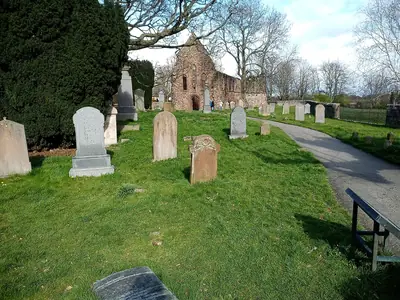
Beside the River Beauly, Beauly Priory preserves the remains of a medieval monastic community. It was probably founded around 1230 as a Valliscaulian monastery, although the identity of its founder is uncertain. Sources associate the foundation with Alexander the Second of Scotland, John Byset, or both.
The former priory church remains the clearest surviving part of the site. French-speaking monks and the nearby landowner John Byset are linked with the name Beauly, associated with beau lieu, or “beautiful place”. The priory became Cistercian in 1510 after the Valliscaulian Order was suppressed, and its lands were later transferred in 1634.
Eilean Donan Castle
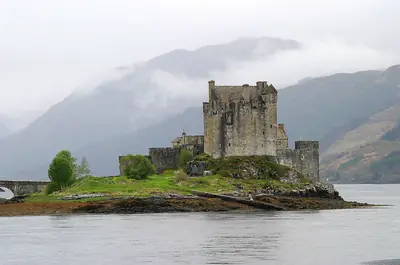
Eilean Donan Castle stands on a small tidal island where Loch Duich, Loch Long and Loch Alsh meet. A footbridge connects the island with the mainland, creating one of the western Highlands’ most recognisable settings.
The island’s name refers to Donnán of Eigg, a Celtic saint who was martyred in 617. A first castle was built in the thirteenth century, and the stronghold later became associated with Clan Mackenzie and Clan MacRae.
Royal forces captured and destroyed the castle after the Jacobite involvement of the Mackenzies in 1719. The building seen today is a twentieth-century reconstruction. Lieutenant-Colonel John Macrae-Gilstrap bought the island in 1911, and the castle was rebuilt between 1913 and 1932.
Glenfinnan Monument and Viaduct
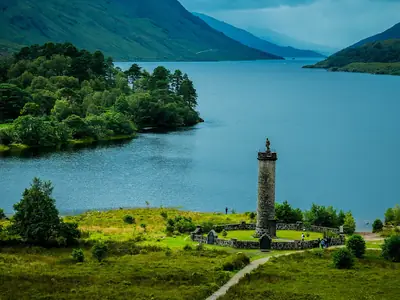
Glenfinnan Monument commemorates the Highlanders who fought in the Jacobite Army during the rising of 1745. Erected in 1814, it is recognised as a Category A listed monument and stands in a landscape overlooking Loch Shiel.
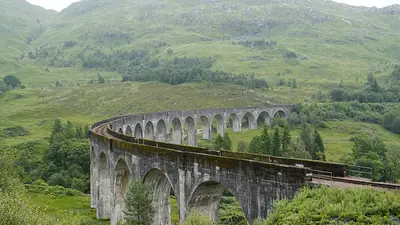
Nearby, Glenfinnan Viaduct carries the West Highland Line across the landscape. Built between 1897 and 1901, it stretches for 380 metres and rests on 21 piers, some reaching 30 metres high. Its elegant curve and mass-concrete construction made it a pioneering railway structure.
The viaduct also appeared in the Harry Potter films Harry Potter and the Chamber of Secrets, Harry Potter and the Prisoner of Azkaban and Harry Potter and the Goblet of Fire, where the Hogwarts Express crosses the bridge. Glenfinnan is close to Fort William, another important Highland destination.
Carrbridge Packhorse Bridge
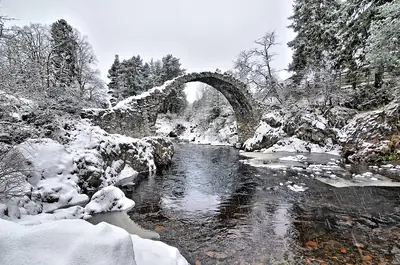
In the Highland village of Carrbridge, the Packhorse Bridge crosses the River Dulnain. Also known as Coffin Bridge, it was built in 1717 so that funeral processions could cross the river on their way to Duthil Church.
Its parapets were washed away during the nineteenth century, but the bridge remains a memorable reminder of the area’s past. It became a Category B listed building in 1971.
Ardtornish Castle and Castle Tioram
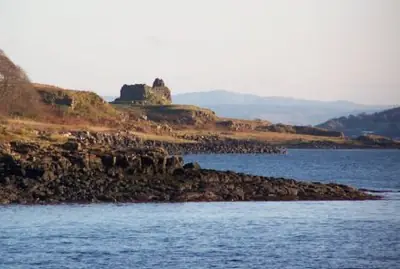
Ardtornish Castle is a ruin on a promontory reaching south into the Sound of Mull, within the grounds of the Ardtornish estate. From the early fourteenth century until the late fifteenth century, it was one of the principal residences of the chiefs of Clan Donald and an important setting for the Lords of the Isles.
The site is also associated with the Treaty of Ardtornish and Westminster, negotiated there in 1461. Ardtornish is about two kilometres south-east of Lochaline and is protected as a scheduled monument.
Castle Tioram stands on the tidal island of Eilean Tioram in Loch Moidart. Also known locally as Dorlin Castle, it is a striking ruin whose Gaelic name, Caisteal Tioram, means “dry castle.”
Further Highland Landmarks
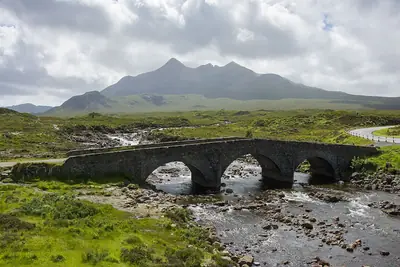
The wider region offers more historic places to discover. Sligachan Old Bridge once carried road traffic across the River Sligachan on the Isle of Skye and now serves as a footpath amid Highland scenery. You can continue your journey towards Skye, where the landscape and history take on a different character.
On the east coast, Dunrobin Castle overlooks the Dornoch Firth. It has been the family seat of the Earl of Sutherland and chief of Clan Sutherland. Sir Charles Barry shaped much of the present building and gardens between 1835 and 1850, and later changes made Dunrobin the largest house in the north of Scotland, with 189 rooms. Part of the original medieval building remains visible in the interior courtyard.
Further north, Dunbeath Castle has stood on its site since the fifteenth century. The present building is mainly seventeenth-century, with nineteenth-century extensions. Freswick Castle, near John o’ Groats, is a tower house in Canisbay, Caithness, accompanied by a bridge over the Freswick Burn, a farmstead, a dovecot and St Madden’s Chapel.
Fortrose Cathedral, near Inverness, preserves the ruins of a church that once served as the episcopal seat of the medieval Scottish diocese of Ross. Its surviving remains mark the former cathedral site at Fortrose, also known as Chanonry.
Explore Inverness with Neywo
Download Neywo to follow two walking tours through Inverness:
- Jacobites, Castle and Old Streets: 1.55 km, 79 minutes and 12 narrated stops.
- Along the Ness: Kirks, Bridges and the Cathedral: 2.77 km, 84 minutes and 9 narrated stops.
The app tells the story of each place as you reach it, at your own pace, with no group and no schedule. Explore Inverness independently, from the castle and museum to the churches, bridges and riverside paths, and use the free audio guide to bring the city’s history to life. You can also discover more of Scotland and the United Kingdom with Neywo.
Places with an audio guide in Inverness
8 places in Inverness with a Neywo audio guide. Each one starts telling its story as you reach it.
Self-guided tours in Inverness
2 tours in Inverness, free in the Neywo app. Each stop tells its story as you reach it.
- Walk
Jacobites, Castle and Old Streets
Start at the statue of Flora Macdonald, who helped Bonnie Prince Charlie escape after Culloden, and climb to the red sandstone castle above the River Ness. Then follow the High Street past the old Town Steeple, the former bank and post office and the Noah's Ark clock at Eastgate, and turn up Church Street to a former church now a bookshop, a 17th-century almshouse and Inverness's oldest surviving house.
Flora Macdonald statue · Inverness Castle · Inverness Museum and Art Gallery · Inverness Town Steeple · Head Office, Caledonian Bank, 9-11 High Street, Inverness · Post Office, 58 High Street, Inverness …
Open this tour: Jacobites, Castle and Old Streets - Walk
Along the Ness: Kirks, Bridges and the Cathedral
Stroll the banks of the River Ness from the wooded Ness Islands and their Victorian suspension bridges, through Bught Park, to the Victorian cathedral and Eden Court. Pass Georgian Balnain House and cross the Greig Street suspension bridge, the famous Bouncy Bridge. End at the two great Bank Street churches with their landmark spires.
Ness Islands · Bught Park · Eden Court Theatre · Inverness Cathedral · St Mary's Roman Catholic Church, Huntly Street, Inverness · Balnain House, 40 Huntly Street, Inverness …
Open this tour: Along the Ness: Kirks, Bridges and the Cathedral
Walk Inverness with Neywo
Neywo turns Inverness into a self-guided audio tour. Stories arrive as you reach the place they belong to, and the route reshapes when you wander off it.

