What to See in Londonderry, United Kingdom: Free Audio Guide
Things to Do in Londonderry: A Self-Guided Walk Through History
Londonderry, also known as Derry, is a cathedral city shaped by the River Foyle and defined by its walled historic centre, religious heritage and difficult modern history. The city is worth visiting for the way these layers remain visible across a compact urban landscape, from historic cathedrals and museums to the Bogside and the river crossings. Neywo offers a free audio guide for Londonderry with 31 narrated places.
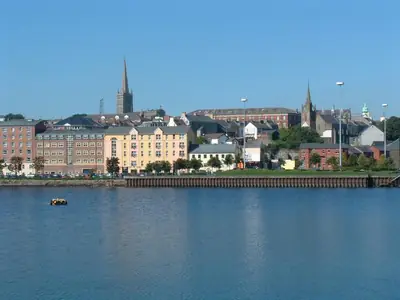
Londonderry is in Northern Ireland, within the United Kingdom. The city stretches across both banks of the River Foyle: the historic Cityside and walled city lie on the west bank, while Waterside occupies the east. Two road bridges and one footbridge connect the two sides.
What to see in Londonderry
St Columb’s Cathedral
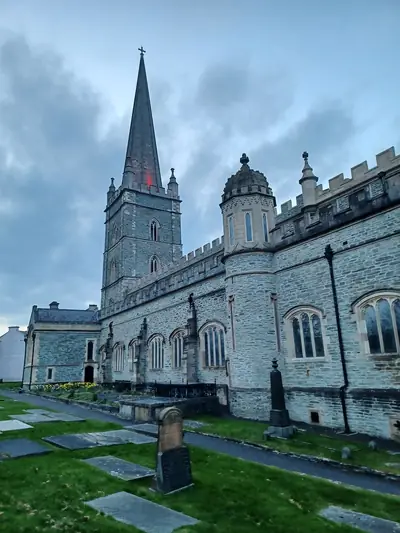
St Columb’s Cathedral stands within the walled city and is dedicated to Saint Columba. Built in 1633, it was the first Anglican cathedral built in Britain and Ireland after the Reformation, and the first non-Roman Catholic cathedral built in Western Europe. It remains an important place of worship for the Church of Ireland.
Tower Museum
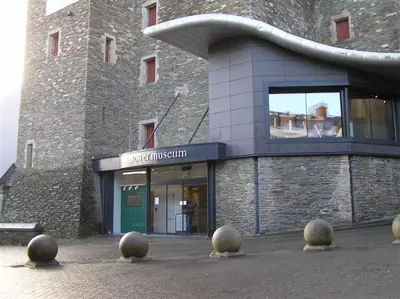
The Tower Museum is a local history museum devoted to Londonderry and its surrounding community. It provides a useful introduction to the history of the city before exploring its streets and other historic sites.
The River Foyle
The River Foyle is one of the defining features of northwest Ireland. It flows through Londonderry, widens into Lough Foyle and continues towards the Atlantic Ocean. The river helps explain the shape of the modern city, linking the older west-bank centre with Waterside.
It also features in a local legend: one story says that Saint Patrick expelled a dragon called Paiste, which fell into the Foyle. Some people still claim to have seen a reptile in the water.
Foyle Valley Railway Museum
The Foyle Valley Railway Museum focuses on the narrow-gauge railways that once served the surrounding region. The small museum is run by the charity Destined and preserves the story of the Foyle Valley Railway, a heritage railway that previously operated from the museum.
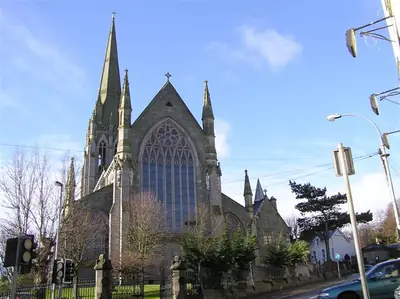
St. Eugene’s Cathedral
St. Eugene’s Cathedral is the Roman Catholic cathedral of Derry and the Mother Church of the Diocese of Derry. It also serves as the parish church of Templemore.
Its construction became possible after the Catholic Relief Act of 1829. Fundraising began in 1840, and building work followed in 1849. The cathedral opened in 1873, although some of its most recognisable features were added later. New stained-glass windows were installed in the late 1890s, while construction of the bell tower and spire began in 1900 and was completed in 1903.
The building’s history is therefore also a story of gradual completion. Early windows used plain glass because funds were limited, and the tower and spire had to wait until the cathedral could support further work.
The Bogside and Free Derry
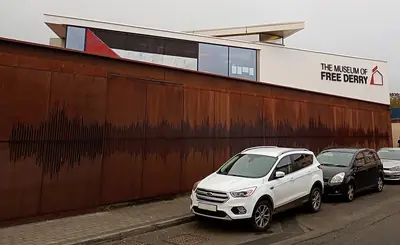
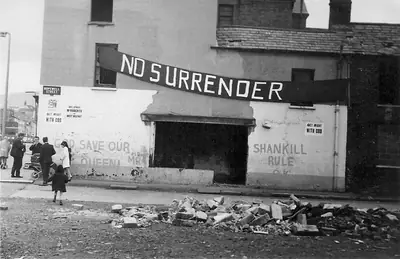
The Bogside is closely associated with the civil rights movement, the Free Derry Irish nationalist movement and the events that led to the Troubles. The Museum of Free Derry documents this history through documentary images and personal objects, offering a direct account of the late 1960s and early 1970s.
Free Derry Corner is another important place connected with this period. Together, these sites help explain the political and social history that shaped the city.
Bloody Sunday
On 30 January 1972, a civil rights march in the Bogside ended when British soldiers shot unarmed civilians. The march had been organised by the Northern Ireland Civil Rights Association to protest against internment without trial.
Twenty-six civilians were shot. Thirteen men were killed outright, and another died four months later from his injuries. The first British investigation, the Widgery Tribunal, was widely criticised. A second investigation, the Saville Inquiry, was established in 1998 and published its report in 2010. It concluded that the shootings were unjustified and that none of those shot posed a threat. Prime Minister David Cameron later apologised on behalf of the United Kingdom.
Visiting the Bogside and the Museum of Free Derry requires attention and respect. These are places where the city’s recent history is not abstract: it is tied to specific streets, families and memories.
Derry Gaol
Derry Gaol, also known as Londonderry Gaol or the Old Derry Jail Tower, is associated with Republican prisoners, executions and two notable episodes of resistance and escape.
Seven executions took place there between 1820 and 1923. On Christmas Day in 1939, interned Irish Republican prisoners took control of the jail to protest their continued imprisonment without charges or trials. On 20 March 1943, twenty-one Irish Republican prisoners escaped through a tunnel in an event remembered as the Big Derry Jail Escape.
Exploring beyond the city
The wider area around Londonderry contains several historic sites. Altinaghree Castle, also known as Liscloon House or Ogilby’s Castle, is an abandoned building believed to have been commissioned by William Ogilby around 1860.
Castlederg Castle is a ruined post-medieval fortification on the north bank of the River Derg. It is a Scheduled Historic Monument, and its name comes from the Irish Caisleán na Deirge, meaning “Castle on the Derg.”
Near Newtownstewart, Harry Avery’s Castle is a rare stone castle associated with the Gaelic Irish chief Henry Aimhréidh O’Neill, who died in 1392. Much of its history remains uncertain. Stewart Castle, also known as Newtownstewart Castle, was built in 1619 by Sir Robert Newcomen in the style of an English manor house. It was damaged during the Irish Rebellion of 1641 and burned in 1689 on the orders of King James.
In Strabane, the Alley Theatre combines an auditorium, art gallery and tourist information centre. Opened in 2007, the complex hosts performances, exhibitions, festivals and workshops. Its piazza features Ambrose the Pig, an eight-foot bronze sculpture by Martin Heron titled Where Dreams Go. The artwork refers to the site’s earlier use as a cattle and pig market and later as a place for travelling circuses.
Explore Londonderry with a free audio guide
A Londonderry self-guided walking tour lets you explore the city independently while hearing its stories at the places where they happened. Neywo has two walking tours in Londonderry:
- Derry on the Foyle: Quays, Stage and Steeples — 2.03 km, 69 minutes and 8 narrated stops
- Walls, Bogside and Free Derry: A City’s Story — 2.54 km, 81 minutes and 9 narrated stops
The free audio guide covers 31 narrated places in total, including the Foyle Valley Railway Museum, Tower Museum, St Columb’s Cathedral, St. Eugene’s Cathedral and the Museum of Free Derry. Each story plays as you reach the place, at your own pace, with no group and no schedule. Narration is available in 11 languages.
Download Neywo and explore Londonderry by following the city’s streets, riverfront and historic sites in your own time.
Places with an audio guide in Londonderry
8 places in Londonderry with a Neywo audio guide. Each one starts telling its story as you reach it.


Self-guided tours in Londonderry
2 tours in Londonderry, free in the Neywo app. Each stop tells its story as you reach it.
- Walk
Derry on the Foyle: Quays, Stage and Steeples
Start where the River Foyle meets the old walled city. Step through the harbour and local-history museums, take in the theatres that brought culture back to the heart of Derry, and finish beside the city's railway heritage. A gentle waterfront-to-wall loop, easy on the legs and rich in stories.
Foyle Valley Railway Museum · The Playhouse, Derry · Harbour Museum · Millennium Forum · Tower Museum · St Columb's Cathedral …
Open this tour: Derry on the Foyle: Quays, Stage and Steeples - Walk
Walls, Bogside and Free Derry: A City's Story
Begin at the first Protestant cathedral built after the Reformation, then walk out of the walls into the Bogside. Stand at Free Derry Corner, step inside the Museum of Free Derry and end beneath the spire of St Eugene's. A thoughtful route through faith, civil rights and the memory of the city.
Millennium Forum · Tower Museum · St Columb's Cathedral · First Derry Presbyterian Church · St. Augustine's Church · St Columba's Church …
Open this tour: Walls, Bogside and Free Derry: A City's Story
Walk Londonderry with Neywo
Neywo turns Londonderry into a self-guided audio tour. Stories arrive as you reach the place they belong to, and the route reshapes when you wander off it.

