Visiting Talkeetna, United States: Top Sights on Foot
Things to do in Talkeetna, Alaska
Looking for things to do in Talkeetna? This small Alaska community is associated with railroad history, rivers, and the wider landscape around Denali. Its compact character makes it a rewarding place to explore slowly, while nearby stops reveal more of the history and scenery of the Matanuska-Susitna region. Neywo has a free audio guide for Talkeetna with 23 narrated places, available in 11 languages.
Talkeetna is part of Alaska, a state whose communities are often separated by vast distances and shaped by transport, rivers, and wilderness. The town itself is the focus here, but the wider area offers plenty of context for understanding life in Alaska.
What to see in Talkeetna and the surrounding area
The Neywo guide includes places in and around Talkeetna, as well as stops across the Matanuska-Susitna region. Together, they form a route through railroad heritage, local communities, memorials, and distinctive landscapes.
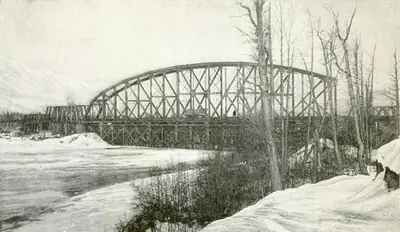
Susitna River Bridge
The Susitna River Bridge, also known as the Gold Creek Bridge, is one of the most impressive engineering landmarks associated with the Alaska Railroad. Its main steel through-truss span stretches 504 feet, or about 154 metres, across the Susitna River.
The bridge was completed in February 1921. Its full structure measures 1,322 feet, or approximately 403 metres, including additional truss spans and trestle approaches. Its historical importance was recognised when it was added to the National Register of Historic Places in 1977.
Alaska Veterans Memorial
Set on a hill above the Byers Lake campground in Denali State Park, the Alaska Veterans Memorial is an outdoor grove dedicated to Alaskans who served in the Army, Navy, Air Force, Marine Corps, Coast Guard, Alaska National Guard, and Merchant Marine.
The main memorial alcove was built in 1983 and dedicated the following year by Governor Bill Sheffield, who was also a veteran. Smaller memorials commemorate passengers and crew members who died in military plane crashes in Alaska. From outside the memorial, clear conditions can offer views of Denali.
Wasilla Community Hall
The Wasilla Community Hall, also known as the Wasilla Museum, occupies a log building on Main Street in Wasilla. Built in 1931 as a community centre, it was converted into a museum in 1967, while much of its original exterior was preserved.
The museum’s displays focus on the history of Wasilla and how the community developed over time. The building was listed on the National Register of Historic Places in 1982.
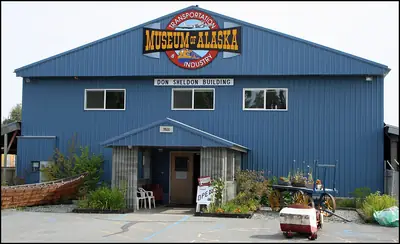
Museum of Alaska Transportation & Industry
Near Wasilla Airport, the Museum of Alaska Transportation & Industry explores how people and goods have moved across Alaska. It offers a useful perspective on the transport systems that connected remote communities and supported the state’s development.
For anyone interested in the practical side of Alaska’s history, this is one of the region’s most relevant museums.
Palmer and its agricultural history
Palmer is a city in the Matanuska Valley and the seat of the Matanuska-Susitna Borough. It was founded in 1916 as an Alaska Railroad station. In 1935, 203 families from Michigan, Wisconsin, and Minnesota relocated there with state support, establishing a farming community that strongly influenced Palmer’s identity.
The city is also home to the National Tsunami Warning Center. Palmer’s history gives visitors a different perspective on Alaska: not only as a land of mountains and wilderness, but also as a place where planned settlement and agriculture played an important role.
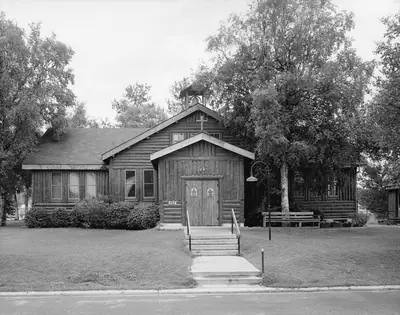
United Protestant Church
The United Protestant Church in Palmer is also known as the Church of a Thousand Trees. This two-storey log building has a cross-shaped plan and a small bell tower above its entrance.
Inside, rustic log features and carved pews create a distinctly handcrafted atmosphere. The church property also includes a manse and garage built in a similar style. Originally non-denominational, the church later became Presbyterian, and the complex was listed on the National Register of Historic Places in 1980.
Willow
Willow is a community with strong links to gold mining and the Alaska Railroad. Prospectors arrived in 1897 to search for gold along Willow Creek, while supplies travelled from Cook Inlet to Knik and then overland to the mining camps.
The Alaska Railroad built a station at Willow in 1920. The area later became associated with an unsuccessful 1976 proposal to move Alaska’s capital from Juneau to Willow. The idea reflected a desire for a more accessible capital without giving Anchorage an even more prominent role.
Lake Louise
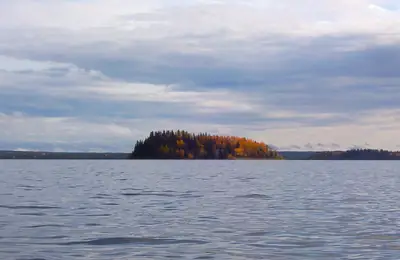
Lake Louise, in the Matanuska-Susitna Borough, was originally known as Shosubenich, a name meaning “great flat water with many islands.” Lieutenant Joseph Castner called it Lake Adah in 1898, but Captain Edwin Glenn later persuaded him to rename it Lake Louise in honour of Glenn’s wife.
The U.S. Army established a recreation facility there towards the end of the Second World War and built the first road to the lake. At Army Point campground, several weathered cabins remain from that period. One was used for four days by General Dwight D. Eisenhower before he became president.
Communities around Wasilla
The wider route also passes through several communities that show how the area around Talkeetna has grown. Houston is a small city in the Matanuska-Susitna Borough, while Gateway lies between Lakes and Palmer near the junction of the Glenn Highway and George Parks Highway.
Knik-Fairview sits on the northwestern shore of the Knik Arm and is the most populated census-designated place in Alaska. Meadow Lakes, west of Wasilla, is characterised by forests and scattered lakes, while Tanaina lies just north of Wasilla. These places are not traditional sightseeing landmarks, but they help put Talkeetna within the broader pattern of settlement in Alaska.
Wasilla’s churches and local history
Several Wasilla churches appear in the audio guide. Wasilla Assembly of God gained national attention in 2008 when Senator John McCain selected Alaska Governor Sarah Palin as his running mate; Palin had attended the church until 2002.
Wasilla Bible Church is a non-denominational evangelical church serving the local community. Together with the Wasilla Community Hall and the Museum of Alaska Transportation & Industry, these stops offer a closer look at the institutions and stories that shaped the area.
Explore Talkeetna with Neywo
There are no scheduled tours or group departures with Neywo. The free Talkeetna audio guide includes 23 narrated places, and each story plays as you reach the location. You can explore at your own pace, with no group and no schedule, while the app explains the history and character of each stop.
Download Neywo and use the Talkeetna audio guide to discover the town and its surrounding communities independently. When you continue travelling through the state, you can also explore Anchorage, Fairbanks, Juneau, Homer, Sitka, and Ketchikan with Neywo.
Places with an audio guide in Talkeetna
8 places in Talkeetna with a Neywo audio guide. Each one starts telling its story as you reach it.

Walk Talkeetna with Neywo
Neywo turns Talkeetna into a self-guided audio tour. Stories arrive as you reach the place they belong to, and the route reshapes when you wander off it.

