Ketchikan, United States: Self-Guided Walking Tour
Things to do in Ketchikan: historic streets, totem poles and Alaska Native heritage
Looking for things to do in Ketchikan? This city combines historic waterfront buildings, salmon-spawning waters, distinctive wooden homes and a rich tradition of Tlingit, Haida and Tsimshian art. It is also a practical introduction to the landscapes and history of Alaska, from rainforest ecology and fishing to logging, mining and maritime life.
Neywo offers a free audio guide for Ketchikan with 14 narrated places, so you can explore the city while its stories play as you reach each stop.
What to see in Ketchikan
The most important sights are concentrated around the downtown waterfront and historic streets, with further cultural highlights slightly beyond the center.
First Lutheran Church
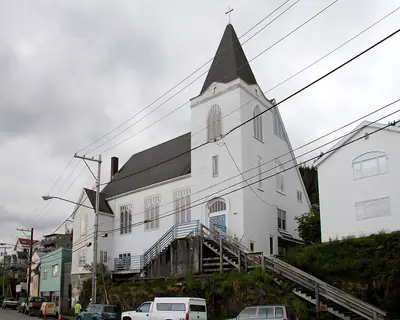
First Lutheran Church is a notable wooden building completed in 1930. Designed by Seattle architect W. G. Brust and built by local builder Carl Foss, it has a two-story wood-frame structure and a three-story tower at the southwest corner. The tower contains the main entrance beneath an arched opening, while the windows combine rectangular sash windows with groups of narrow Gothic lancet windows. The church was added to the National Register of Historic Places in 1987.
Walker-Broderick House
Also known as the Doc Walker House, the Walker-Broderick House is a carefully preserved example of early twentieth-century residential architecture. Built between 1916 and 1920 by Carl Foss, it features Craftsman details including broad eaves, large knee arches, a front porch supported by brick piers and a matching brick chimney. Its interior woodwork remains well preserved, and the house was listed on the National Register of Historic Places in 1982.
Burkhart-Dibrell House
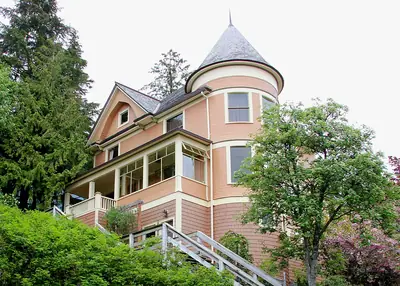
At the head of Main Street, the Burkhart-Dibrell House—also called the Monrean House—is the only significant surviving Queen Anne-style house in Ketchikan. Built in 1904 by H. Z. Burkhart, founder of Ketchikan Spruce Mills, it later belonged to Captain Walter Dibrell, Superintendent of Lighthouses for all of Alaska. Its turret, conical roof and gold spire give the three-story wooden house an unmistakable silhouette.
The Gilmore Building
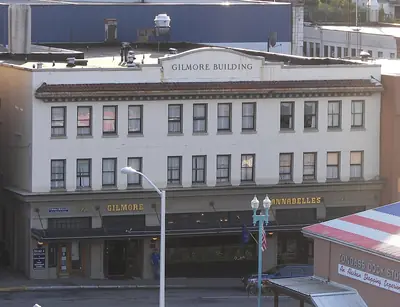
The Gilmore Building, also known as the Gilmore Hotel, is one of the few surviving reminders of Ketchikan in the 1920s. Constructed in 1926 and 1927 by P. J. Gilmore, Senior, it was designed to provide both retail space and hotel rooms. The three-story masonry building has a reversed-L layout, with commercial storefronts on the lower level and hotel rooms above. It stands at 326 Front Street, next to Ketchikan City Hall.
Southeast Alaska Discovery Center
The Southeast Alaska Discovery Center offers context for the region’s natural and cultural history. Its galleries explore temperate rainforest ecosystems and the ways people have lived and worked in Southeast Alaska, with exhibits on Native traditions, fishing, logging, mining and tourism. The center also has hands-on activities and scavenger hunts, a 150-seat theater showing short films, and an Alaska Geographic bookstore.
Ketchikan Federal Building
The Ketchikan Federal Building at 648 Mission Street has served as a working federal courthouse since its completion in 1938. It is a courthouse for the United States District Court for the District of Alaska and was added to the National Register of Historic Places on April 28, 2006.
Raven Stealing the Sun totem pole
Outside the Tongass Historical Museum stands the Raven Stealing the Sun Kootéeyaa, a totem pole honoring the Tongass Tlingit. Its figures tell the story of Raven stealing the sun and giving daylight to humankind. Dempsey Bob and Stanley Bevan carved the pole in 1982, and it was installed at the museum on May 21, 1983.
Chief Johnson totem pole
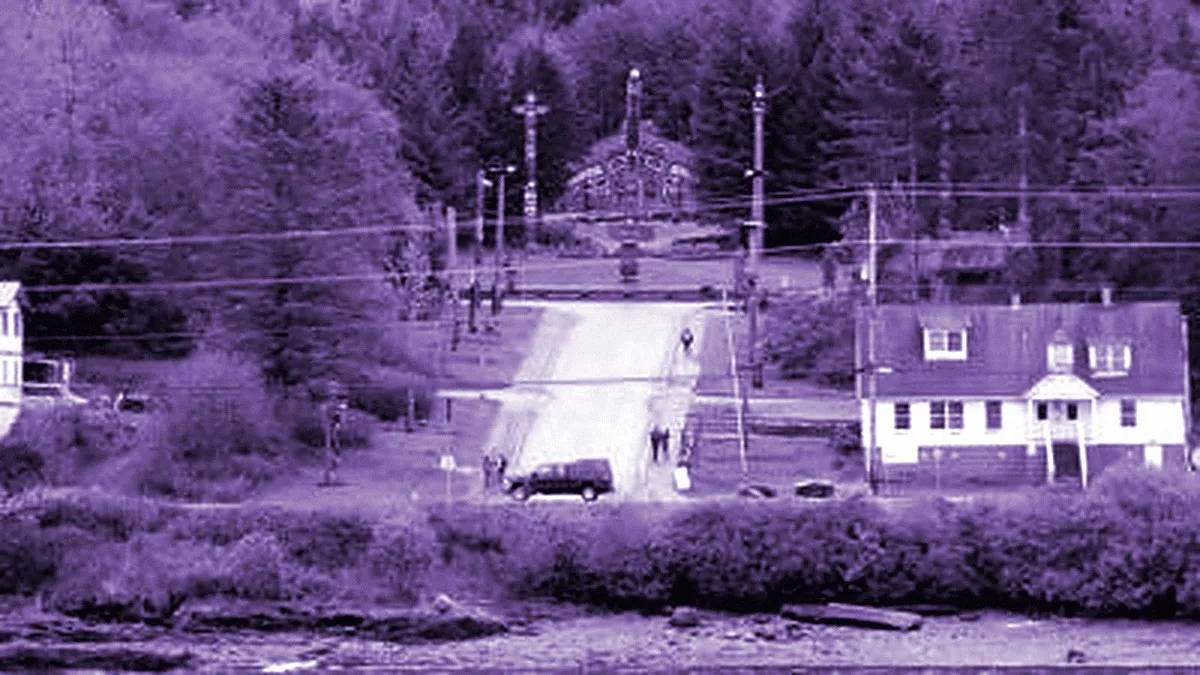
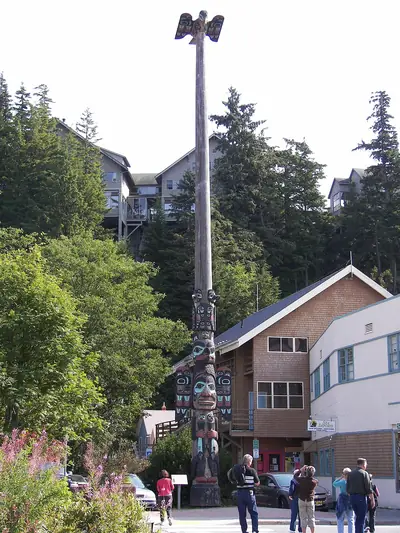
Near the entrance to Creek Street, opposite Whale Park, the Chief Johnson totem pole rises 55 feet above the waterfront. Also known as the Kadjuk Pole, it was carved from a single western red cedar log. Chief George Johnson commissioned the original in 1902; the pole now standing was recreated in 1989 by Israel Shotridge, also known as Kinstaádaál. The original is preserved at the Totem Heritage Center.
The carvings honor the Kadjuk House of the Raven Clan and depict the Tlingit story of Fog Woman, which explains the origin of salmon. At the summit, the Kadjuk bird represents the clan and the family it represents.
The Star
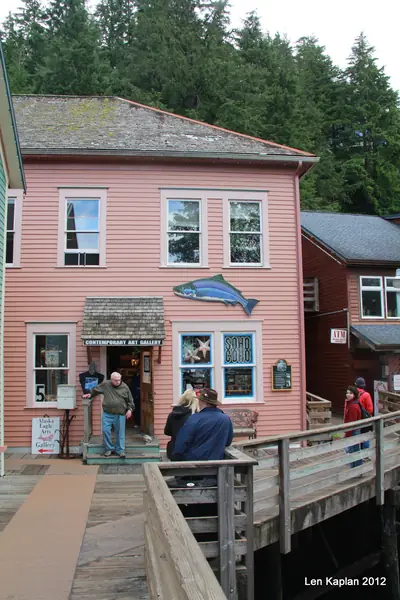
The Star, at 5 Creek Street, is the only surviving brothel from Ketchikan’s former red-light district to retain its historical integrity. Built on stilts over Ketchikan Creek after a 1903 ordinance moved brothels away from the downtown core, it expanded in 1910 and 1917. Its name comes from the inlaid wooden star at the center of its former dance floor.
The building remained active until World War Two, reopened in 1946 and was permanently closed by the city in 1953. Thelma Baker continued to live there until her death in a fire in 1972.
Creek Street
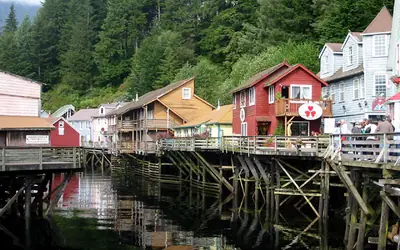
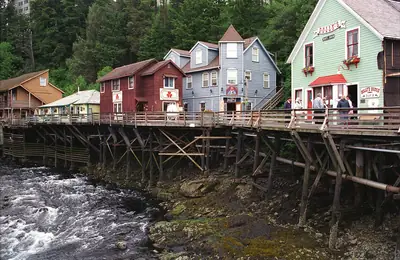
Creek Street is one of the best places to understand Ketchikan’s waterfront history. The wooden boardwalk runs on stilts above Ketchikan Creek and became the city’s red-light district from 1903 to 1954. Miners, fishermen and loggers once visited its narrow line of buildings; today, shops, galleries and eateries occupy the historic spaces.
In late summer, salmon can often be seen swimming upstream near the Salmon Ladder viewing area. The nearby Married Man’s Trail leads into the forest and was once used by clients attempting to evade the law during raids.
Ketchikan Creek and Dolly’s House
Ketchikan Creek runs through downtown on its way from a lake to Tongass Narrows. The salmon-spawning stream is about six miles, or 9.7 kilometers, long, and is also known as Fish Creek and Kitschkhin in Tlingit.
Dolly’s House Museum stands along Creek Street beside the water. The green, dollhouse-style building was once the home and workplace of Dolly Arthur, described as one of Alaska’s most famous madams. Its cabbage rose wallpaper, vintage furnishings, photographs and personal artifacts evoke early twentieth-century frontier life. A secret closet recalls the period when Dolly hid bootleg liquor during Prohibition.
Totem Heritage Center
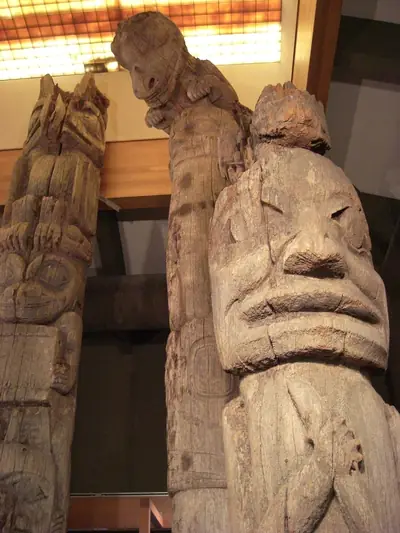
The Totem Heritage Center was founded in 1976 to preserve and share the artistic and cultural heritage of the Tlingit, Haida and Tsimshian peoples. Its collection includes 33 totem poles recovered from abandoned villages near Ketchikan, including Village Island and Old Kasaan. Sixteen are displayed permanently.
The collection includes memorial poles, family poles and story poles. Their weathered surfaces preserve family histories, ancestral memory and Indigenous storytelling. One unusual pole has a beard and is associated with contact with Russians during the period known as Russian America.
Eagle Park and Whale Park
At Eagle Park, “The Rock” is a bronze sculpture with seven life-sized figures. Six represent pioneer archetypes—a fisherman, miner, logger, bush pilot, frontierswoman and Native drummer—while the group evokes the salmon, gold, timber and wildlife associated with Southeast Alaska. It was Ketchikan’s first bronze sculpture and stands near the cruise ship docks at Berth Two.
Whale Park is another waterfront stop near the city’s arrival area, offering a place to pause while exploring the surrounding sights.
Explore Ketchikan with a self-guided audio tour
Neywo’s Ketchikan self-guided walking tour, Totems, Spires and Stilted Streets of Ketchikan, covers 3.23 km in about 96 minutes and includes 12 narrated stops. The route visits First Lutheran Church, the Walker-Broderick House, Burkhart-Dibrell House, Gilmore Building, Southeast Alaska Discovery Center, Ketchikan Federal Building, Raven Stealing the Sun totem pole, Chief Johnson totem pole, The Star, Creek Street, Ketchikan Creek and the Totem Heritage Center.
Download Neywo and explore Ketchikan at your own pace. The app tells the story of each place as you reach it, with no group and no schedule. Narration is available in 11 languages. From Ketchikan, you can also continue discovering other cities in Alaska, including Sitka and Juneau.
Places with an audio guide in Ketchikan
8 places in Ketchikan with a Neywo audio guide. Each one starts telling its story as you reach it.
Self-guided tours in Ketchikan
1 tour in Ketchikan, free in the Neywo app. Each stop tells its story as you reach it.
- Walk
Totems, Spires and Stilted Streets of Ketchikan
Walk from Ketchikan's wooden Lutheran church past Queen Anne and Craftsman houses to Front Street and the cruise-dock district. Then follow the totem poles to Creek Street's stilted boardwalk, where salmon run beneath the old red-light district, and end at the Totem Heritage Center.
First Lutheran Church · Walker-Broderick House · Burkhart-Dibrell House · Gilmore Building · Southeast Alaska Discovery Center · Ketchikan Federal Building …
Open this tour: Totems, Spires and Stilted Streets of Ketchikan
Walk Ketchikan with Neywo
Neywo turns Ketchikan into a self-guided audio tour. Stories arrive as you reach the place they belong to, and the route reshapes when you wander off it.

