What to See in Sitka, United States: Free Audio Guide
Things to Do in Sitka: Russian, Tlingit and Alaskan History
The best things to do in Sitka combine Tlingit heritage, Russian Alaska, American history and the landscapes of Southeast Alaska. The city was once known as New Archangel, the capital of Russian America, and its museums, churches and historic sites preserve the stories of those who shaped the region. Neywo has a free audio guide for Sitka with 35 narrated places.
Sitka lies in the Alaska Panhandle, beside forested islands and the waters of the Pacific Ocean. It is a rewarding destination for travellers who want to explore history and culture while taking in the wider setting of Alaska.
What to see in Sitka
Russian Bishop’s House
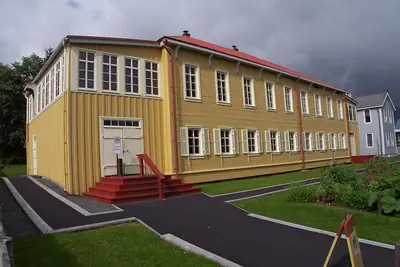
The Russian Bishop’s House is one of the few surviving examples of Russian colonial architecture in North America. Built between 1841 and 1843, it is also one of the oldest surviving buildings from the period of Russian America.
The building served both as a residence and as an administrative centre for the Russian Orthodox bishop. At the time, Sitka was called New Archangel and was the capital of Russian America. The bishop’s diocese extended from California to Siberian Kamchatka, making the house an important centre of religious and cultural activity.
The log building contains restored rooms including the bishop’s residence, a chapel and administrative areas. It now forms part of Sitka National Historical Park.
St. Michael’s Cathedral
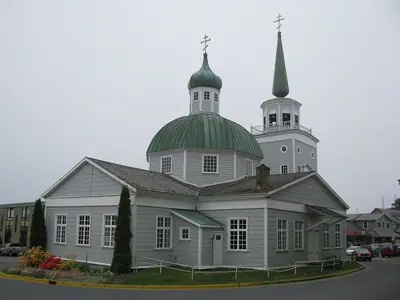
The green domes and golden crosses of St. Michael’s Cathedral are among Sitka’s most distinctive landmarks. Built in the 1840s, when Alaska was under Russian control, it served as the headquarters of the Russian Orthodox Church in Alaska and is described as the earliest Orthodox cathedral in the New World.
The original building was destroyed by an accidental fire on January 2, 1966. The cathedral was rebuilt in 1976 using the original plans and reproducing the earlier design. Its architecture reflects nineteenth-century Russian Orthodox traditions, particularly those associated with churches in Saint Petersburg.
Inside, the cathedral preserves a notable collection of religious icons, including works dating from the middle of the seventeenth century and two by Vladimir Borovikovsky. In 1962, it was recognised as a national historic landmark for its importance in the history of Russian influence in North America.
Russian America in New Archangel
Sitka was central to the history of Russian America, the name given to Russia’s North American possessions from 1799 to 1867. The territory consisted mostly of present-day Alaska and also included an important outpost at Fort Ross in California.
The Russian presence followed eastward expansion across Siberia. Russian explorers reached the Pacific in 1639, and expeditions led by Vitus Bering and Aleksei Chirikov opened the way for Russian claims in Alaska.
The history was also marked by conflict with the Tlingit people. In 1802, Tlingit warriors destroyed several Russian settlements, including Redoubt Saint Michael, also known as Old Sitka. The Russians returned two years later after the Battle of Sitka. In 1808, the rebuilt settlement, now called New Archangel, became the capital of Russian America after the colonial headquarters moved from Kodiak.
This colonial period ended in 1867, when Alaska was transferred from Russia to the United States.
Sheldon Jackson Museum
The Sheldon Jackson Museum holds one of Alaska’s oldest and most significant collections of Indigenous cultural artefacts. Its exhibits represent many Alaska Native cultures and include masks, carvings, clothing, tools, household objects and traditional watercraft.
The museum was founded in 1888 on the campus of Sheldon Jackson College. Its present building was completed in 1895 and is notable as the oldest concrete structure in Alaska. It is also listed on the National Register of Historic Places. Since 1984, the museum has been part of the Alaska State Museums system.
Among the collections are objects associated with the Inupiat, Yup’ik, Unangax, Athabascan and Northwest Coast peoples. An Unangan baidarka, or skin kayak, and a Tlingit dugout canoe show the importance of marine transportation in different parts of Alaska.
Sitka History Museum
The Sitka History Museum presents the community’s story through Tlingit, Russian and American perspectives. Its detailed scale model of Sitka in 1867 is especially useful for understanding the town during the transfer of Alaska from Russia to the United States. The model shows the streets, buildings and waterfront as they were laid out at that time.
The museum also highlights Tlingit traditions through objects such as cedar and spruce-root baskets. A Chilkat Blanket, traditionally woven from mountain goat wool and cedar bark, is another important piece.
The exhibits also follow the history of the Sheldon Jackson School, which began as a missionary school and later became a college.
Sitka Rose Gallery
Sitka Rose Gallery is another stop for visitors exploring Sitka’s cultural side. It offers a place to look around at your own pace as part of a wider visit to the city.
Baranof Island and the surrounding landscape
Sitka’s setting is part of the experience. Baranof Island is a rugged island in the Alexander Archipelago and one of Alaska’s ABC islands, together with Admiralty Island and Chichagof Island. Its mountainous landscape rises to 1,596 metres, and its surroundings are described as almost covered by ice.
Chichagof Island is another major island in the Alexander Archipelago. The entire island lies within Tongass National Forest, while its western coastal portion is designated as the West Chichagof-Yakobi Wilderness. It is known for its forests, coastline and waterways, as well as for having the highest population of bears per square mile of any place on Earth.
The smaller islands in Sitka City and Borough—including Gold Island, Kirushkin Island, Makhnati Island, Mogilnoi Island, Nevski Island and Rashimosti Island—place the city within a broad maritime landscape rather than a single urban setting.
Explore Sitka with a self-guided audio tour
Neywo makes it easy to turn these sights into a Sitka self-guided walking tour. The app has two walking tours and one bus route, with 35 narrated places in total. Each story plays as you reach the place, at your own pace: there is no group and no schedule. Narration is available in 11 languages.
The available routes are:
- New Archangel: Sitka’s Russian and Tlingit Waterfront — a 1.52 km walk lasting 70 minutes, with 10 stops.
- Salmon, Totems and Eagles: Sitka’s Green Edge — a 1.35 km walk lasting 40 minutes, with 5 stops.
- The Blue Line: Sawmill Creek Road to the Totem Park — a 7.4 km bus route lasting 32 minutes, with 4 stops.
The first walk follows Sitka’s Russian and Tlingit waterfront, with stops including Sitka Pioneer Home, Alaska Native Brotherhood Hall, Castle Hill, St. Michael’s Cathedral and the Russian Bishop’s House. The second connects Sitka’s green edge with places such as Sheldon Jackson College, Sitka National Historical Park and the Alaska Raptor Center. The bus route links Sawmill Creek Road with the Totem Park.
Download Neywo and explore Sitka at your own pace
Download Neywo’s free audio guide for Sitka and explore the city’s Russian, Tlingit and American history as you walk or ride. Choose one of the two walks or the bus route, reach each stop in your own time, and let the app tell the story of the place in front of you—without a group and without a schedule.
Sitka is one of the most distinctive cities in United States, and it makes a natural starting point for discovering more of the region alongside Juneau and Ketchikan.
Places with an audio guide in Sitka
8 places in Sitka with a Neywo audio guide. Each one starts telling its story as you reach it.
Self-guided tours in Sitka
3 tours in Sitka, free in the Neywo app. Each stop tells its story as you reach it.
- Bus ride
The Blue Line: Sawmill Creek Road to the Totem Park
Sitka's fixed-route Blue Line (Sawmill Creek Road) carries you from the Science Center on the old Sheldon Jackson campus past St. Peter's and the Russian Bishop's House to the totem poles of the national historical park, for a few dollars and no parking.
Sitka Sound Science Center · St. Peter's by-the-Sea Episcopal Church · Russian Bishop's House · Sitka National Historical Park
Open this tour: The Blue Line: Sawmill Creek Road to the Totem Park - Walk
New Archangel: Sitka's Russian and Tlingit Waterfront
Walk the compact downtown of the former capital of Russian America: the Pioneer Home on Katlian Street, the Tlingit brotherhood hall on pilings over the water, Castle Hill and the flag-raising site where Alaska changed flags in 1867, the 1930s post office, the first Protestant church in Alaska, the onion-domed cathedral, the log Bishop's House and a Gothic Revival church with a Star of David in its rose window.
Sitka Pioneer Home · Alaska Native Brotherhood Hall · Cable House and Station · Castle Hill · American Flag-Raising Site · Sitka United States Post Office and Court House …
Open this tour: New Archangel: Sitka's Russian and Tlingit Waterfront - Walk
Salmon, Totems and Eagles: Sitka's Green Edge
Leave the harbour for the old Sheldon Jackson campus, now home to Outer Coast College and the Sound Science Center with its salmon hatchery and touch tanks, then follow the Indian River into the rainforest of the national historical park, past Tlingit and Haida totem poles, to the raptor centre where injured eagles learn to fly again.
Outer Coast College · Sheldon Jackson College · Sitka Sound Science Center · Sitka National Historical Park · Alaska Raptor Center
Open this tour: Salmon, Totems and Eagles: Sitka's Green Edge
Walk Sitka with Neywo
Neywo turns Sitka into a self-guided audio tour. Stories arrive as you reach the place they belong to, and the route reshapes when you wander off it.

