Visiting Savannah, United States: Top Sights on Foot
Things to Do in Savannah: Historic Squares, Museums and Riverfront Landmarks
Looking for things to do in Savannah? Georgia’s oldest city, founded beside the Savannah River in 1733, is known for its historic squares, grand houses, leafy streets and layered cultural history. Its compact historic core is especially rewarding on foot, with landmarks that connect architecture, art, religion, railways, African American heritage and the waterfront. Neywo also offers a free audio guide for Savannah with 74 narrated places.
Savannah is the capital of Georgia, in the United States, and one of the country’s most distinctive Southern cities. The best way to experience it is slowly: follow the squares, pause at the museums and historic homes, and listen to the stories attached to each street and building.
What to see in Savannah
Wright Square
Wright Square is one of Savannah’s original public squares, laid out in 1733. It occupies a central position in the historic plan, between Johnson Square and Chippewa Square, and its name recalls James Wright, Georgia’s third and final royal governor.
The square is also associated with Tomochichi, a leader of the Yamacraw people and an important ally of James Oglethorpe. A monument honoring him stands at the southeast corner, replacing an earlier monument that had been dedicated to William Washington Gordon.
Cathedral Basilica of St. John the Baptist
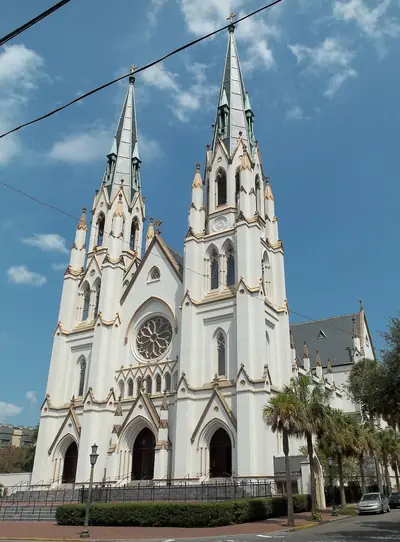
Near Lafayette Square, the Cathedral Basilica of St. John the Baptist stands out with its white Gothic façade, pointed entrances, rose window and slender spires. It is the mother church of the Roman Catholic Diocese of Savannah.
The present building was largely completed in the nineteenth century. A major fire in 1898 destroyed much of the interior, but the walls and spires survived. Restoration followed, and the cathedral’s elaborate decoration was completed in 1912. Inside, the long nave, ribbed vaults and richly decorated sanctuary make it one of Savannah’s most striking interiors.
Mercer Williams House
The Mercer Williams House is an elegant Italianate mansion with tall arched windows and ornate ironwork balconies. Created by architect John Norris, it became widely known through Midnight in the Garden of Good and Evil.
Jim Williams bought the house in 1969 and filled it with fine art and antiques. Although the mansion is also linked to the crime involving Williams and his lover, visits place particular emphasis on the house’s architecture, early history and Williams’s work as a collector and conservator.
Andrew Low House Museum
The Andrew Low House was completed in 1849 for Scottish-born cotton merchant Andrew Low. Its architecture combines the symmetry of the Greek Revival style with Italianate details, including fluted columns, cast-iron balconies, bracketed eaves and two cast-iron lions guarding the entrance.
The formal garden follows a design created in 1849, with a central path dividing two hourglass-shaped planting beds. Inside, decorated ceilings, plaster cornices and carved woodwork offer a close look at nineteenth-century domestic design and social history.
Davenport House Museum
Standing on Columbia Square, Davenport House Museum is a Federal-style home with an important preservation story. Built by Isaiah Davenport in 1820 for his family and nine enslaved people, the property later became a neglected rooming house.
When demolition threatened the building in 1955, local residents joined together to buy it. That campaign became the first act of the Historic Savannah Foundation and helped launch a preservation movement that saved hundreds of historic buildings. The museum’s restored rooms use period furnishings, wallpaper and floor designs based on historical records.
Telfair Museums and the Jepson Center
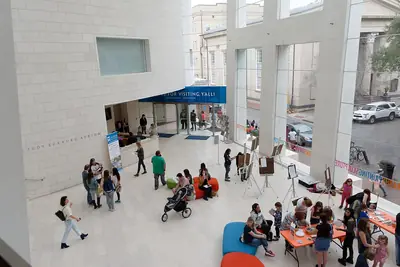
The Jepson Center for the Arts is the contemporary part of the Telfair Museums complex. Designed by Moshe Safdie and completed in 2006, it added modern galleries and education spaces to Savannah’s historic district.
Its structure consists of two sections connected by glass bridges over a protected walkway from Savannah’s original 1733 town plan. The galleries include African American artwork, Southern art, photography and works on paper, alongside changing exhibitions.
SCAD Museum of Art
The SCAD Museum of Art serves students at the Savannah College of Art and Design while welcoming the wider public. Its permanent collection contains more than 4,500 works across art, fashion, photography, sculpture, prints, rare books and antiques.
The collection includes artists such as Salvador Dalí, Pablo Picasso, Andy Warhol and Annie Leibovitz. The building’s eighty-six-foot steel-and-glass lantern gives this former railway area a distinctive contemporary landmark.
Central of Georgia Depot and Trainshed
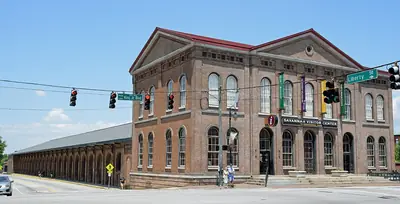
The Central of Georgia Depot and Trainshed form part of a historic railway complex dating from 1860. The red-brick passenger terminal and trainshed are now connected with the Savannah History Museum, where exhibits trace the city’s story from its establishment in 1733 to the present.
The wider site includes a cotton yard, blacksmith shop, brick viaduct, office car and caboose. The complex was recognized as a National Historic Landmark in 1976, with recognition expanded in 1978 to include the former Central of Georgia Railway Savannah Shops and Terminal Facilities.
Georgia State Railroad Museum
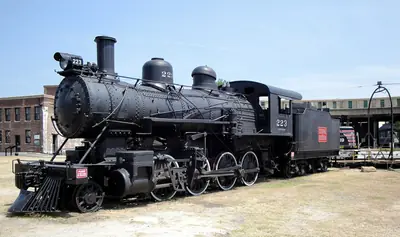
The Georgia State Railroad Museum preserves one of the most complete surviving antebellum railroad complexes in the United States. Built by the Central of Georgia Railway in 1853, it includes historic railroad shops and terminal buildings later recognized as a National Historic Landmark.
Visitors can see a partial roundhouse with an operating turntable, a machine shop, blacksmith shop, boiler house, storehouse and print shop. Locomotives, railroad stock, model train layouts and antique shaft-driven machinery help explain how nineteenth-century railway work was carried out.
King-Tisdell Cottage
King-Tisdell Cottage explores African American history in Savannah and the nearby Sea Islands. Built in 1896, the cottage was threatened with demolition in 1970 before the City of Savannah and the Historic Savannah Foundation preserved and moved it.
The house is furnished to resemble a typical Black home of the 1890s. Its exhibits include an original bill of sale for enslaved people with Arabic handwriting by enslaved plantation workers. Outside, the Free to Fly fountain and a gas lamp dedicated to Sadie Steele add further context.
African-American Monument
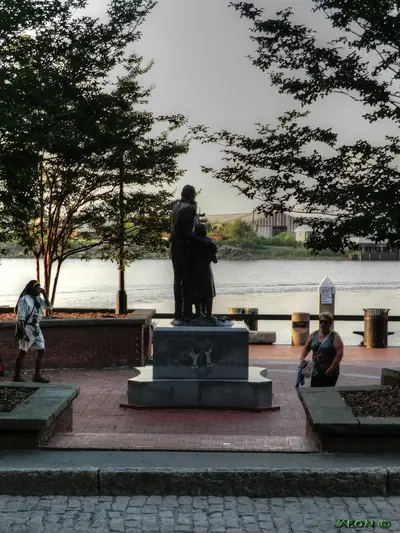
Along River Street, the African-American Monument depicts a family standing together on a tall granite base. Created in 2002, the four bronze figures represent a father, mother, son and daughter beginning a new life after emancipation.
Broken shackles and chains at their feet connect the family’s freedom with the generations who endured slavery. The granite base carries an inscription by Maya Angelou describing the suffering of people transported aboard slave ships before ending with a message of collective hope.
Ships of the Sea Maritime Museum
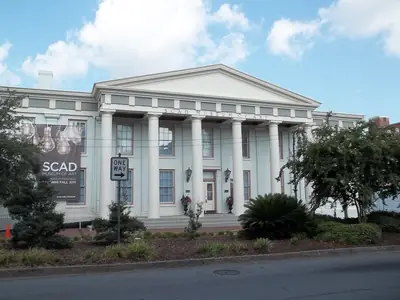
The Ships of the Sea Maritime Museum is housed in the William Scarborough mansion, built in 1819 and designed by architect William Jay. The building is an early example of Greek Revival architecture in Savannah, with Roman-style windows and a monumental Doric portico.
Nine galleries present nautical art, ship models, paintings, carvings, knotwork and scrimshaw. Together, they tell stories connected with Savannah’s maritime heritage and the sea.
United States Customhouse
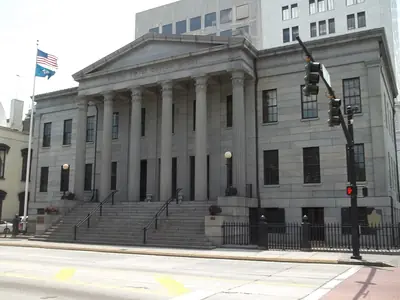
The United States Customhouse is a historic Savannah landmark created to house the offices of the United States Customs Service. It is one of the stops that helps connect the city’s historic center with its commercial and riverfront past.
Savannah Priory
Savannah Priory is a Catholic monastery of Benedictine monks, founded in 1877. It is also home to Benedictine Military School, bringing monastic life and education together in the city.
1996 Olympic Yachting Cauldron
Near Savannah, a park contains the 1996 Olympic Yachting Cauldron, a distinctive reminder of the city’s connection with the Olympic yachting events. It offers a different perspective on Savannah beyond its historic squares and nineteenth-century buildings.
Explore Savannah with a self-guided audio tour
A Savannah self-guided walking tour lets you explore the city without joining a group or following a fixed schedule. Neywo’s free audio guide includes 5 walking tours and 1 bus route, with narration available in 11 languages.
The walks range from 1.52 to 2.38 km and take between 68 and 87 minutes:
- Squares, Spires and Gothic Mansions — 2.32 km, 87 minutes, 11 narrated stops
- Where Savannah Began: Bluff, Customs and River — 1.52 km, 73 minutes, 10 narrated stops
- Forsyth Park to Jones Street — 1.81 km, 70 minutes, 10 narrated stops
- Rails, Art and Freedom on the West Side — 2.38 km, 76 minutes, 8 narrated stops
- The Theatres, Townhouses and the East Side — 2.14 km, 68 minutes, 8 narrated stops
There is also the Savannah Free Downtown Loop, a 2.5 km bus route lasting 11 minutes, with 6 narrated stops.
Download Neywo and explore Savannah at your own pace. The app tells the story of each place as you reach it, with no group and no schedule—just the city, its landmarks and the freedom to stop whenever you want.
Places with an audio guide in Savannah
8 places in Savannah with a Neywo audio guide. Each one starts telling its story as you reach it.
Self-guided tours in Savannah
6 tours in Savannah, free in the Neywo app. Each stop tells its story as you reach it.
- Bus ride
Savannah Free Downtown Loop
Ride the Forsyth Loop, the free downtown shuttle run by Chatham Area Transit, past Madison and Wright squares, the Customhouse and the synagogue on Monterey Square.
Green-Meldrim House · Independent Presbyterian Church · United States Customhouse · Lutheran Church of the Ascension · Savannah Theatre · Congregation Mickve Israel
Open this tour: Savannah Free Downtown Loop - Walk
Squares, Spires and Gothic Mansions
Stroll Savannah's oldest squares, where Oglethorpe's 1733 plan still shapes every block. Pass the first public art museum in the South and its modern neighbour, the Girl Scouts' birthplace, grand churches and a synagogue, then finish among salmon-pink mansions and a white Gothic cathedral.
Telfair Academy of Arts and Sciences · Jepson Center for the Arts · Wright Square · Lutheran Church of the Ascension · Juliette Gordon Low Historic District · Independent Presbyterian Church …
Open this tour: Squares, Spires and Gothic Mansions - Walk
Where Savannah Began: Bluff, Customs and River
Walk from City Hall's golden dome down to the cobbled waterfront where cotton ships once loaded. Visit the Customhouse, the Mother Church of Georgia, the bluff where Oglethorpe landed and the bronze Waving Girl watching the river.
Savannah City Hall · African-American Monument · United States Customhouse · Christ Church · The Olde Pink House · Claghorn and Cunningham Range …
Open this tour: Where Savannah Began: Bluff, Customs and River - Walk
Forsyth Park to Jones Street
Begin at the famous fountain in Forsyth Park and drift north through Monterey and Taylor squares, past a Renaissance Revival mansion, a folk-art museum and Savannah's first public school. End on Jones Street, often called the prettiest street in America.
Forsyth Park Fountain · Armstrong Kessler Mansion · Casimir Pulaski Monument · Hurn Museum · Wesley Monumental United Methodist Church · Massie Heritage Center …
Open this tour: Forsyth Park to Jones Street - Walk
Rails, Art and Freedom on the West Side
Follow the railway that built Savannah, from the civil rights museum to the trainshed and the SCAD Museum of Art. Finish at the City Market end of town with the oldest Black Baptist congregations in North America.
Ralph Mark Gilbert Civil Rights Museum · Georgia State Railroad Museum · Central of Georgia Depot and Trainshed · SCAD Museum of Art · Savannah Civic Center · Franklin Square …
Open this tour: Rails, Art and Freedom on the West Side - Walk
Theatres, Townhouses and the East Side
Explore Savannah's eastern squares: two historic theatres, a Regency mansion, one of the city's oldest houses, the only fenced square and the cultural centre of Black Savannah. A quieter walk through lesser-known streets.
Owens-Thomas House · Lucas Theatre for the Arts · Trustees Theater · Hampton Lillibridge House · Crawford Square · Beach Institute African American Cultural Center …
Open this tour: Theatres, Townhouses and the East Side
Walk Savannah with Neywo
Neywo turns Savannah into a self-guided audio tour. Stories arrive as you reach the place they belong to, and the route reshapes when you wander off it.

