Things to Do in Raleigh, United States: Walking Guide
Things to Do in Raleigh: Museums, Historic Buildings and Walkable Downtown Streets
The best things to do in Raleigh bring together state history, art, science, architecture and lively urban districts. North Carolina’s capital is especially rewarding on foot, from the Greek Revival State Capitol and historic churches to museums around Moore Square and contemporary art in the Warehouse District. Neywo has a free audio guide for Raleigh with 73 narrated places, so you can explore while the city’s stories play at the places themselves.
What to See in Raleigh
City of Raleigh Museum and the Odd Fellows Building
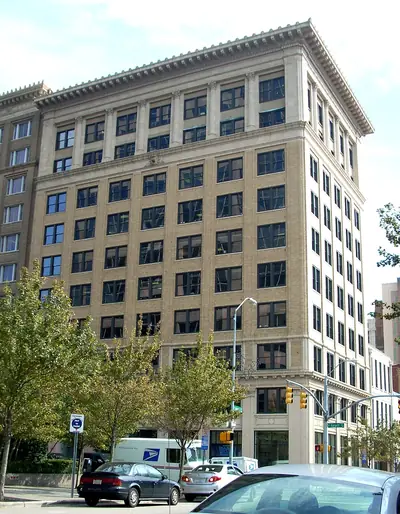
The City of Raleigh Museum, also known as the COR Museum, is a useful starting point for understanding the city. Nearby, the ten-story Odd Fellows Building—also called the Commerce Building—adds an architectural landmark to the visit. Built in 1923, it combines Late 19th and Early 20th Century American Movements architecture with Classical Revival design. Its organized base, shaft and capital arrangement reflects the formal character of the period. The building served both as a meeting hall for the Independent Order of Odd Fellows and as a business building, and it was listed on the National Register of Historic Places in 1997.
North Carolina State Capitol
At the centre of Union Square, the North Carolina State Capitol has been a defining Raleigh landmark since 1840. It was built after the first State House burned in 1831, with the cornerstone laid in 1833. Architects Ithiel Town and Alexander Jackson Davis designed the Greek Revival building with monumental columns and symmetrical proportions.
For almost fifty years, the legislature, Supreme Court and State Library all operated here. The Court and Library moved elsewhere in 1888, followed by the General Assembly in 1963. The governor and immediate staff still use offices on the first floor, giving the Capitol a continuing role in state government.
Presidents North Carolina Gave the Nation
The monument on the Capitol grounds honours the three U.S. presidents born in North Carolina: Andrew Jackson, James K. Polk and Andrew Johnson. Dedicated on October 19, 1948, it was unveiled at a ceremony whose principal address was given by President Harry S. Truman.
The monument connects Raleigh with a broader story of North Carolina’s political history. Andrew Johnson, the seventeenth president, was born in Raleigh, while Jackson and Polk were born elsewhere in the state.
Sacred Heart Cathedral and Holy Name of Jesus Cathedral
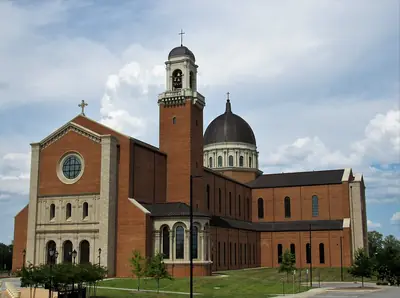
Sacred Heart Cathedral is a neo-Gothic stone church on Hillsborough Street and a contributing property in the Capitol Area Historic District. Its cornerstone was laid in 1922, and it was dedicated in October 1924 as the cathedral of the newly created Diocese of Raleigh. It served that role from 1924 until 2017. The restored sanctuary reflects its 1939 appearance.
Holy Name of Jesus Cathedral later replaced Sacred Heart Cathedral as the seat of the Diocese of Raleigh. It serves the Catholic community of eastern North Carolina and accommodates more than two thousand worshippers.
Raleigh Banking and Trust Company Building
The Raleigh Banking and Trust Company Building, also known as the Raleigh Building, stands on Fayetteville Street. Its original three-story section was completed in 1913, making it the city’s first true skyscraper. Eight additional floors were added between 1928 and 1929.
The upper façade combines brick veneer and white terra cotta ornament in a Classical Revival style. The lower three floors were remodelled in the mid-1930s in the Art Moderne style, giving the building two contrasting architectural identities.
North Carolina Museum of Natural Sciences
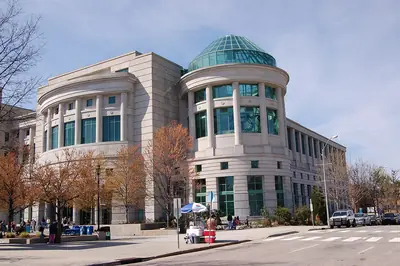
The North Carolina Museum of Natural Sciences is the oldest museum in the state and the largest natural history museum in the Southeast. Its origins date to 1879, when two state-owned collections of geological and agricultural specimens were combined.
The museum’s collections cover amphibians, reptiles, birds, fish, mammals, invertebrates, fossils, plants, geology and meteorites. Exhibits explore subjects including deep-sea life, evolution and ecosystems, offering a broad journey through the diversity of life on Earth. Admission to the museum is free.
North Carolina Museum of History
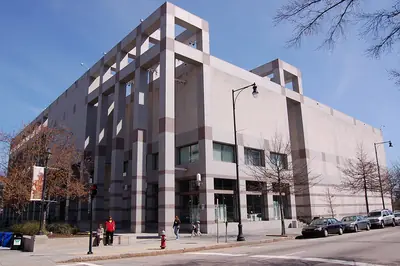
The North Carolina Museum of History is the state’s flagship history museum. Its signature exhibition follows 14,000 years of North Carolina history, from the earliest inhabitants to the present, within a collection of more than 350,000 artefacts.
Galleries examine subjects including pirates, the Civil War and North Carolina sports legends. Interactive exhibits, lectures, films and family programmes make the museum more than a collection of objects. The museum is currently temporarily closed, so check its status before planning a visit.
Marbles Kids Museum and Moore Square
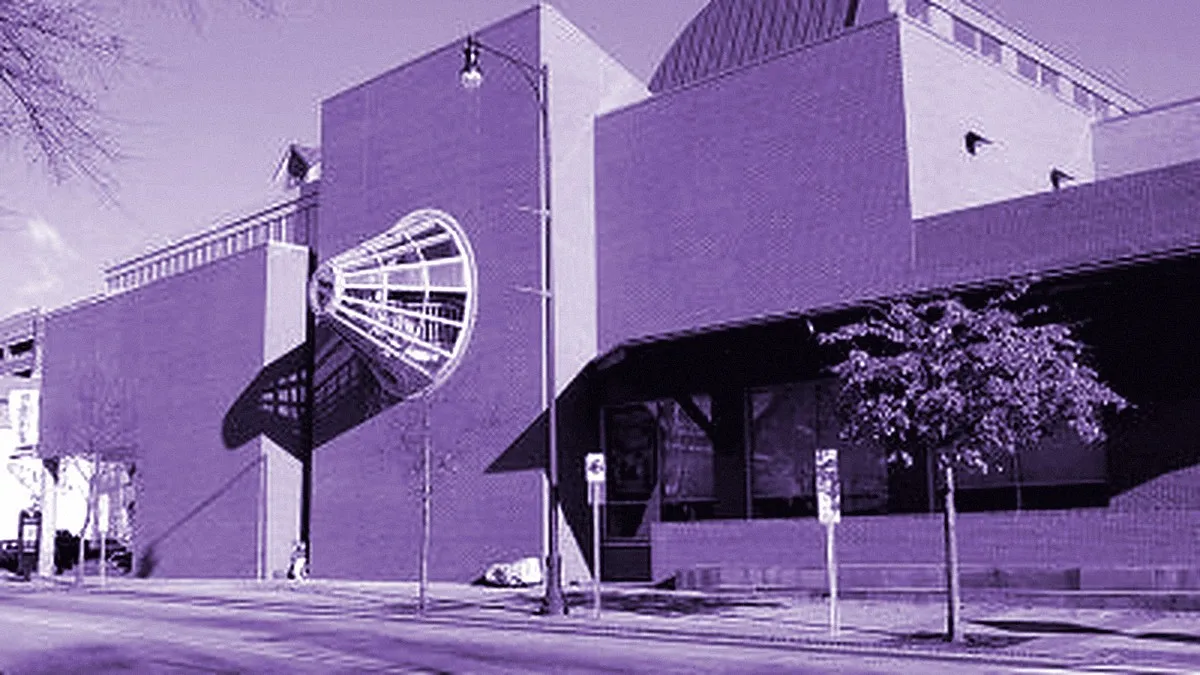
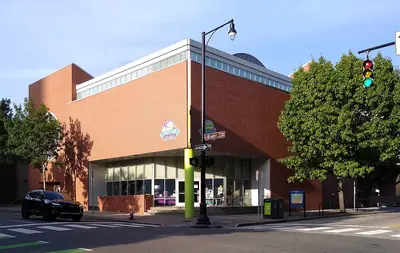
Marbles Kids Museum sits in the Moore Square Historic District and focuses on learning through play. Created in 2007 through the merger of Exploris and Playspace, the nonprofit museum includes interactive areas for children and families.
Around Town presents a child-sized version of adult community life, while Moneypalooza introduces financial literacy through hands-on play. At imagiFAB, science, technology, engineering, arts and mathematics become practical creative activities. The museum also has an IMAX theatre with North Carolina’s largest conventional IMAX screen, measuring seventy feet wide and capable of showing fully 3D films.
Outside, Moore Square provides one of downtown Raleigh’s central public spaces. Nearby City Market recalls the city’s commercial history and adds another distinctive stop to a downtown itinerary.
Pullen Park Carousel
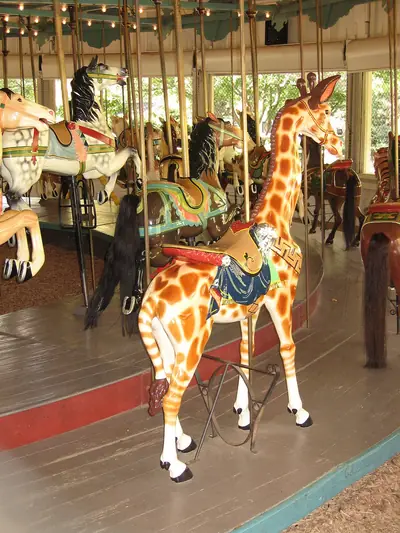
The historic Pullen Park Carousel dates from 1900 and remains one of the park’s best-known attractions. Its wooden platform carries 52 hand-carved basswood animals and two chariots, surrounded by 18 large gilded mirrors and canvas panels.
Music comes from a Wurlitzer number 125 band organ made in 1924. The carousel was restored between 1977 and 1982, when its original factory paint was uncovered, documented and conserved. Each animal was restored to its exact Munsell Color System paint colour, while the original paint beneath a layer of shellac was preserved.
North Carolina Museum of Art
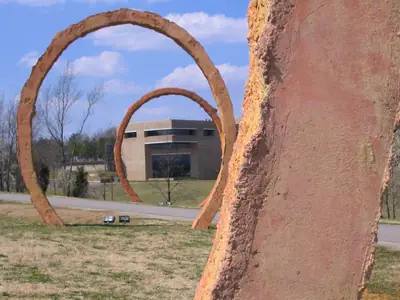
The North Carolina Museum of Art combines galleries with an extensive outdoor setting. It was the first major museum collection in the United States to be formed through state legislation and state funding. The museum opened in 1956, and admission to its permanent collection has been free since opening day.
More than forty galleries present over five thousand years of human creativity. Outside, the museum park covers 164 acres and includes more than a dozen major sculptures. The West Building, added in 2010, contributed 127,000 square feet of gallery space and received an international design award for its energy-efficient architecture.
Pope House Museum and 311 Gallery
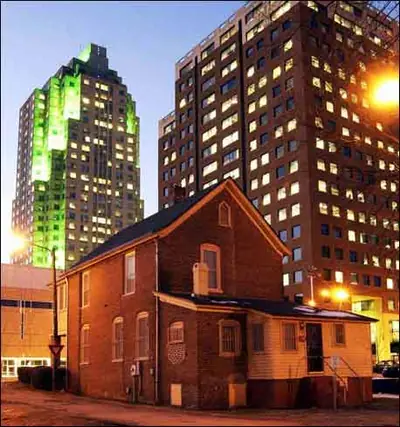
The Pope House Museum preserves the two-story home built by Dr. Pope in 1901. The house contained features that were unusually advanced for its time, including gas and electric lighting, running water in the kitchen, a second-floor bathroom, coal-burning heating stoves and a telephone. A call-bell system connected rooms to an annunciator panel in the back hall. Later, part of the back hall became a small medical office.
In the Warehouse District, 311 Gallery offers a different kind of cultural experience. Its rotating exhibitions include national juried works and guest artists, while twelve studios house more than thirty resident artists. The gallery also has a gift shop with handmade items created by its artists.
Explore Raleigh with Neywo
Neywo offers five walking tours in Raleigh, one bus route and one bike route, with 73 narrated places across the city. The walks range from 1.08 km and 42 minutes to 2.56 km and 73 minutes. They include:
- Capitol Square: 1.58 km, 83 minutes and 11 stops.
- Freedom and old Raleigh: 2.56 km, 73 minutes and 8 stops.
- State museums and Moore Square: 1.36 km, 56 minutes and 8 stops.
- South downtown: 1.08 km, 42 minutes and 6 stops.
- Oakwood and Blount Street: 2.3 km, 60 minutes and 6 stops.
The free R-Line downtown circulator route covers 7.4 km in 32 minutes and has 11 narrated stops. The Blount Street bike route covers 2.6 km in 13 minutes and has 5 stops. Each story plays as you reach the place, at your own pace, with no group and no schedule. Narration is available in 11 languages.
Download Neywo and explore Raleigh with an audio guide that accompanies your route, whether you are walking through Capitol Square, visiting the museums around Moore Square or cycling along Blount Street. For more ideas across the region, see North Carolina and discover other cities such as Charlotte and Asheville.
Places with an audio guide in Raleigh
8 places in Raleigh with a Neywo audio guide. Each one starts telling its story as you reach it.
Self-guided tours in Raleigh
7 tours in Raleigh, free in the Neywo app. Each stop tells its story as you reach it.
- Bike ride
Blount Street ride: from St. Paul A.M.E. to the Mordecai House
Ride the downtown bike lanes from a historic Black church past the cathedral and the Capitol to the Executive Mansion, then north on Blount Street to Raleigh's oldest home, the Mordecai House.
St. Paul A.M.E. Church · Sacred Heart Cathedral · North Carolina State Capitol · North Carolina Executive Mansion · Mordecai House
Open this tour: Blount Street ride: from St. Paul A.M.E. to the Mordecai House - Bus ride
R-Line: Raleigh's free downtown circulator
The R-Line is a free city bus that loops through downtown. Ride it from the natural sciences museum past the Odd Fellows tower, the convention district and the Pope House to First Baptist and the history museum, then west along Hargett and Edenton Streets to St. Paul A.M.E. Church, the CAM gallery, the old water tower and the Dodd-Hinsdale House.
North Carolina Museum of Natural Sciences · First Presbyterian Church · City of Raleigh Museum (COR Museum) · Raleigh Convention Center · Pope House Museum · First Baptist Church …
Open this tour: R-Line: Raleigh's free downtown circulator - Walk
Capitol Square: from Raleigh's first skyscraper to the governor's mansion
Raleigh was planned in 1792 as a capital city, and this walk follows that plan. Start on Fayetteville Street under the city's first skyscraper and an old hardware store turned museum, pass three Gothic and Romanesque churches, then climb to the Greek Revival Capitol and finish at a house that hosted Sherman and Grant and the Victorian Executive Mansion built by convict labour.
City of Raleigh Museum (COR Museum) · Raleigh Banking and Trust Company Building · Raleigh City Museum · First Presbyterian Church · Church of the Good Shepherd · Sacred Heart Cathedral …
Open this tour: Capitol Square: from Raleigh's first skyscraper to the governor's mansion - Walk
Freedom and old Raleigh: from Edenton Street to Joel Lane's house
A westward walk through the quarter where Raleigh grew up. See the church founded by enslaved Methodists and rebuilt by Black masons, an old power house, Victorian homes and the city's first water tower, and end at the 1769 house of the man who sold the land for the capital.
Edenton Street United Methodist Church · Dodd-Hinsdale House · St. Paul A.M.E. Church · Raleigh Electric Company Power House · Hillyer Memorial Christian Church · Raleigh Water Tower …
Open this tour: Freedom and old Raleigh: from Edenton Street to Joel Lane's house - Walk
State museums and Moore Square
Start at the Legislative Building, then walk through the two big free state museums, history and natural sciences, past the oldest Baptist congregation in town. Finish in the east-side park left from the 1792 plan, the old City Market with its cobbled lanes and the children's museum with the state's biggest IMAX screen.
North Carolina State Legislative Building · North Carolina Museum of Natural Sciences · North Carolina Museum of History · First Baptist Church · Long View Center · Marbles Kids Museum …
Open this tour: State museums and Moore Square - Walk
South downtown: the Shimmer Wall to Shaw University
A short loop through the south end of downtown. See the outdoor amphitheater and the convention center's Shimmer Wall of 80,000 aluminum panels, look up at the 22-storey FNB Tower, then visit the home of Dr. Manassa Pope, one of the first Black physicians in North Carolina, the Greek Revival performing arts complex, and Estey Hall, built in 1873 for the higher education of Black women.
Red Hat Amphitheater · Raleigh Convention Center · FNB Tower · Pope House Museum · Betty Ray McCain Art Gallery · Estey Hall
Open this tour: South downtown: the Shimmer Wall to Shaw University - Walk
Oakwood and Blount Street: Raleigh's historic north side
A northward walk through the historic streets behind the Capitol. See a Victorian Episcopal chapel from 1874, an Italianate house on North Blount Street, the antebellum main building of Peace College and a church built in 2015, then end at Raleigh's oldest house still on its original foundation and the chapel in its park.
Free Church of the Good Shepherd · Andrews-Duncan House · Holy Trinity Anglican Church (Raleigh, North Carolina) · Peace College Main Building · Mordecai House · St. Mark's Chapel
Open this tour: Oakwood and Blount Street: Raleigh's historic north side
Walk Raleigh with Neywo
Neywo turns Raleigh into a self-guided audio tour. Stories arrive as you reach the place they belong to, and the route reshapes when you wander off it.

