Things to Do in Lynchburg, United States: Walking Guide
Things to Do in Lynchburg, Tennessee
Looking for things to do in Lynchburg? This small Tennessee community is known for its connection with Jack Daniel’s Distillery, but the Lynchburg experience also includes local history, rural Southern character, and the stories of a place shaped by craftsmanship and tradition. Neywo’s free audio guide for Lynchburg brings 22 narrated places to life as you explore.
What to See in Lynchburg
Jack Daniel’s Distillery
Jack Daniel’s Distillery is the landmark most closely associated with Lynchburg. Its reputation has made the town internationally known and gives visitors a way to explore Tennessee whiskey heritage, traditional production, and the relationship between a globally recognized maker and its small-town home.
The distillery is also part of Lynchburg’s wider identity. Whiskey culture is woven into the community rather than standing apart from it, making the town itself an important part of the story.
Lynchburg Courthouse
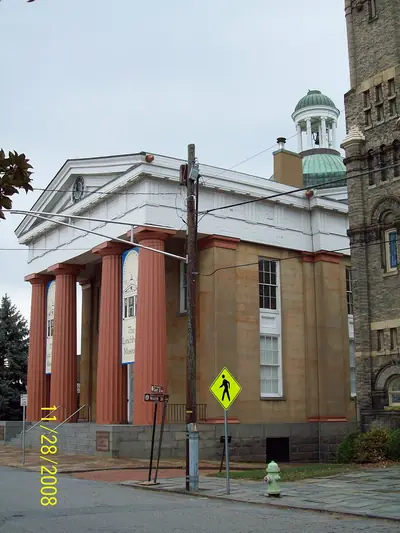
The Lynchburg Courthouse rises above the steep steps of Monument Terrace and is one of the city’s most prominent historic landmarks. Built in 1855, it is an impressive example of Greek Revival design.
Its three-bay Doric portico, stucco-over-brick walls, and granite ashlar basement give the building a formal, solid appearance. Above the roof ridges, a shallow dome is topped by a small open belfry formed by Ionic columns beneath a hemispherical dome. The courthouse was added to the National Register of Historic Places in 1972 and stands within the Court House Hill-Downtown Historic District.
Bragassa Toy Store
The Bragassa Toy Store preserves a glimpse of Lynchburg’s commercial life during the Reconstruction period. Francisco Bragassa purchased the property in 1871 and built the Italianate store between 1875 and 1876.
The ground floor housed a confectionery and toy store, while the upper floor contained living quarters. Its shop windows were the first plate glass windows installed in Lynchburg. The building remained with the Bragassa family until 1987, and the Lynchburg Historical Foundation purchased it in January 1988. It was listed on the National Register of Historic Places in 1991.
Allied Arts Building
At 725 Church Street, the Allied Arts Building stands out for its Art Deco design and height. Completed in 1931 after construction began in 1929, the 17-story building was Lynchburg’s tallest until 1972.
Its steel frame, yellow brick facing, and greenstone details give it a distinctive appearance. The design by Stanhope S. Johnson and Addison Staples closely resembles the Central National Bank in Richmond, Virginia.
Court Street Baptist Church
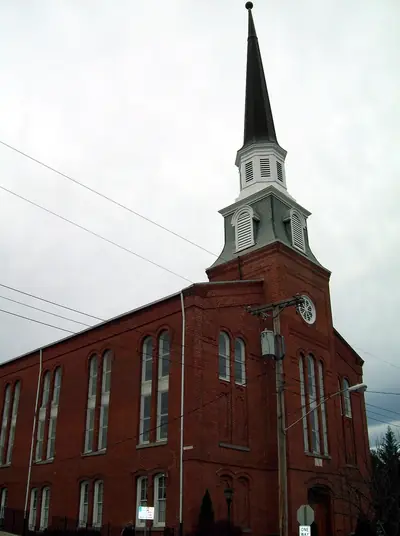
Court Street Baptist Church is the tallest object on Lynchburg’s downtown skyline and an important landmark for the city’s Black Baptist community. Its congregation traces its roots to 1843, when it was organized as the African Baptist Church of Lynchburg—the city’s first congregation of its kind.
The present building was designed by R. C. Burkholder and completed in 1880. Its position above downtown reflects the prominence the congregation has held in Lynchburg for generations.
First Baptist Church
The Church of the Good Shepherd, formerly known as First Baptist Church, is a historic Gothic Revival church on Court Street. Its architecture adds another important religious landmark to Lynchburg’s historic cityscape.
Diamond Hill Historic District
The Diamond Hill Historic District covers about fourteen blocks between the Lynchburg Expressway and the central commercial core. Its streets and houses preserve much of the city’s late nineteenth- and early twentieth-century development.
The neighborhood includes everything from speculative houses to substantial residences built for upper-middle-class families. Washington and Clay streets are especially notable for their Georgian Revival and Colonial Revival homes. Diamond Hill Historic District was added to the National Register of Historic Places in 1979, with its designation expanded in 1983.
Diamond Hill Baptist Church
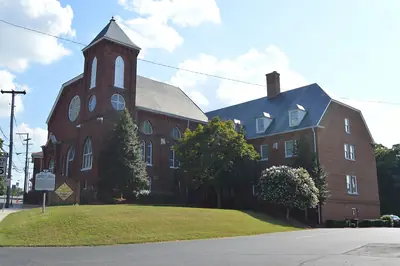
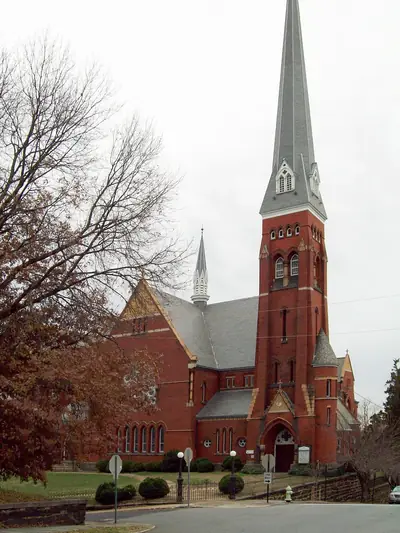
Within the Diamond Hill Historic District, Diamond Hill Baptist Church has a strong Gothic presence. Built in 1886, the three-story, L-shaped brick building features a tall entrance tower and steeple, brick buttresses capped with limestone, pointed-arch windows, and a jerkinhead roof.
The church was individually listed on the National Register of Historic Places in 2011. Its architecture and history make it an important part of the district’s broader story.
Anne Spencer House
The Anne Spencer House was the home of Anne Spencer, a poet of the Harlem Renaissance. She lived there from 1903 to 1975, and the house opened as a museum in 1977, preserving a direct connection to her life and work.
Fifth Street Historic District
The Fifth Street Historic District is a historic African American section of Lynchburg where homes, shops, churches, businesses, and institutions form a varied urban landscape. The district contains 57 contributing buildings and one contributing object, with about half of the buildings dating from 1875 to 1940.
Among its historic places are the William Phaup House, Tal-Fred Apartments, Humbles Building, Moser Furniture Company, Miller Tire and Battery Company, Fifth Street Baptist Church, and Community Funeral Home. The district was listed on the National Register of Historic Places in 2012.
Jones Memorial Library
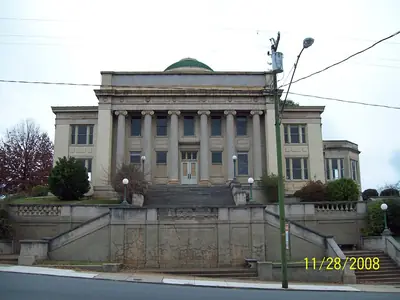
Jones Memorial Library is a specialized center for genealogy and historical research, with collections focused especially on central Virginia. Its resources include county histories, court records, family histories and genealogies, land and personal property tax records, census records, and works on the Civil War.
Mary Frances Watts Jones founded the library in memory of her husband, George Morgan Jones. It opened in June 1908 as the second oldest public library in Virginia. Today, the Jones Memorial Library occupies the second floor above the Lynchburg Public Library’s main branch at 2311 Memorial Avenue.
South River Friends Meetinghouse
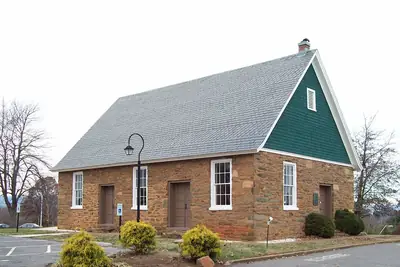
Also known as the Quaker Meeting House, South River Friends Meetinghouse is a compact rubble-stone building completed in 1798. Its walls are about sixteen inches thick and twelve feet high, and the structure measures approximately thirty by fifty-one feet.
The meetinghouse was abandoned in the 1840s when local Quakers moved to Ohio because of economic hardship and their moral opposition to slavery. Presbyterians later purchased the ruins and surrounding land in 1899, rebuilt the structure, and held their first service there in 1901. It was restored to its historic appearance in 1990.
Centerview
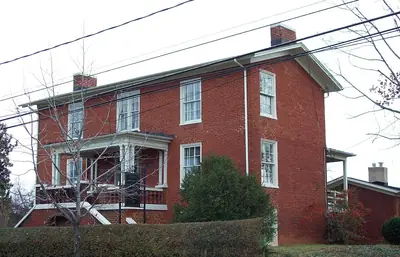
Centerview is a historic two-story brick home completed in 1871 in the Greek Revival style. The property also includes a smaller brick dependency, possibly dating to 1861, which originally served as a summer kitchen and cook’s dwelling among other functions.
Both buildings were rehabilitated in 1999 and 2000 for use as law offices. Centerview was listed on the National Register of Historic Places in 2000.
Aviary
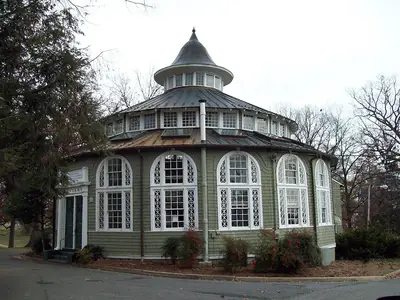
In Miller Park, the Aviary is a distinctive multi-sided Queen Anne building designed by the local firm Frye and Chesterman. Built in 1902, it was created for displaying animals and birds.
When it opened, the building contained seven cages of monkeys, a cage holding at least six alligators, and separate cages for cockatoos, Australian doves, parrots, and canaries. Randolph Guggenheimer gave the Aviary to Lynchburg. After its use as an animal exhibition house, it became a branch library and later an office for the city’s Department of Parks and Recreation.
Maier Museum of Art at Randolph College
The Maier Museum of Art at Randolph College focuses on American art from the nineteenth through the twenty-first centuries. Randolph College, originally founded as Randolph-Macon Woman’s College, began collecting American art in 1907.
The museum now houses several thousand paintings, prints, drawings, and photographs, alongside changing exhibitions and education programs.
Kemper Street Industrial Historic District
The Kemper Street Industrial Historic District preserves a group of historic industrial sites and a railway corridor connected with Lynchburg’s early twentieth-century development. Its Georgian Revival buildings reflect the district’s first major period of growth in the early 1900s, while later construction from the 1930s and 1940s adds further layers to its industrial history.
The district was listed on the National Register of Historic Places in 2008.
Explore Lynchburg with a Self-Guided Walking Tour
A Lynchburg self-guided walking tour is a practical way to connect the city’s landmarks and neighborhoods without joining a group. Neywo offers three walking tours:
- Court House Hill: Skyscrapers, Stages and Steep Steps — 2.55 km, 102 minutes, 10 narrated stops.
- Diamond Hill to Fifth Street: Black Lynchburg’s Story — 4.54 km, 104 minutes, 6 narrated stops.
- West of Downtown: Mills, Monkeys and a Civil War Fort — 4.19 km, 86 minutes, 4 narrated stops.
Together, the tours cover 20 stops, while the Lynchburg audio guide includes 22 narrated places in total. Each story plays as you reach the place, at your own pace, with no group and no schedule. Narration is available in 11 languages.
Download Neywo and Explore Lynchburg
Download Neywo to explore Lynchburg with a free audio guide that tells the story of each place as you arrive. Choose one of the three walking tours, follow the route at your own pace, and discover the city’s courthouses, churches, historic districts, libraries, industrial sites, and other landmarks without a group or fixed schedule.
Lynchburg is part of Tennessee in the United States. To continue exploring the region, discover Nashville, Chattanooga, or Manchester.
Places with an audio guide in Lynchburg
8 places in Lynchburg with a Neywo audio guide. Each one starts telling its story as you reach it.
Self-guided tours in Lynchburg
2 tours in Lynchburg, free in the Neywo app. Each stop tells its story as you reach it.
- Walk
Court House Hill: Skyscrapers, Stages and Steep Steps
Climb through downtown Lynchburg's historic core, from a Reconstruction-era toy store with the city's first plate glass windows to a Greek Revival courthouse above Monument Terrace and an Art Deco high-rise. End at the old Point of Honor, once a secret dueling ground above the James River. A short stroll on, the Jones Memorial Library tells how Lynchburg's second oldest public library came to be.
Bragassa Toy Store · First Baptist Church · Lynchburg Courthouse · Allied Arts Building · Saint Paul's Vestry House · St. Paul's Church …
Open this tour: Court House Hill: Skyscrapers, Stages and Steep Steps - Walk
Diamond Hill to Fifth Street: Black Lynchburg's Story
Trace the African American neighbourhoods and institutions that shaped Lynchburg: the Gothic Diamond Hill Baptist Church, the home of Harlem Renaissance poet Anne Spencer, the Fifth Street district and the library where she worked.
Diamond Hill Historic District · Diamond Hill Baptist Church · Anne Spencer House · Fifth Street Historic District · Court Street Baptist Church · Jones Memorial Library
Open this tour: Diamond Hill to Fifth Street: Black Lynchburg's Story
Walk Lynchburg with Neywo
Neywo turns Lynchburg into a self-guided audio tour. Stories arrive as you reach the place they belong to, and the route reshapes when you wander off it.

