Chengdu, China: Self-Guided Walking Tour
Things to do in Chengdu
Chengdu, the capital of Sichuan Province in southwestern China, blends a relaxed, leafy atmosphere with the energy of a major metropolitan center, making it a compelling destination for travelers interested in wildlife, food, history and modern urban life. Neywo offers a free audio guide for Chengdu with 44 narrated places, letting you explore the city at your own pace.
Key sights in Chengdu
Temple of Marquis Wu
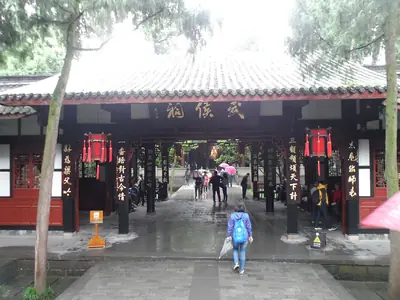
The Temple of Marquis Wu is the only place in China where an emperor and his minister are worshipped side by side. The complex fuses the Han Zhaolie Temple dedicated to Emperor Liu Bei, the Wuhou Temple honoring his strategist Zhuge Liang, and the Huiling Tomb where Liu Bei was laid to rest. The site dates back to 223 AD, was unified in the early Ming Dynasty, and its present buildings stem from a Qing restoration in 1672. Covering 150,000 square meters, it consists of three zones: a core historical area with the twin temples, tomb and Sanyi Temple, and a western area that includes the Liu Xiang Cemetery.
Wenshu Monastery
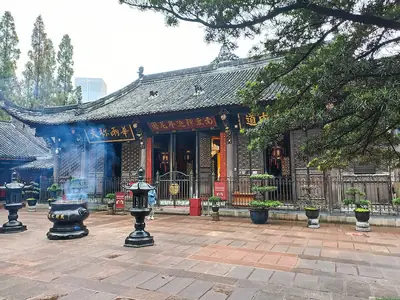
Located in Chengdu’s Qingyang district, Wenshu Monastery serves as a Buddhist sanctuary that combines a working Zen temple, a celebrated classical garden, and a centre for study and devotion. Known as the Temple of Manjushri, the bodhisattva of wisdom, its notable structures include the Three Saints Hall, the Chenjing Baolou—a precious sutra repository—and the Wenshu Pagoda that gives the monastery one of its names.
Mao Zedong Statue
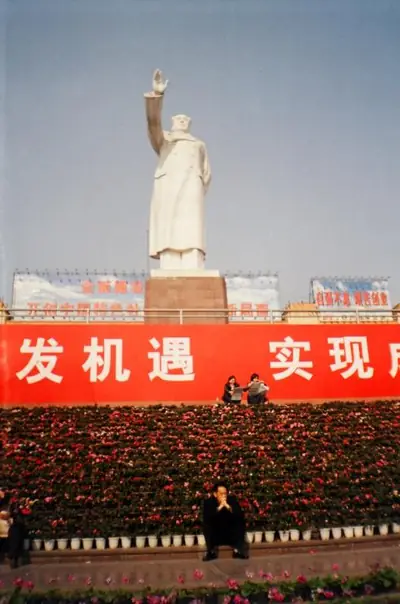
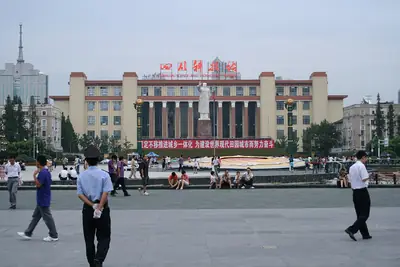
Dominating Tianfu Square, the thirty‑metre‑tall marble statue of Chairman Mao watches over the city with his right arm outstretched toward the south and his left fist clenched behind his back. The statue has overlooked Chengdu for more than half a century; its marble was shaped around a mould made from thirty tons of plaster brought from Henan province. Before 1967 the square housed the Shu King’s Palace, the ancient royal residence of the Shu Kingdom.
West Pearl Tower (Tianfu Panda Tower)
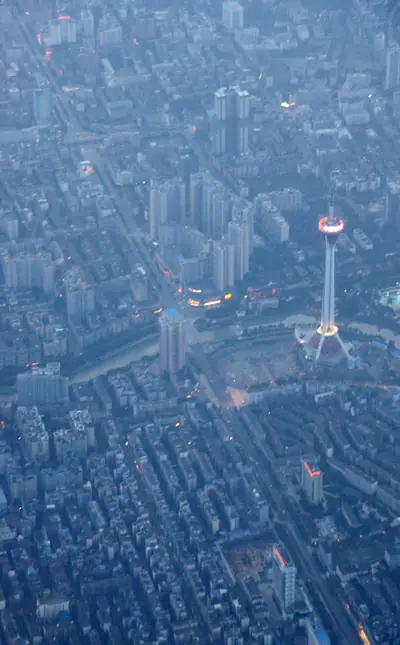
Rising 339 metres in Chengdu’s Chenghua District, the West Pearl Tower is the tallest tower in western China and the fifth tallest in the country. Construction began in December 1992 as a joint project of the China Architecture Southwest Design Institute and the Ministry of Radio, Film and Television’s design institute. The tower has been closed to visitors since 30 December 2022 due to weathering, but its slender silhouette remains a prominent skyline feature.
Old Buildings of Wangjianglou
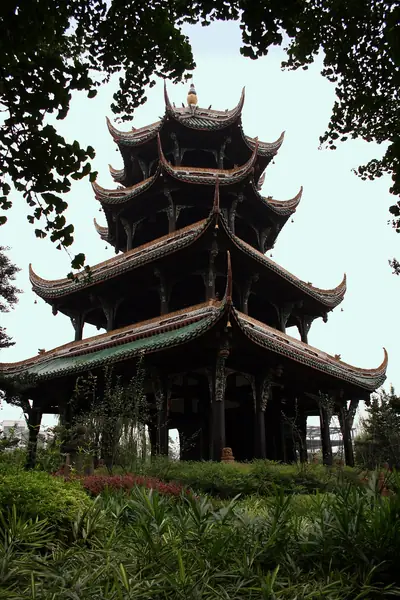
Wangjiang Lou Park lies along the banks of the Jinjiang River and honours the Tang Dynasty poet Xue Tao. The park’s ensemble includes the soaring Chongli Pavilion, the Zhuojin and Yinshi Towers, the Huanjian Pavilion where paper was rinsed, the Wuyunxian Hall, the Quanxiang Pavilion, the Liubei Pond with its floating wine cups, and the quiet Qingwan Room. Over a hundred bamboo species grow here, reflecting the poet’s love for the plant.
Zhaojue Temple
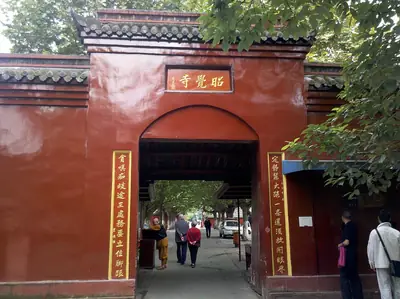
Zhaojue Temple, situated in Chenghua District, is one of Chengdu’s most important Buddhist sanctuaries. The present temple was completed in 1984 after numerous cycles of destruction and rebirth caused by natural disasters and war. It neighbours the Chengdu Zoo, and the two are often spoken of interchangeably by locals. The temple houses the Dizang Hall, dedicated to the bodhisattva Ksitigarbha.
Chengdu Museum
The Chengdu Museum is the largest city museum in Southwest China. Its nine‑story façade, clad in brass that creates a “gold‑inlaid‑with‑jade” appearance, was designed by the Scottish firm Sutherland Hussey Harris. With 65,000 square metres of floor space, the museum opened to the public in June 2016 after construction began in 2009. Two permanent exhibitions anchor the collection: “Flower‑heavy Jin Guan Cheng,” which traces Chengdu’s history and culture, and a remarkable assemblage of Chinese shadow puppets displayed in an eight‑hundred‑seat theatre.
Jianchuan Museum
About an hour’s drive from Chengdu, in the historic town of Anren, the Jianchuan Museum Cluster is China’s largest private museum complex. Spanning over 100,000 square metres, it holds more than ten million objects, including over four hundred items designated as national first‑class cultural relics. Assembled over six or seven decades by entrepreneur Fan Jianchuan, the museums are organised into thirty‑two halls grouped into four themes: the War of Resistance against Japan, folk customs and daily life, the Red Era of revolutionary history, and the 2008 Wenchuan earthquake relief efforts.
South Railway Station
Beneath the south plaza of Chengdu South Railway Station lies an underground metro hub that connects Line 1, Line 7 and the newer Line 18. Located in the High‑Tech Zone, it is one of the busiest interchange points in the city’s metro network.
Huaxiba Station
Huaxiba Station is a busy interchange where Chengdu Metro Lines 1 and 13 cross beneath the streets of Wuhou District. In October 2013 it became the first station in the Chengdu Metro system to offer a mother‑and‑baby waiting room, a service introduced because of its proximity to the Sichuan University Huaxi Women’s and Children’s Hospital. The station provides easy access to nearby stops such as Jinjiang Hotel, Sichuan Gymnasium and Xinnanmen.
Stone Pagoda Temple
Set in the countryside of Qionglai, the Stone Pagoda Temple dates back to the Song dynasty and is famed for its stone pagoda. The pagoda, built of red sandstone, stands 17.8 metres tall on a square base and rests on a double Sumeru pedestal. A cloister with twelve eave columns supports the first roof level, above which rise twelve tiers of close‑set eaves. The main hall was rebuilt during the Ming Zhengtong period; the site has been protected as a provincial cultural relic since 1980 and as a national key cultural relic since 2001. Since 1996 the grounds have also housed the Red Army Long March Memorial Hall, and in 1935 the temple served as the headquarters of the Chinese Workers’ and Peasants’ Red Army Stone Pagoda Temple District Soviet government.
Immaculate Conception Cathedral
Known locally as Ping’anqiao Catholic Church, the Immaculate Conception Cathedral is the mother church of the Roman Catholic Diocese of Chengdu. It has been the seat of the bishop since the diocese was established and the complex—comprising a main chapel, a smaller chapel and the bishop’s residence—covers more than eight thousand square metres. The façade blends Western ecclesiastical design with its setting in Qingyang District, and since 1957 the cathedral has operated under the Chinese Catholic Patriotic Association.
Mount Qingcheng
Mount Qingcheng rises southwest of the ancient Dujiangyan irrigation system and is regarded as one of the birthplaces of Taoism. Legend holds that the Yellow Emperor studied here with the sage Ning Fengzi, laying the spiritual foundations for Chinese philosophy. Over the centuries dozens of Taoist monasteries and temples have been built on its slopes, creating one of the most concentrated collections of Taoist architecture in China. The mountain spans 36 peaks, with the highest, Laoxiao Peak, reaching 1,600 metres. Its ancient name was Zhangren Shan, and it earned the poetic reputation “Qingcheng Tianxia You”—the most secluded and tranquil place under heaven. Although the 2008 Wenchuan earthquake damaged the site, the temples have since been restored.
Explore Chengdu with Neywo
Neywo provides three self‑guided walking tours in Chengdu, each narrated in 11 languages and available free of charge.
- Tianfu Square: Where a Palace Became a Plaza – 4.14 km, about 105 minutes, 8 narrated stops including the Monument to the Martyrs of the Railway Protection Movement, Chengdu Museum, Chengdu Huangcheng Mosque, Immaculate Conception Cathedral, Sichuan Science and Technology Museum, Tianfu Square, the Mao Zedong Statue and Gulou South Street Mosque.
- Zen Gardens, Tang Streets and the Panda Tower: Chengdu’s East – 5.65 km, about 111 minutes, 4 stops: Wenshu Monastery, Gulou South Street Mosque, the Neighborhood Relics of Tang and Song Dynasties at Jiangnanguan Street and the West Pearl Tower.
- Poet, Minister and Ancient Chengdu: The West Side – 4.33 km, about 89 minutes, 4 stops: Du Fu Thatched Cottage, Sichuan Museum, the Shi’erqiao Site and the Temple of Marquis Wu, Chengdu.
As you walk, the app tells the story of each place exactly when you reach it, allowing you to move at your own pace with no group and no schedule. Simply download Neywo, choose a tour, and let the audio guide enrich your visit.
If you’re planning further travels in China, you might also explore the cultural highlights of Beijing, the scenic charm of Guilin or the historic atmosphere of China as a whole. Safe travels!
Places with an audio guide in Chengdu
8 places in Chengdu with a Neywo audio guide. Each one starts telling its story as you reach it.
Self-guided tours in Chengdu
1 tour in Chengdu, free in the Neywo app. Each stop tells its story as you reach it.
- Walk
Tianfu Square: Where a Palace Became a Plaza
Stand on the site of the old Shu King's palace, torn down in 1967 to make room for a 30-metre Mao statue. Walk from a 1913 obelisk in People's Park past Chengdu's brass-wrapped city museum, the largest mosque in Sichuan inside the old imperial city wall and the city's Catholic mother church to the science museum, the great square and the Gulou Mosque.
Monument to the Martyrs of the Railway Protection Movement · Chengdu Museum · Chengdu Huangcheng Mosque · Immaculate Conception Cathedral · Sichuan Science and Technology Museum · Tianfu Square …
Open this tour: Tianfu Square: Where a Palace Became a Plaza
Walk Chengdu with Neywo
Neywo turns Chengdu into a self-guided audio tour. Stories arrive as you reach the place they belong to, and the route reshapes when you wander off it.

