Guilin, China: Self-Guided Walking Tour
Things to do in Guilin
Guilin, located in China, is known for its limestone karst peaks, the Li River, and a calm scenic character. Visitors come for the iconic river views, ancient caves, and historic sites that showcase the city’s natural and cultural heritage. Neywo offers a free audio guide for Guilin with 13 narrated places.
Explore Guilin’s highlights
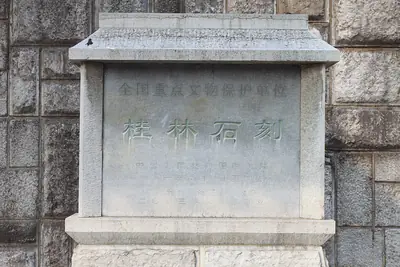
Guihai Forest of Steles Museum
Set within Qixing Park at the southwestern foot of Crescent Hill, the Guihai Forest of Steles Museum (also called the Guilin Stele Forest Museum) houses the cliff inscriptions of Longyin Rock and Longyin Cave. These stones form the most concentrated collection of historic carvings in Guilin, with the text integrated directly into the rock surface.
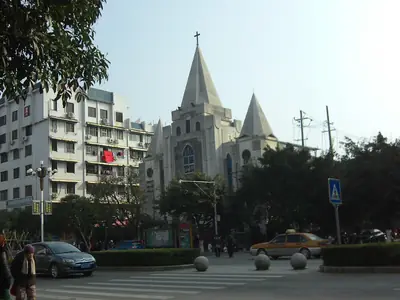
Guilin Christian Church
Located on Zhongshan Middle Road in Xiufeng District, the Guilin Christian Church serves as an important place of worship for the local Christian community. The current building dates from 1994 and stands at number 50 Zhongshan Middle Road; its predecessor, the Guilin Baptist Church, was founded in 1912. Today the church hosts the Guilin Christian Three‑Self Patriotic Movement Committee and the Guilin Christian Association, whose offices are in Gonghou Lane.
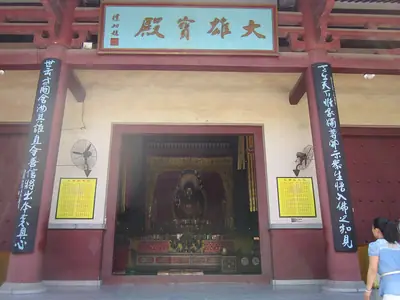
Jianshan Temple
In Yangshuo County, Jianshan Temple (鉴山寺) is a Buddhist site covering roughly 21.5 mu, with buildings occupying about 5,589 square metres. The complex includes a mountain gate, Mahavira Hall, meditation room and dining room, all designed in a style inspired by Tang dynasty architecture. The temple’s name was written by the lay Buddhist figure Zhao Puchu.
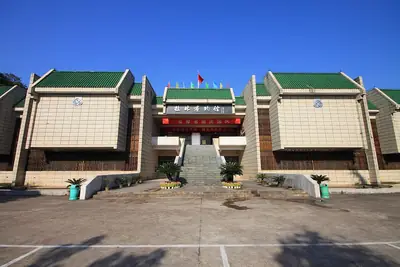
Guilin Museum
The Guilin Museum is a large comprehensive museum situated in the Yiyuan Liangguan complex of Lingui District. It presents a broad overview of the region’s history, culture and natural environment.
Li River
The Li River winds through Guilin’s striking karst landscape in China, offering clear waters that carry little sediment and a riverbed of water‑worn stones. Along its banks, the scenery is shaped by karst formations, with Elephant Trunk Hill visible near the city and the pointed peaks of Yangshuo farther downstream. This stretch of the river is the scene depicted on China’s twenty‑yuan banknote.
South China Karst
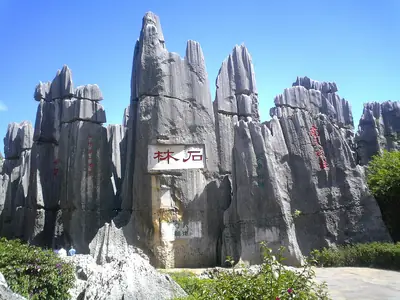
Guilin’s surroundings belong to the South China Karst, a UNESCO World Heritage site in China noted for its extraordinary variety of rock formations, dramatic scenery and rich biodiversity. The property comprises seven karst clusters across Chongqing, Guangxi, Guizhou and Yunnan; the Guilin Karst cluster was added in 2014, joining Shilin, Libo and Wulong (inscribed 2007). Visitors can see tower karst, pinnacle karst (stone forests), cone karst (pointed hills), as well as depressions, table mountains, gorges and mineral‑rich cave systems.
Yangshuo County
Yangshuo County lies beside the Li River and is encircled by striking karst peaks, a landscape that has attracted visitors for generations. Recognized as one of China’s important tourist towns, it was among the first to open to foreign travelers after the reform and opening period, and tourism remains a pillar of the local economy. The saying that Yangshuo’s scenery surpasses even Guilin’s has earned it a three‑star rating in the Michelin Green Guide, and the Li River scene on the twenty‑yuan note is often photographed near Yangshuo.
Elephant Trunk Hill
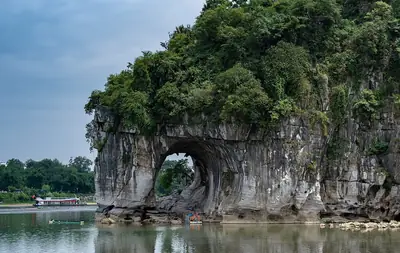
Elephant Trunk Hill stands where the Taohua River meets the Li River, inside Elephant Trunk Hill Park. Its silhouette resembles an elephant lowering its trunk into the water, making it a symbol of the city. Visitors can see the Puxian Pagoda on the summit, the Water Moon Cave on the eastern side, a passage that looks like an elephant’s eye, and stone steps that lead up both slopes.
Official residence of Li Zongren
On the southern shore of Shanhu Lake, at Number 4 Wenming Road in Xiangshan District, is the Official Residence of Li Zongren. The building marks a notable historic site in the city.
Reed Flute Cave
Reed Flute Cave (Ludi Yan) lies within Reed Flute Park on Brightness Mountain in Guilin’s northwestern outskirts. Named for the reeds near its entrance that can be fashioned into flutes, the cave contains stalactites, stalagmites and formations nicknamed Crystal Palace, Fish Tail Peak and Dragon Pagoda. Multicolored lighting highlights the natural shapes, earning it the title Palace of Natural Arts. More than seventy ink inscriptions of poems and travel accounts adorn the walls, the oldest dating to 792 CE (Tang dynasty). A local legend claims a giant stalactite was the magic spear of the Dragon King, later used by the Monkey King Sun Wukong in Journey to the West; the cave was rediscovered in the 1940s by a group of refugees.
Chongshan Street Mosque
The Chongshan Street Mosque (Chongshan Lu Qingzhensi) is the largest mosque in Guilin, providing an important venue for the city’s Muslim community to gather and reflect on its heritage.
广西狮子山国家森林公园 (Jiang Yiwǔ memorial)
Within this forest park stands a memorial to Jiang Yiwǔ, marking the place where he died for the revolution. Erected in 1913 when Sun Yat‑sen came to Guilin to direct the Northern Expedition, the monument was designated a Guangxi cultural heritage site in 1963. Built from blue stone, it has a square, tapering shaft topped by a four‑sided pyramid, with three steps around the base and a total height of about 4.5 metres including the platform.
广西狮子山国家森林公园 (Yu Hill Park)
Also part of the same forest park, Yu Hill Park takes its name from Yu Hill and lies in the northern part of the city. It is closely linked to the early development of Guilin’s landscape sightseeing tradition.
Experience Guilin with Neywo
Neywo provides a free audio guide for Guilin that you can use at your own pace. The app offers one walking tour – “Guilin’s Elephant Hill and the Old Town” – which is 5.63 kilometres long, takes about 111 minutes and includes five narrated stops: Guihai Forest of Steles Museum, Elephant Trunk Hill, the Official residence of Li Zongren, Chongshan Street Mosque and Guilin Christian Church. As you reach each location, the app tells the story of that place, allowing you to explore without a group or a fixed schedule. Narration is available in 11 languages, covering the 13 narrated places across the city.
Places with an audio guide in Guilin
8 places in Guilin with a Neywo audio guide. Each one starts telling its story as you reach it.


Walk Guilin with Neywo
Neywo turns Guilin into a self-guided audio tour. Stories arrive as you reach the place they belong to, and the route reshapes when you wander off it.

