What to See in Nanjing, China: Free Audio Guide
Things to do in Nanjing
Nanjing is a historic city in Jiangsu province where imperial monuments, republican-era architecture and poignant memorials sit alongside modern skyscrapers and lively cultural venues. Its layered past makes it a rewarding destination for anyone interested in China’s dynastic shifts, revolutionary story and contemporary creativity. Neywo offers a free audio guide for Nanjing with 46 narrated places, letting you explore at your own pace.
What to see in Nanjing
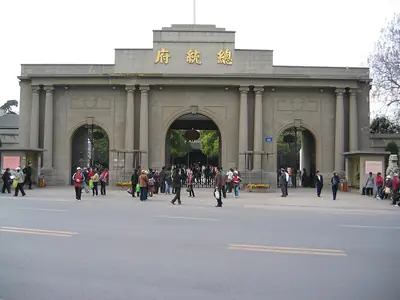
Presidential Palace of Nanjing
The Presidential Palace at 292 Changjiang Road has housed successive governments from a Ming princely residence to the Qing Liangjiang Governor-General’s office, the Taiping Heavenly King’s palace, the provisional Republic of China headquarters (where Sun Yat‑sen took his oath), the National Government of the 1920s‑40s and, after 1949, Jiangsu provincial offices. Since 2003 it operates as the Nanjing China Modern History Sites Museum, preserving one of the city’s largest and best‑preserved architectural complexes.
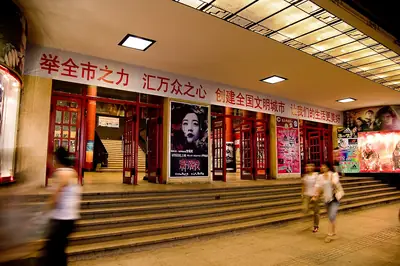
Dahua Cinema
Located in the Qinhuai District near the Xinjiekou commercial area, Dahua Cinema (also Dahua Theater) blends Chinese and Western design in a Republican‑era building. Designed by Yang Tingbao, construction started in 1934 and the theatre opened in 1936 as Nanjing’s largest and most modern venue. After being renamed Dahua Cinema in 1959, it gained municipal heritage status in 1992 and provincial protection in 2002, reopening in 2013 following a restoration that returned its original name.
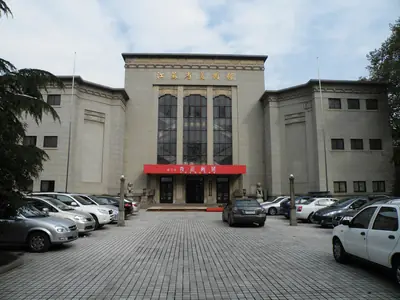
Jiangsu Art Gallery
The Jiangsu Provincial Art Museum on Changjiang Road in Xuanwu District traces its origins to 1936, when it became China’s first state‑level museum. Renamed in 1960, it moved into a 27,449‑square‑metre building designed by the German firm KSP Jürgen Engel Architekten in 2010. As the largest gallery in Jiangsu Province, it displays traditional and contemporary Chinese art under one roof.
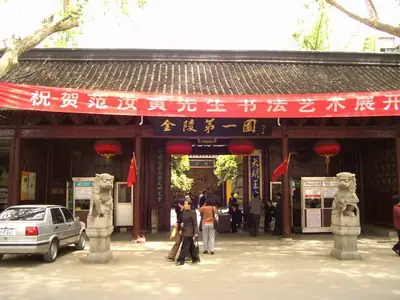
Zhan Garden
Zhan Garden (Zhan Yuan), known as the Garden of Forward Watching, is Nanjing’s oldest surviving private garden and the First Garden of Jinling. Together with Xuyuan it forms one of the city’s two great classical gardens and is a national key cultural heritage monument. Its origins date to the Ming dynasty, when the site was linked to Zhu Yuanzhang’s pre‑imperial residence and later to general Xu Da. The garden was expanded during the Jiajing period, served as a Jiangning provincial office in the Qing era, suffered damage in the Taiping Rebellion and was subsequently restored, including work after 1949.
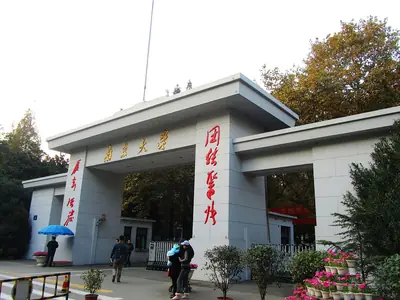
Nanjing University
The Gulou Campus of Nanjing University is part of a broader institution that teaches and researches across Nanjing and Suzhou. Founded in 1902 as Sanjiang Normal School, it evolved through Nanjing Higher Normal School, National Southeastern University and National Central University before adopting its current name in 1950 and merging with the University of Nanking in 1952. Today it is a comprehensive research university with more than twenty schools covering literature, history, philosophy, languages, sciences, medicine, law, business, engineering, architecture and computer science.
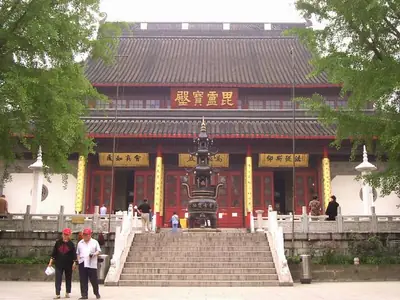
Qixia Temple
Set at the western foot of Qixia Mountain about 22 kilometres northeast of central Nanjing, Qixia Temple is a significant Buddhist monastery whose history reaches back to the Southern and Northern Dynasties. During the Sui and early Tang periods it became associated with the Three Treatises school and was known as Gongde Temple, one of the four great monastic centres of its time. Visitors can see the Sui dynasty Sarira Pagoda on the grounds, the Thousand Buddha Cliff grottoes and the Stele of Ming Zhengjun nearby.
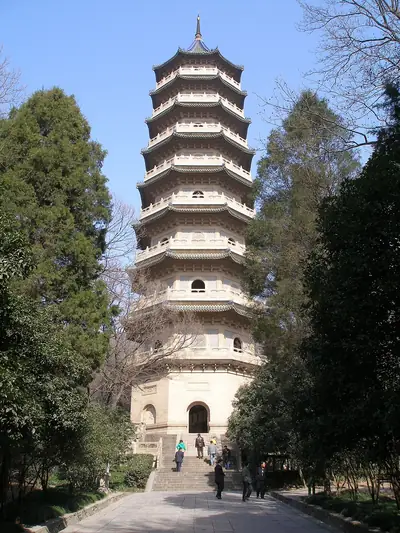
Linggu Temple
Linggu Temple lies on the southeastern slope of Purple Mountain within Linggu Park. Established in 514 by Emperor Wu of Liang to honor the Buddhist master Baozhi, it has borne several names over the centuries. The Hongwu Emperor moved the monastery to its present site in 1381 to make way for the Ming Xiaoling Mausoleum, creating Linggu Zen Temple. Much of the original complex was destroyed in mid‑Qing conflicts with the Taiping Army, rebuilt on a smaller scale during the Tongzhi era, and later its former grounds were used for a National Revolutionary Army cemetery in 1928.
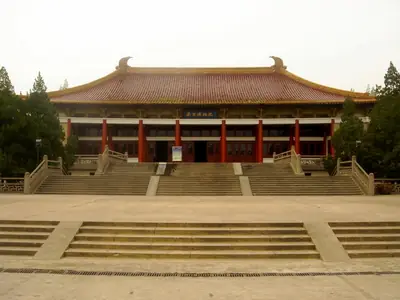
Nanjing Museum
Located in Banshan Garden inside Zhongshan Gate at the southern foot of Purple Mountain, Nanjing Museum is one of China’s major history and art museums. Covering more than 70,000 square metres, it holds over 400,000 objects, including a world‑class collection of Ming and Qing imperial porcelain. The museum’s origins date to 1933, when the Nationalist government prepared a National Central Museum, the first large modern comprehensive museum built by the Chinese government.
Jinjue Mosque
Also called Jingjue Mosque, this is the largest mosque in Nanjing, situated in the Qinhuai District near Sanshan Street at 28 Shengzhou Road. First built during the Ming dynasty, it is recognized as a Jiangsu provincial cultural heritage site. The complex includes a main prayer hall, a second hall, a gateway, a Moon‑Watching Tower, north and south lecture halls, a stele pavilion and a water room, together occupying about 2,000 square metres within a 4,000‑square‑metre area.
Zifeng Tower
Rising above Gulou Square, Zifeng Tower is a supertall skyscraper that reaches 450 metres with 89 floors. Completed in 2010, it was developed by Shanghai Greenland Group and the Nanjing State‑owned Assets Group and designed by Skidmore, Owings and Merrill under Adrian Smith. Its mixed‑use layout contains offices, retail, the Nanjing Greenland InterContinental Hotel, restaurants and a public observatory in the upper floors. After being topped out in September 2008 it became the tallest building in China and remains the tallest in Nanjing and Jiangsu Province.
Sun Yat‑sen Mausoleum
On the southern slope of Purple Mountain, the Sun Yat‑sen Mausoleum (Zhongshan Ling) honours the founder of the Republic of China. Construction began in January 1926 after Sun Yat‑sen’s death in Beijing, the main buildings were finished in spring 1929 and his remains were interred on 1 June 1929; the project was completed by 1931. Architect Lü Yanzhi gave the complex the shape of a warning bell, arranging the archway, entrance gate, stele pavilion and sacrificial hall along the mountainside. Traditional Chinese mausoleum planning provides the symmetry, central axis, pathway and steps, while broad greenery links the structures to the mountain behind them.
Memorial Hall of the Victims in Nanjing Massacre by Japanese Invaders
Known locally as the Jiangdongmen Memorial Hall, this museum in southwestern Nanjing stands near a burial ground for thousands of victims of the 1937 Nanjing Massacre. Established by the Nanjing Municipal Government in 1985 and expanded in 1995 and 2005, its grounds now cover about 74,000 square metres, featuring exhibition areas, a remembrance site, a peace park and spaces for collections and exchange. The displays include artefacts, human remains and historical documents that bear witness to the atrocities.
Ming Xiaoling Mausoleum
The Ming Xiaoling Mausoleum, the tomb of the Hongwu Emperor Zhu Yuanzhang and his empress Ma, sits at the southern foot of Purple Mountain. Construction started in 1381 during the emperor’s lifetime and finished in 1405 under his son, the Yongle Emperor, involving roughly 100,000 labourers. Its original enclosing wall stretched more than 22.5 kilometres and was guarded by 5,000 troops. Named “Xiaoling” after Empress Ma’s posthumous title Xiaoci, the mausoleum’s layout and stone carvings represent the pinnacle of early Ming architecture and served as a model for imperial tombs for the next five hundred years.
Nanjing Massacre Mass Graves
This memorial site preserves the memory of Chinese soldiers and civilians killed during the 1937 Nanjing Massacre. Known in Chinese as 侵华日军南京大屠杀死难同胞丛葬地, it comprises nineteen mass burial locations, including Jiangdong Gate and the Shangxin River, and serves as a place of remorse and reflection.
Jizhaoying Mosque
Also written as 吉兆营清真寺 (Jízhàoyíng Qīngzhēnsì), this place of worship is located in Nanjing’s Xuanwu District. It continues to serve the local Muslim community while reflecting the city’s long Islamic heritage.
Explore with Neywo
Neywo provides a free audio guide for Nanjing that includes 46 narrated places. The platform offers 4 walking tours, 1 bus route and 1 bike route:
- Republican Nanjing: Presidents, Cinemas and Peace Talks – 3.15 km, 101 min, 7 stops (Dahua Cinema, Cathedral of the Immaculate Conception, 南京新百, Deji Art Museum, Jiangsu Art Gallery, Presidential Palace of Nanjing, Memorial of Meiyuan Xincun)
- Qinhuai River: Gardens, Exams and a Porcelain Tower – 5.41 km, 113 min, 6 stops (Porcelain Tower of Nanjing, Nanjing City Wall Museum, Zhan Garden, Jinjue Mosque, Jiangnan Examination Hall, 圣保罗堂)
- Sun Yat‑sen’s Hillside: Mausoleum, Memorial Hall and Linggu Temple – 4.99 km, 104 min, 6 stops (Ming Xiaoling, Sun Yat‑sen Mausoleum, Sun Yat‑sen Mausoleum Music Stage, Sun Zhongshan ji nian guan, National Revolutionary Army Memorial Cemetery, Linggu Temple)
- Gulou: Supertall Tower, Campus and Churches – 4.57 km, 98 min, 4 stops (Zifeng Tower, Nanjing University, Christ’s Church, Nanjing, 侵华日军宪兵司令部旧址)
- Bus 163: Presidential Palace, Art Gallery and Nanjing Museum – 6.8 km, 29 min, 4 stops (Memorial of Meiyuan Xincun, Presidential Palace of Nanjing, Jiangsu Art Gallery, Nanjing Museum)
- Republican Nanjing by Bike: Cathedral to the Presidential Palace – 1.8 km, 9 min, 3 stops (Cathedral of the Immaculate Conception, 南京新百, Presidential Palace of Nanjing)
Each story plays automatically as you reach the location, letting you move at your own pace with no group and no schedule. Narration is available in 11 languages, so you can enjoy the guide in the language that suits you best.
To start exploring, download the Neywo app, select Nanjing, and choose any of the tours above—or wander freely and let the audio guide reveal the stories behind each place you encounter.
Places with an audio guide in Nanjing
8 places in Nanjing with a Neywo audio guide. Each one starts telling its story as you reach it.
Self-guided tours in Nanjing
5 tours in Nanjing, free in the Neywo app. Each stop tells its story as you reach it.
- Bike ride
Republican Nanjing by Bike: Cathedral to the Presidential Palace
A short ride on the city's cycle lanes through Xinjiekou: from the Shigu Road cathedral past the Xinjiekou department store to the gates of the Presidential Palace.
Cathedral of the Immaculate Conception · Presidential Palace of Nanjing
Open this tour: Republican Nanjing by Bike: Cathedral to the Presidential Palace - Bus ride
Bus 163: Presidential Palace, Art Gallery and Nanjing Museum
A city bus (line 163) that runs through Nanjing's Republican quarter. Ride it past Meiyuan Xincun, the Presidential Palace and the Jiangsu Art Gallery to the Nanjing Museum.
Memorial of Meiyuan Xincun · Presidential Palace of Nanjing · Jiangsu Art Gallery · Nanjing Museum
Open this tour: Bus 163: Presidential Palace, Art Gallery and Nanjing Museum - Walk
Republican Nanjing: Presidents, Cinemas and Peace Talks
For a decade Nanjing was the capital of the Republic of China, and this walk follows that era through the city centre. See an Art Deco cinema from 1936 and the Catholic cathedral, pass the Xinjiekou department store, then walk to the Presidential Palace where Sun Yat-sen took his oath in 1912. It ends at Meiyuan Xincun, where Zhou Enlai's delegation negotiated in 1946.
Dahua Cinema · Cathedral of the Immaculate Conception · Deji Art Museum · Jiangsu Art Gallery · Presidential Palace of Nanjing · Memorial of Meiyuan Xincun
Open this tour: Republican Nanjing: Presidents, Cinemas and Peace Talks - Walk
Qinhuai River: Gardens, Exams and a Porcelain Tower
Walk the old south of Nanjing from the rebuilt Porcelain Tower to the glass-walled City Wall Museum beside Zhonghua Gate. Visit the Ming-era Zhan Garden, the city's largest mosque and the vast hall where imperial examinations were held, and finish at a Gothic Revival church with a Chinese timber frame.
Porcelain Tower of Nanjing · Nanjing City Wall Museum · Zhan Garden · Jinjue Mosque · Jiangnan Examination Hall
Open this tour: Qinhuai River: Gardens, Exams and a Porcelain Tower - Walk
Sun Yat-sen's Hillside: Mausoleum, Memorial Hall and Linggu Temple
Start at the tomb of the Hongwu Emperor, founder of the Ming dynasty. Climb Purple Mountain's southern slope to the tomb of Sun Yat-sen, laid out in the shape of a warning bell. Continue to the open-air music stage and memorial hall, then finish at the National Revolutionary Army cemetery and the Ming-era Linggu Temple with its beamless brick hall.
Ming Xiaoling · Sun Yat-sen Mausoleum · Sun Yat-sen Mausoleum Music Stage · Sun Zhongshan ji nian guan · National Revolutionary Army Memorial Cemetery · Linggu Temple
Open this tour: Sun Yat-sen's Hillside: Mausoleum, Memorial Hall and Linggu Temple
Walk Nanjing with Neywo
Neywo turns Nanjing into a self-guided audio tour. Stories arrive as you reach the place they belong to, and the route reshapes when you wander off it.