Things to Do in Hangzhou, China: Walking Guide
Things to do in Hangzhou
Hangzhou is a city in eastern China celebrated for West Lake, historic temples, and the Grand Canal, offering a blend of natural beauty and cultural heritage worth exploring. Neywo provides a free audio guide for Hangzhou with 47 narrated places.
Explore Hangzhou’s highlights
Ten Scenes of West Lake (Old Ten Scenes)
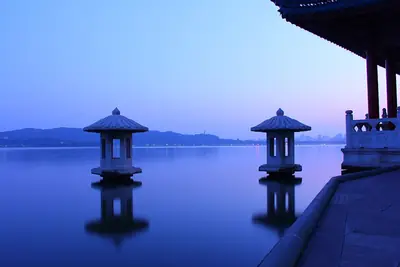
The shores of West Lake are framed by ten celebrated views known as the Ten Scenes of West Lake. Their poetic names—Spring Dawn at Su Causeway, Lotus in the Breeze at Crooked Courtyard, Autumn Moon over the Calm Lake, Lingering Snow on the Broken Bridge, Viewing Fish at Flower Harbor, Evening Bell Ringing at Nanping Hill, Twin Peaks Piercing the Clouds, Leifeng Pagoda in the Evening Glow, Three Pools Mirroring the Moon, and Orioles Singing in the Willows—first appeared during the Southern Song period. Over time the list expanded to eighteen and even twenty‑four views, but the original ten remained the most famous. In 1985 Hangzhou institutions selected a new group called the New Ten Scenes of West Lake, while the earlier set became known as the Old Ten Scenes.
Stone Pillars of Brahma Temple
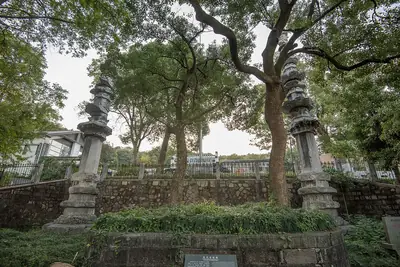
A pair of richly carved stone pillars stands at the eastern foot of Phoenix Mountain along Brahma Temple Road in Shangcheng District. Built in 965 during the Northern Song period when Qian Chu, king of the Wuyue Kingdom, rebuilt the Southern Pagoda Temple, each pillar rises 15.76 metres and has an eight‑sided shaft covered with fine carvings. The two pillars are a little over ten metres apart and are among the surviving remains of the former Brahma Temple, also called the Dharani Pillars of Fantian Temple.
Zhakou White Pagoda
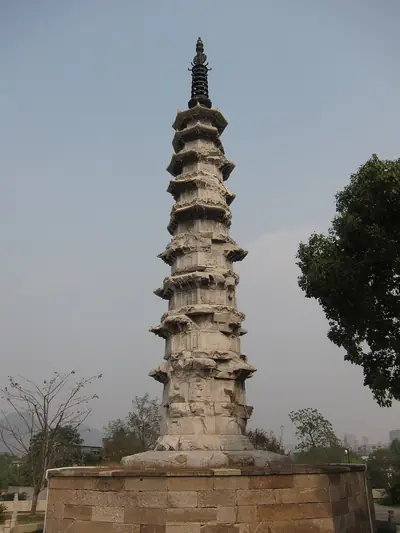
Beside the Qiantang River in White Pagoda Park stands the Zhakou White Pagoda, a stone tower that imitates the appearance of a wooden structure. Its exact date of construction is unknown, but architectural style and surviving records suggest it was built between the Five Dynasties period and the Northern Song period. The pagoda is fourteen metres high, has nine levels in an octagonal pavilion‑style design, and every level bears carved images or Buddhist scriptures. Centuries of weathering have eroded parts of the stone, adding to the sense of its long history.
Grand Canal
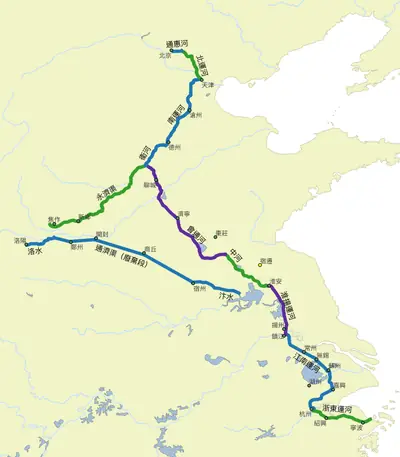
Hangzhou lies at the southern end of the Grand Canal, the world’s longest artificial waterway. The main Jing‑Hang Grand Canal stretches about 1,776 kilometres, linking Hangzhou with Beijing. From Hangzhou the Jiangnan Canal begins at the Qiantang River and continues through Jiaxing, Suzhou, and Wuxi toward the Yangtze. The canal’s origins date to the early fifth century BC, when sections were built to supply the states of Wu and Yue. It was later expanded under Emperor Yang of Sui, connecting the fertile south with Luoyang and the northern frontier. Successive dynasties restored and improved it despite floods, wars, and rebellions. In the tenth century the Song engineer Qiao Weiyue invented the pound lock, allowing ships to navigate changes in elevation.
Cathedral of the Immaculate Conception
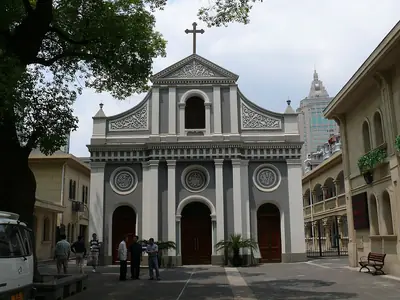
Near Wulin Square stands the Cathedral of the Immaculate Conception, a historic Roman Catholic cathedral at 415 Zhongshan Road North. It serves as the cathedral of the Catholic Diocese of Hangzhou and is a notable landmark in the city’s downtown area.
严州城墙 (Yan Prefecture old city wall)
In Meicheng Town, Jiande City, a surviving section of the southern stretch of Yan Prefecture’s old city wall remains along the river. Most of the wall has disappeared, but this fragment offers a glimpse of the historic prefecture that once stood here. The area was also the seat of Jiande County within the former prefecture, and in 2010 the ruins were recognized as a Jiande municipal cultural relic protection site.
Qiantang River
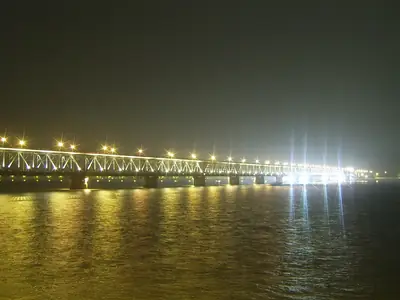
The Qiantang River flows from the Huangshan area through Anhui and Zhejiang, passing Hangzhou before reaching Hangzhou Bay. It is famed for its tidal bore, where the incoming tide surges against the river’s current to create the spectacular “Silver Dragon.” In Chinese tradition the Qiantang River tide is celebrated as the finest tide under heaven. The river has borne several historical names—Zhejiang, Zhe River, Zhi River—with the name Zhe River giving Zhejiang Province its name. During the Sui dynasty the river was linked to the Yangtze by the Grand Canal, forming an important commercial route.
West Lake
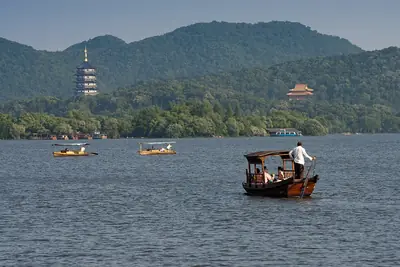
West Lake (Xihu) is a freshwater lake beside the city’s former walled centre, encircled by gentle hills on three sides. Covering about 6.39 square kilometres, it stretches roughly 3.2 kilometres north‑south and 2.8 kilometres east‑west, with a shoreline circuit of nearly 15 kilometres. The lake’s landscape is traditionally described as one mountain, two pagodas, three islands, four causeways, and five lakes. Gushan is the largest natural island; three small artificial islands lie in Outer West Lake, while the Bai, Su, and Yanggong causeways cross or divide the water. The Leifeng and Baochu pagodas face each other across the lake. West Lake has attracted visitors since the Tang dynasty and became a major cultural landmark when the Southern Song capital moved to Hangzhou during the Song dynasty.
Wu Chinese
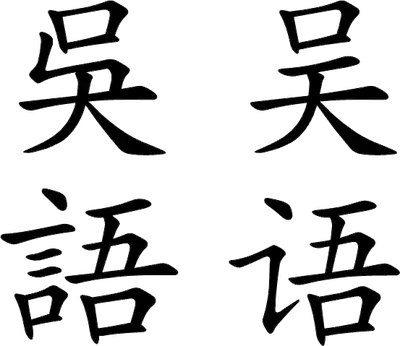
Hangzhou lies in a region where Wu Chinese (Wu语 or Wúyǔ) has deep roots. This major language group is associated with Shanghai, most of Zhejiang, and parts of Jiangsu and neighbouring areas. Many Wu varieties preserve voiced initial sounds from medieval Chinese and often retain a checked tone marked by a glottal stop. Their sound systems may include eight tones, because the traditional four tones are split into two groups, although some varieties have fewer or more. Wu also has its own patterns of tone changes, vocabulary, and grammar. In the Ming and Qing periods Suzhou speech served as a widely used shared form of Wu; after Shanghai opened in the nineteenth century Shanghainese gradually replaced it as the most influential variety. Suzhou speech is traditionally described as gentle to the ears, reflected in the expression “the tender speech of Wu.” The language has a literary presence, notably in the novel The Sing‑song Girls of Shanghai, which was written in Wu.
Zhejiang
Zhejiang is a coastal province in eastern China whose capital is Hangzhou. Shaped by mountains, rivers, islands, trade, and a dynamic economy, its territory was once controlled by the Kingdom of Yue during the Spring and Autumn period before being annexed by the Qin dynasty in 222 BC. In the late Ming and Qing periods its ports became important centres of international trade. Besides Hangzhou, the province includes major cities such as Ningbo, Yiwu, and Wenzhou. Wu Chinese is spoken throughout Zhejiang, and the province ranks among China’s leading centres for research and education.
Zhejiang University
Zhejiang University (ZJU or Zheda) is a public, comprehensive research university affiliated with China’s Ministry of Education. Its origins trace to 1897 when Hangzhou official Lin Qi founded Qiushi Academy. After several changes the institution was rebuilt on the former academy site in 1927 as National Third Chung Shan University and renamed National Chekiang University the following year. In 1952 it was reorganized as an engineering‑focused institution, and its present comprehensive form emerged in 1998 when it merged with Zhejiang Medical University, Hangzhou University, and Zhejiang Agricultural University. Today the university has seven campuses—Zijin’gang, Yuquan, Xixi, Huajiachi, Zhijiang, Zhoushan, and Haining—and combines undergraduate and graduate education with research, affiliated hospitals, a museum, and international joint institutes.
Hangzhou Xiaoshan International Airport
Hangzhou Xiaoshan International Airport (codes HGH and ZSHC) lies in Xiaoshan District, outside the city centre, and is one of the major airports serving Zhejiang Province and the Yangtze River Delta. The airport has four terminals: Terminals 1 and 3 handle domestic flights, Terminal 2 serves international and regional flights, and Terminal 4 manages international, regional, and selected domestic services. Designed by the architecture firm Aedas, Terminal 4 opened on 8 September 2022, adding capacity as passenger traffic continued to grow.
Liangzhu culture
More than five thousand years ago the Liangzhu culture flourished around the Taihu Lake area, leaving over five hundred known sites. Its central area was near Mojiao Mountain at the Liangzhu site in northwestern Hangzhou. Jade is the culture’s most distinctive symbol: large jade cong, jade bi discs, and jade axes were placed in burials. The cong, often carved with a refined animal‑face design, was associated with divine power, while the axe represented military and royal authority. These objects show how ritual and status structured Liangzhu society, which could organise large workforces to build ritual places, walls, and raised earth structures for flood control. Political groups were organised as chiefdoms, some scholars considering them an early form of state. Alliances linked different centres, and religion played a powerful role in public life. The culture eventually ended when its chiefdoms or possible early state broke apart, agriculture declined, and jade production ceased.
Deshou Palace
The remains of a Song‑era palace have been brought back into view at Deshou Palace. Today the site hosts a museum and tourist attraction dedicated to this important part of Hangzhou’s past. The palace ruins are part of the remains of Lin’an, the Southern Song capital, and lie north of the Southern Song palace complex. The site began as the residence of Qin Hui and later became a palace for Emperors Gaozong and Xiaozong after they abdicated the throne. For a time it was known as the Northern Inner Palace.
Leifeng Pagoda
On the southern shore of West Lake, Leifeng Pagoda rises above Sunset Hill. This five‑story, eight‑sided tower is one of Hangzhou’s most recognisable landmarks, blending a long Buddhist history with famous legends and lake views. The current structure was rebuilt in 2002 on the site of the original pagoda, which was erected in 975 by Qian Chu, King of Wuyue, as a Buddhist merit tower for enshrining relics. The original tower stood until 1924, when it collapsed, leaving only the site. The rebuilt pagoda continues the tradition of names linked to imperial consorts, such as Huangfei Pagoda and Wangfei Pagoda. One story says it was built to celebrate the birth of a child to Qian Chu’s favoured consort Huang; another says it was raised to honour Buddhist relics. The pagoda is especially known from the Legend of the White Snake, where Fahai suppresses Bai Suzhen beneath its shadow. At sunset the tower’s silhouette against the lake remains a beloved sight.
More to see in Hangzhou
Beyond the sites above, Hangzhou offers additional attractions that enrich any visit. Guo Zhuang presents a peaceful retreat where balanced planting, architecture, and water highlight the refined relationship between gardens and their natural surroundings. Lingyin Temple is especially renowned as an active Buddhist sanctuary set amid wooded hills. Yue Fei Temple honours the celebrated general and provides insight into Southern Song military history. The Hangzhou Botanical Garden showcases a diverse collection of plants from across China and beyond. The China Seal Museum displays the art and history of seal carving, a traditional Chinese craft. Finally, Zhejiang’s art institutions—including galleries and academies—offer exhibitions that reflect the province’s vibrant creative scene.
Explore Hangzhou with Neywo
Neywo’s free audio guide turns a walk through Hangzhou into a self‑guided discovery. The app offers four walking tours and one bike route:
- West Lake’s Southern Shore: Poets, Pagodas and Silk – 4.86 km, about 101 minutes, 5 stops
- Wushan Hill and the Song Capital – 5.09 km, about 108 minutes, 7 stops
- Phoenix Mountain: a river pagoda, Song kilns and carved pillars – 4.64 km, about 92 minutes, 4 stops
- Canal, church and mosque: Hangzhou’s east side – 5.36 km, about 97 minutes, 4 stops
- West Lake by bike: from Nanshan Road to Gushan – 6.4 km, about 32 minutes, 6 stops
Each tour provides narrated stories that play automatically as you reach each place, allowing you to go at your own pace with no group and no schedule. Narration is available in 11 languages. Simply download Neywo, select a tour, and let the city’s history, scenery, and culture unfold step by step.
Places with an audio guide in Hangzhou
8 places in Hangzhou with a Neywo audio guide. Each one starts telling its story as you reach it.
Self-guided tours in Hangzhou
3 tours in Hangzhou, free in the Neywo app. Each stop tells its story as you reach it.
- Bike ride
West Lake by bike: from Nanshan Road to Gushan
Ride a loop of the lake on the quiet shore roads, with a public bicycle if you like: the West Lake Museum and the CAA Art Museum on the eastern shore, the Silk Museum and Leifeng Pagoda on the south, then west to the Ten Scenes and the Zhejiang Provincial Museum on Gushan. Push your bike on the Su and Bai causeways at busy times.
West Lake Museum · CAA Art Museum · China National Silk Museum · Leifeng Pagoda · Ten Scenes of West Lake · Zhejiang Provincial Museum
Open this tour: West Lake by bike: from Nanshan Road to Gushan - Walk
West Lake's Southern Shore: Poets, Pagodas and Silk
Start at the lake's great museum on Gushan Island, then follow the shore where ten poetic views were named by Song dynasty scholars. Finish below Leifeng Pagoda, home of the White Snake legend, and at the world's largest silk museum.
Zhejiang Provincial Museum · Ten Scenes of West Lake · West Lake · Leifeng Pagoda · China National Silk Museum
Open this tour: West Lake's Southern Shore: Poets, Pagodas and Silk - Walk
Wushan Hill and the Song Capital
Start under Leifeng Pagoda, then follow Nanshan Road along the lake to art and lake museums, a 150-year-old pharmacy still filling prescriptions, the ruins of a Southern Song palace and a mosque whose prayer hall dates from 1281.
Leifeng Pagoda · CAA Art Museum · West Lake Museum · China Finance & Taxation Museum · Hu Qing Yu Tang · Deshou Palace …
Open this tour: Wushan Hill and the Song Capital
Walk Hangzhou with Neywo
Neywo turns Hangzhou into a self-guided audio tour. Stories arrive as you reach the place they belong to, and the route reshapes when you wander off it.

