Grenoble, France: Self-Guided Walking Tour
Things to do in Grenoble: history, museums and Alpine landmarks
Grenoble is a French city in Auvergne-Rhône-Alpes, surrounded by the Alps and shaped by the Isère River. The best things to do in Grenoble range from exploring archaeological remains and historic churches to discovering literary landmarks, covered markets and the Bastille. Neywo offers a free audio guide for Grenoble with 101 narrated places, so you can learn the story of the city as you explore it.
What to see in Grenoble
Grenoble’s historic centre and riverside districts bring together nearly two thousand years of history. These are some of the places that best reveal the city’s character.
Grenoble Archaeological Museum
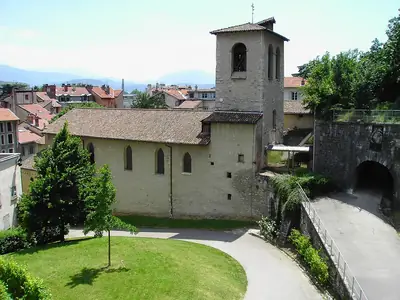
At the foot of the Bastille, beside the Isère, the Grenoble Archaeological Museum occupies the former Saint-Laurent church. The site preserves almost two thousand years of religious and funerary history, beginning with a Gallo-Roman necropolis.
Beneath and around the church, successive buildings reveal changing practices from the fourth to the nineteenth century. The architectural highlight is the Saint-Oyand crypt, a rare sixth-century early medieval monument. Early Christian mausoleums and Romanesque elements complete the layered history of the complex.
Musée dauphinois
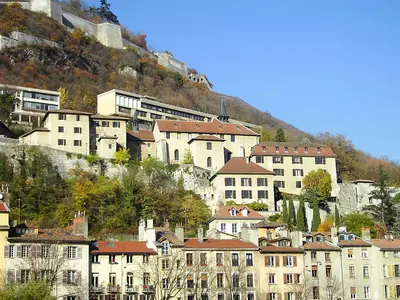
The Musée dauphinois occupies the former Sainte-Marie-d’en-Haut convent on the slopes of the Bastille, above the Saint-Laurent neighbourhood. Its cloisters and chapel are classified as a Historic Monument, and the setting provides views over Grenoble’s old town and the Isère River.
The building has served as a religious school, prison, military barracks and private residence. Founded in 1906, the museum explores the history of the former province of Dauphiné, including rural mountain life in its permanent exhibition, Gens de l’Alpe.
Museum of the Old Archbishopric
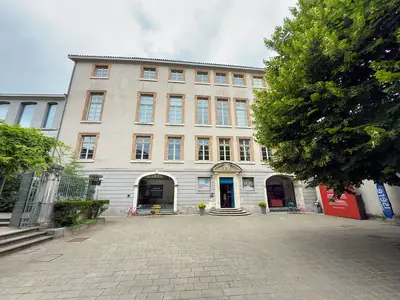
In Grenoble’s historic heart, the Museum of the Old Archbishopric occupies the former bishop’s palace, a protected Historic Monument. Ancient stone vaults and staircases are combined with contemporary exhibition spaces.
The basement contains one of the museum’s most important features: a restored fourth-century early Christian baptistery. Nearby sections of the Gallo-Roman wall show the city’s religious and defensive foundations side by side. The upper floors house the permanent exhibition Isère in History.
Grenoble Cathedral
Grenoble Cathedral, or Cathédrale Notre-Dame, forms part of a wider religious complex rather than standing alone. Historic homes are attached directly to it, and the adjoining Saint-Hugues church communicates with the cathedral.
Construction began as early as the tenth century, while the present cathedral and Saint-Hugues church were rebuilt in the mid-thirteenth century. Look for the Romanesque portal dating from around 1140, the Saxon pillar and the massive porch tower. The cathedral has been protected as a historic monument since 1862.
Collegiate Church of Saint-André
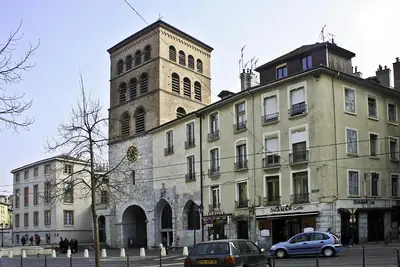
Facing the former Palace of the Parliament of the Dauphiné on Place Saint-André, the Collegiate Church of Saint-André was begun in 1228 as the private chapel of the Dauphins. Its 56-metre bell tower was Grenoble’s tallest building until the late nineteenth century.
The church is a notable example of thirteenth-century Lombard Gothic architecture, built mainly in brick. Its Gothic spire was completed in 1331, while the tower later took on a civic role by housing Grenoble’s first public clock in 1398.
House of Doctor Gagnon and the birthplace of Stendhal
Grenoble has a strong connection with Henri Beyle, better known as the writer Stendhal. The House of Doctor Gagnon, also called the Stendhal Museum, is where he spent his childhood from 1790 to 1796. The sixteenth- and seventeenth-century residence presents his family and social world through spaces including an Italian-style living room, a natural history cabinet, a study and a terrace overlooking the Jardin de Ville.
Nearby, on rue Jean-Jacques Rousseau, is Stendhal’s birthplace. Henri Beyle was born there on January 23, 1783, on the second floor of the town house. The apartment, façades, roof and stairwell have been protected as historic monuments since 2000, although interior visits are limited to special occasions.
Halle Sainte-Claire
Halle Sainte-Claire is a covered market and one of the architectural landmarks of Grenoble’s historic centre. A market began on the site of a former fifteenth-century convent in 1825, while the present building was completed in 1874.
Its cast-iron framework, brick walls and decorative details reflect the influence of the Paris market halls associated with the Baltard style. Look for the mascarons, iron arches, cast-iron friezes, roof lantern and the stylised dolphin on the fountain.
The Lion and Serpent Fountain
On Place de la Cymaise in the Saint-Laurent district, the Lion and Serpent Fountain represents Grenoble as a lion holding a snake. The snake symbolises the Isère River.
Created by Grenoble sculptor Victor Sappey and inaugurated on November 18, 1843, the fountain combines bronze with Sassenage stone. It is one of the city’s oldest fountains and a distinctive landmark beside the river.
Porte de France
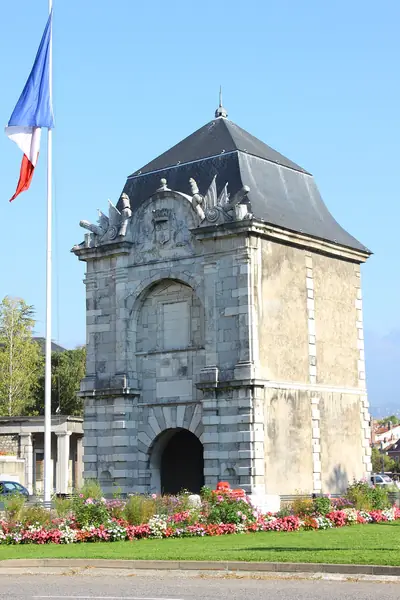
The Porte de France marks the historic western entrance to Grenoble, beside the Esplanade. This stone gateway was erected in 1620 as part of the new fortifications ordered by the Duke of Lesdiguières to protect the Bastille hill above the city.
Perret Tower
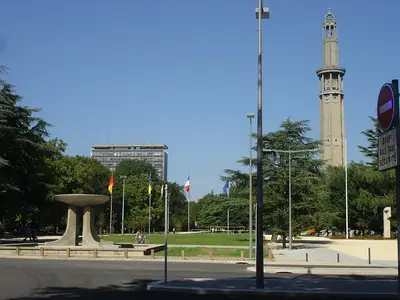
In Paul Mistral Park, the Perret Tower rises above the trees as a slender reinforced-concrete landmark. Completed in 1924, it was the first tower in Europe built entirely of reinforced concrete.
Originally called La tour pour regarder les montagnes—the tower for looking at the mountains—it served as the orientation tower and symbol of the 1925 International Exhibition of Hydropower and Tourism. It is the only surviving remnant of that fair. After closing in 1965 because of deterioration, it reopened in July 2026 following a restoration project that ran from 2022 to 2026.
More historic churches and cultural buildings
Several other places add depth to a walk through Grenoble:
- Saint-Louis Church follows the simple form of classical French architecture and contains an eighteenth-century high altar, paintings by Brother André and a distinctive entrance oculus combining stained glass with the church clock.
- Basilique Saint-Joseph de Grenoble, on Place de Metz, is an early twentieth-century basilica with a 38-metre spire.
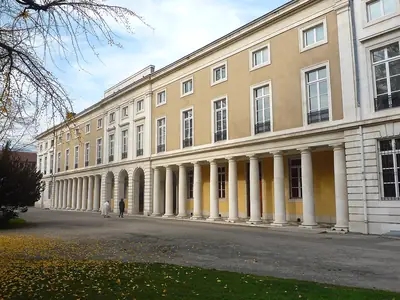
- Ancien musée-bibliothèque de Grenoble, on Place de Verdun, opened in 1870 as a shared home for the municipal library and museum. The library remained there until 1970, while the Museum of Grenoble’s collections stayed until 1992.
- Muséum d’histoire naturelle occupies a registered historic monument and houses Grenoble’s natural history collections.
Grenoble is part of a region with several contrasting destinations, including Lyon, Annecy and Chamonix.
Explore Grenoble with Neywo
Download Neywo and explore Grenoble with four walking tours, one bus route and one bike route. The four walks range from 1.46 to 2.62 km and last between 75 and 94 minutes, with 8 to 12 narrated stops each. The bus route covers 2.2 km in 9 minutes with 5 stops, while the bike route covers 1.2 km in 6 minutes with 5 stops.
Choose a walk focused on Stendhal’s Grenoble, the bishops and museums along the Isère, the Saint-Laurent district and the Bastille, or Grenoble’s concrete architecture and parks. Each story plays as you reach the place, at your own pace: no group and no schedule. Narration is available in 11 languages.
Places with an audio guide in Grenoble
8 places in Grenoble with a Neywo audio guide. Each one starts telling its story as you reach it.
Self-guided tours in Grenoble
6 tours in Grenoble, free in the Neywo app. Each stop tells its story as you reach it.
- Bike ride
Grenoble by the Isère: A Riverside Roll
A short, flat ride along the quays of the Isère, from the 1620 Porte de France to the 1615 Porte Saint-Laurent, with the stone bridge and the old footbridge on the way.
Porte de France · Pont Marius Gontard · Passerelle Saint Laurent · Tour de l'Isle · Porte Saint-Laurent
Open this tour: Grenoble by the Isère: A Riverside Roll - Bus ride
Bus 261 Along the Isere Quays
A regional bus that follows Grenoble's riverside, passing the 1620 Porte de France, two old bridges and the entrance to the Musee de Grenoble before reaching the Ile Verte district. A cheap way to see the Isere waterfront.
Porte de France · Pont Marius Gontard · Passerelle Saint Laurent · Place de Lavalette · Église Saint-Luc de Grenoble
Open this tour: Bus 261 Along the Isere Quays - Walk
Stendhal's Grenoble: Tiles, Turrets and a Novelist's Boyhood
Wander from the belle-epoque Place Victor Hugo into the old town where Henri Beyle, the future Stendhal, was born and raised. Pass his birthplace and his grandfather's apartment, the Parliament of the Dauphine whose defiance sparked the Day of the Tiles, Bayard's statue and Saint-Andre's Gothic spire, and end at the iron-framed market hall.
Place Victor Hugo · Saint-Louis Church, Grenoble · Rue Félix-Poulat · Place Grenette · Birthplace of Stendhal · House of Doctor Gagnon …
Open this tour: Stendhal's Grenoble: Tiles, Turrets and a Novelist's Boyhood - Walk
Bishops, Saints and Fine Art on the Isère
From the old Museum-Library on Place de Verdun, follow Grenoble's religious and artistic memory: two convents, a chapel, a cathedral begun in the tenth century, a bishop's palace with a fourth-century baptistery and one of Europe's great art museums. End beside the river at the crypts of Saint-Laurent and a gate built in 1615.
Ancien musée-bibliothèque de Grenoble · Couvent Sainte-Cécile de Grenoble · Chapelle Sainte-Marie-d'en-Bas · Grenoble Cathedral · Museum of the Old Archbishopric · Couvent des Minimes de Grenoble …
Open this tour: Bishops, Saints and Fine Art on the Isère - Walk
Saint-Laurent and the Bastille: Lions, Bridges and a Mountain Fortress
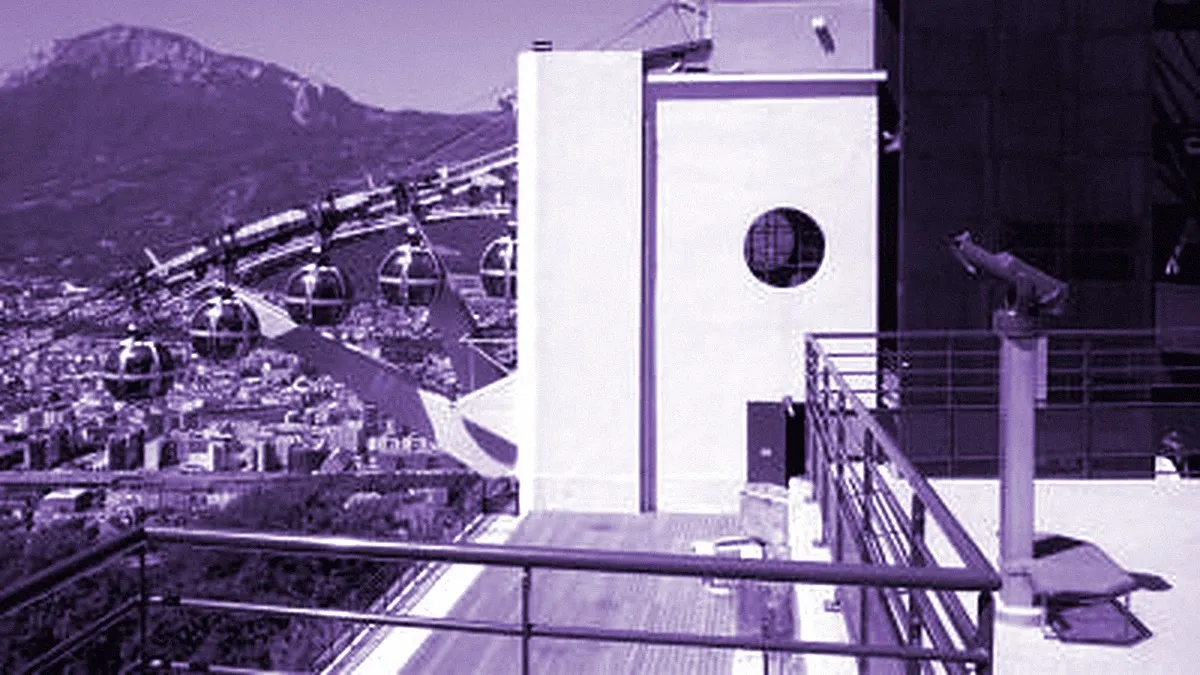
Cross the Isère from the 1620 Porte de France and the old stone bridge, past an 18th-century theatre and the wooden-bridge footbridge, to the lion and serpent fountain of Saint-Laurent. Then ride the Bubbles up to the Bastille fortress.
Porte de France · Pont Marius Gontard · Théâtre Municipal de Grenoble · Passerelle Saint Laurent · The Lion and Serpent fountain · Musée dauphinois …
Open this tour: Saint-Laurent and the Bastille: Lions, Bridges and a Mountain Fortress - Walk
Concrete, Resistance and a Park: Saint-Joseph to the Perret Tower
South-east of the old town, Grenoble shows its modern face: a basilica where Abbe Pierre once served, the museum of the Resistance in the Isere, a natural history museum, and the 95-metre Perret Tower, Europe's first all-reinforced-concrete tower, rising above Paul Mistral Park.
Basilique Saint-Joseph de Grenoble · Place de Verdun · Temple de l'église réformée de Grenoble · Musée de la Résistance et de la Déportation à Grenoble · Notre-Dame Réconciliatrice · Muséum d'histoire naturelle …
Open this tour: Concrete, Resistance and a Park: Saint-Joseph to the Perret Tower
Walk Grenoble with Neywo
Neywo turns Grenoble into a self-guided audio tour. Stories arrive as you reach the place they belong to, and the route reshapes when you wander off it.

