What to See in Rennes, France: Free Audio Guide
Things to Do in Rennes: What to See in the Historic Centre
Rennes is the capital of Brittany, a city shaped by medieval streets, classical architecture and a long cultural history. Its half-timbered houses, historic churches, market halls and museums make it one of the most rewarding places to explore in Brittany. Neywo has a free audio guide for Rennes with 104 narrated places, so you can discover the city while walking at your own pace.
What to See in Rennes
Rennes Cathedral
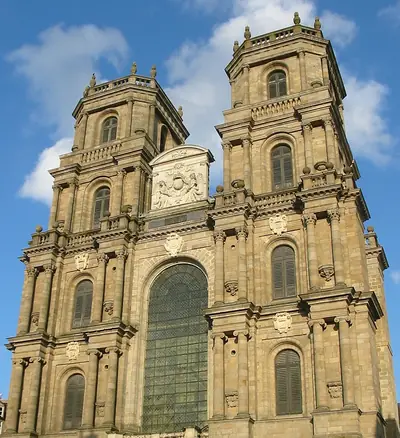
Saint Peter’s Cathedral, or Cathédrale Saint-Pierre, stands in the heart of Rennes. Its imposing granite façade and classical interior reflect centuries of rebuilding. The cathedral’s history reaches back to the sixth century, while the present building was completed in 1845 after successive interruptions and reconstructions.
The façade was built in four stages between the sixteenth and eighteenth centuries, and its two towers rise to 48 metres. Today, the cathedral is the seat of the Archbishop of Rennes, Dol and Saint-Malo, and one of Brittany’s nine historic cathedrals.
The Palace of the Parlement of Brittany
The Palace of the Parlement of Brittany is one of Rennes’ most important heritage buildings. Built in 1655 under the direction of Salomon de Brosse, it became the seat of Brittany’s Parlement, where the province’s nobles defended their rights and privileges.
The building survived the Great Fire of 1720 and has served as a Court of Appeals since 1804. Its interior is especially remarkable: the Great Chamber features a coffered ceiling decorated with painted canvases by Noël Coypel. The palace stands on Parlement Square, close to Town Hall Square.
Place de la Mairie and the Rennes Opera House
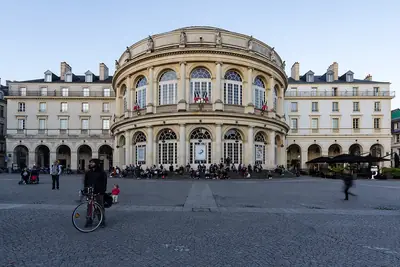
Place de la Mairie brings together two of Rennes’ best-known civic and cultural landmarks: the town hall and the Opéra de Rennes. The opera house occupies the eastern side of the square, directly facing the town hall.
Designed by Charles Millardet and built in the 1830s, it is an Italian-style theatre with a horseshoe-shaped auditorium. Its first performance took place on February 29, 1836. The elegant façade and roof have been protected as historic monuments since 1961, and the entire building was listed in 1975.
Église Saint-Germain
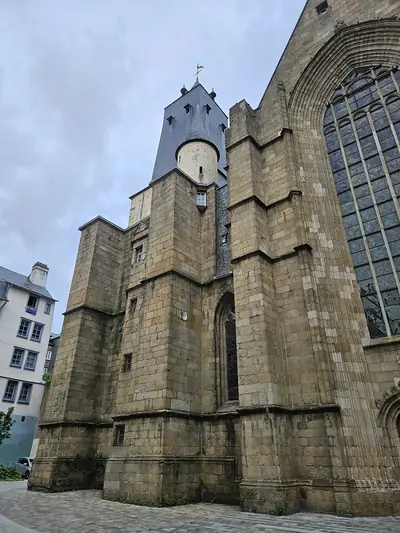
The Église Saint-Germain stands beside Place Saint-Germain in Rennes’ historic new town. Construction lasted from the fifteenth century into the seventeenth, giving the church its flamboyant Gothic character.
Inside, it preserves the oldest stained-glass window in Rennes. Its organ is also considered one of the finest in the city, adding a musical dimension to the church’s architectural history.
Saint George Palace and the Abbey of Saint-Georges
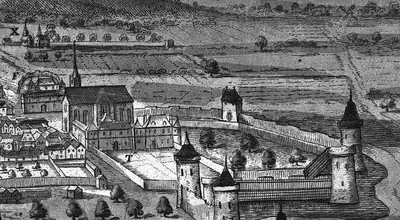
Saint George Palace occupies the site of the former Benedictine Abbey of Saint George, founded between 1024 and 1034 by Alain III, Duke of Brittany. The abbey was established for his sister Adèle, who became its first abbess, and remained a community for women religious until the French Revolution.
The palace was built in 1670 as a replacement for the older abbey residence. Its long gallery is framed by nineteen windows set into granite arches, with a double staircase leading up to it. At each end, a pavilion rises beneath the mansard roof. The façade also preserves the name of the abbess who commissioned the rebuilding in its ironwork.
Hôtel de Blossac
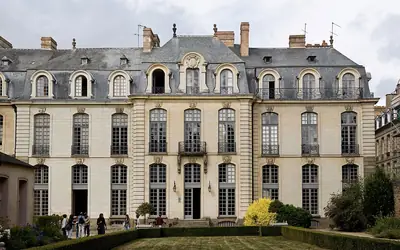
The Hôtel de Blossac is a grand private mansion built in 1728, after the fire that devastated Rennes in 1720. Designed for Louis Gabriel de La Bourdonnaye, Count of Blossac, the building is attributed to the architect Jacques Gabriel.
Two wings frame the central courtyard, while the garden side has a formal façade and entrance staircase. On the courtyard side, a ceremonial staircase combines marble columns and wrought-iron balustrades. A statue of Themis, the goddess of justice, is set into the wall. For almost two centuries, the mansion served as the official residence of the commander-in-chief of Brittany.
Halles Martenot and Place des Lices
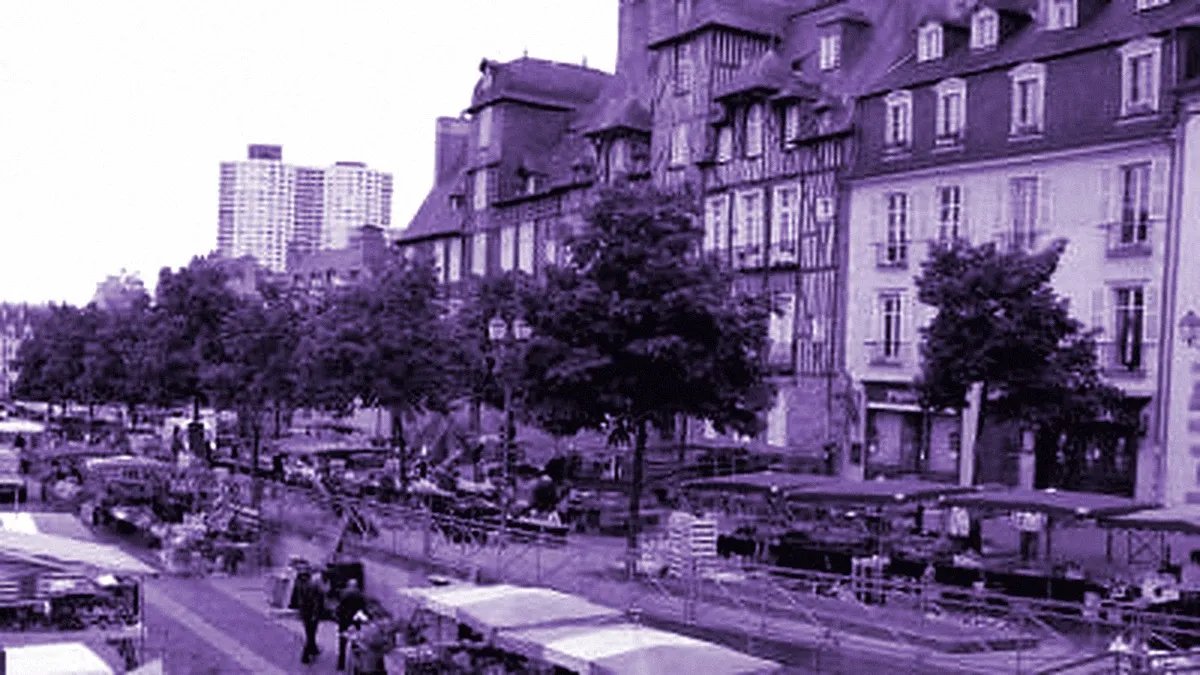
Place des Lices is one of Rennes’ liveliest historic squares. Before it became a market, it was a tournament ground: the name refers to the barriers that separated medieval knights during contests. The site became a market in 1622 and developed into the square seen today in 1658.
The Halles Martenot house the Marché des Lices, one of France’s largest farmers’ markets. Since 1622, producers and artisans have gathered here on Saturday mornings. The two iron-and-brick market halls have stood on the square for more than a century and a half, continuing a tradition closely associated with daily life in Rennes.
Notre-Dame-en-Saint-Melaine
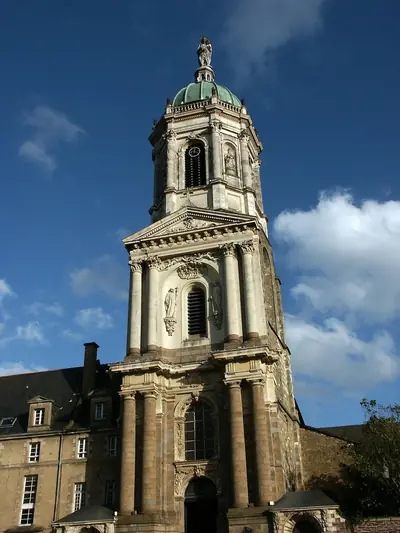
At the northeastern edge of the medieval centre, Notre-Dame-en-Saint-Melaine occupies the site traditionally linked to Saint Melaine, the city’s first bishop. It was once the abbey church of a Benedictine monastery and later became a parish church.
Between 1803 and 1844, while Rennes Cathedral awaited reconstruction, the church served as the city’s pro-cathedral. Its architecture combines a medieval nave and transept with later Gothic details and a classical bell tower. The tower was heightened in 1855 and crowned with a dome and a gilded statue of the Virgin, now one of Rennes’ recognizable landmarks.
Basilique Saint-Sauveur
The Basilique Saint-Sauveur is a Catholic minor basilica dedicated to Our Lady of Miracles and Virtues. Its origins reach back to before the twelfth century, although the present building was rebuilt in an eighteenth-century classical style between 1703 and 1768.
Inside, look for the baldachin over the high altar, the ornate wrought-iron pulpit, the organ and the numerous ex-votos. These offerings reflect the church’s long history of devotion to the Virgin Mary and the events regarded as miraculous.
Théâtre du Vieux Saint-Étienne
The Théâtre du Vieux Saint-Étienne began as the church of Saint-Étienne, dating from the twelfth century. It once served as the chapel of an Augustinian convent and still retains elements of its religious past.
The building stands below Place Sainte-Anne, opposite the former Ambroise Paré military hospital. It was classified as a historical monument in 1926 and now serves as a theatre.
Musée des Beaux-Arts de Rennes
The Musée des Beaux-Arts de Rennes occupies the former University Palace on Quai Émile Zola. The building dates from 1847, while the museum’s collection was established in 1794 from artworks confiscated during the French Revolution.
Its holdings were expanded by the collection of Christophe-Paul de Robien, president of the Parlement of Brittany. The museum now brings together works ranging from ancient Egyptian artefacts to modern art, including drawings, prints, paintings, antiquities and sculptures.
Église Toussaints
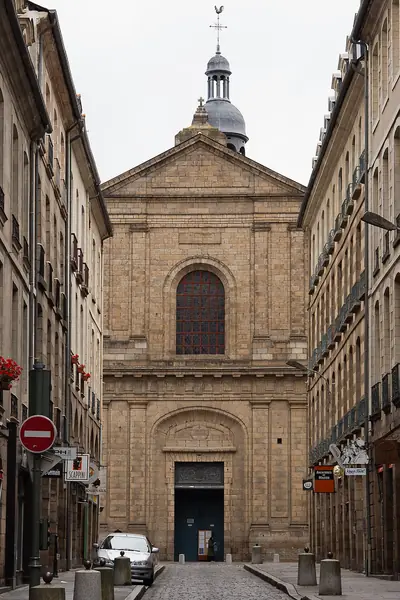
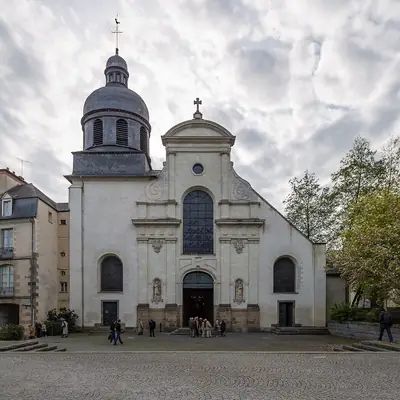
The Église Toussaints began as the chapel of Saint Thomas College, built between 1624 and 1651. Its architecture reflects the Counter-Reformation Baroque style and the influence of the Jesuits.
In 1803, it became a parish church, replacing an older Église Toussaints located nearby. Its balanced classical proportions make it a quieter but significant stop in the centre of Rennes.
Explore Rennes with a Self-Guided Audio Tour
A Rennes self-guided walking tour is an easy way to connect the city’s monuments without following a group. Neywo offers four walking tours, one bus route and one bike route in Rennes. Together, they cover routes from 1.2 to 3 km and from 12 to 87 minutes, with between 7 and 10 narrated stops per tour.
The walks include the city rebuilt after the 1720 fire, the market halls and cathedral, the half-timbered squares and Thabor gardens, and the museums and theatres around the Champs Libres. The bus route covers 2.7 km in 12 minutes with 7 stops, while the bike route covers 3 km in 15 minutes with 7 stops.
Download Neywo and explore Rennes with a free audio guide. The app tells the story of each place as you reach it, at your own pace, with no group and no schedule. Its narration is available in 11 languages. You can also continue discovering Brittany with Saint-Malo or Vannes, or browse the wider guide to France.
Places with an audio guide in Rennes
8 places in Rennes with a Neywo audio guide. Each one starts telling its story as you reach it.
Self-guided tours in Rennes
6 tours in Rennes, free in the Neywo app. Each stop tells its story as you reach it.
- Bike ride
Rennes by bike: from the Champs Libres quarter to the old ramparts
A relaxed ride on Rennes' dense network of bike lanes. Start at the National Theatre of Brittany, pass the fine arts museum and the covered market, cross Place de la République, then reach the not-very-academic bathers of Place de Bretagne, the medieval Tour du Chesne and the old Saint-Etienne church.
Théâtre National de Bretagne · Musée des Beaux-Arts de Rennes · Halles centrales (Rennes) · Place de la République · Des baigneuses pas très académiques · Tour du Chesne …
Open this tour: Rennes by bike: from the Champs Libres quarter to the old ramparts - Bus ride
La Navette: Rennes' centre-ville shuttle past the Parliament and the cathedral
A small electric shuttle on the STAR network that loops through the historic centre every 10 to 15 minutes, Monday to Saturday. It passes the opera, the Parliament of Brittany, the Basilica of Bonne Nouvelle, the old Saint-Etienne church, the Porte Mordelaise and the Basilica of Saint-Sauveur, and ends at Place de la République.
Rennes Opera house · Palace of the Parlement of Brittany · Basilique Notre-Dame de Bonne Nouvelle de Rennes · Théâtre du Vieux Saint-Étienne · Porte Mordelaise · Basilique Saint-Sauveur de Rennes …
Open this tour: La Navette: Rennes' centre-ville shuttle past the Parliament and the cathedral - Walk
Phoenix of Brittany: the city rebuilt after the 1720 fire
A week-long fire in December 1720 burned medieval Rennes to the ground and the king's architect redrew it with straight streets and golden granite. Walk the result: the old Ouest-France newspaper building, the town hall and opera on their rational square, the Parliament of Brittany, and the abbey, church and mansion that came through.
Ancien siège d'Ouest-France · Place de la Mairie · Rennes Opera house · Place du Parlement-de-Bretagne · Palace of the Parlement of Brittany · Église Saint-Germain de Rennes …
Open this tour: Phoenix of Brittany: the city rebuilt after the 1720 fire - Walk
Dukes' gate, market halls and a cathedral of white columns
Start on the old tournament ground of Place des Lices, where du Guesclin unhorsed a dozen knights and where Brittany now sells its galette-saucisse. Then follow the ramparts to the Porte Mordelaise where every new duke entered the city, pass the not-very-academic bathers of Place de Bretagne, and finish among the cathedral's white columns, a Versailles-style staircase and the one street the 1720 fire spared.
Hôtel Racapé-de-La-Feuillée · Halles Martenot · Porte Mordelaise · Tour du Chesne · Des baigneuses pas très académiques · Chapelle Saint-Yves de Rennes …
Open this tour: Dukes' gate, market halls and a cathedral of white columns - Walk
Half-timbered squares and the gardens of Thabor
Begin at the gate of the Thabor, a monks' orchard turned into one of France's finest gardens, and pass the abbey church of Saint-Melaine. Then drop into the old quarter where the 1720 fire stopped, to see timber houses lean like a house of cards on Place du Champ-Jacquet.
L'Enlèvement d'Eurydice · Main gate of the Parc du Thabor · Saint-Melaine Palace · Notre-Dame-en-Saint-Melaine · Place Sainte-Anne · Basilique Notre-Dame de Bonne Nouvelle de Rennes …
Open this tour: Half-timbered squares and the gardens of Thabor - Walk
Old masters, a figure-eight theatre and the Champs Libres
A culture walk along the Vilaine: the covered market and La Criée, Place de la République and its Palace of Commerce, the fine arts museum with its Leonardo and Michelangelo drawings, the baroque Toussaints church, and the Champs Libres complex by Portzamparc, ending at the National Theatre of Brittany nicknamed the Great Eight.
Halles centrales (Rennes) · La Criée · Place de la République · Palais du Commerce · Musée des Beaux-Arts de Rennes · Église Toussaints de Rennes …
Open this tour: Old masters, a figure-eight theatre and the Champs Libres
Walk Rennes with Neywo
Neywo turns Rennes into a self-guided audio tour. Stories arrive as you reach the place they belong to, and the route reshapes when you wander off it.

