Things to Do in Blois, France: Walking Guide
Things to do in Blois
Blois is a historic town set on the Loire River in the Centre-Val de Loire region of France, where royal architecture, medieval streets and a lively riverside scene come together in a compact, welcoming setting. Its layered past – from a medieval fortress to a Renaissance palace and beyond – makes it a rewarding stop for anyone interested in French history, art or simply strolling along the water. Neywo provides a free audio guide for Blois with 38 narrated places, letting you discover the city’s stories at your own pace.
Exploring Blois’ highlights
Château de Blois
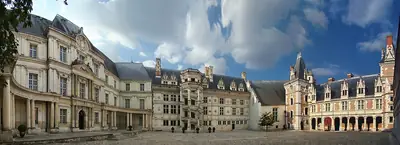
The Château de Blois stands in the heart of the town, right on the banks of the Loire. Rather than a single building, it is made up of four wings arranged around a courtyard, each representing a major phase of French architecture from the 13th to the 17th century. The oldest part is a medieval fortress once belonging to the Counts of Blois, followed by a Louis XII wing in flamboyant Gothic, a Francis I Renaissance wing famous for its open staircase, and a Gaston of Orléans wing that adds a grand Classical façade. For over a century the château served as a favoured residence of French kings, from Louis XII to Henry III, and it was here that Joan of Arc received a blessing in 1429 before marching to Orléans.
Blois Cathedral
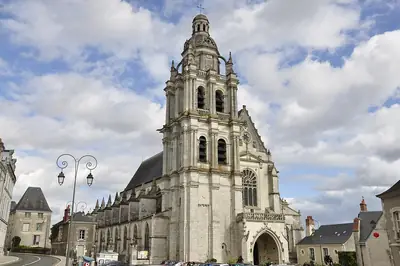
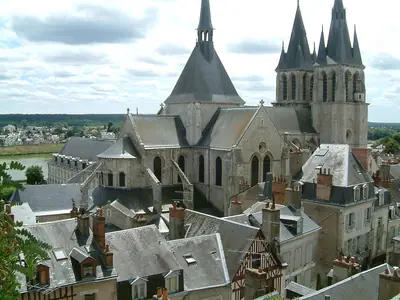
Opposite the château, Blois Cathedral rises as a Late Gothic masterpiece that has been the spiritual centre of the city for centuries. It became the seat of the Diocese of Blois in 1697, though the site has hosted a church since the sixth century. The present façade and bell tower date from 1544, while the nave was destroyed by a hurricane in 1678 and rebuilt between 1680 and 1700 under architect Arnoult‑Séraphin Poictevin. King Louis XIV donated the organ loft in 1704, after which the building was rededicated to Saint Louis. A Lady Chapel was added in 1860 by Jules Potier de la Morandière, completing the harmonious blend of Gothic and Renaissance elements visible today.
Halle aux Grains
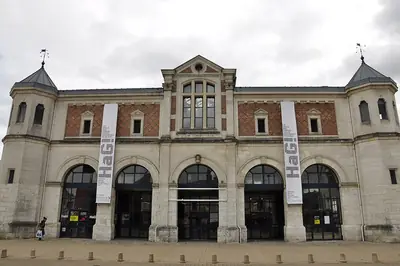
Located on Place Jean‑Jaurès, the Halle aux Grains is a striking brick‑and‑stone building erected in 1849 and opened the following year as a covered grain market. Its façade deliberately echoes the Louis XII wing of the château, linking the city’s commercial past to its royal heritage. After the grain trade moved elsewhere, the building was listed as a historic monument in 1982 and reopened in 1985 as the Palais des Congrès et de la Culture. Today it houses the Scène nationale de Blois, a national stage for theatre, dance and music, and regularly hosts conferences and exhibitions.
Château de la Vicomté (Castle of the Viscounty)
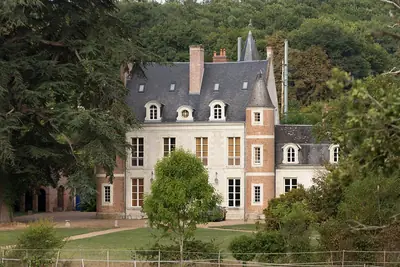
Tucked away in the Grouëts quarter on the western edge of Blois, the Château de la Vicomté was the private residence of the viscounts of Blois, a branch of the powerful counts’ family. Its origins reach back to the 10th century, and over the centuries the structure has been rebuilt and altered, leaving a palimpsest of different architectural periods visible in its walls today.
Pont Jacques‑Gabriel
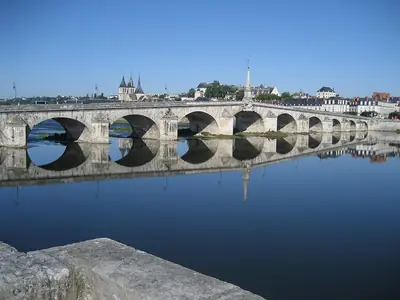
Spanning the Loire, the Pont Jacques‑Gabriel is a humpback bridge distinguished by its curved profile that rises to a gentle centre point. At 283 metres long and carried on eleven stone arches, it is the last bridge of its kind still standing along the entire length of the Loire. Built between 1716 and 1724 under the direction of Jacques Gabriel, architect to Louis XV, the bridge has survived partial destruction and reconstruction three times – during the Franco‑Prussian War of 1870 and again in 1940 and 1944 during the Second World War.
Notre‑Dame de la Trinité Basilica
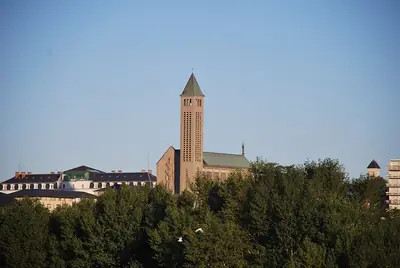
Overlooking the city, the Basilica of Notre‑Dame de la Trinité is a 20th‑century sanctuary dedicated to Our Lady of the Trinity. Construction began in 1932, though the building was not consecrated until 1949, after the Second World War had ended. Its clean lines and modest façade reflect the faith and craftsmanship of the era in which it was raised.
Blois‑Vienne Church (Église Saint‑Saturnin)
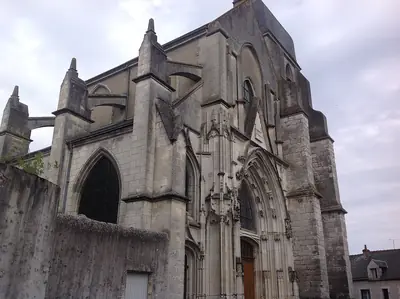
Situated on the left bank of the Loire in the former riverside suburb of Vienne, this parish church is dedicated to Saint Saturnin of Toulouse. Although its origins trace to the Carolingian period, the present building was largely rebuilt between 1500 and 1528 in the late Flamboyant Gothic style. The west façade opens onto the Aître Saint‑Saturnin, a Renaissance churchyard that is one of only four of its kind still surviving in France. Joan of Arc knelt here to pray on 25 April 1429 during her stay in Blois, and the church has been protected as a historic monument since 1942.
Saint Nicholas Church
Dating back to the 12th century, the Church of Saint Nicholas began as the abbey church of Saint‑Laumer, a Benedictine monastery that has long since disappeared. The surviving structure is primarily Romanesque, with solid rounded arches and thick walls, illustrating the transition from Romanesque to early Gothic. In the Middle Ages it housed relics of several saints, including a fragment believed to be from the True Cross, making it a major pilgrimage destination. Its historical importance was recognised early – it appeared on the very first list of French historical monuments in 1840 – and it has endured wars, revolutions and the passage of time largely intact.
Église Saint‑Vincent de Blois
Originally constructed between 1625 and 1660 as the private chapel of the Jesuit college in Blois, the building was dedicated to Saint Louis. For two centuries it served only the college community before being redesignated in the 19th century as a parish church and renamed Saint Vincent de Paul. Today it stands as a quiet reminder of the city’s educational and religious past.
Hôtel de Condé
Classified as a historic monument, the Hôtel de Condé is an elegant mansion situated in the city centre of the Loir‑et‑Cher department. Its façade and interior details bear witness to the aristocratic lifestyle of Blois in earlier centuries.
Hôtel Viart
Just a short walk away, the Hôtel Viart is a Renaissance mansion built in the mid‑16th century for the Viart family. It exemplifies the shift from medieval houses to the new Renaissance style that took hold under Louis XII, when Blois became a royal residence. Like many of the town’s grand homes, it is now protected as a historic monument.
Escalier Denis‑Papin
Cutting a dramatic line up the hillside, the Escalier Denis‑Papin links the upper town to the riverbank below. The monumental stone staircase comprises 122 steps interrupted by four broad landings, each offering a changing perspective of the Jacques‑Gabriel bridge, the Loire valley and the rooftops of the old town. Built to connect the historic centre with the Puits‑Châtel quarter, the climb is as rewarding as the view from the top.
Maison Calcat
Also known as the Logis du Loup, the Maison Calcat is a modest historic house that adds to the varied architectural fabric of Blois’s streets.
Maison de la Magie
Directly opposite the Royal Château de Blois, the Maison de la Magie Robert‑Houdin is Europe’s only public museum devoted to the art of illusion. It combines historic magic collections with a permanent stage for live performance. The building was gifted to the city by Robert‑Houdin’s descendants in 1981, opened to the public on 1 June 1998 and earned the Musée de France label. During the tourist season, magic shows are performed daily, allowing visitors to witness illusion in the very theatre where it continues to thrive.
Musée des Beaux‑Arts de Blois
Housed in the Louis XII wing of the château, the Musée des Beaux‑Arts has occupied this setting since the mid‑19th century. Founded in 1850, it is one of France’s earlier provincial fine‑arts museums. Its collections span the 16th through the 19th centuries, featuring paintings, sculptures, decorative arts and a particularly noteworthy tapestry collection. The Renaissance architecture of the wing itself forms part of the museum experience.
Using Blois as a base for the Loire Valley
Blois makes a convenient starting point for exploring the wider Loire Valley. From here you can venture to neighbouring cities such as Orléans and Tours, both celebrated for their own châteaux, vineyards and historic centres. The region’s gentle landscape of farms, vineyards and riverside towns is easily reached by car or train, letting you discover the architectural and culinary riches of the Val de Loire at a relaxed pace.
Explore Blois with Neywo
Neywo’s free audio guide turns a simple walk into a self‑guided discovery of Blois. The platform offers three walking tours and one bus route in the city:
- Kings, Magicians and the Loire: Royal Blois – 1.79 km, 113 minutes, 12 stops
- Cathedral Quarter: Mansions, Markets and a Modern Basilica – 2.39 km, 108 minutes, 11 stops
- Across the Loire: Stairs, Bridge and a Riverside Churchyard – 1.11 km, 45 minutes, 4 stops
- Bus A: Château, Old Town and the Loire Bridge – 1.2 km, 5 minutes, 4 stops
Each tour features 38 narrated places in total, with stories that play automatically as you reach each site. You set the pace, pause whenever you like, and follow the route without a group or a fixed schedule. Narration is available in 11 languages, so you can enjoy the commentary in the language that suits you best. Simply download the Neywo app, select Blois, and let the city’s history, architecture and legends unfold step by step.
Places with an audio guide in Blois
8 places in Blois with a Neywo audio guide. Each one starts telling its story as you reach it.
Self-guided tours in Blois
4 tours in Blois, free in the Neywo app. Each stop tells its story as you reach it.
- Bus ride
Bus A: Château, Old Town and the Loire Bridge
Azalys line A is Blois's main urban bus. It runs from the royal château through the old town, past the Denis-Papin staircase and over the Loire on the last humpback bridge of its kind, for the price of a bus ticket.
Château de Blois · Maison de la Chancellerie · Escalier Denis-Papin · Pont Jacques-Gabriel (Blois)
Open this tour: Bus A: Château, Old Town and the Loire Bridge - Walk
Kings, Magicians and the Loire: Royal Blois
Stand where Joan of Arc was blessed and Marie de Médicis climbed down a rope ladder, then wander the lanes under the château. You will pass rebuilt Renaissance mansions, the museum of the magician Robert-Houdin, a half-timbered townhouse and the monumental staircase that drops to the Loire and its 18th-century humpback bridge.
Saint Nicholas Church (Blois) · Amboise Hotel · Épernon Hotel · Château de Blois · Musée des Beaux-Arts de Blois · Maison de la Magie …
Open this tour: Kings, Magicians and the Loire: Royal Blois - Walk
Cathedral Quarter: Mansions, Markets and a Modern Basilica
Leave the château behind and climb into the upper town. This walk threads through the lanes of Renaissance townhouses to the cathedral rebuilt after a hurricane, the brick-and-stone grain hall that is now a congress and culture centre and, at the end, the 20th-century basilica above the city.
Église Saint-Vincent de Blois · Tour Beauvoir · Hôtel de Condé · Hôtel de Rochefort · Maison de Denis Papin à Blois · Hôtel de Lavallière …
Open this tour: Cathedral Quarter: Mansions, Markets and a Modern Basilica - Walk
Across the Loire: Stairs, Bridge and a Riverside Churchyard
Climb down the monumental Denis-Papin staircase to the river, pass the site of the old Bourg-Moyen abbey and cross the 18th-century humpback bridge to Vienne, the old riverside suburb. End at the Flamboyant Gothic church of Saint-Saturnin, where Joan of Arc knelt in 1429, and its Renaissance churchyard.
Escalier Denis-Papin · Abbaye de Bourg-Moyen · Pont Jacques-Gabriel (Blois) · Blois-Vienne Church
Open this tour: Across the Loire: Stairs, Bridge and a Riverside Churchyard
Walk Blois with Neywo
Neywo turns Blois into a self-guided audio tour. Stories arrive as you reach the place they belong to, and the route reshapes when you wander off it.

