Visiting Agra, India: Top Sights on Foot
Things to Do in Agra: Mughal Monuments and Historic Streets
Agra is a historic city in Uttar Pradesh, India, best known for the Taj Mahal and its remarkable Mughal heritage. The city is worth visiting for its monumental architecture, powerful imperial history, and the nearby former capital of Fatehpur Sikri. Neywo offers a free audio guide for Agra with 23 narrated places, available in 11 languages.
Agra lies beside the Yamuna River and forms part of the Braj region. Its golden age began in the early sixteenth century, when it became a capital of the Mughal Empire under rulers from Babur to Shah Jahan. The city’s monuments still reveal how Mughal architecture developed from imposing red sandstone structures to refined white-marble buildings.
What to See in Agra
The Taj Mahal
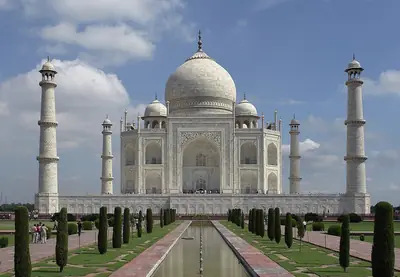
The Taj Mahal is Agra’s defining landmark and one of the most celebrated buildings in the world. Shah Jahan built the white-marble mausoleum between 1632 and 1648 in memory of his wife, Mumtaz Mahal.
Its design combines balanced gardens, intricate decoration, and harmonious proportions. The monument also represents the later Mughal preference for white marble and pietra dura inlay, a style that developed from earlier red-sandstone architecture. Set beside the Yamuna, the Taj Mahal remains the essential starting point for discovering Agra.
Agra Fort
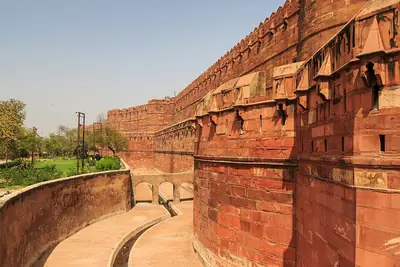
Agra Fort is a vast walled complex that once served as the political and military heart of the Mughal Empire. Known locally as Lal-Qila or Qila-i-Akbari, it stands 2.5 kilometres northwest of the Taj Mahal and is recognized as a UNESCO World Heritage Site.
The present structure began taking shape when Emperor Akbar undertook a major renovation in 1565, completing it in 1573. Shah Jahan later added more refined elements. For more than a century, from Akbar’s reign until 1638, the fort was the chief residence of the Mughal rulers.
Inside its red-sandstone walls are palaces, audience halls, mosques, courtyards, and gardens. The complex includes several buildings associated with the imperial household:
- Jahangiri Mahal was built by Akbar as the principal zenana, or private residence for the royal women. Its architecture combines Hindu, Asian, and Islamic influences.
- Akbari Mahal, also in the fort’s zenana, served as a residence for the imperial consorts and a place where Akbar could rest.
- The Khas Mahal is a historic palace within the fort.
- The Mina Mosque, also called the Heavenly Mosque, was built entirely of white marble by Shah Jahan between 1631 and 1640 for his personal use. It is now recognized as a Monument of National Importance.
- The Shah Jahan Mahal marks the emperor’s early attempt to remodel the fort’s red-sandstone architecture according to his preference for white marble. Its position between the Khas Mahal and Jahangiri Mahal illustrates the transition between the two styles.
Together, these buildings make Agra Fort feel less like a single fortress than a walled imperial city.
The Tomb of I’timād-ud-Daulah
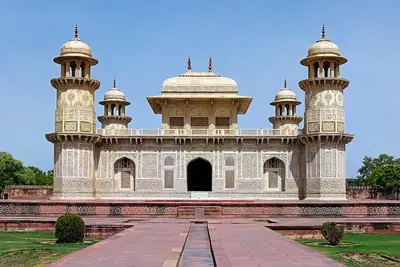
Along the Yamuna stands the Tomb of I’timād-ud-Daulah, a Mughal mausoleum often regarded as a model for the Taj Mahal. Nur Jahan commissioned it in memory of her father, Mirzā Ghiyās Beg, whose title was I’timād-ud-Daulah.
Built entirely of white marble in the 1620s, the tomb represents an important change from earlier Mughal buildings of red sandstone. Its walls feature pietra dura inlay and vivid paintings of trees, animals, birds, and occasionally human figures—an unusual decorative detail in Islamic architecture.
The building’s jewel-box appearance and garden setting make it one of Agra’s most distinctive monuments, especially for visitors interested in the architectural evolution that led to the Taj Mahal.
Akbar’s Tomb at Sikandra
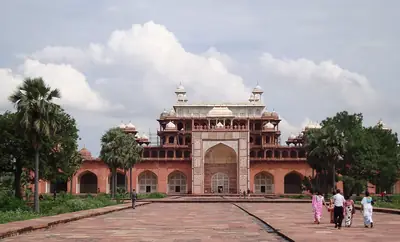
The Tomb of Akbar the Great lies in Sikandra, set within 119 acres of tranquil gardens. Construction began during Akbar’s lifetime, and his son Jahangir completed the mausoleum between 1605 and 1613.
The tomb combines deep red sandstone with delicate white marble. Three-storey minarets rise at each corner, creating a particularly striking approach to the monument. The site also includes Kanch Mahal, a palace at the southeast corner of the tomb complex.
The mausoleum later suffered a raid in 1688, when Hindu Jat forces plundered and desecrated the site. Its history therefore reflects not only Mughal architectural achievement but also the political turmoil that followed the empire’s period of dominance.
Fatehpur Sikri
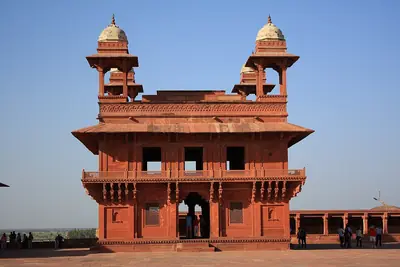
Around 35 kilometres from Agra, Fatehpur Sikri was the Mughal capital under Emperor Akbar. Akbar founded the city in 1571, and it remained the imperial capital until 1585. It was eventually abandoned completely by 1610 and is now a UNESCO World Heritage Site.
The city’s architecture brings together Mughal, Persian, and Hindu influences. Among its principal sights are:
- Jama Masjid, a sixteenth-century Friday mosque and dargah complex commissioned by Akbar in honour of the Sufi saint Salim Chishti. At about 540 feet, or roughly 165 metres, long, it remains one of the largest mosques in India.
- Buland Darwaza, the monumental southern gateway of the mosque. Standing 54 metres high, it was erected in 1573 to celebrate Akbar’s victory in Gujarat.
- The Tomb of Salim Chishti, a white-marble dargah within the mosque complex.
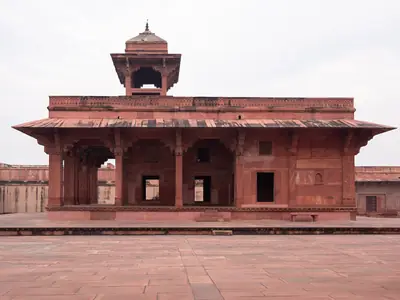
- Jodha Bai Mahal, a red-sandstone palace commissioned in 1569 for Mariam-uz-Zamani, widely known as Jodha bai. Its design blends Hindu and Persian styles.
- Mariam’s House, also known as Miriam’s House, a historic building in Fatehpur Sikri.
- Diwan-i-Khas, one of the city’s notable Mughal buildings.
- Hiran Minar, another landmark of the former imperial city.
Fatehpur Sikri adds a different perspective to an Agra itinerary: rather than a single monument or palace complex, it presents an entire abandoned capital shaped by Akbar’s ambitions.
The Cathedral of the Immaculate Conception of Agra
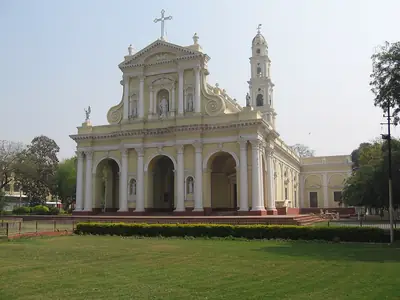
The Cathedral of the Immaculate Conception is a striking church in the heart of Agra. It provides a glimpse of the city’s religious and architectural variety alongside its Mughal monuments.
Agra’s Layered Heritage
Agra’s history extends across several periods. Before Mughal rule, the fort was associated with the Chauhan Rajputs, and Sikandar Lodi later made Agra his capital. After the first Battle of Panipat in 1526, the Mughals took control of the city. Later, the fort passed through periods under the Marathas and the Jats of Bharatpur before British rule.
That long history is visible in the city’s changing architectural language: red sandstone citadels, white-marble mausoleums, palace courtyards, mosques, churches, and the remains of an abandoned imperial capital. Exploring Agra therefore means looking beyond the Taj Mahal to the many buildings that explain how the city became a centre of power.
Agra belongs to Uttar Pradesh, a state with other major historic destinations including Lucknow and Varanasi. It is also part of the wider heritage of India.
Explore Agra with Neywo
Neywo’s Agra audio guide includes three walking tours:
- From the Old City to the Red Fort of the Mughals: 2.53 km, 81 minutes, and 9 narrated stops, including Agra Fort, Jama Masjid, Jahangiri Mahal, Akbari Mahal, Khas Mahal, Nagina Masjid, and Moti Masjid.
- Tombs, Churches and the Taj Mahal: 5.85 km, 114 minutes, and 4 narrated stops, including the Cathedral of the Immaculate Conception of Agra, the Tomb of I’timād-ud-Daulah, and the Taj Mahal.
- Fatehpur Sikri: Akbar’s Abandoned Capital: 1.65 km, 54 minutes, and 6 narrated stops, including Jama Masjid, Jodha Bai Mahal, Mariam’s House, Diwan-i-Khas, and Hiran Minar.
Download Neywo and explore Agra at your own pace. The app tells the story of each place as you reach it, so you can walk independently, without a group or a schedule.
Places with an audio guide in Agra
8 places in Agra with a Neywo audio guide. Each one starts telling its story as you reach it.

Self-guided tours in Agra
2 tours in Agra, free in the Neywo app. Each stop tells its story as you reach it.
- Walk
From the Old City to the Red Fort of the Mughals
Begin in the lanes of old Agra at a Shiva shrine wrapped in silver, pass the minaret-less Jama Masjid commissioned by Shah Jahan's daughter, then enter the Red Fort where emperors from Akbar to Shah Jahan ruled. Wander through the royal palaces and end at the white marble mosques of the Mughal court.
Mankameshwar Temple · Jama Masjid · Agra Fort · Jahangiri Mahal · Akbari Mahal · Shah Jahani Mahal …
Open this tour: From the Old City to the Red Fort of the Mughals - Walk
Fatehpur Sikri: Akbar's Abandoned Capital
A day trip 35 km from Agra to the city Akbar built in 1571 and left empty by 1610. Walk through the great Friday mosque, the red sandstone palace of Jodha Bai, Mariam's House and the Diwan-i-Khas, then out to the Hiran Minar.
Fatehpur Sikri · Jama Masjid, Fatehpur Sikri · Jodha Bai Mahal · Mariam's House · Diwan-i-Khas · Hiran Minar
Open this tour: Fatehpur Sikri: Akbar's Abandoned Capital
Walk Agra with Neywo
Neywo turns Agra into a self-guided audio tour. Stories arrive as you reach the place they belong to, and the route reshapes when you wander off it.

