Things to Do in Hyderabad, India: Walking Guide
Things to Do in Hyderabad: Historic Monuments, Palaces and Museums
Hyderabad is a historic city in India known for its monumental Old City, royal palaces, imposing mosques, museums and distinctive lakefront landmarks. The best things to do in Hyderabad include visiting Charminar and Golconda, exploring the heritage of the Nizams, and discovering the city’s religious and cultural diversity. Neywo offers a free audio guide for Hyderabad with 52 narrated places.
What to See in Hyderabad
Charminar
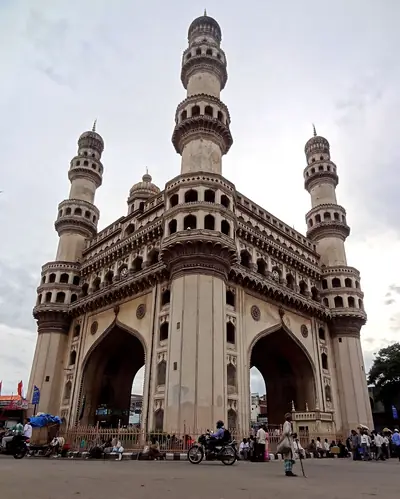
Charminar has stood at the centre of Hyderabad for more than four centuries. Built in 1591, it takes its name from the Urdu words chār and minar, meaning four minarets. Four pillars linked by grand arches form the monument, which also contains an active mosque on its top floor.
For nearly four hundred years, Charminar was the tallest structure in the city. It remains one of Hyderabad’s defining symbols and appears on the official emblem of Telangana. The monument stands beside Mecca Masjid, making the surrounding area one of the main centres of religious life in the Old City.
Mecca Masjid
Mecca Masjid is Hyderabad’s largest mosque and one of the biggest in India. Its prayer hall can accommodate 10,000 worshippers, and its construction lasted nearly eight decades.
Muhammad Qutb Shah began the project in the early 1600s. Bricks made from soil brought from Mecca were used in the central arch, giving the mosque its name. Construction continued under his successors and was completed in 1694 by the Mughal Emperor Aurangzeb. The main prayer hall measures 180 feet by 220 feet, with a ceiling 75 feet high.
Chowmahalla Palace
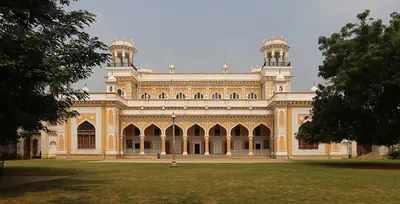
Chowmahalla Palace was the official residence and centre of power of the Nizams from 1720 until 1948. Its name means “four palaces”, referring to the four palace buildings originally arranged around a central courtyard.
Construction began in 1769 under Nizam Ali Khan, the second Asaf Jahi ruler, on the site of an older Qutb Shahi palace. The complex was completed in the late nineteenth century under the fifth Nizam. It once covered 45 acres and included durbar halls, courtyards, assembly rooms, fountains and formal gardens.
Today, Chowmahalla Palace is a museum and remains the private property of the royal family. Its halls and grounds offer a close look at the ceremonial world of Hyderabad’s former rulers.
Salar Jung Museum
On the southern bank of the Musi River, the Salar Jung Museum houses one of the great private collections assembled by a single person. After Salar Jung III died, his family gave the collection to the nation. The museum opened on December 16, 1951, first occupying the family’s palace, Dewan Deorhi, before moving to its current purpose-built home in 1968.
Its collections span the first century to the modern era and are divided into six main sections: Indian art, Middle Eastern treasures, works from Nepal and Tibet, pieces from Myanmar and the Far East, European paintings and decorative arts, and a children’s section.
Visitors can see sculptures, paintings, ivory and sandalwood carvings, textiles, manuscripts, ceramics, metalwork, carpets, clocks and furniture from places including Japan, China, Burma, Nepal, India, Persia, Egypt, Europe and North America.
Golconda
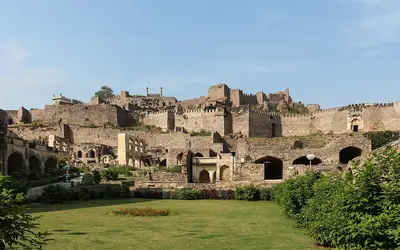
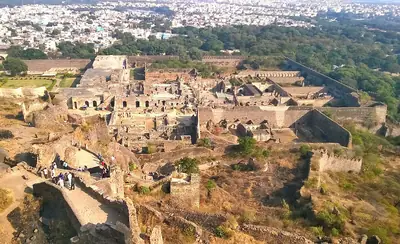
Golconda is a fortified citadel built on a 120-metre-high black rock hill on the western outskirts of Hyderabad. The first fort was made of mud in the eleventh century by the Kakatiya ruler Pratāparudra. It later became a stone stronghold and, from 1512, the capital of the Qutb Shahi Sultanate.
Much of the fort visible today dates from the Qutb Shahi rebuilding. Massive bastions surround the site, reflecting its role as a defensive city. One of its most remarkable features is the acoustic system near the main entrance: a clap can carry 300 feet to the highest pavilion, allowing a warning to reach the commander quickly.
Golconda is one of the essential places to visit for anyone interested in Hyderabad’s medieval history and the Qutb Shahi rulers.
Falaknuma Palace
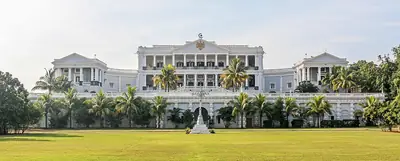
Falaknuma Palace stands on a hillock five kilometres from Charminar. Its name means “like the sky” or “mirror of the sky” in Urdu. Completed in 1893, it was once the tallest building in Hyderabad and occupies a 32-acre estate.
The palace began with Nawab Sir Viqar-ul-Umra, prime minister of Hyderabad and a relative of the sixth Nizam. Construction started in 1884 and took nearly a decade. The elevated setting gives views across the city, while the estate includes grand halls, marble staircases and a chandelier valued at more than thirty-five crore rupees.
The palace hosted figures including King Edward, Viceroy Lord Wavell, C. Rajagopalachari and Dr. Rajendra Prasad.
Hussain Sagar and the Buddha Statue
Hussain Sagar is a heart-shaped lake between Hyderabad and Secunderabad. Built in 1562 during the reign of Ibrahim Quli Qutb Shah, it was commissioned by the Sufi saint Hazrat Hussain Shah Wali to meet the region’s drinking-water needs. The lake covers 5.7 square kilometres and is fed by the Musi River and the Balkapur tributary.
At its centre, on Gibraltar Rock, stands the Buddha Statue of Hyderabad. The monolithic statue is 17.5 metres tall and weighs 350 tonnes. It was carved from a single block of stone and erected in 1992. The statue can be reached by boat from Lumbini Park.
Necklace Road follows the eastern bund and connects the two cities. The promenade is lined with statues of celebrated historical figures and has ornamental gateways in Vijayanagara and Kakatiya architectural styles.
Birla Science Museum
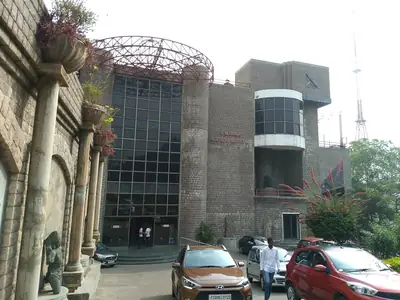
The B. M. Birla Science Museum combines several attractions in one complex: a museum, planetarium, science centre, art gallery and dinosaurium. Opened in 1990, it also explores India’s journey into space.
The planetarium presents the sky, stars, space and eclipses in displays designed to resemble the real night sky. Presentations are offered in Telugu, English and Hindi and last about 35 minutes. The complex moves from astronomy and space exploration to dinosaurs, art and general science.
Taramati Baradari
Taramati Baradari is a historical sarai, or travellers’ rest house, within Ibrahim Bagh, a Persian-style garden. It was built during the reign of Ibrahim Quli Qutub Shah, the fourth Sultan of Golconda, and is considered one of the early examples of Persian architectural influence in the region.
Churches and religious landmarks
Hyderabad and Secunderabad also reveal their history through their churches and other places of worship. St Joseph’s Cathedral, in the Gunfoundry area, opened on Christmas Day in 1875. Built on a high rocky site, it is recognised as a heritage structure by the Hyderabad Urban Development Authority.
All Saints Church in Trimulgherry began as a Garrison Church served by Army Chaplains. Since 1947, it has belonged to the Church of South India and serves Secunderabad’s Tamil-speaking congregation, with weekly services in English and Tamil.
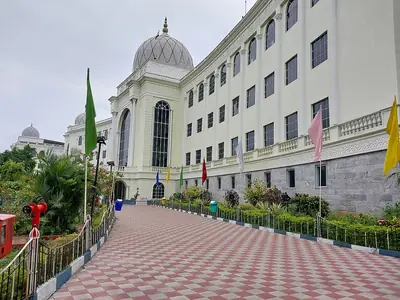
The State Art Gallery provides another perspective on the region’s culture through its diverse collection of visual arts. Afzal Gunj Masjid, built in 1866 by Afzal-ud-Daulah, the fifth Nizam of Hyderabad, is another historic religious landmark in the city.
Explore Hyderabad with Neywo
Neywo has five self-guided walking tours in Hyderabad, covering 21.63 kilometres in total and including 25 narrated stops:
- Old City Heart: Charminar and the Nizams’ Hyderabad — 3.63 km, 105 minutes, 8 stops
- Golconda and the Qutb Shahi Sultans — 6.99 km, 120 minutes, 4 stops
- Hussain Sagar: Buddha on the Lake — 3.33 km, 68 minutes, 4 stops
- Hill Fort to Abids: Colonial Hyderabad — 2.47 km, 60 minutes, 5 stops
- Secunderabad: Churches of the Cantonment — 4.22 km, 80 minutes, 4 stops
Download Neywo and explore Hyderabad at your own pace. The app tells the story of each place as you reach it, with no group and no schedule. Narration is available in 11 languages, and the Hyderabad audio guide includes 52 narrated places.
Hyderabad is one destination in India with a particularly rich mix of palaces, forts, museums and religious landmarks. When you continue travelling through the country, you can also discover Mumbai, Delhi or Kolkata with Neywo.
Places with an audio guide in Hyderabad
8 places in Hyderabad with a Neywo audio guide. Each one starts telling its story as you reach it.

Self-guided tours in Hyderabad
3 tours in Hyderabad, free in the Neywo app. Each stop tells its story as you reach it.
- Walk
Old City Heart: Charminar and the Nizams' Hyderabad
Start at a ruined Paigah palace, cross into the Nizams' Chowmahalla Palace, then step out to the great Mecca Masjid and the four minarets of the Charminar. Wander through Laad Bazaar to Hyderabad's earliest Friday mosque and on to the Nizam's old mansion, where silver models of the city wait, and finish among the treasures of the Salar Jung Museum.
Khursheed Jah Devdi palace · Chowmahalla Palace · Mecca Masjid · Charminar · Jama Masjid, Hyderabad · Purani Haveli …
Open this tour: Old City Heart: Charminar and the Nizams' Hyderabad - Walk
Hussain Sagar: Buddha on the Lake
Walk the shore of the heart-shaped lake the Qutb Shahis built in 1562, see the giant Buddha on Gibraltar Rock, and stroll through NTR Gardens to the Birla Science Museum.
Hussain Sagar · Buddha Statue of Hyderabad · NTR Gardens · Birla Science Museum
Open this tour: Hussain Sagar: Buddha on the Lake - Walk
Hill Fort to Abids: Colonial Hyderabad
From Naubhat Pahad's Hill Fort Palace, once a royal residence and later the Ritz Hotel, past the memory of the vanished Bashirbagh Palace, walk down to the churches of Abids and Gunfoundry: St. George's, the Methodist compound, and St. Joseph's Cathedral on its rocky hill.
Hill Fort Palace · Bashirbagh Palace · St. George's Church, Hyderabad · Centenary Methodist Church · St Joseph's Cathedral
Open this tour: Hill Fort to Abids: Colonial Hyderabad
Walk Hyderabad with Neywo
Neywo turns Hyderabad into a self-guided audio tour. Stories arrive as you reach the place they belong to, and the route reshapes when you wander off it.

