Visiting Delhi, India: Top Sights on Foot
Things to Do in Delhi: Monuments, Museums and Historic Neighbourhoods
Looking for things to do in Delhi? India’s capital brings together monumental government buildings, Mughal tombs, astronomical instruments, museums and places of worship shaped by several centuries of history. Neywo’s free audio guide for Delhi covers 46 narrated places, helping you understand the city as you explore it.
Delhi’s landmarks are spread across distinct areas, so a self-guided route is a useful way to connect them. From Raisina Hill and India Gate to Lodi Gardens, Connaught Place and the memorials of Gandhi, Nehru and Indira Gandhi, the city offers a wide range of places to visit.
What to See in Delhi
Rashtrapati Bhavan and Raisina Hill
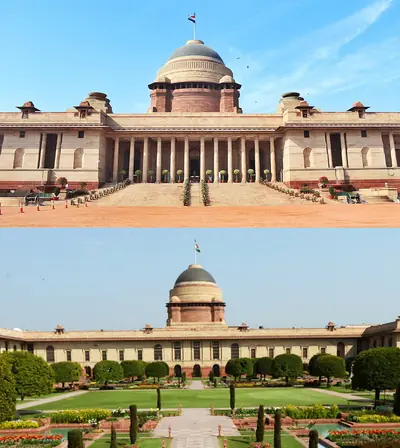
Rashtrapati Bhavan is the official residence of the President of India and one of New Delhi’s most imposing landmarks. It stands on Raisina Hill at the western end of Rajpath, now officially called Kartavya Path.
The building began as Viceroy’s House during British rule. Construction started in 1912 and was completed in 1929. Designed by Edwin Lutyens and Herbert Baker, it combines a Delhi Order with Indo-Saracenic architectural elements. The main structure has four floors, a basement, 340 rooms and about two and a half kilometres of corridors, set within a 320-acre presidential estate.
India Gate and the ceremonial axis
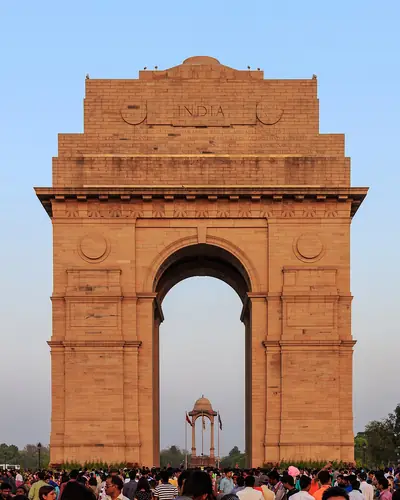
At the eastern end of New Delhi’s ceremonial axis, India Gate commemorates 74,187 soldiers of the Indian Army who died between 1914 and 1921. The names of 13,300 servicemen, including soldiers and officers from the United Kingdom, are inscribed on the monument.
Designed by Edwin Lutyens, the arch draws on the ancient Roman tradition of the triumphal arch. Beneath it is the Amar Jawan Jyoti, or Flame of the Immortal Soldier, installed after the Indo-Pakistani War of 1971. The surrounding area connects India Gate with several important institutions and memorials, including the National War Memorial and the National Gallery of Modern Art.
The National Museum
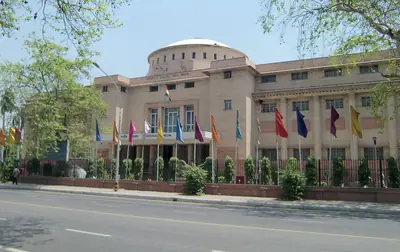
The National Museum is one of India’s largest museums, with collections spanning more than five thousand years of history. Established in 1949, it holds around 200,000 works, mostly from India, alongside objects from other parts of the world.
Its collections include archaeological objects, weapons, decorative arts, jewellery, manuscripts and paintings. The museum is on Janpath, near the intersection with Maulana Azad Road, and offers a broad introduction to India’s artistic and historical heritage.
Jantar Mantar
Jantar Mantar is an astronomical observatory built to study the movements of the Sun, Moon and planets with the naked eye. Construction began in 1723, and the Delhi observatory was completed in 1724 as one of five observatories built by Maharaja Sawai Jai Singh of Jaipur.
The site contains thirteen architectural instruments. The Samrat Yantra uses sunlight to provide information about time and the positions of celestial bodies, while the Misra Yantra can measure the shortest and longest days of the year. The Ram Yantra and Jai Prakash Yantra were used to study astronomical movements.
Gurudwara Bangla Sahib
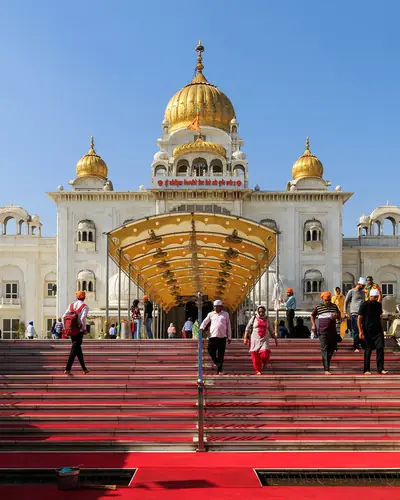
Gurudwara Bangla Sahib is one of Delhi’s most prominent Sikh houses of worship. Its complex includes the Sarovar, a sacred pond associated with Guru Har Krishan’s stay in Delhi.
The site was originally a bungalow belonging to Raja Jai Singh the First of Amber. Tradition holds that Guru Har Krishan provided water and assistance to people affected by smallpox and cholera. In 1783, Sikh General Sardar Baghel Singh rebuilt the bungalow as a small shrine.
Sacred Heart Cathedral
Sacred Heart Cathedral is one of New Delhi’s oldest church buildings. This Latin Rite Catholic cathedral stands near the southern end of Bhai Vir Singh Marg Road in Connaught Place.
Construction began in 1930 and was financed by colonial officers of the British Empire. The cathedral continues to host services for the Catholic community throughout the year.
Tomb of Safdar Jang
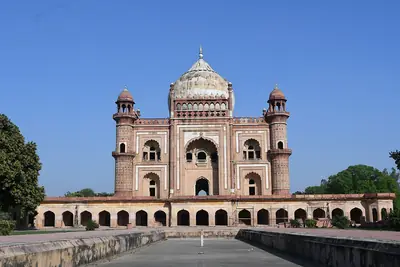
Tomb of Safdar Jang is a sandstone and marble mausoleum completed in 1754 for Nawab Safdar Jang of Awadh. His son, Nawab Shuja-ud-Daula, commissioned the tomb, which also contains the grave of Safdar Jang’s wife.
The central structure follows the tradition of earlier Mughal imperial tombs, particularly Humayun’s Tomb and the Taj Mahal. Its main building is largely red sandstone, while the central dome is made of white marble. Four octagonal minarets rise from the corners, and the interior follows the hasht bihisht plan, with eight rooms around the main chamber.
The garden is divided into four sections, with water features extending towards the surrounding buildings. Pavilions known as Moti Mahal, Jangli Mahal and Badshah Pasand form part of the complex.
Bara Gumbad in Lodi Gardens
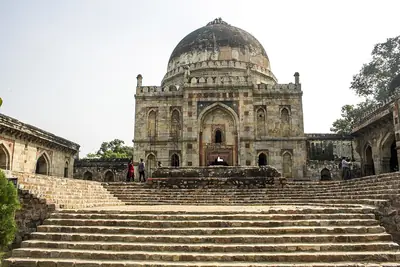
Bara Gumbad, or Bada Gumbad, means “big dome.” Built in 1490 during the Lodi dynasty, it forms part of a group that also includes a Friday mosque, a guest house associated with Sikandar Lodi, the Tomb of Sikandar Lodi and Shisha Gumbad.
The monument’s original purpose remains uncertain. It may have been intended as a free-standing tomb, although no tombstone has been identified; it may also have served as a gateway. Its dome is believed to be the earliest full dome constructed for a building in Delhi.
Gandhi Smriti
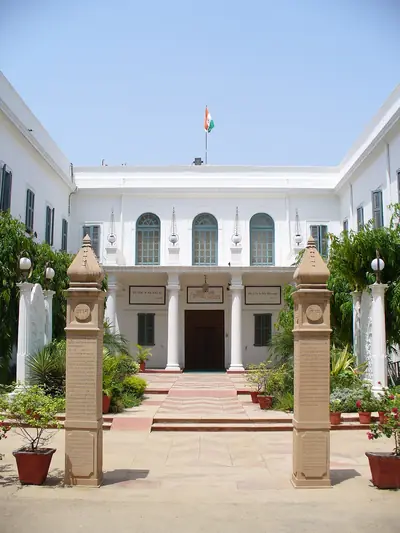
Gandhi Smriti preserves the memory of the final chapter of Mahatma Gandhi’s life. Formerly known as Birla House or Birla Bhavan, the building was originally owned by the Birla family. Gandhi spent the last 144 days of his life there and was assassinated at the site on 30 January 1948.
The museum and memorial opened to the public in 1973. The site also houses the Eternal Gandhi Multimedia Museum, established in 2005.
Teen Murti Bhavan and the Prime Ministers’ Museum
Teen Murti Bhavan was built in 1930 as part of New Delhi’s imperial capital and first served as the residence of the Commander-in-Chief of the British Indian Army. After independence, Jawaharlal Nehru lived there for sixteen years, until his death on 27 May 1964.
The complex now includes his former residence and Pradhan Mantri Sangrahalaya, the Prime Ministers’ Museum. It follows the lives, contributions and legacies of India’s prime ministers since independence in 1947.
Indira Gandhi Memorial
The Indira Gandhi Memorial occupies the building where Indira Gandhi lived with her family during her premiership. India’s first and only female prime minister, she was assassinated at this site.
The museum contains material remains connected with Indira Gandhi and her son, Rajiv Gandhi. Together with Gandhi Smriti and Teen Murti Bhavan, it forms part of a group of places connected with India’s modern political history.
National Gallery of Modern Art
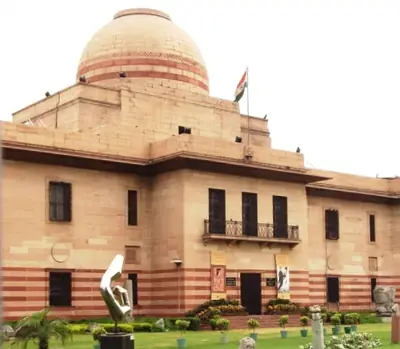
Housed in Jaipur House, the National Gallery of Modern Art is the premier art gallery under India’s Ministry of Culture. Established by the Government of India on 29 March 1954, its Delhi collection contains more than 17,000 works by over 2,000 artists.
The oldest works preserved there date back to 1857. The gallery provides a look at India’s modern artistic heritage across around 12,000 square metres of exhibition space.
National Rail Museum
The National Rail Museum in Chanakyapuri brings together the heritage of rail transport in India. Inaugurated on 1 February 1977, it covers more than 4.4 hectares, with an indoor octagonal gallery and an outdoor railway yard.
The collection includes models of locomotives and coaches, including a model and engine associated with India’s first railway. One of its notable exhibits is the Fairy Queen, whose engine was built in 1855 and is described as the world’s oldest working train.
National Charkha Museum
Above Palika Bazaar in Connaught Place, the National Charkha Museum explores the history and evolution of the charkha, or spinning wheel. The object became a symbol of nationalism, indigenous cloth and the empowerment of Indian citizens.
The museum’s central feature is a chromium stainless steel charkha measuring 26 feet long and 13 feet high. It weighs five tons and is described as the world’s largest spinning wheel. Other charkhas and three monkeys associated with Mahatma Gandhi are displayed around it.
Explore Delhi with a Free Audio Guide
Download Neywo and explore Delhi independently with five walking tours and one bus route. The walks range from 3.88 to 4.89 km and take between 93 and 115 minutes, with six to ten narrated stops each. The bus route covers 11.5 km in 49 minutes and has five stops.
Choose a route through India Gate and the memorials of the Republic, Connaught Place and Sacred Heart Cathedral, the tombs and gardens around Lodi Gardens, or the places connected with Gandhi, Nehru and Indira. You can also follow the Parliament and Raisina Hill walk or take Bus 166 from Nizamuddin to the heart of New Delhi.
The app tells the story of each place as you reach it, at your own pace, with no group and no schedule. Narration is available in 11 languages. Delhi is also a good starting point for discovering more of India, including Amritsar, Gwalior and Jaipur.
Places with an audio guide in Delhi
8 places in Delhi with a Neywo audio guide. Each one starts telling its story as you reach it.
Self-guided tours in Delhi
6 tours in Delhi, free in the Neywo app. Each stop tells its story as you reach it.
- Bus ride
Bus 166: Nizamuddin to the Heart of New Delhi
DTC bus 166 runs from Nizamuddin railway station through Lutyens' Delhi to Connaught Place. Ride past the Green Tower, Vigyan Bhavan, the Sunehri Bagh Mosque, the metro and the Charkha Museum for a few rupees.
Sabz Burj · Vigyan Bhavan · Sunehri Bagh Mosque · Delhi Metro · National Charkha Museum
Open this tour: Bus 166: Nizamuddin to the Heart of New Delhi - Walk
India Gate and the Memorials of the Republic
Start at Khair-ul-Manzil, a Mughal-era mosque opposite Purana Qila, then walk west across India's ceremonial lawns past the National Gallery of Modern Art, the National War Memorial, the Param Yodha Sthal and the great arch of India Gate. End at Vigyan Bhavan, the National Museum and the Sunehri Bagh Mosque.
Khair-ul-Manzil · National Gallery of Modern Art · National War Memorial · Param Yodha Sthal · India Gate · Vigyan Bhavan …
Open this tour: India Gate and the Memorials of the Republic - Walk
Connaught Place and the Sacred Heart of New Delhi
From the vast hub of New Delhi railway station to the colonnaded circles of Connaught Place, an 18th-century observatory, the golden-domed Bangla Sahib, a Viceroy-era cathedral and a Hindu temple opened by Gandhi, this walk crosses the faiths and eras of central Delhi.
New Delhi railway station · Connaught Place · National Charkha Museum · Jantar Mantar · Gurudwara Bangla Sahib · Sacred Heart Cathedral, New Delhi …
Open this tour: Connaught Place and the Sacred Heart of New Delhi - Walk
Tombs, Lodi Gardens and Khan Market
Visit the last great Mughal garden tomb, then wander Lodi Gardens among 15th-century domed tombs of the Delhi Sultanate, ending at Khan Market, which was founded for refugees of Partition.
Tomb of Najaf Khan · Tomb of Safdar Jang · Bara Gumbad · Shish Gumbad · Sikandar Lodhi's grave · Khan Market
Open this tour: Tombs, Lodi Gardens and Khan Market - Walk
Gandhi, Nehru and Indira
Homes and memorials that shaped modern India: Teen Murti Bhavan, Nehru's residence for sixteen years, the Indira Gandhi Memorial and the spot where she was assassinated, then Gandhi Smriti and the Eternal Gandhi Multimedia Museum, where Mahatma Gandhi spent his last 144 days, ending at Khan Market.
Teen Murti Bhavan · Indira Gandhi Memorial · Assassination of Indira Gandhi · Gandhi Smriti · Eternal Gandhi Multimedia Museum · Assassination of Mahatma Gandhi …
Open this tour: Gandhi, Nehru and Indira - Walk
Parliament and Raisina Hill
Walk from the Sunehri Bagh Mosque to the heart of Indian democracy: the Parliament precincts with Gandhi's bronze statue, the Lok Sabha and Rajya Sabha, a Sikh martyrdom shrine and a Viceroy-era cathedral, ending at the Jaipur Column and the presidential palace.
Sunehri Bagh Mosque · Mahatma Gandhi · Lok Sabha · Rajya Sabha · Parliament Museum · Gurdwara Rakab Ganj Sahib …
Open this tour: Parliament and Raisina Hill
Walk Delhi with Neywo
Neywo turns Delhi into a self-guided audio tour. Stories arrive as you reach the place they belong to, and the route reshapes when you wander off it.

