Guwahati, India: Self-Guided Walking Tour
Things to Do in Guwahati: What to See in Assam’s Largest City
The best things to do in Guwahati include visiting historic temples and museums, looking out over the Brahmaputra River, and exploring the cultural identity of Assam. As the largest city in Assam and the largest metropolis in northeastern India, Guwahati is also a major river port and a gateway to Northeast India. Neywo offers a free audio guide for Guwahati with 14 narrated places, available in 11 languages.
What to See in Guwahati
Kamakhya Temple
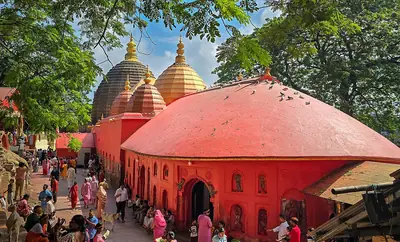
Kamakhya Temple is one of Guwahati’s most important religious landmarks. Set on the Nilachal Hills, it is dedicated to the goddess Kamakhya and is one of the 51 sacred pithas of the Shakta tradition. It is also one of the oldest and most revered centres of Tantric practice.
The temple’s present structure combines several architectural influences in a distinctive local style known as Nilachal. Although its origins reach back to the eighth or ninth century, the temple has been rebuilt many times. Its history is also closely linked with the rulers of Kamarupa, the Palas, the Koch rulers and the Ahoms.
The wider complex includes shrines dedicated to the ten Mahavidyas of Shaktism. Tripurasundari, Matangi and Kamalatmika are worshipped within the main temple, while the other seven have separate shrines nearby.
Umananda Temple and Peacock Island
A short boat ride across the Brahmaputra leads to Umananda Temple, also known as Umananda Mandir. The Shiva temple stands on Umananda Island, commonly called Peacock Island, giving it a memorable setting in the middle of the river.
Country boats carry visitors from the Brahmaputra bank to the island. The temple was built in 1694 by order of Ahom King Gadadhar Singha. Its original structure was destroyed by the Assam earthquake of 1897, adding another chapter to the history of this island shrine.
The Brahmaputra River
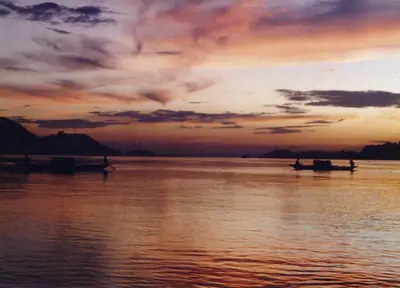
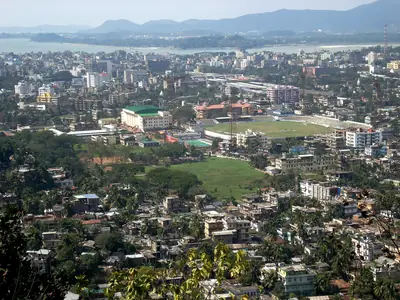
The Brahmaputra is central to Guwahati’s character and to Assam’s history, culture and civilization. The river changes its name along its journey: in Tibet it is the Yarlung Tsangpo, while in Arunachal Pradesh it is known as the Siang or Dihang. After other major rivers join it, it becomes the Brahmaputra in Assam before eventually merging with the Ganges and reaching the Bay of Bengal.
In Guwahati, it is worth taking time to observe the river’s braided form, with channels that can divide and change course. Spring floods can become severe when Himalayan snow melts, yet the river is also important for irrigation and transportation and is navigable for most of its length.
Its name has an unusual meaning: Brahmaputra means “son of Brahma” in Sanskrit. In Assam, the river is also known as Luit, Bar Luit and Louhitya.
Assam State Museum
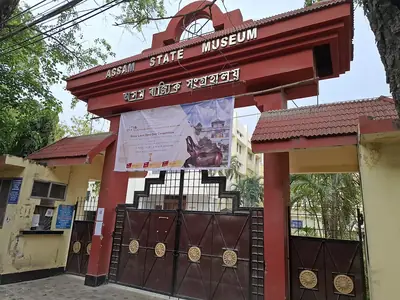
At the southern end of Dighalipukhuri tank, the Assam State Museum explores the historical and cultural heritage of Assam. It is regarded as one of the principal museums in Northeast India.
The museum was established in 1940 by the Kamarupa Anusandhan Samiti, also known as the Assam Research Society. Its founder and president was Kanaklal Barua. It opened on April 21, 1940, under the inauguration of Sir Robert Reid, then governor of undivided Assam.
Originally known as the Assam Provincial Museum, it came under the responsibility of the Assam State Government in 1953 and was placed within the education department’s museum and archaeology administration.
Guwahati Planetarium
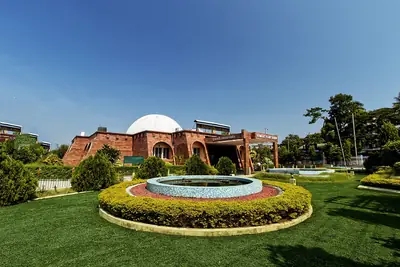
The Guwahati Planetarium stands near Dighali Pukhuri and is recognisable by its distinctive dome and sloping walls. Established in 1994, it is the oldest planetarium in Assam and Northeast India.
Its shows use the Chronos star field projector, digital high-definition video projectors and a Dolby sky theatre sound system. The planetarium offers shows in Assamese and English, as well as regular night-sky watching sessions.
Its hybrid projection system was the first of its kind in the Northeast and the second such system in India after the planetarium in New Delhi. The institution combines astronomical education and research with an accessible introduction to the solar system and the stars.
Gandhi Mandap
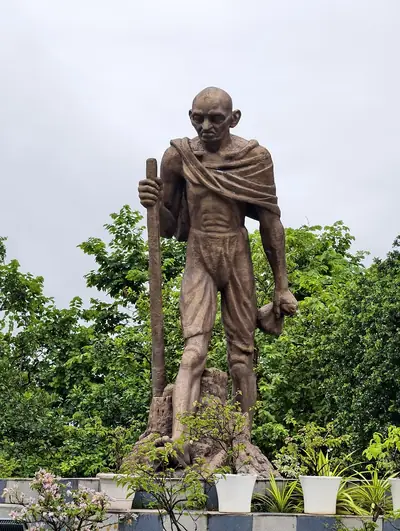
Gandhi Mandap is a museum on the summit of Sharania Hill, built in memory of Mahatma Gandhi. The hill is also connected with Gandhi’s visit to the site in 1946.
The museum was inaugurated on October 2, 1970, in a ceremony attended by India’s then Prime Minister, Indira Gandhi, and Assam Chief Minister Bishnuram Medhi. A national flag rises above the site; at 319 feet, it is described as the third-highest national flag in India.
Srimanta Sankaradeva Kalakshetra
In the Panjabari area, Srimanta Sankaradeva Kalakshetra—commonly known as Kalakshetra—brings together the art, heritage and traditions of Assam and the wider northeastern region.
Built in the 1990s, the complex includes a cultural museum, a library, a children’s park and spaces for preserving, demonstrating and performing cultural traditions. Its other facilities include open-air theatres, eateries, places of worship and emporiums.
The institution is named after Srimanta Sankardev, the medieval poet, playwright, reformer, Vaishnava teacher and scholar. Its name reflects Kalakshetra’s role in Assamese cultural identity.
Regional Science Centre, Guwahati
Formerly known as the Regional Science Centre, the National Science Centre, Guwahati, uses interactive exhibits and educational activities to make science accessible. It is an important centre for science communication in Northeast India.
Its displays and outdoor spaces include a science park, mathematics park and Jurassic Park. The centre was inaugurated on March 15, 1994, and became part of the National Council of Science Museums under India’s Ministry of Culture. It was upgraded and renamed the National Science Centre, Guwahati, on January 7, 2024.
Saraighat Bridge
Saraighat Bridge crosses the Brahmaputra and was Assam’s first rail-cum-road bridge over the river. Its two levels carry different types of traffic: the upper road level is 7.3 metres wide, while the railway runs beneath it.
The bridge is 1,298 metres long. Construction began in January 1958, and it opened for transporting materials in October 1962. It was formally opened to passengers on June 7, 1963, by India’s then Prime Minister, Jawaharlal Nehru.
Originally called the Brahmaputra Bridge, it was later renamed Saraighat, recalling a battle fought here in March 1671 between the Ahom Empire and the Mughal Empire. The Mughals were defeated. Beneath the bridge, Lachit Barphukan Memorial Park and Silai Rai Park were opened in 1962.
Dispur
Dispur is a suburb of Guwahati and the capital of Assam. It became the state capital in 1973, after the creation of Meghalaya made Shillong the capital of the new state. At the time, Dispur was a small village; migration and the expansion of Guwahati later transformed it into a densely populated urban area within Greater Guwahati.
Dispur is the seat of Assam’s government and includes the Assam Secretariat, also known as Janata Bhawan, the Assam Legislative Assembly House, MLA hostels and the State Emergency Operations Centre. The Assam Trunk Road and G S Road also pass through the area.
Chatrakar Devalaya
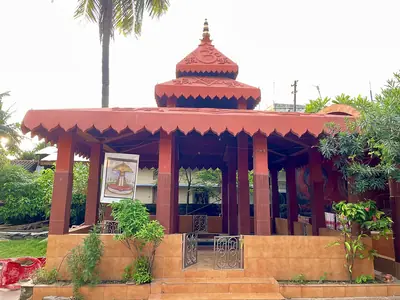
In Uzan Bazar, Chatrakar Devalaya is a temple with roots in the Ahom period. It was constructed during the Ahom era under the supervision of Swargadeo Kamaleswar Singha. The temple of Mangala Chandi stands alongside it.
St. Joseph’s Co-Cathedral
St. Joseph’s Co-Cathedral is a church building in Guwahati and another part of the city’s religious landscape. Its presence adds to the variety of places of worship found across Guwahati.
Guwahati as the City of Temples
Guwahati’s identity reaches beyond individual landmarks. The city is known as the “City of Temples”, reflecting the number and variety of religious sites associated with it. Alongside Kamakhya and Umananda, these include Ugratara, Basistha, Doul Govinda, Navagraha and Sukreswar.
The city also preserves links with the ancient capitals of Pragjyotishpura and Durjaya, located in the North Guwahati area. These older centres belonged to the ancient state of Kamarupa, whose history remains visible in Guwahati’s temples and cultural heritage.
Explore Guwahati with Neywo
Neywo’s free Guwahati audio guide includes one self-guided walking tour: “Guwahati: From Gandhi’s Hill to Peacock Island.” The walk covers 5.36 km, takes 102 minutes and includes five narrated stops: Gandhi Mandap, Assam State Museum, Guwahati Planetarium, the Brahmaputra River and Umananda Temple.
The app tells the story of each place as you reach it, at your own pace, with no group and no schedule. Download Neywo and explore Guwahati independently, from Gandhi’s Hill to Peacock Island, while discovering more of India.
Places with an audio guide in Guwahati
8 places in Guwahati with a Neywo audio guide. Each one starts telling its story as you reach it.
Walk Guwahati with Neywo
Neywo turns Guwahati into a self-guided audio tour. Stories arrive as you reach the place they belong to, and the route reshapes when you wander off it.

