Visiting Capri, Italy: Top Sights on Foot
Things to Do in Capri: What to See on the Island
The best things to do in Capri combine dramatic limestone scenery, Roman history, churches, museums and gardens overlooking the Tyrrhenian Sea. From the lively Piazza Umberto I to Villa Jovis and the Gardens of Augustus, the island rewards travellers who explore beyond its famous coastline. Neywo has a free audio guide for Capri with 30 narrated places.
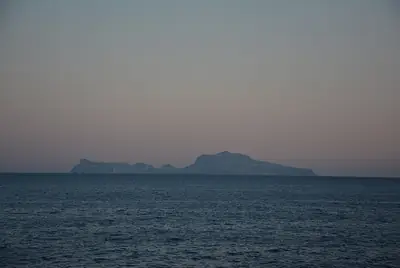
Capri lies off the Sorrento Peninsula, on the southern side of the Gulf of Naples. Its rugged landscape includes high cliffs, coastal grottoes and the distinctive Faraglioni sea stacks. The island is divided between the municipalities of Capri and Anacapri, with Anacapri extending higher up the slopes of Monte Solaro, Capri’s highest point. The island also has two harbours, Marina Grande and Marina Piccola, and has attracted visitors since the time of the Roman Republic.
For more places to explore in the region, see Campania, or combine Capri with Naples and Sorrento.
What to see in Capri
Piazza Umberto I and the Piazzetta
Piazza Umberto I, usually called La Piazzetta, has been the centre of Capri town since Roman times. The square is known as the “little theater of the world” and remains one of the island’s best-known meeting places.
The Torre dell’Orologio, or Piazzetta Tower, is one of its most recognisable features. The origins of the tower are uncertain: theories connect it with elements of Hagia Sophia, while others suggest that it may have developed from an ancient watchtower. The square’s modern social life took shape in the twentieth century, when outdoor cafés transformed it into Capri’s lively gathering place.
Santo Stefano
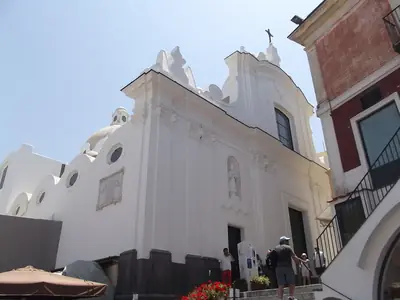
Santo Stefano is the largest church on Capri and the parish church of the town. It was the cathedral of the Diocese of Capri from 1560 until 1818. The present building was erected between 1688 and 1697 on the site of an earlier foundation dedicated to Santa Sofia and associated with a Benedictine monastery dating to 580.
Its Baroque façade is arranged in two levels, with faux-marble panels, niches containing statues of saints, pilasters and a large central window framed by volutes. The church stands directly around Piazza Umberto I, connected to the square by a staircase.
Museo Ignazio Cerio
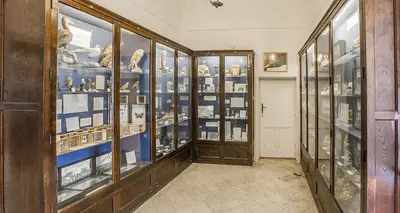
The Ignazio Cerio Museum occupies the historic Palazzo Cerio on the Piazzetta. Its collections trace Capri’s natural and human history through fossils, minerals, prehistoric finds, Roman artefacts, and examples of local flora and fauna.
The museum is based on the studies and collections of Ignazio Cerio. It was created in 1947 by Edwin Cerio and his sister-in-law, Mabel Normannel, and forms part of the Centro Caprense Ignazio Cerio together with its library.
One of its most striking sections looks back roughly 250,000 years. Remains of bears, panthers and hyenas from the Quisisana area evoke Capri’s prehistoric environment. Other exhibits reveal the island during the Roman age, particularly under Augustus and Tiberius, through objects from Roman villas.
Sant’Anna
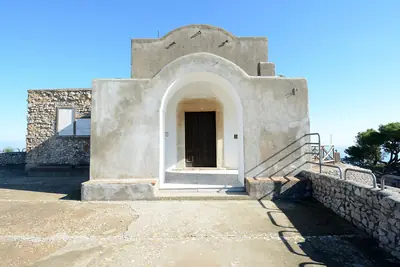
Sant’Anna is a small church and one of Capri’s oldest buildings. It was originally known as San Pietro e Paolo a Carcara, and later as Santa Maria delle Grazie. It eventually took the name Sant’Anna because it housed a canvas depicting the saint.
Gardens of Augustus
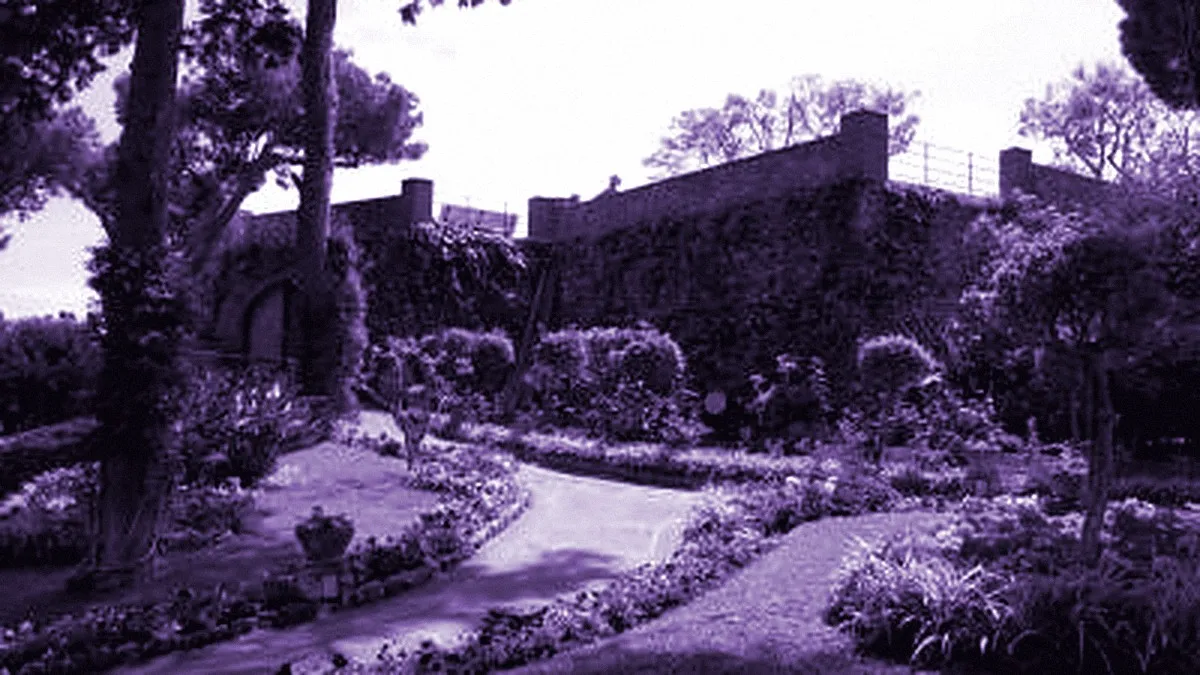
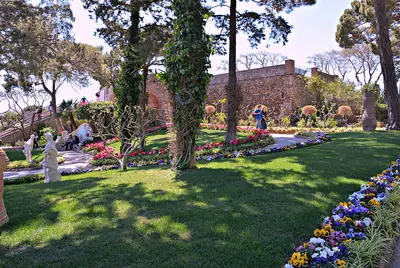
The Gardens of Augustus, or Giardini di Augusto, are terraced botanical gardens with wide views over Mount Solaro, Marina Piccola and the Faraglioni. Their paths offer a 180-degree panorama that brings together the mountain, the bay and Capri’s most recognisable sea stacks.
The gardens were established in the early twentieth century by Friedrich Alfred Krupp, a German industrialist who planned to build a mansion on Capri. They were initially known as the Krupp Gardens and took their current name in 1918. Geraniums, dahlias and broom grow among the ornamental planting.
A monument to Vladimir Lenin stands within the gardens. Created in 1968 by the sculptor Giacomo Manzù, it consists of marble blocks rising five metres in front of the house of the Russian writer Maxim Gorky, who hosted Lenin there in 1908.
Chiesa di San Costanzo
Chiesa di San Costanzo, also known as Maria Santissima della Libera, is dedicated to San Costanzo, Capri’s patron saint. It served as the cathedral of the Diocese of Capri from 987 until 1560 and remains a parish church where the saint continues to be venerated.
Chiesa di San Michele
The Church of San Michele, also known as San Michele alla Croce, is one of Capri’s churches. It provides a quieter stop while exploring the island and appears on the route leading towards its historic villas and archaeological sites.
Grotta di Matromania
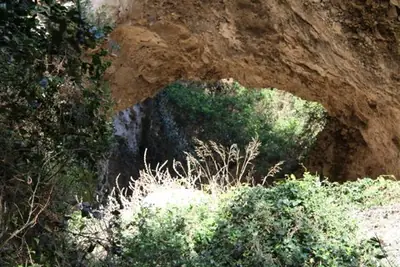
Near Capri’s Natural Arch, the Grotta di Matromania, also called the Grotta di Matermania, is a large natural cave measuring about 27 metres long, 18 metres wide and 18 metres high.
In Roman times, the cave was transformed into a luxurious nymphaeum, or ornamental grotto. Only a few masonry remains survive. The site is associated with the worship of Mithras, although another interpretation connects its Roman dedication with Cybele, or Mater Magna. Archaeological finds from the surrounding area add to the cave’s ancient setting.
Villa Lysis
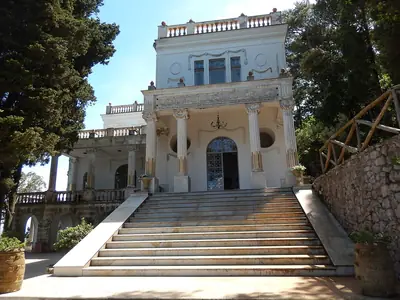
Villa Lysis, also known as Villa Fersen, is an eclectic hilltop villa created in 1905 by the French industrialist and poet Jacques d’Adelswärd-Fersen. After a scandal in Paris, Fersen came to Capri and made the villa his home, dedicating it to “the youth of love”.
The building combines Art Nouveau with neo-Gothic and neoclassical influences. A marble staircase and wrought-iron railings lead into a complex that includes a library, altars and a basement room known as the Chinese Room, or opium room. The name Villa Lysis refers to a dialogue by the ancient Greek philosopher Plato.
Villa Jovis
Villa Jovis, or the Villa of Jupiter, is one of Capri’s most important Roman sites. Built for Emperor Tiberius and completed in 27 AD, it became the place from which he mainly ruled until his death in 37 AD.
The villa was the largest of the twelve Tiberian villas on Capri mentioned by the historian Tacitus. Its complex covered about 7,000 square metres across several terraces, with an elevation difference of roughly 40 metres. Built on Monte Tiberio, which rises to about 334 metres, the residence combined the scale of a Roman palace with the privacy and security of a secluded location.
Surviving walls and staircases suggest the size of the original complex. Roman engineers also created an elaborate cistern system to collect and store rainwater, solving the challenge of supplying a large residence at such a height. The ruins look out over Capri’s shoreline and the Bay of Naples.
Certosa di San Giacomo
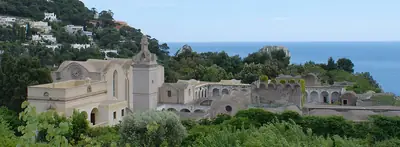
The Certosa di San Giacomo, or Charterhouse of Saint James, is the oldest monastery on Capri. Founded by Giacomo Arcucci, it is now a museum and a setting for cultural events.
The complex is arranged in three main sections. One included the pharmacy and the women’s church; another served the monks and external guests, with granaries, stables and workshops; the third was devoted to seclusion, with monastic cells arranged around two cloisters.
The Great Cloister has a late Renaissance design, with cross vaults supported by stone columns and green spaces at its centre. The smaller cloister is more delicate, with cross vaults resting on Roman marble columns. The entrance path leads through the complex towards a fortified tower.
Museo Diefenbach
Museo Diefenbach is devoted to an artist associated with Capri. It offers a focused cultural stop and adds an artistic dimension to the island’s Roman remains, churches, gardens and viewpoints.
Chiesa di Sant’Andrea
Near Marina Piccola, the Chiesa di Sant’Andrea has a strong connection with Capri’s fishing community. Built in 1900 for local fishermen, it stands on the site of an earlier watchtower used to look out for invading Saracen pirates.
Its pronaos is supported by two columns, while the central apse occupies the position of the former watchtower. The central altar displays a triptych of the Crucifixion of Saint Andrew. Another altar is dedicated to the Madonna of Pompeii, and a spiral staircase leads to the organ.
Chiesa di San Costanzo and other historic churches
Capri’s religious heritage continues with smaller churches such as Chiesa di San Costanzo and the Church of San Michele. Together with Santo Stefano and Sant’Anna, they show how the island’s history is woven into its streets and neighbourhoods, not only into its grand villas and panoramic gardens.
A Capri self-guided walking tour with Neywo
Neywo offers two walking tours in Capri, with 30 narrated places available across the city. Each story plays as you reach the place, at your own pace: there is no group and no schedule.
The first walk, Capri Town: Piazzetta, Baroque Churches and Garden Views, covers 3.03 km in 90 minutes and has 10 narrated stops. It includes Piazza Umberto I, Santo Stefano, Museo Ignazio Cerio, Sant’Anna, the Gardens of Augustus, Chiesa di San Costanzo, Marina Grande and other places in Capri town.
The second, In the Footsteps of Tiberius: Caves, Villas and an Emperor’s Palace, covers 3.32 km in 72 minutes and has 5 narrated stops. Its route connects Piazza Umberto I with Chiesa di San Michele, Grotta di Matromania, Villa Lysis and Villa Jovis.
Download Neywo and explore Capri with its free audio guide. The app tells the story of each place as you reach it, so you can discover the island at your own pace, with no group and no schedule. If you are continuing through Italy, you can also explore nearby Amalfi, Ischia or Salerno.
Places with an audio guide in Capri
8 places in Capri with a Neywo audio guide. Each one starts telling its story as you reach it.
Self-guided tours in Capri
2 tours in Capri, free in the Neywo app. Each stop tells its story as you reach it.
- Walk
Capri Town: Piazzetta, Baroque Churches and Garden Views
Start at the Piazzetta, the 'little theater of the world', and work through Capri town's churches, museums and the old charterhouse. Finish with the sea panorama from the Gardens of Augustus, then wander down past the Non-Catholic Cemetery to the harbour of Marina Grande.
Piazza Umberto I · Santo Stefano · Museo Ignazio Cerio · Sant'Anna · Via Vittorio Emanuele III · Museo Archeologico di Capri …
Open this tour: Capri Town: Piazzetta, Baroque Churches and Garden Views - Walk
In the Footsteps of Tiberius: Caves, Villas and an Emperor's Palace
Climb out of the Piazzetta toward Capri's wilder east side. Pass a quiet church and the cave of Matromania, then reach Villa Lysis, a poet's Art Nouveau hideaway, and end at Villa Jovis, the palace from which the Emperor Tiberius ruled Rome.
Piazza Umberto I · Chiesa di San Michele · Grotta di Matromania · Villa Lysis · Villa Jovis
Open this tour: In the Footsteps of Tiberius: Caves, Villas and an Emperor's Palace
Walk Capri with Neywo
Neywo turns Capri into a self-guided audio tour. Stories arrive as you reach the place they belong to, and the route reshapes when you wander off it.

