Things to Do in Taranto, Italy: Walking Guide
Things to Do in Taranto: What to See in the City Between Two Seas
Taranto is a historic city in Apulia, set between the open Mar Grande and the sheltered Mar Piccolo. Its old town brings together Greek, Roman, Byzantine, medieval and Baroque traces, while its museums reveal the importance of ancient Taras and the traditions of the modern city. Neywo has a free audio guide for Taranto with 51 narrated places, so you can explore the city while its stories play as you arrive.
Part of Apulia and the wider heritage of Italy, Taranto is especially rewarding for travellers interested in archaeology, architecture, religious art and waterfront city life.
What to see in Taranto
Taranto Cathedral
The Cathedral of San Cataldo, or Duomo di San Cataldo, is regarded as the oldest cathedral in Apulia and serves as the cathedral of the Archdiocese of Taranto. Its history reaches back at least to the fifth century, while the present building took shape in the eleventh century on the site of an earlier Christian church.
The cathedral combines early Christian, Byzantine, Romanesque and Baroque elements. Its façade was rebuilt in the Baroque style in the early eighteenth century, with statues and ornament attributed to Mauro Manieri. Inside, a mosaic-covered floor, wall murals and a wooden coffered ceiling preserve different layers of the building’s long history.
Castello Aragonese
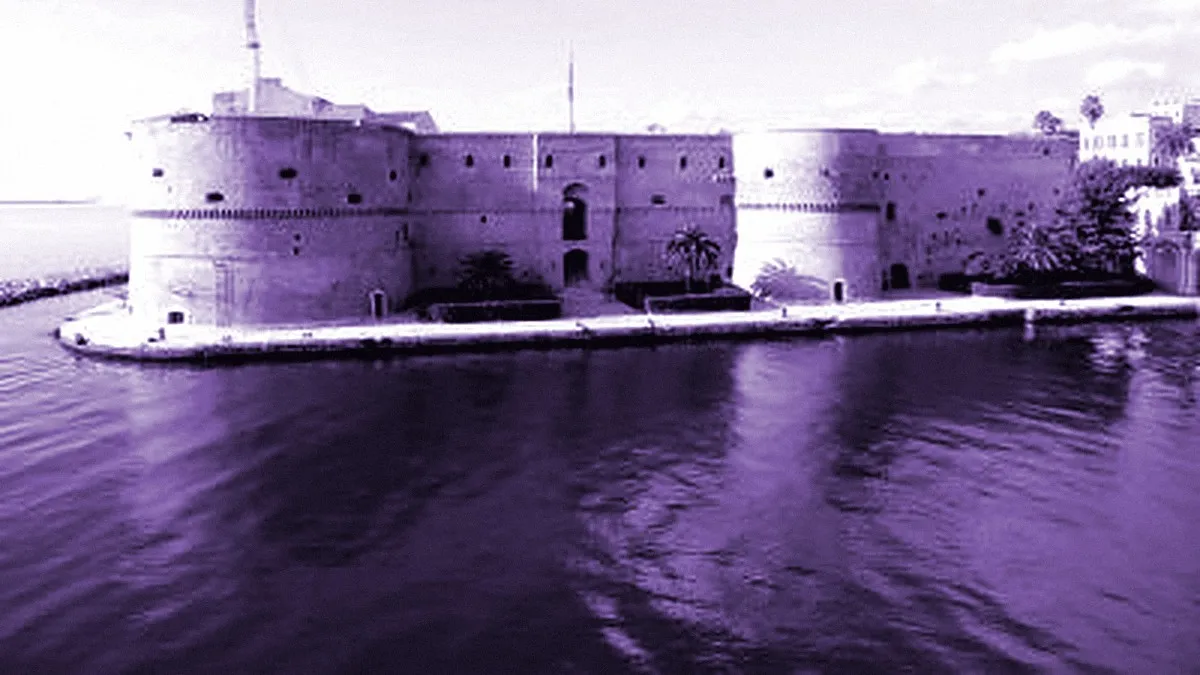
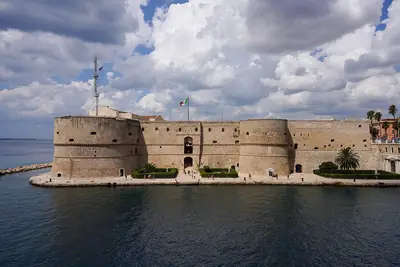
At the southern tip of the old town, the Castello Aragonese—also known as Castel Sant’Angelo—stands beside the canal and the Ponte Girevole. Its quadrangular fortress has four main towers and a large central courtyard.
The present design is associated with the Sienese architect Francesco di Giorgio Martini. Built on the site of earlier fortifications, the fortress was begun on the orders of Ferdinand of Naples and completed in 1492. Its military role changed as artillery transformed warfare, and parts of the castle were later adapted for guns.
The National Archaeological Museum of Taranto
The National Archaeological Museum of Taranto, known as MArTA, is one of the city’s essential places to visit. Founded in 1887 and housed in a former monastery, it brings together finds from Taranto, Apulia and the wider world of Magna Graecia.
The collections cover prehistoric times and the Greek and Roman periods, with Greek, Roman and Iapygian objects illustrating both daily life and the wealth of Taranto’s aristocratic society. Among the highlights are the celebrated Gold of Taranto, a fifth-century BCE kore, a head of Aphrodite, a statue of Athena, a Greek Roman head of Heracles and the bronze Zeus of Ugento.
The Spartan Hypogeum Museum
Beneath Corso Vittorio Emanuele II, the Spartan Hypogeum Museum offers an unusual way to explore Taranto’s origins. The underground chambers belong to Palazzo de Beaumont Bonelli, a seventeenth-century noble palace in the old town. The lower structure is also known as the Bellacicco Hypogeum.
The route descends about sixteen metres below street level and four metres below sea level into ancient chambers covering around 800 square metres. The site connects the modern city with Taranto’s foundation as a colony established by exiled Spartans known as the Parthenians in the eighth century BC. Stone quarried here is believed to have been used in important Greek temples, including the temple remains marked by the Two Columns in Piazza Castello.
Palazzo Pantaleo and the Ethnographic Museum
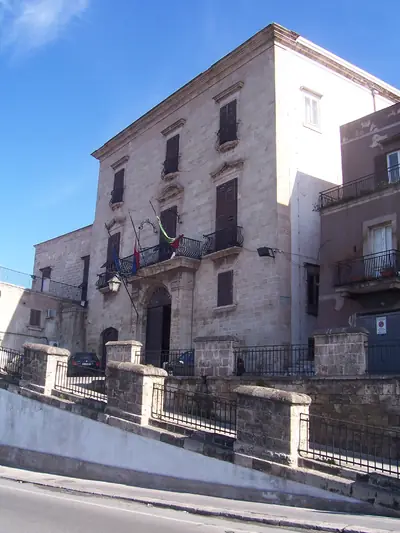
Facing the Mar Grande, Palazzo Pantaleo is an eighteenth-century noble residence built in 1770 for Baron Francesco Maria Pantaleo. Its entrance gives its name to the Rampa Pantaleo, and the palace occupies a prominent position near the route towards the Ponte di Porta Napoli.
The building now houses the Alfredo Majorano Ethnographic Museum. Its collections document the traditions of Taranto and its province through objects, recordings and other traces of popular culture. Particularly notable are recordings of pizzica made by Alfredo Majorano in the 1950s and material connected with tarantism.
Palazzo Amati
Palazzo Amati is one of the most imposing historic residences in Taranto’s Borgo Antico. Its façade faces the Mar Grande, while its entrance opens onto Vico Vigilante. Baron Giacomo Amati created the palace in the second half of the eighteenth century by joining three smaller buildings.
The residence once contained 37 rooms, along with iron loggias, a marble staircase, a gallery and a great hall. Its multi-level basement included wells and cisterns for preserving oil and wine, and once offered direct access to the sea. The building was altered, abandoned and restored several times before its present use.
Palazzo Carducci Artenisio and Palazzo Ulmo
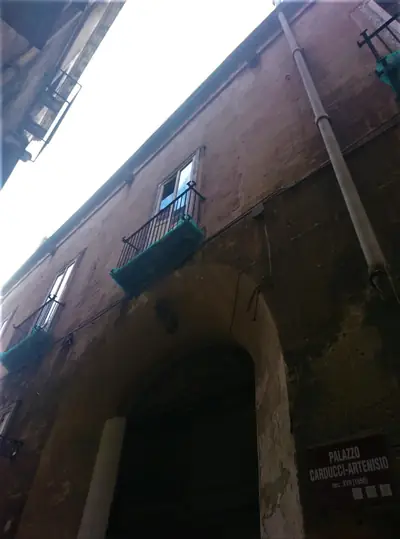
Palazzo Carducci Artenisio is one of Taranto’s principal aristocratic palaces. Commissioned in 1650 by Ludovico Carducci, it has preserved much of its noble character, including refined decorative details and furnishings.
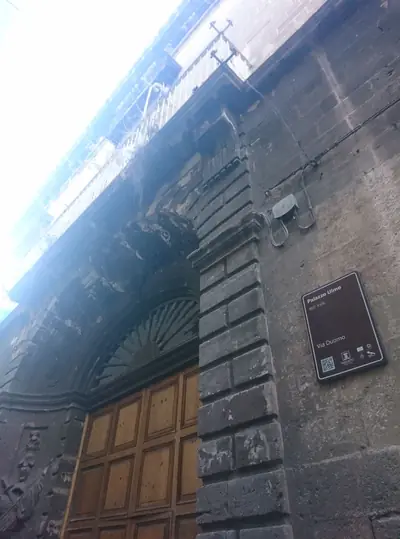
On Via Duomo, Palazzo Ulmo provides a quieter link with the city’s eighteenth-century history. The building probably takes its name from Pierantonio Ulmo, who was mayor of Taranto in 1750.
Palazzo Calò
Palazzo Calò connects Taranto’s architecture with one of its important Holy Week traditions. Built by the Calò family during the eighteenth century, it is associated with Don Diego Calò, who is credited with introducing the Holy Week rites to Taranto from the seventeenth century onwards.
The palace once contained a chapel housing statues of Our Lady of Sorrows and the Dead Christ. From there, the statues set out during the rites before being donated to the Carmine Confraternity in 1765.
The Cripta del Redentore
The Cripta del Redentore is an underground rock-cut church inside an ancient circular grotto about eight metres across. It began as a Roman imperial-period chamber tomb and later became part of the church of Santa Maria di Murivetere.
The apse contains a twelfth-century fresco of Christ Pantocrator between Saint John and the Virgin Mary. Other saints, including Saint Basil, Saint Euplus and Saint Blaise, appear along the side walls. The crypt was rediscovered in 1899 by the archaeologist Luigi Viola and reopened to the public in December 2011 after restoration and structural protection.
The Diocesan Museum
The Diocesan Museum, or MuDi, occupies the rooms of the sixteenth-century Archbishop’s Seminary in Taranto’s old city. Its four floors contain more than 300 works dating from the seventh to the twentieth century.
Seven thematic sections cover the liturgy, Christ, the Virgin Mary, the saints, religious orders and confraternities, the cathedral and the archbishops. The collection includes paintings, sculptures, relics, vestments, sacred furnishings and liturgical objects, as well as the Treasury of San Cataldo and its ancient golden cross. The basement also preserves remains of an ancient Iapygian village.
Concattedrale Gran Madre di Dio
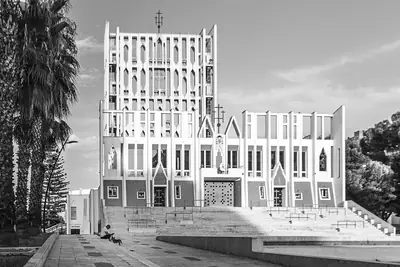
Taranto’s modern character comes into focus at the Concattedrale Gran Madre di Dio in Borgo Nuovo. Inaugurated in 1970, the church was designed by Gio Ponti for the developing Città Nuova district and serves as a co-cathedral alongside San Cataldo.
Its façade resembles a sail, while three reflecting pools suggest the sea. The concrete structure stretches 87 metres and rises 35 metres, with two walls set one metre apart and pierced by geometric openings that create a Gothic outline.
Other historic churches and spaces
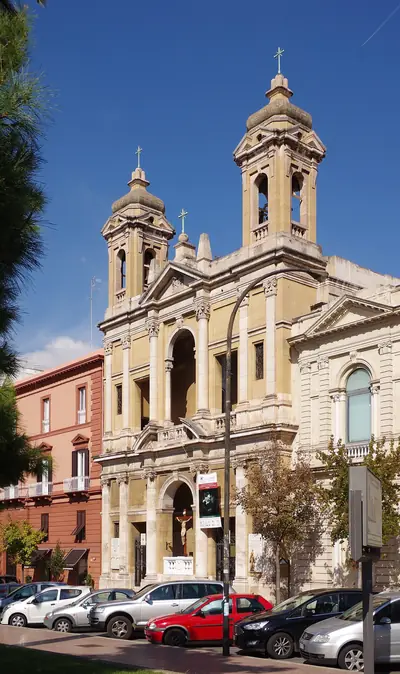
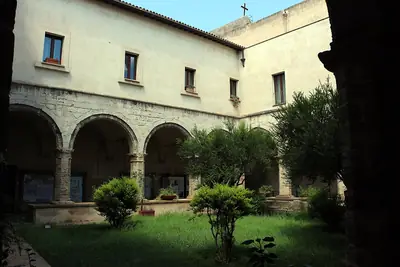
The Church of San Pasquale, also known as San Pasquale Bailon, stands in the Umbertino district. The cloister of the San Domenico convent is described as both a cloister and a museum, adding another historic stop to a walk through Taranto.
Together with the city’s palaces, museums and archaeological sites, these places show how densely Taranto’s history is layered. Its old town is particularly suited to exploring on foot, with the waterfront and the canal providing a constant connection to the city’s maritime setting.
Explore Taranto with Neywo
Download Neywo and explore Taranto with a free audio guide that tells the story of each place as you reach it, at your own pace, with no group and no schedule. The app offers four walking tours and one bike route:
- Noble Palaces and the Spartan Underground: 1.02 km, 88 minutes and 12 narrated stops.
- Two Columns and a Castle: Taranto’s Greek Heart: 0.87 km, 69 minutes and 11 narrated stops.
- Borgo Umbertino: Sailors, Palaces and a Hidden Garden: 1.68 km, 67 minutes and 9 narrated stops.
- Città Nuova: Wind Fountain, Painted Crypt and Gio Ponti’s Stone Sail: 3.59 km, 83 minutes and 6 narrated stops.
- Seafront Cycle Lane through the Borgo Umbertino: a 1 km bike route lasting 5 minutes, with 3 narrated stops.
Neywo’s narration is available in 11 languages. Choose a walk or cycle route, reach the next place and let the app bring Taranto’s history to life while you explore.
Places with an audio guide in Taranto
8 places in Taranto with a Neywo audio guide. Each one starts telling its story as you reach it.
Self-guided tours in Taranto
5 tours in Taranto, free in the Neywo app. Each stop tells its story as you reach it.
- Bike ride
Seafront Cycle Lane through the Borgo Umbertino
A short ride along Taranto's cycle lane from the canal to the southern waterfront, linking the Order of Malta palace, the fortress-like Palazzo del Governo and the Bank of Italy palace.
Palazzo Savino Amelio · Palazzo del Governo · Palazzo della Banca d'Italia
Open this tour: Seafront Cycle Lane through the Borgo Umbertino - Walk
Noble Palaces and the Spartan Underground
Taranto's old town sits on an island between two seas, and its western end is a maze of baroque palaces, a Romanesque cathedral and a hidden Greek acropolis. Walk Via Duomo past the oldest cathedral in Puglia, then descend sixteen metres below street level into the Spartan hypogeum, where the city's founders once held their rites. Look for Palazzo Gallo, whose three underground levels hide wells and cisterns beneath the old town.
Museo etnografico Alfredo Majorano · San Domenico Maggiore (Taranto) · Palazzo Ulmo · Palazzo Ciura · Palazzo Amati · Diocesan Museum Taranto …
Open this tour: Noble Palaces and the Spartan Underground - Walk
Two Columns and a Castle: Taranto's Greek Heart
From the baroque masks of Palazzo Natoli to the Aragonese fortress on the canal, this walk crosses the eastern half of the old town. Stand before the last two columns of the oldest Doric temple in Magna Graecia, pass under the Governor's arch, and finish on the swing bridge that opens for warships.
Palazzo Natoli · Palazzo Gennarini · Palazzo Galeota · Palazzo Latagliata · San Michele · Palazzo Calò …
Open this tour: Two Columns and a Castle: Taranto's Greek Heart - Walk
Borgo Umbertino: Sailors, Palaces and a Hidden Garden
Cross the swing bridge into Taranto's nineteenth-century new town, laid out on a grid by the sea. Greet the two bronze sailors on the waterfront, admire the monumental palaces of the 1930s, then reach the archaeological museum and the shaded Peripato gardens above the Mar Piccolo.
Palazzo Savino Amelio · Monumento al Marinaio di Taranto · Palazzo del Governo · Postal Palace · Maria Santissima del Monte Carmelo · Monument to the fallen of Taranto …
Open this tour: Borgo Umbertino: Sailors, Palaces and a Hidden Garden - Walk
Città Nuova: Wind Fountain, Painted Crypt and Gio Ponti's Stone Sail
Leave the old town behind and follow Taranto's twentieth-century growth along the sea. Start at the fountain of the eight wind-heads on Piazza Ebalia, pass the Bank of Italy palace and the Venetian-Gothic Palazzo Magnini, then walk on to the church of San Francesco di Paola, where the Good Friday procession rests for an hour. End at the Roman tomb turned Byzantine crypt with its twelfth-century Christ, and Gio Ponti's sail-shaped co-cathedral with its three reflecting pools.
Fountain of the Rose of the Winds · Palazzo della Banca d'Italia · Palazzo Magnini · San Francesco di Paola · Cripta del Redentore · Concattedrale Gran Madre di Dio
Open this tour: Città Nuova: Wind Fountain, Painted Crypt and Gio Ponti's Stone Sail
Walk Taranto with Neywo
Neywo turns Taranto into a self-guided audio tour. Stories arrive as you reach the place they belong to, and the route reshapes when you wander off it.

