Things to Do in Trani, Italy: Walking Guide
Things to Do in Trani: What to See in the Apulian Seaside City
Trani is a historic coastal city in Apulia, known for its Romanesque cathedral beside the Adriatic, medieval landmarks, and layers of Jewish, Norman, Swabian, and Baroque heritage. The old town is compact enough to explore on foot, with the waterfront providing a memorable setting for its churches, palaces, and fortress. Neywo offers a free audio guide for Trani with 19 narrated places.
What to See in Trani
Trani Cathedral
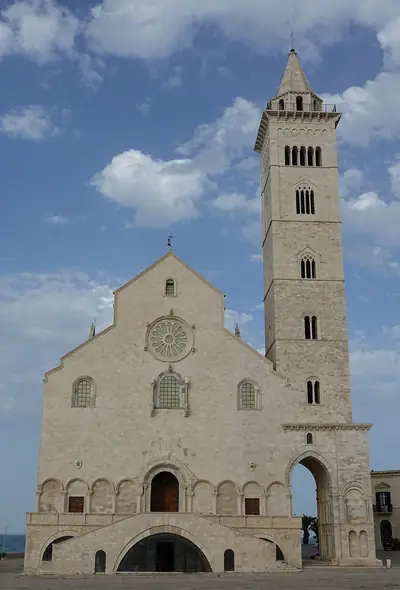
Trani Cathedral is the city’s defining monument and one of the finest examples of Apulian Romanesque architecture. Officially dedicated to the Assumption of Mary, it is more commonly associated with Saint Nicholas the Pilgrim, a young Greek pilgrim whose story is linked to the Norman period in southern Italy.
Consecrated in 1143, the cathedral was built from Trani’s local calcareous tuff. The stone has a remarkably light pink, almost white colour that seems to glow in the southern light. Its position directly beside the sea makes it especially striking: unlike many medieval churches, it stands apart from surrounding buildings and can be viewed from several sides.
The transept is particularly imposing, with an elaborate cornice. Beneath the bell tower, a high pointed arch creates an unusual feature within the Romanesque design.
Castle of Trani
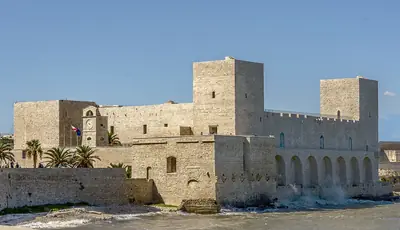
The Castle of Trani, or Castello Svevo, stands beside the waterfront as a reminder of the city’s medieval importance. Built in 1233 during the reign of Frederick II of Swabia, it is considered one of the most important and best-preserved examples of his castles in southern Italy.
Later transformations altered parts of the original layout, but the structure still reveals the characteristic military architecture associated with Frederick II. The castle was declared a national monument in 1936.
Chiesa di Ognissanti
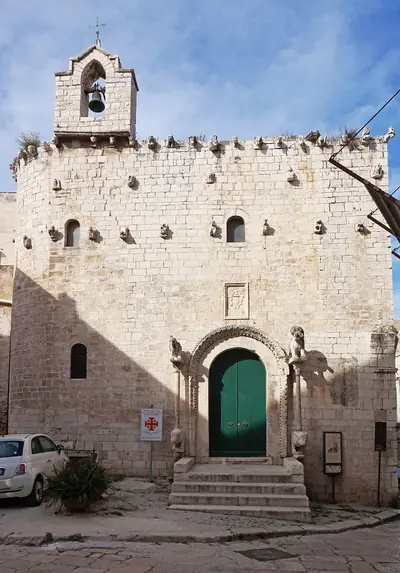
On the edge of the harbour, Chiesa di Ognissanti is a small Romanesque church dating from the twelfth century. It is also known as the Church of the Templars and, locally, as the Church of Purgatory.
Its simple architecture and waterfront position make it an atmospheric first stop when exploring Trani’s harbour. The building offers a quieter contrast to the imposing cathedral nearby while reflecting the medieval character of the city.
Scolagrande Synagogue and the Synagogue Museum Saint Anne
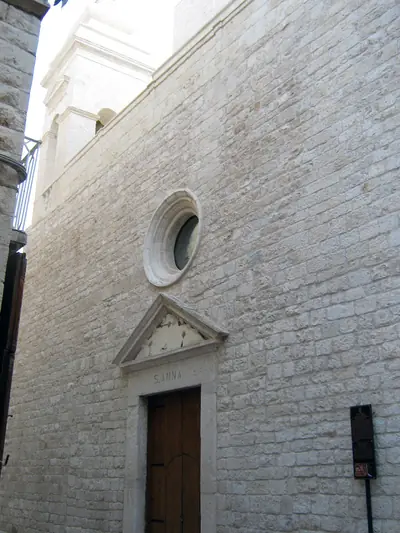
In Trani’s old Jewish quarter, the Scolagrande Synagogue—also called the Grand Synagogue—occupies a building with a complex history. It was completed in 1247 by the Jewish community of Apulia and is one of the few surviving medieval synagogues in southern Italy.
In 1380, the building was acquired by the Catholic Church and converted into a church. It was first dedicated to Saints Quiricus and Julietta and later to Saint Anne, giving rise to the name Church of Sant’Anna. After several restorations, the building was deconsecrated in 2004 and returned to the Jewish community.
Today, the site functions both as a synagogue and as the Synagogue Museum Saint Anne, also known as the St. Anna Synagogue Museum. Its history makes it one of the most significant places to visit in Trani.
Palazzo Torres
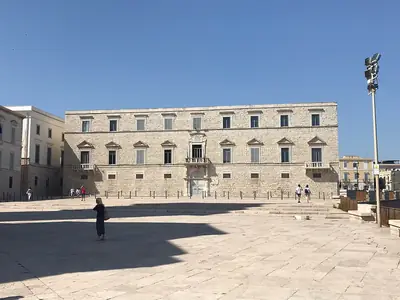
Palazzo Torres occupies a prominent position in Piazza Duomo. This sixteenth-century palace now serves as the seat of the Trani Court, housing the criminal court, the Assize court, and the prosecutor’s office.
Its presence adds a civic dimension to the square, where medieval religious architecture and later urban institutions stand close together.
Palazzo Beltrani
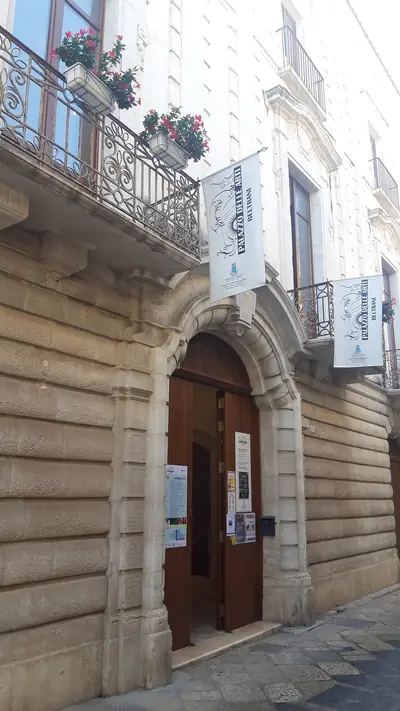
At the edge of the ancient borgo, where it meets the nineteenth-century district, Palazzo Beltrani illustrates another layer of Trani’s history. The historic palace now functions as a multifunctional museum, with works by local and southern Italian artists, temporary exhibitions, and events.
Churches in the Historic Centre
Trani’s historic centre contains several smaller churches that reward a slower walk through its streets.
The Church of San Giacomo, on Via Romito, dates from the twelfth century and is a quiet example of the medieval religious architecture found across the old town. San Martino, on Via San Martino, is a small Lombard church and a rare reminder of the Lombards’ presence in Italy.
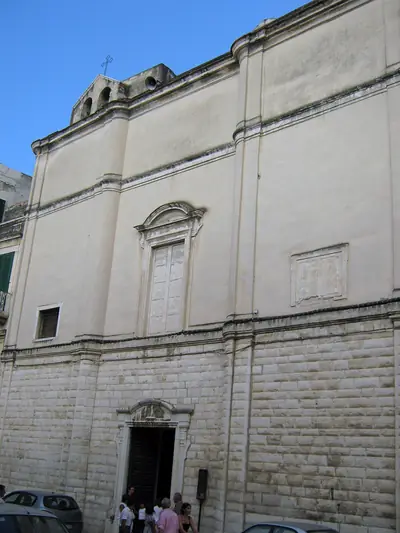
San Domenico is a Baroque church distinguished by the sail-like shape of its façade and a window that opens towards the sky. The Church of Santa Teresa, built in the seventeenth century by the Teresians, is another notable example of Baroque design.
The Church of the Carmine, or Beata Maria Vergine del Carmine, adds to Trani’s religious heritage, while San Giovanni and San Toma provide further historic stops within the city. Outside the centre, the Church of Santa Maria di Giano stands on the border between Trani and Bisceglia, beside the provincial road connecting Bisceglie and Andria.
Monastero di Santa Maria di Colonna
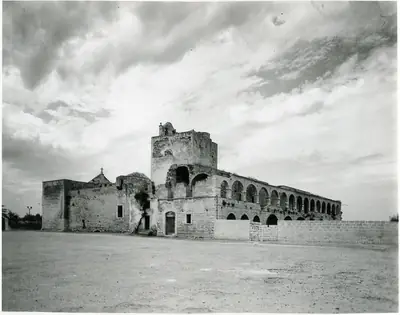
The Monastero di Santa Maria di Colonna lies on Capo Colonna, a small peninsula in Trani. The monastery is attached to a Romanesque church, making the site a worthwhile extension to a visit focused on the old town and waterfront.
A Trani Self-Guided Walking Tour
A self-guided walk is a practical way to connect Trani’s main landmarks without following a group itinerary. Neywo’s first walk, Trani: Stupor Mundi’s Castle, the Sea Cathedral and the Ghetto, covers 1.6 km in 76 minutes and includes 10 narrated stops. Its route brings together the Castle of Trani, Palazzo Torres, Trani Cathedral, Chiesa di Ognissanti, the synagogue area, San Martino, Palazzo Beltrani, the Church of San Giacomo, and Santa Chiara.
The second walk, Baroque Sails and Plague Chapels: Trani’s Churches, covers 1.55 km in 52 minutes and has six stops. It focuses on San Toma, San Francesco, San Rocco, San Domenico, Beata Maria Vergine del Carmine, and Santa Teresa.
Together, these routes offer a focused way to explore Trani’s medieval waterfront, Jewish heritage, civic buildings, and churches. They also make it easy to continue discovering Italy beyond the city, with other Apulian destinations such as Polignano a Mare and Ostuni.
Explore Trani with Neywo
Download Neywo to explore Trani with two walking tours, covering 1.6 km and 1.55 km in 76 and 52 minutes, with 10 and six narrated stops respectively. The app tells the story of each place as you reach it, at your own pace, with no group and no schedule. Narration is available in 11 languages, so you can explore Trani independently while learning about its cathedral, castle, synagogues, palaces, and churches.
Places with an audio guide in Trani
8 places in Trani with a Neywo audio guide. Each one starts telling its story as you reach it.
Self-guided tours in Trani
2 tours in Trani, free in the Neywo app. Each stop tells its story as you reach it.
- Walk
Trani: Stupor Mundi's Castle, the Sea Cathedral and the Ghetto
Trani's old town is a compact stage of Puglian history. Start at Frederick II's seaside castle, step into Piazza Duomo for the pale Romanesque cathedral that stands alone on the water, then wind through the Giudecca, where two medieval synagogues survived centuries as churches, and finish at a Franciscan convent built over ancient cisterns.
Castle of Trani · Palazzo Torres · Trani Cathedral · Chiesa di Ognissanti · Scolanova Synagogue · Synagogue Museum Saint Anne …
Open this tour: Trani: Stupor Mundi's Castle, the Sea Cathedral and the Ghetto - Walk
Baroque Sails and Plague Chapels: Trani's Churches
Beyond the cathedral Trani hides smaller churches with stories of their own: a plague chapel from 1528, a Baroque facade shaped like a sail that frames the sky, and a Romanesque parish church still full of life. Walk the streets of the southern old town church by church.
San Toma · San Francesco · San Rocco · San Domenico · Beata Maria Vergine del Carmine · Santa Teresa
Open this tour: Baroque Sails and Plague Chapels: Trani's Churches
Walk Trani with Neywo
Neywo turns Trani into a self-guided audio tour. Stories arrive as you reach the place they belong to, and the route reshapes when you wander off it.

