Rimini, Italy: Self-Guided Walking Tour
Things to Do in Rimini: Roman History, Renaissance Art and Fellini’s World
The best things to do in Rimini include exploring Roman monuments, discovering Malatesta architecture, visiting the Fellini Museum and following the city’s historic streets towards the Adriatic. Rimini combines an ancient past with Renaissance art and twentieth-century cinema, making it much more than a beach destination. Neywo offers a free audio guide for Rimini with 72 narrated places.
What to See in Rimini’s Historic Centre
Arch of Augustus
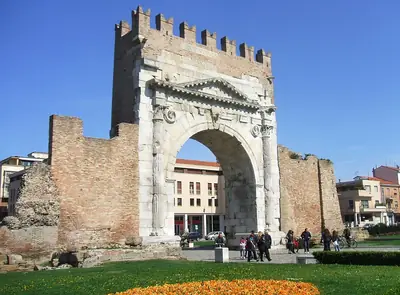
The Arch of Augustus, or Arco d’Augusto, is one of Rimini’s defining Roman monuments. Built in 27 BC, it marked the end of the Flaminian Way, the road connecting Rimini with Rome. The Roman Senate commissioned it to honour Augustus after he restored the Flaminian Way, the Via Emilia and the Via Popilia.
Made from Istrian stone, the arch has an unusually wide opening designed to allow traffic to pass through. Fluted columns with Corinthian capitals frame the structure, while four shields represent Jupiter, Apollo, Neptune and Roma. It once formed part of a larger gateway, but the attached walls were demolished in the 1930s.
Roman Amphitheatre of Rimini
Built in the second century AD, the Roman Amphitheatre hosted public spectacles, mainly gladiatorial shows. It stood outside the main urban area, east of the historic centre and near the sea, in the direction of the beach. Its construction reflected the growing importance of Ariminum, the Roman city that became Rimini.
The amphitheatre joined an already significant collection of Roman buildings, including the theatre and the bridge begun under Augustus.
Ponte d’Augusto, or Bridge of Tiberius
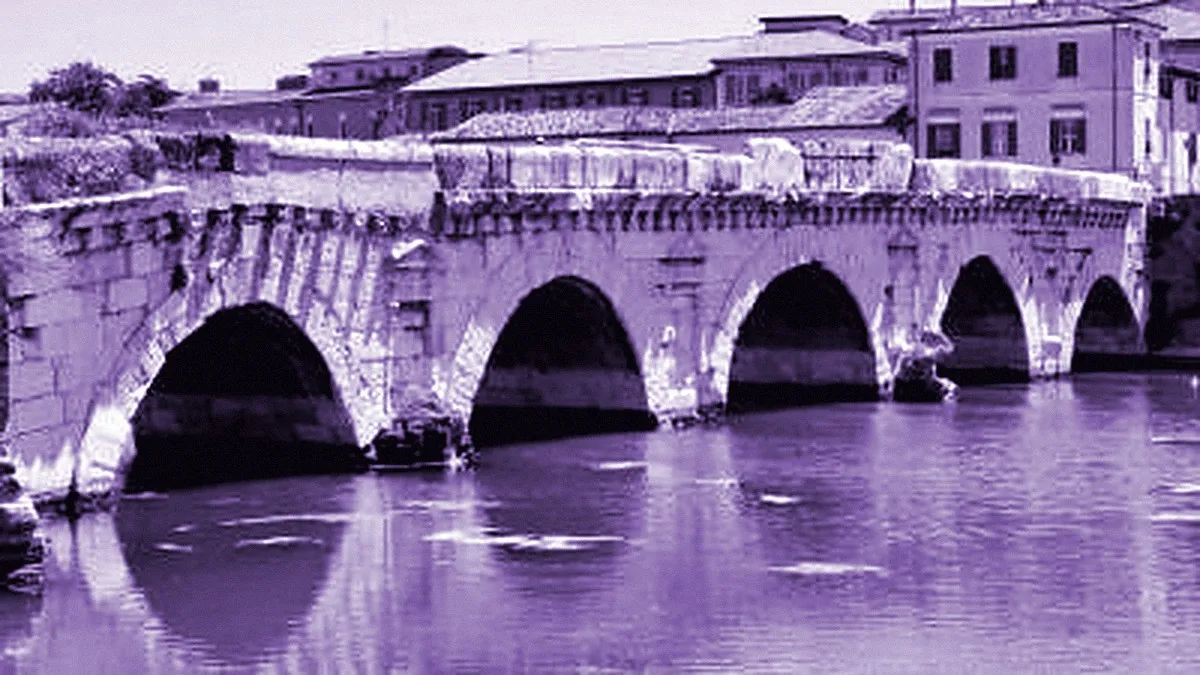
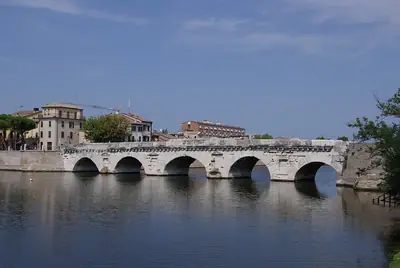
The Ponte d’Augusto, also known as the Bridge of Tiberius, has connected Rimini’s historic areas for nearly two thousand years. Construction began in 14 AD, during the final years of Augustus’s reign, and ended in 21 AD under Tiberius.
The bridge is built entirely from Istrian stone and has five Doric arches. Its gently rising roadway creates a curved, “donkey-back” profile. Niches, pilasters, tablets, pediments and decorative cornices enrich the upper structure. The bridge stands at the beginning of the Via Emilia and was also connected with routes towards Ravenna and Rome.
City Museum of Rimini
The City Museum of Rimini, or Museo della città di Rimini Luigi Tonini, occupies a former Jesuit convent beside the Church of the Suffrage and the House of the Surgeon archaeological site. Alfonso Torreggiani designed the building, which was constructed between 1746 and 1755 as a seminary and Jesuit convent. It later became a civic hospital, remaining in use until 1977.
The museum opened in 1981 and was redesigned in 1990. Its collections cover Rimini’s history from the eleventh to the twentieth century. In the cloister, a Roman lapidarium displays stone fragments dating from the first to the fourth centuries. The basement preserves surgical instruments discovered at the neighbouring House of the Surgeon, while the galleries include Giovanni da Rimini’s Renaissance fresco of the Last Judgement and more than fifty works from the Rimini Savings Bank Foundation.
aRimini Caput Viarum
The visitor experience aRimini Caput Viarum includes the former church of Santa Maria ad Nives, which houses the Visitor Center of Roman Rimini. The church dates from the fourteenth century, although it was completely reconstructed in the middle of the eighteenth century. Until 1814, it was known as Santa Maria della Misericordia.
It offers another place to understand Rimini’s Roman heritage while seeing how a medieval building was transformed in a later period.
Discover Rimini’s Malatesta Heritage
Castel Sismondo
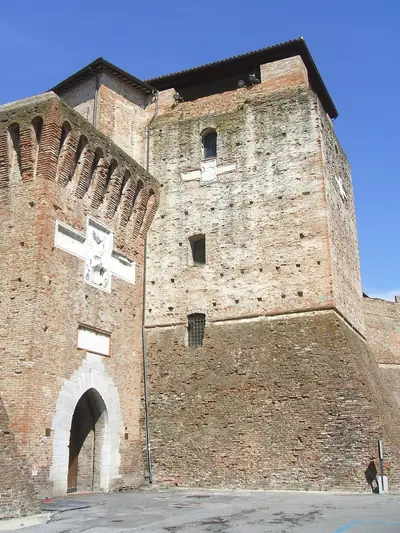
Castel Sismondo in Malatesta Square is the surviving central core of a fortified palace built for Sigismondo Pandolfo Malatesta, lord of Rimini and Fano. Construction began in 1437 and continued for almost fifteen years. Several architects worked on the project, including Filippo Brunelleschi.
The original fortress was far larger than the structure visible today. Enormous towers, thick sloping walls, a double ravelin, a drawbridge, a central courtyard, a massive keep and the three-storey Isotta wing formed part of the complex. Another circuit of walls and a moat once protected it. The outer walls and towers later disappeared, and parts of the building were demolished. From 1821, the castle served as barracks.
Palazzo dell’Arengo
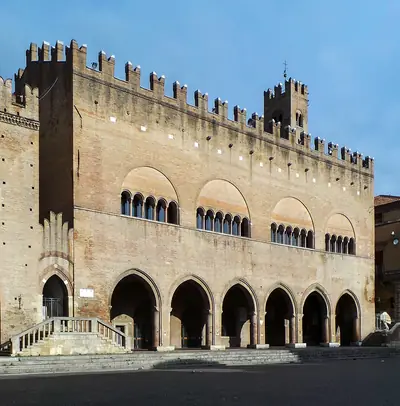
In Piazza Cavour, Palazzo dell’Arengo recalls Rimini’s medieval civic power. Built between 1204 and 1207, it was originally known as the Palatium comunis and served as a broletto, a town hall of the kind found in northern Italy.
Justice was administered beneath its portico, while the upper floor held the assembly hall. Ghibelline battlements, strong colonnades, pointed arches and a grand loggia define its Romanesque-Gothic appearance. The building also preserves fourteenth-century frescoes and medieval capitals. During the Middle Ages, the General Council met here, making the palace a symbol of Rimini’s civic authority.
Tempio Malatestiano
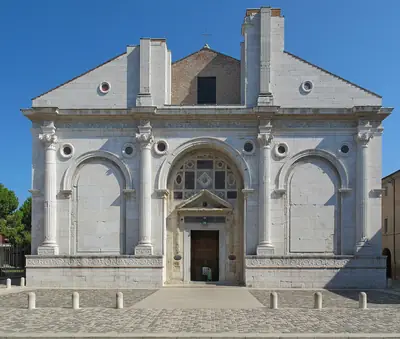
The Tempio Malatestiano is Rimini’s cathedral and one of its most important Renaissance buildings. Locals usually call it the Duomo. The church began as a thirteenth-century Franciscan building, but Sigismondo Pandolfo Malatesta commissioned its transformation in 1450 as a mausoleum for himself and Isotta degli Atti and as an expression of his authority.
Leon Battista Alberti designed the façade with ancient Roman architecture in mind, drawing inspiration from the Arch of Augustus. The side arcades recall Roman aqueducts, while the building’s unfinished state remains part of its character: the planned eastern rotunda was never added.
Follow Fellini Through Rimini
Fellini Museum at Castel Sismondo
Castel Sismondo forms the main exhibition space of the Fellini Museum. The museum extends across three connected settings: the castle, Valloni Palace with the Fulgor Cinema, and Malatesta Square, transformed into the Square of Dreams.
The museum links Rimini with Federico Fellini’s imagination. According to the story associated with the site, the young Fellini ran away from home and reached the Malatestian Stronghold, where he saw a circus tent and a carnival in front of the forbidding castle. The theatrical atmosphere seemed to anticipate the world of dreams and fantasy he later created in film.
In the Square of Dreams, a circular bench recalls the ring-around-the-Rosie scene from 8 1/2, while a fountain produces a continuous mist reminiscent of effects in Fellini’s films.
Fulgor Cinema
A few steps away, the Fulgor forms another part of the Fellini Museum. The cinema occupies Valloni Palace on Augusto Street, whose façade was rebuilt in 1787 to a design by Giuseppe Valadier. After restoration work in 1920, the palace became Cinema Fulgor.
The two ground-floor screening rooms were designed by production designer Dante Ferretti in an old Hollywood style. The Federico Room has 190 seats and the Giulietta Room has 52. The building also contains photographs, portraits, posters, unfinished projects and projected sequences from Fellini’s films. Above, the ceiling carries a reproduction of the astral chart of Fellini’s birth, dated January 20, 1920.
Explore More of Rimini and Its Surroundings
Rimini’s museums extend beyond the historic centre. The Museo dell’Aviazione, in the hills above the city, occupies about one hundred thousand square metres and displays more than fifty original aircraft, as well as anti-aircraft and armoured vehicles, flying scale models, uniforms, documents, decorations and medals.
The Museo degli Sguardi and the Museo Nazionale del Motociclo offer two further museum visits. For a taste of Emilia-Romagna, the Tavern of Three Moors, or Taverna I Tre Mori, is near the Arch of Augustus. Open since 2003, it serves traditional appetisers and snacks and has a cellar with more than 150 Italian wines.
Rimini is also the capital of the Emilia-Romagna region, a territory shaped by the Adriatic coast and inland hills. Its province includes seaside destinations such as Riccione, Cattolica, Bellaria Igea Marina and Misano Adriatico. For a wider trip through the region, consider nearby Ravenna, Cesenatico or Bologna.
Explore Rimini with Neywo’s Audio Guide
Neywo helps turn a visit into a Rimini self-guided walking tour. The app has two walking tours, one bus route and one bike route:
- Ariminum: Rome on the Adriatic — a 3.31 km walk lasting 87 minutes, with 8 narrated stops.
- Malatesta Rimini — a 1.53 km walk lasting 77 minutes, with 10 narrated stops.
- Bus 15: Malatesta Temple to Roman Rimini — a 4.4 km bus route lasting 19 minutes, with 5 narrated stops.
- From the Old Town to Fellini’s Grand Hotel by Bike — a 5.9 km bike route lasting 30 minutes, with 6 narrated stops.
Each story plays as you reach the place, at your own pace, with no group and no schedule. Narration is available in 11 languages. Download Neywo and explore Rimini through its Roman bridges, Malatesta monuments, museums and Fellini landmarks while the city’s stories unfold around you.
Places with an audio guide in Rimini
8 places in Rimini with a Neywo audio guide. Each one starts telling its story as you reach it.

Self-guided tours in Rimini
4 tours in Rimini, free in the Neywo app. Each stop tells its story as you reach it.
- Bike ride
From the Old Town to Fellini's Grand Hotel by Bike
A flat ride on Rimini's cycle lanes from the southern suburb of Colonnella to the Roman Arch of Augustus, then through the old town towards the seafront. Pass the Grand Hotel, the palace made famous by Fellini, and end at the harbour church of San Nicolò al Porto.
Madonna della Colonnella · San Giovanni Battista · Arch of Augustus · San Bartolomeo, Rimini · The Grand Hotel Rimini · San Nicolò al Porto
Open this tour: From the Old Town to Fellini's Grand Hotel by Bike - Bus ride
Bus 15: Malatesta Temple to Roman Rimini
Local bus 15 crosses the old town of Rimini from the harbour district past the Malatesta Temple and the Santa Croce church to the Arch of Augustus, the Roman gate that opens the Flaminian Way, and on to Sant'Andrea dell'Ausa.
San Nicolò al Porto · Tempio Malatestiano · Chiesa di Santa Croce nuova, Rimini · Arch of Augustus · Chiesa di Sant'Andrea dell'Ausa
Open this tour: Bus 15: Malatesta Temple to Roman Rimini - Walk
Ariminum: Rome on the Adriatic
Rimini was the Roman town of Ariminum, where the Flaminian and Emilian roads began. Walk from the gladiators' amphitheatre past the oldest surviving Roman arch, the square where Caesar is said to have rallied his legion and the surgeon's house under glass, to a Roman bridge that survived every war.
Roman Amphitheatre of Rimini · Arch of Augustus · Square Tre Martiri · Domus del Chirurgo · City Museum of Rimini · Porta Montanara …
Open this tour: Ariminum: Rome on the Adriatic - Walk
Malatesta Rimini
In the 15th century Sigismondo Malatesta turned Rimini into a Renaissance court. See his fortress, the civic squares and palaces of the medieval commune, and the unfinished temple where Alberti borrowed the shape of a Roman arch.
Sant'Agostino, Rimini · Castel Sismondo · Teatro Amintore Galli · Piazza Cavour (Rimini) · Palazzo dell'Arengo · Palazzo del Podestà …
Open this tour: Malatesta Rimini
Walk Rimini with Neywo
Neywo turns Rimini into a self-guided audio tour. Stories arrive as you reach the place they belong to, and the route reshapes when you wander off it.

