Visiting Ravenna, Italy: Top Sights on Foot
Things to Do in Ravenna: Mosaics, Monuments and Dante
Ravenna is an Italian city known for its early Christian monuments, Byzantine mosaics and layers of Roman, Ostrogothic and medieval history. The best things to do in Ravenna include visiting its UNESCO-listed churches and baptistries, discovering historic tombs and palaces, and following the story of Dante Alighieri through the city. Neywo offers a free audio guide for Ravenna with 91 narrated places.
Part of Emilia-Romagna, Ravenna is a rewarding destination to explore on foot. Its historic centre brings together major works of Byzantine art and smaller, quieter places where the city’s long history remains visible in brick walls, cloisters and archaeological remains.
What to See in Ravenna
Basilica of San Vitale
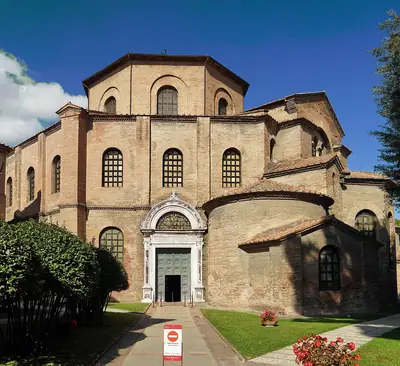
The Basilica of San Vitale is one of Ravenna’s most important churches and one of the great monuments of Byzantine art. Construction began in 532 and the basilica was consecrated in 547. Dedicated to Saint Vitalis, a Roman slave and Christian martyr, it combines Roman and Byzantine traditions in an unusual octagonal design.
Inside, the mosaics are the main attraction. They include the celebrated images of Emperor Justinian and Empress Theodora, linking religious imagery with imperial authority. The church also contains notable architectural details, including a dome built with hollow terra-cotta tubes inserted into one another and early examples of flying buttresses.
Mausoleum of Galla Placidia
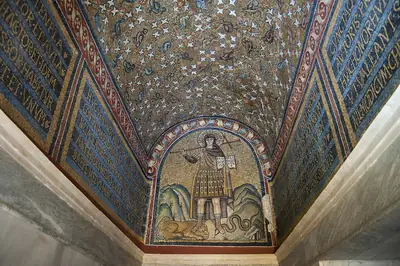
The Mausoleum of Galla Placidia is a small building with an exceptionally rich interior. Dating from approximately 425 to 430, it has the form of a Greek cross, with a central dome and four vaulted arms.
Its mosaics transform the space with deep colours and Christian imagery. The dome is covered by a starry sky surrounded by the apostles and symbolic doves. Above the entrance, Christ appears as the young Good Shepherd. Thin alabaster panels filter the light through the windows, creating the mausoleum’s distinctive atmosphere.
Despite its traditional name, Galla Placidia was probably not buried here: she died in Rome and was buried there. The building’s original purpose is also debated. It may have been an imperial mausoleum, a chapel, a martyrium or an oratory linked to the Church of Santa Croce.
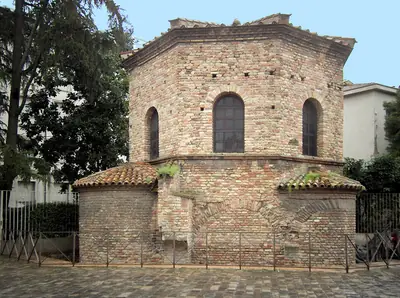
Baptistry of Neon
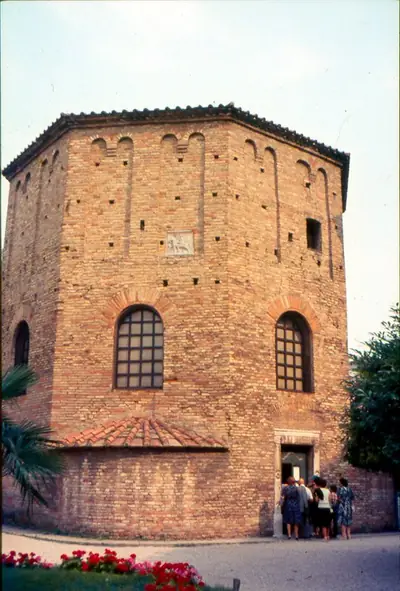
Also called the Baptistery of the Orthodox, the Baptistry of Neon is the oldest surviving building in Ravenna. This octagonal brick structure began at the end of the fourth or the beginning of the fifth century under Bishop Ursus, and Bishop Neon completed it toward the end of the fifth century.
The number of sides carries symbolic meaning: seven represent the days of the week, while the additional side evokes the Resurrection and eternal life. Inside, a stone baptismal font stands beneath a dome covered in mosaics. The central scene shows John the Baptist baptizing Christ in the Jordan River.
The original floor is now around two to three metres below the present ground level, giving the building a clear sense of how Ravenna has changed over time.
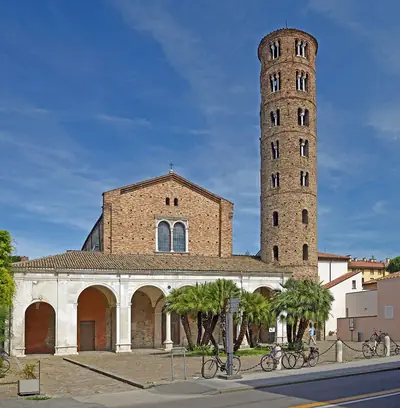
Basilica of Sant’Apollinare Nuovo
The Basilica of Sant’Apollinare Nuovo preserves an extraordinary mosaic cycle along its walls. The building began in the early sixth century as a chapel belonging to the palace of the Ostrogothic king Theodoric. It was originally an Arian place of worship and was dedicated to Christ the Redeemer in 504.
After Ravenna came under Byzantine rule, Emperor Justinian I rededicated it in 561 to Saint Martin of Tours. Its present name dates from the ninth century, after the relics of Saint Apollinaris were transferred here from the Basilica of Sant’Apollinare in Classe because of pirate raids along the coast.
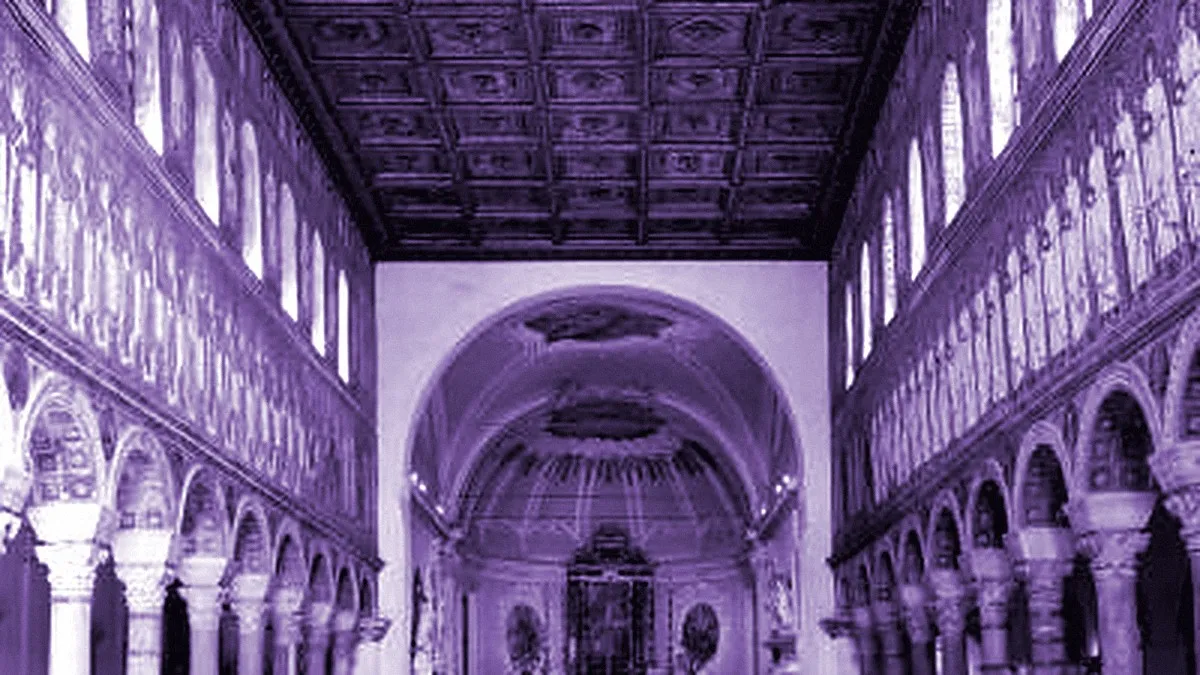
The mosaics show scenes of Jesus’s miracles and parables, as well as saints, prophets and evangelists. They reveal the meeting of western and eastern decorative traditions during the late fifth and early sixth centuries.
Basilica of Sant’Apollinare in Classe
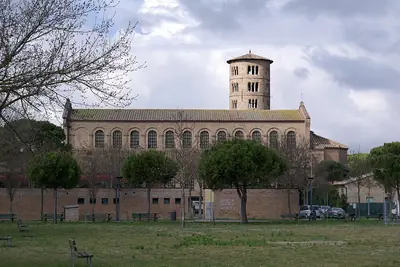
The Basilica of Sant’Apollinare in Classe stands outside the city in the area associated with Ravenna’s former port. Built in brick and completed in the sixth century, it was consecrated in 549 by Bishop Maximian and dedicated to Saint Apollinaris, remembered as the first bishop of Ravenna and Classe.
Its early Christian basilica form is marked by a clear design, carefully used space and rich decoration. In 856, the remains of Saint Apollinaris were transferred from this church to Sant’Apollinare Nuovo. The basilica has belonged to the UNESCO listing of Ravenna’s Early Christian Monuments and Mosaics since 1996.
A bike route from the city gates to Sant’Apollinare in Classe offers a way to connect Ravenna’s historic centre with this important monument.
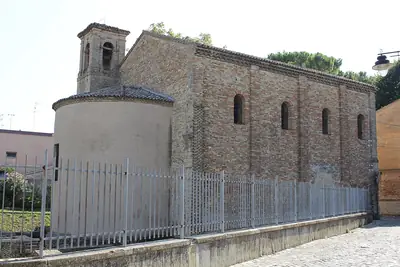
Arian Baptistry
The Arian Baptistry was built for Ravenna’s Arian Christian community during the reign of Theodoric. Construction began in the late fifth century and was completed in the first half of the sixth century. The small, octagonal building originally belonged to the Arian cathedral, now known as the Church of the Holy Spirit.
Its exterior is made of brick and has subsided by about two and a quarter metres. Inside, the decoration is deliberately restrained: the brickwork is exposed, furnishings do not survive, and only a circular marble slab marks the former baptismal font.
The focus is the mosaic dome. At its centre, John the Baptist baptizes Christ in the Jordan River, with the Holy Spirit represented by a dove. The surrounding decoration is simpler than that of the Baptistry of Neon.
Archbishop’s Chapel and the Archiepiscopal Museum
The Archbishop’s Chapel, also known as the Chapel of Saint Andrew, occupies the first floor of Ravenna’s Archbishop’s Palace. It is part of the Archiepiscopal Museum, a collection founded in 1734 and regarded as the first diocesan museum established in Italy.
The museum preserves early Christian relics and fragments from Ravenna’s churches. Among its most important objects is the sixth-century Byzantine Ivory Cathedra, a bishop’s seat considered one of the finest examples of ivory carving in Western art.
The chapel itself dates from the end of the fifth century, during the time of Theodoric. Its mosaics include the initials of Christ, a symbol that reaffirmed the Orthodox creed during a period when Arians held dominance in Ravenna.
Ravenna Cathedral
Ravenna Cathedral is the principal place of worship in the city and the seat of the Archdiocese of Ravenna-Cervia. Its official name is the Metropolitan Cathedral of the Resurrection of Our Lord Jesus Christ.
The present building belongs to the Baroque tradition and was created during a radical eighteenth-century transformation. It replaced the ancient Ursiana Basilica, Ravenna’s first cathedral. The origins of that earlier cathedral are connected with the transfer of the capital of the Western Roman Empire from Milan to Ravenna in 402, when the bishop’s seat also moved here from Classe.
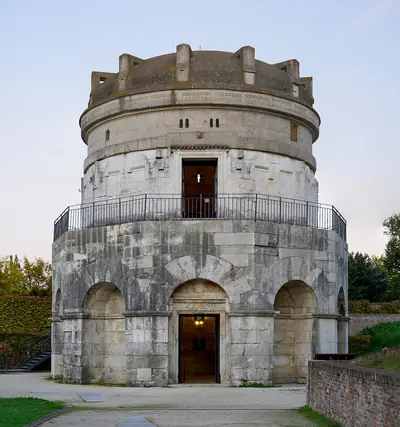
Mausoleum of Theodoric
The Mausoleum of Theodoric is one of Ravenna’s most distinctive monuments. It is a two-level funerary structure made from enormous blocks of Aurisina stone rather than brick, setting it apart from many of the city’s early Christian buildings.
Its design draws on Roman mausoleums, while its Gothic decoration and powerful crowning frame give it a distinctive character. Syriac influences can also be seen in the upper finish. The exact construction date is uncertain, but the building was created as the resting place of an Ostrogothic ruler.
Dante Museum and the Franciscan Cloisters
The Chiostri Francescani, or Franciscan Cloisters, provide the setting for the Museo Dantesco. Located near Dante Alighieri’s final resting place, the museum explores the poet’s life, works and influence, with particular attention to the Divine Comedy.
The museum was inaugurated in 1921, the six-hundredth anniversary of Dante’s death. Its collection originally brought together relics and memorabilia belonging to the municipality, along with objects sent from around the world to commemorate the poet.
The cloisters and museum make Dante’s connection with Ravenna tangible, adding a literary dimension to a city more often associated with mosaics.
Other historic places
Several smaller stops add further depth to a visit. Brancaleone Fortress, also known as Rocca Brancaleone, was built by the Venetians in the fifteenth century and is now home to one of Ravenna’s parks. The so-called Palace of Theodoric preserves a fragment of masonry along Via di Roma, close to Sant’Apollinare Nuovo.
Palazzo della Provincia contains the Rasponi Crypt and hanging gardens. The present building replaced the Rasponi family’s seventeenth-century residence, which was destroyed by arson in 1922 and rebuilt between 1926 and 1928. The surviving crypt is the oldest element of the architectural ensemble.
Explore Ravenna with Neywo
Download Neywo and explore Ravenna with three walking tours and one bike route. The walks range from 2.06 to 2.92 km and last between 92 and 119 minutes, with 8 or 12 narrated stops each. The bike route to Classe covers 5 km, lasts 25 minutes and includes 3 narrated stops.
Neywo tells the story of each place as you reach it, at your own pace, with no group and no schedule. Narration is available in 11 languages, so you can turn a visit to Ravenna’s mosaics, baptistries and historic quarters into a self-guided experience. Ravenna is also one of the cities to explore in Italy, with nearby destinations including Rimini, Ferrara and Bologna.
Places with an audio guide in Ravenna
8 places in Ravenna with a Neywo audio guide. Each one starts telling its story as you reach it.
Self-guided tours in Ravenna
4 tours in Ravenna, free in the Neywo app. Each stop tells its story as you reach it.
- Bike ride
By Bike to Classe: City Gates to Sant'Apollinare
Ride south from the old gates of Ravenna along the flat cycle path to Classe, once the great Roman fleet harbour. The ride ends at the brick basilica of Sant'Apollinare in Classe, a UNESCO site with a glittering apse mosaic.
Porta San Mama · Portonaccio · Basilica of Sant'Apollinare in Classe
Open this tour: By Bike to Classe: City Gates to Sant'Apollinare - Walk
Ravenna's Golden Age: Mosaics and Baptistries
Ravenna was an imperial capital, and eight of its monuments are UNESCO World Heritage. This walk strings the best together: a hidden Roman house with stone carpets, the octagon of San Vitale, the starry vault of Galla Placidia, the baptistry of Neon, the archbishop's museum, the church where Dante's funeral was held, and the long mosaic nave of Sant'Apollinare Nuovo.
Domus dei Tappeti di Pietra · Basilica of San Vitale · Mausoleum of Galla Placidia · Baptistry of Neon · Archiepiscopal Museum of Ravenna · Basilica di San Francesco …
Open this tour: Ravenna's Golden Age: Mosaics and Baptistries - Walk
In Theodoric's Footsteps: The Eastern Quarter
Follow the quieter east side of the old centre, where the Ostrogothic king Theodoric built his palace and his Arian cathedral. Start at his massive stone tomb, then walk from the Venetian fortress through the Holy Spirit church and the surviving palace wall to an art museum, a basilica and the monumental gate at the southern edge of town.
Mausoleum of Theodoric · Brancaleone Fortress · San Giovanni Evangelista, Ravenna · La Gerusalemme Celeste · Spirito Santo · Palace of Theodoric in Ravenna …
Open this tour: In Theodoric's Footsteps: The Eastern Quarter - Walk
Dante's Last Home: Piazza, Library and Tomb
The poet Dante died in exile in Ravenna in 1321, and the city still guards his tomb. Start in the market quarter and the main square, then walk into the Dante district: the Franciscan cloisters, the basilica where his funeral was held, the oldest churches nearby and the Roman house hidden under San Nicolo.
Dante Alighieri · Church of San Domenico (Ravenna) · Palazzo sede della Casa Matha · Palazzo Comunale · Teatro Comunale Dante Alighieri · Palazzo della Provincia …
Open this tour: Dante's Last Home: Piazza, Library and Tomb
Walk Ravenna with Neywo
Neywo turns Ravenna into a self-guided audio tour. Stories arrive as you reach the place they belong to, and the route reshapes when you wander off it.

