Ferrara, Italy: Self-Guided Walking Tour
Things to Do in Ferrara, Italy: A Self-Guided Walk Through the Este City
Ferrara is a historic city in Emilia-Romagna shaped by the Este family, with Renaissance palaces, medieval streets, churches and quiet squares gathered around a compact centre. The city is especially rewarding for travellers who want to explore at a relaxed pace and see how its religious, civic and university buildings fit into one coherent urban landscape. Neywo has a free audio guide for Ferrara with 192 narrated places.
What to See in Ferrara
Ferrara’s most important sights range from its cathedral and castle to former monasteries, noble residences and university buildings. The following places offer a useful introduction to the city.
Ferrara Cathedral and the Loggia dei Merciai
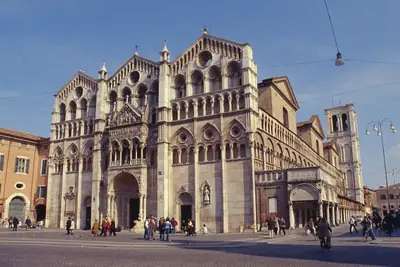
The Cathedral of Saint George the Martyr, usually called Ferrara Cathedral, stands at the centre of the city, facing the Palazzo Municipale and beside Piazza delle Erbe. It is the principal Catholic church of Ferrara and the mother church of the Archdiocese of Ferrara-Comacchio.
The cathedral also contains the tomb of Pope Urban III. In 1959, Pope John XXIII raised it to the rank of minor basilica. After restoration and structural consolidation addressing problems connected with the 2012 Emilia earthquake, the cathedral reopened for worship on 23 March 2024.
Along the cathedral’s side, the Loggia dei Merciai—also known as the Loggia dei Mercanti or Loggia degli Strazzaroli—adds a commercial and lively element to the square. Its shops face Piazza Trento e Trieste and the Palazzo della Ragione.
Palazzina Marfisa d’Este
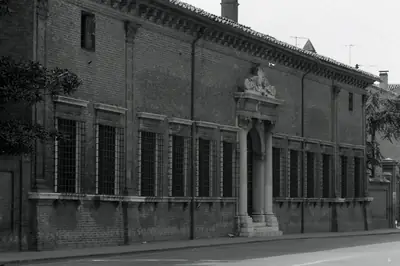
Palazzina Marfisa d’Este is one of Ferrara’s finest examples of a sixteenth-century noble residence. Built by the Este family, the palace preserves the character of an important aristocratic home. Since 1938, it has served as a museum, making it possible to experience the building as both a historic residence and a cultural site.
Corpus Domini Monastery
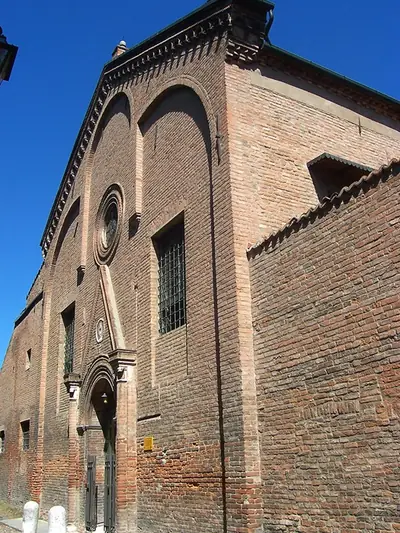
The Church and Monastery of Corpus Domini is closely connected with Ferrara’s Este family and religious history. Founded in 1406, the monastery was once an extensive complex stretching between Via Praisolo, Via Campofranco, Via Pergolato and Via Savonarola. A fire later destroyed it, and the monastery was rebuilt on a smaller scale.
Sant’Antonio in Polesine
The Church and Monastery of Sant’Antonio in Polesine forms a single religious complex where the church and monastic setting remain closely connected. It is one of the places that gives Ferrara’s southern historic area its distinctive atmosphere.
Castello di Fossa d’Albero
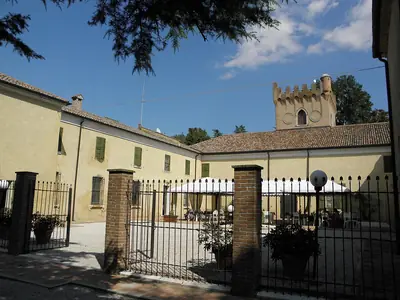
In the Fossadalbero district, the Castello di Fossa d’Albero is also known as the Delizia di Fossadalbero. Niccolò III d’Este built the historic residence during the first half of the fifteenth century. It later became one of the Este family’s Delizie through the wishes of Borso d’Este.
Ex Caserma Pastrengo
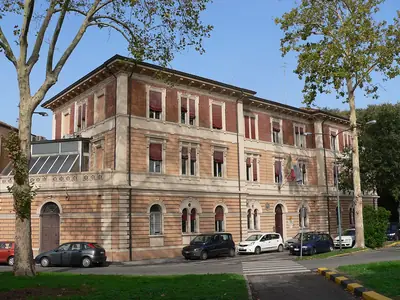
The former Pastrengo Barracks, or Ex Caserma Pastrengo, is a monumental building at 28 Corso Isonzo. Its scale and formal character reflect the institutional architecture found throughout Ferrara.
Palazzo Turchi di Bagno and the Museum of Paleontology
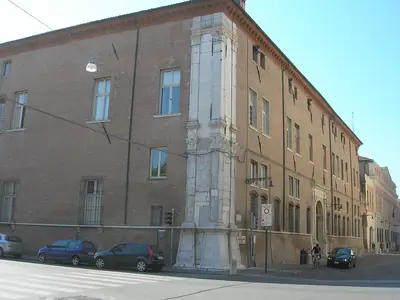
Palazzo Turchi di Bagno stands at 32 Corso Ercole I d’Este. Biagio Rossetti built the Renaissance palace between 1493 and 1501 for the Bagno family. After the family transferred it to the military authorities in 1933, the University of Ferrara restored the building, which now houses university departments.
The palace also contains the Museo di Paleontologia e Preistoria Piero Leonardi. Founded in 1964 on the initiative of geologist, palaeontologist and naturalist Piero Leonardi, the museum presents the evolution of vertebrates. Its exhibits include amphibians, Permian mesosaur reptiles, Triassic therapsids, a marine crocodile and Jurassic ichthyosaurs, as well as mammal remains such as giant Paleogene perissodactyl skulls, a sabre-toothed tiger and a Pleistocene woolly rhinoceros. The museum has been temporarily closed.
Palazzo Massari and the Museo Giovanni Boldini
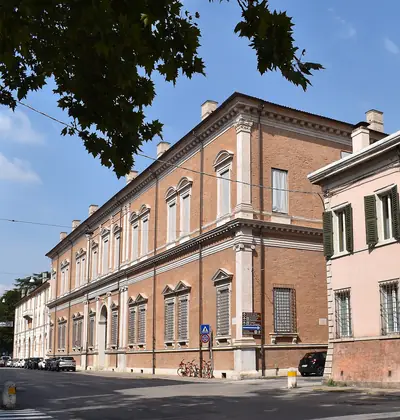
Palazzo Massari is a grand historic noble palace at 9 Corso Porta Mare. It is also home to the Museo Giovanni Boldini, dedicated to the painter Giovanni Boldini. Following the 2012 Emilia earthquake, the museum closed for restoration work.
Palazzo Gulinelli
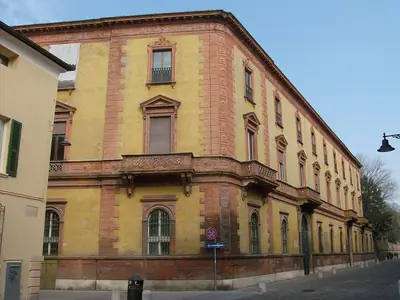
At the intersection of Corso Ercole I d’Este and Via Armari, Palazzo Gulinelli is also known as Palazzo Canonici Mattei. Renovated during the second half of the nineteenth century, the building later became the long-standing home of the Istituto Canonici Mattei, which remained there until it closed in 2011.
Palazzo della Borsa and Palazzo della Camera di Commercio
In Largo Castello, Palazzo della Borsa—formerly the Monte di Pietà—stands directly opposite the Castello Estense. Beside it is the Palazzo della Camera di Commercio, another monumental building that helps define the beginning of Corso Ercole I d’Este.
The Camera di Commercio building faces Via Borgoleoni, opposite the Palazzo delle Assicurazioni Generali. Together, these buildings form an important civic group around the castle.
Palazzo di Giulio d’Este
Further along Corso Ercole I d’Este, Palazzo di Giulio d’Este reveals the Renaissance character of the street. Although it has historic origins, the building now serves as the headquarters of the prefecture offices, bringing its earlier and present-day roles together.
Palazzo Paradiso
Palazzo Paradiso is another historic palazzo in Ferrara. It belongs to the sequence of civic and aristocratic buildings that make the city’s centre rewarding to explore on foot.
Palazzo Renata di Francia
Palazzo Renata di Francia is also known as Palazzo Gavassini and Palazzo Pareschi. Today, it houses the rectorate of the University of Ferrara, which has used the palace since 1959.
The building was acquired and restored by the university in a project led by architect Piero Bottoni, completed in 1963. The University of Ferrara itself was founded in 1391 by Marquis Alberto V d’Este with permission from Pope Boniface IX, and is described as one of the oldest universities in the world.
Santo Spirito
The Chiostro di Santo Spirito, also known as the Chiesa di Santo Spirito, is a Catholic church on Via Montebello. Its cloister and church setting add another layer to Ferrara’s network of religious and historic buildings.
Exploring Ferrara with a Self-Guided Audio Guide
A Ferrara self-guided walking tour lets you connect the city’s main sights without joining a group or following a fixed timetable. Neywo’s free audio guide includes 4 walking tours, 1 bus route and 1 bike route, with narration available in 11 languages.
The walking tours cover different sides of the city:
- Cathedral, Ghetto and the Convent of the Dukes: 2.37 km, 110 minutes and 12 narrated stops.
- Rossetti’s Ideal City: From the Castle up Corso Ercole: 1.59 km, 107 minutes and 12 narrated stops.
- The Southern Edge: Walls, Delizie and an Unfinished Palace: 2.32 km, 89 minutes and 10 narrated stops.
- Ferrara’s Pantheon and the Quiet West: 1.49 km, 51 minutes and 6 narrated stops.
There is also Line 9 Along Corso Giovecca, a 3.6 km bus route taking 15 minutes with 8 narrated stops, and Ferrara’s Walls by Bike, a 7.1 km cycling route taking 36 minutes with 8 narrated stops.
Download Neywo and explore Ferrara at your own pace. The app tells the story of each place as you reach it, with no group and no schedule—whether you are walking through the historic centre, taking the bus along Corso Giovecca or cycling beside the city walls. Ferrara is also a natural stop within Emilia-Romagna, alongside cities such as Bologna, Modena and Ravenna.
Places with an audio guide in Ferrara
8 places in Ferrara with a Neywo audio guide. Each one starts telling its story as you reach it.
Self-guided tours in Ferrara
6 tours in Ferrara, free in the Neywo app. Each stop tells its story as you reach it.
- Bike ride
Ferrara's Walls by Bike
Ferrara still has its Renaissance walls and they are made for cycling. Ride the northern stretch of the ring from the west gate past the Torrione del Barco, the Porta degli Angeli and the Torrione di San Giovanni, then roll down to the bastion of San Tommaso at the end of Corso Giovecca.
Chiesa di San Giacomo Apostolo · Torrione del Barco · Delizia di Belfiore · Porta degli Angeli · Torrione di San Giovanni · Santa Maria del Perpetuo Soccorso …
Open this tour: Ferrara's Walls by Bike - Bus ride
Line 9 Along Corso Giovecca
Tper's line 9 leaves the station and follows Ferrara's grand Corso Giovecca, the Este avenue that cuts through the middle of the Renaissance city. Ride it past the old Monte di Pietà, the Teatini church and Marfisa d'Este's palace, to the monumental arch that closes the street at the east end.
Palazzo Panfilio · Palazzo delle Poste · Palazzo della Borsa · Chiesa di Santa Maria dei Teatini · Palazzo della Cassa di Risparmio (Ferrara) · Palazzo Pico Cavalieri …
Open this tour: Line 9 Along Corso Giovecca - Walk
Cathedral, Ghetto and the Convent of the Dukes
Start at the marble cathedral square where Ferrara's medieval life gathered, then slip into the old ghetto lanes and the quiet streets where the Este court built its secret retreats. You will see the synagogue that has stood since 1485, the courtyard house of Casa Romei, Marfisa d'Este's pleasure palace and the convent where the Este dukes were buried.
Torre dell'orologio · Town hall of Ferrara · Regina · Palazzo Arcivescovile · Ferrara Cathedral · Ferrara Cathedral Museum …
Open this tour: Cathedral, Ghetto and the Convent of the Dukes - Walk
Rossetti's Ideal City: From the Castle up Corso Ercole
Ferrara was one of the first cities in Europe planned on paper. Begin under the four towers of the Este castle and walk the Renaissance extension that architect Biagio Rossetti laid out for Duke Ercole I, past palaces, the state picture gallery and the Massari palace, to the great square where Ariosto looks down over the lawn.
Castello Estense · Palazzo della Borsa · Palazzo della Camera di Commercio · Palazzo Gulinelli · Palazzo di Giulio d'Este · Pinacoteca Nazionale …
Open this tour: Rossetti's Ideal City: From the Castle up Corso Ercole - Walk
The Southern Edge: Walls, Delizie and an Unfinished Palace
A quieter walk through the south of Ferrara where the Este dukes kept their gardens and retreats. It runs from a thirteenth-century palace through Via XX Settembre, to a theatrical archway at the end of the street, then out along the old bastions to a nuns' convent and the unfinished palace of Ludovico il Moro.
Chiesa di Santa Maria in Vado · Palazzo Bonacossi · Museo Lapidario · Santa Maria della Visitazione · Prospettiva della Ghiara · Bagni Ducali …
Open this tour: The Southern Edge: Walls, Delizie and an Unfinished Palace - Walk
Ferrara's Pantheon and the Quiet West
The western side of the old town is where Ferrara keeps its oldest churches and its most moving museum. Start in the former prison that now tells the story of Italian Jews, pass Rossetti's great apse, find the church where the city buries its poets and painters, and end at the Dominican church in its square.
Museum of Italian Judaism and the Shoah · San Nicolò · Santo Stefano · San Paolo, Ferrara · San Michele · San Domenico
Open this tour: Ferrara's Pantheon and the Quiet West
Walk Ferrara with Neywo
Neywo turns Ferrara into a self-guided audio tour. Stories arrive as you reach the place they belong to, and the route reshapes when you wander off it.

