Visiting Alghero, Italy: Top Sights on Foot
Things to Do in Alghero: What to See in Sardinia’s Catalan City
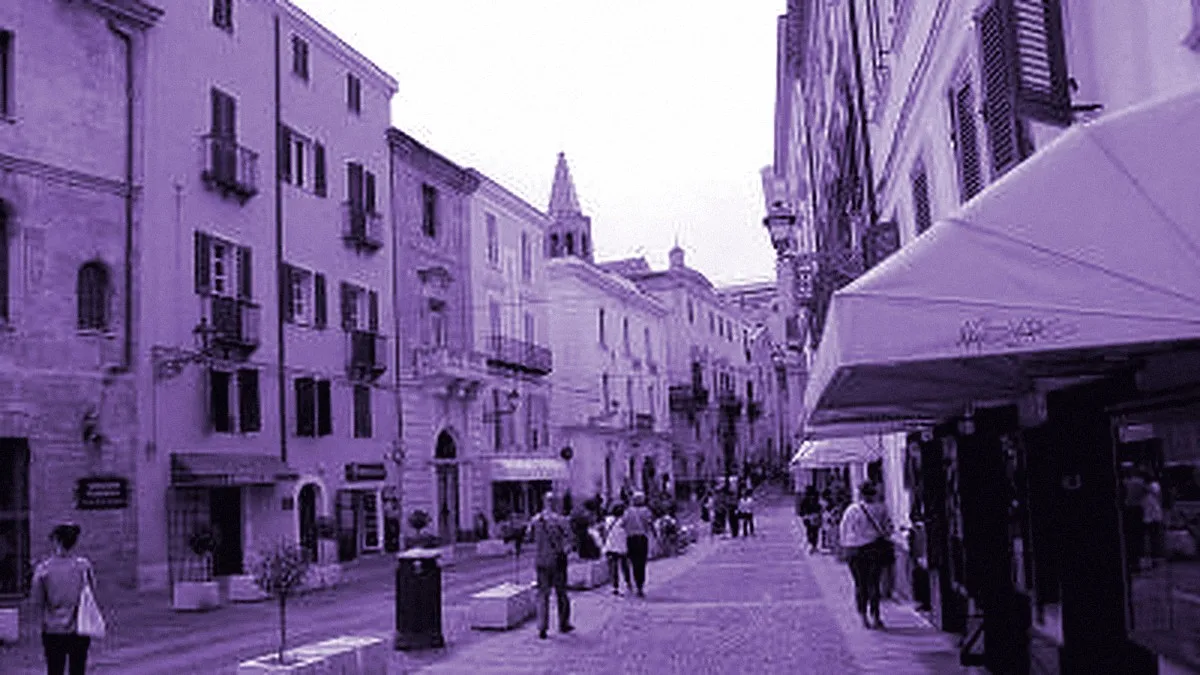
Alghero is a historic coastal city in northwest Sardinia, known for its Catalan Gothic architecture, defensive walls, prehistoric sites and connection to Mediterranean coral. The old town brings together churches, palaces and fortifications, while the surrounding area adds ancient burial sites, a Nuragic settlement and the dramatic natural setting of Neptune’s Grotto. Neywo offers a free audio guide for Alghero with 53 narrated places.
What to See in Alghero
Alghero Cathedral
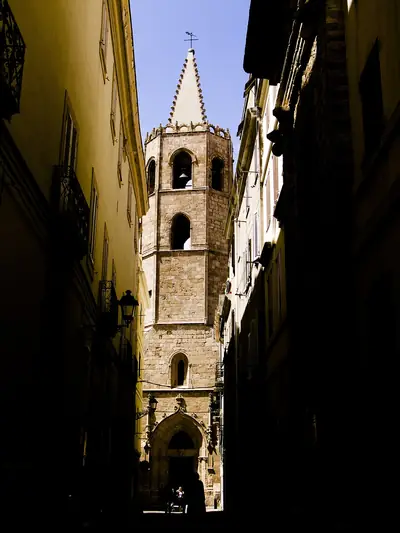
The Cathedral of Saint Mary is the spiritual heart of Alghero’s historic center and has been an episcopal seat since 1503. Construction began in the 1530s, but the cathedral was not fully completed and consecrated until 1730. Its long building history is visible in the architecture: the chapels, ambulatory and bell tower base are Catalan Gothic, while the nave and aisles belong to the Late Renaissance. A Neo-Classical narthex was added in the nineteenth century.
San Michele
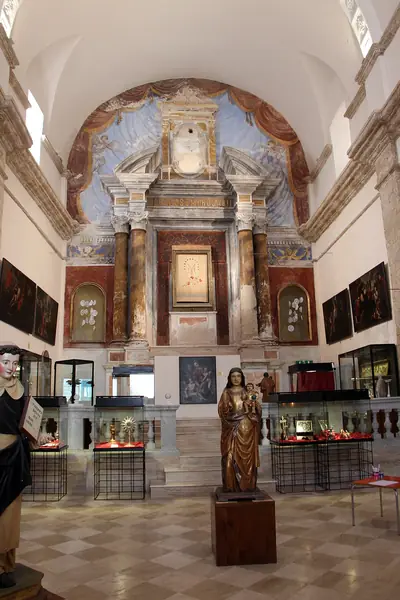
On Via Carlo Alberto, the Church of San Michele stands out for its colorful maiolica-covered dome. The current tiles date from the 1960s, preserving the church’s distinctive appearance. Construction began in the late sixteenth century, and the church opened in 1593. Inside, a wooden sculpture depicts Saint Michael defeating Satan, reinforcing the dramatic Baroque character of the building.
Palazzo Ferrera
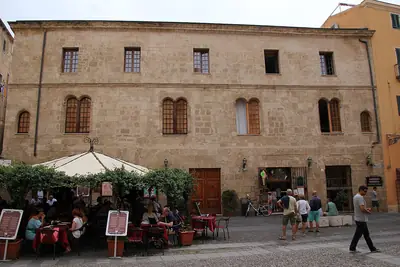
Palazzo Ferrera occupies a prominent position in Piazza Civica. Built in the fifteenth century, it is a notable example of Catalan Gothic architecture, with a façade formed from regularly laid square stone blocks. A grand staircase connects its three floors, while the second floor contains four large arches carved from single blocks of stone. Emperor Charles V stayed here in 1541 during the battle associated with his visit.
Palazzo Lavagna
Also located in Plaça Cívica, Palazzo Lavagna was originally known as Carcassona Palace and stood in the heart of the former Jewish quarter. Its fifteenth-century sandstone façade features an off-center entrance, a decorated arch and four mullioned windows framed by small trefoil arches. The details reflect the Mediterranean connections of Aragonese architecture, with influences visible across Sardinia, Naples, Palermo and Valencia.
Palazzo Peretti
Palazzo Peretti, on Plaça Porta Terra, dates from the fifteenth century and was built by the Guyo Duran family. The Peretti family acquired it in the eighteenth century, and the palace has remained in their hands since then. Its façade combines exposed square-cut sandstone with plastered sections, while the main wooden doorway is framed by carved stone details typical of the Gothic-Catalan style.
Palazzo della Dogana reale
Alghero’s Civic Palace now serves as the Town Hall and stands in Municipality Square. The nineteenth-century Neoclassical façade combines squared sandstone blocks with a granite base. Inside, preserved ceiling frescoes add to the building’s civic and architectural interest.
Bastione della Maddalena
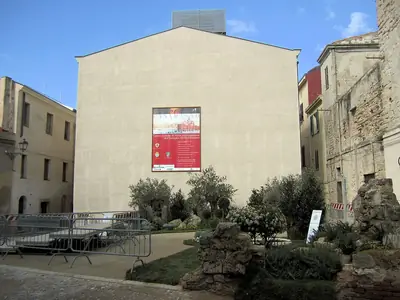
The Maddalena Fort is the last surviving fort of three that once defended the northern side of the old town. Its fortifications date from the end of the sixteenth century, while the central Torre della Maddalena, also known as the Torre di Garibaldi, has medieval origins. The site is named after Mary Magdalene, whose weathered statue remains there.
Coral Museum
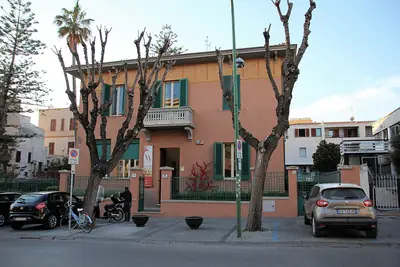
Housed in Villa Costantino, an Art Deco villa built in 1927, the Coral Museum explores Alghero’s long relationship with red Mediterranean coral. Known locally as “red gold”, corallium rubrum influenced the city’s culture, economy and traditions. Exhibits trace coral harvesting from earlier methods to more sustainable contemporary practices. The villa was renovated in 2016, and its Liberty-style architecture forms part of the visit.
Necropolis of Anghelu Ruju
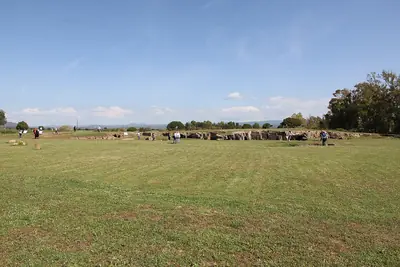
The Necropolis of Anghelu Ruju is the largest pre-Nuragic burial site in Sardinia. It was discovered by chance in 1903, when workers digging the foundations of a farmhouse found a human skull and a tripod vase. Archaeologist Antonio Taramelli investigated the site the following year, and excavations eventually revealed 38 rock-cut tombs.
The necropolis was used from the Late Neolithic through the early Bronze Age, roughly between 3200 and 1600 BC. Its tombs, carved into soft sandstone, include the domus de janas—“houses of the fairies”—a name given to Sardinia’s prehistoric rock-cut burial chambers. In 2025, the site joined the UNESCO World Heritage list alongside other pre-Nuragic sites on the island.
Necropolis of Santu Pedru
The Necropolis of Santu Pedru lies on a hill reached by the road towards Uri. Its ten tombs date from the recent Neolithic period, long before the construction of the island’s famous nuraghe towers. The chambers were carved into trachyte, a volcanic stone that was relatively soft when first exposed and hardened over time.
Some tombs consist of a single chamber, while others contain several rooms, pillars and decorative elements. Like Anghelu Ruju, the site is made up of domus de janas, which were sacred burial places before later traditions associated them with mythical female spirits.
Nuraghe Palmavera
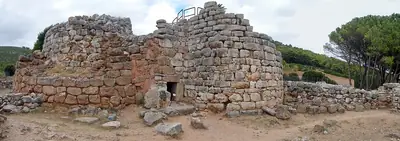
The Palmavera Nuragic Complex is one of Sardinia’s most important prehistoric sites. Founded around the fifteenth century BC, it remained in use for nearly a thousand years. At its center is a nuraghe, the massive stone tower characteristic of Sardinia’s Nuragic civilization.
The original tower contains a central chamber with a tholos vault. Around six centuries later, a second tower was added and joined to it by a curtain wall, creating a courtyard. A settlement developed around this fortified core. Archaeologists have uncovered around 50 circular huts, although the original village may have contained roughly 200. The huts included simple rooms and more specialized spaces used for storage, workshops or sleeping.
Neptune’s Grotto
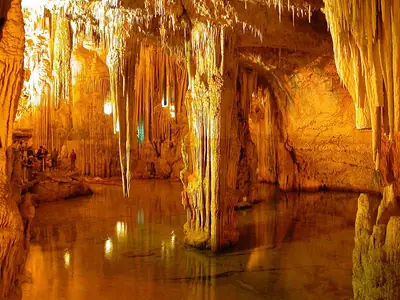
Neptune’s Grotto is a karst cave system in the limestone cliffs of Capo Caccia, about 24 kilometers northwest of Alghero. Created by the slow action of water over more than ten million years, the cave contains stalactites, stalagmites and the second-largest underground lake in Europe.
The grotto opens onto the Mediterranean and takes its name from Neptune, the Roman god of the sea. Among its most striking formations is a great column created when a stalactite and stalagmite fused together. It rises 12 meters and measures 30 meters across at its base.
Torre del Bol
Torre del Bol stands on a rocky promontory between Tramariglio and the cliffs of Capo Caccia. The coastal watchtower formed part of the defensive network that protected Sardinia’s shores from the early Middle Ages until the mid-nineteenth century. From its position 34 meters above sea level, it overlooks the entrance to Porto Conte bay and illustrates how the coastline was monitored and defended.
Explore Alghero with a Free Audio Guide
Neywo’s Alghero audio guide includes 53 narrated places, with stories available in 11 languages. The app plays each story as you reach the place, at your own pace, with no group and no schedule.
There are two walking tours and one bus route:
- Little Barcelona: Catalan Gothic Palaces of Alghero — a 1.08 km walk lasting 72 minutes, with 12 narrated stops.
- Coral Gold and Sea Walls: Alghero’s Ramparts — a 2.37 km walk lasting 85 minutes, with 11 narrated stops.
- From Fertilia to the old town on the AF bus — a 6.8 km bus route lasting 29 minutes, with 4 narrated stops.
Download Neywo and explore Alghero independently, from the cathedral and Gothic palaces to the sea walls, coral museum and historic streets. When you are ready to continue through the island, discover Bosa, Cagliari or Santa Teresa Gallura.
Places with an audio guide in Alghero
8 places in Alghero with a Neywo audio guide. Each one starts telling its story as you reach it.
Self-guided tours in Alghero
3 tours in Alghero, free in the Neywo app. Each stop tells its story as you reach it.
- Bus ride
From Fertilia to the old town on the AF bus
Line AF is the public ARST bus that links Fertilia, the 1930s town on the bay, with Alghero. Ride it from the church of San Marco down the coast to the walls: get off at the Porta Terra tower, the Coral Museum and the church of the Mercede, and walk from there into the old town.
San Marco · Torre di Porta Terra · Museo del Corallo · Nostra Signora della Mercede
Open this tour: From Fertilia to the old town on the AF bus - Walk
Little Barcelona: Catalan Gothic Palaces of Alghero
Alghero has spoken Catalan since the 14th century, and its old town still looks like a corner of Barcelona set on the Sardinian coast. Walk from the Porta Terra gateway through narrow lanes of golden sandstone palaces, a Gothic cloister, the cathedral and a 19th-century opera house. On the way you also pass the Palazzo Civico in Piazza Civica and the quiet lanes around the cathedral.
Torre di Porta Terra · Palazzo Peretti · Chiesa di San Francesco · Palazzo Ferrera · Town hall of Alghero · Palazzo della Dogana reale …
Open this tour: Little Barcelona: Catalan Gothic Palaces of Alghero - Walk
Coral Gold and Sea Walls: Alghero's Ramparts
Alghero kept about 70 percent of its medieval walls, and they now make a seaside promenade. Start in the park by the harbour and the gardens by the Maddalena Fort, learn why red coral is called red gold, then follow bastions, towers and a row of old cannon along the sea.
Parco Tarragona · Nostra Signora della Mercede · Giardini Giuseppe Manno · Aquarium of Alghero · Museo del Corallo · Torre di Sulis …
Open this tour: Coral Gold and Sea Walls: Alghero's Ramparts
Walk Alghero with Neywo
Neywo turns Alghero into a self-guided audio tour. Stories arrive as you reach the place they belong to, and the route reshapes when you wander off it.

