Visiting Mantova, Italy: Top Sights on Foot
Things to Do in Mantova: What to See in the Renaissance City
Things to do in Mantova range from exploring Gonzaga palaces and Renaissance churches to discovering painted chambers, historic squares, and museums. The city is especially rewarding on foot: its compact historic centre brings together major monuments, artistic treasures, and layers of medieval and Renaissance history. Neywo has a free audio guide for Mantova with 70 narrated places, available in 11 languages.
Mantova is in Lombardy, in northern Italy. Its identity is closely tied to the Gonzaga family, whose patronage shaped the city’s architecture, religious buildings, and artistic heritage.
What to See in Mantova
Palazzo del Te
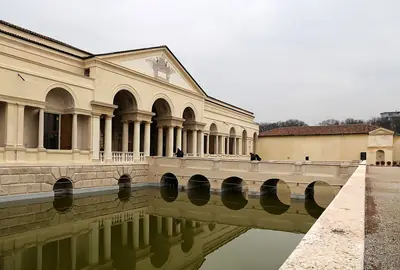
Palazzo del Te is one of Mantova’s most remarkable landmarks and Giulio Romano’s most famous work. Commissioned by Federico II Gonzaga, Marquis of Mantova, the palace was built between 1524 and 1534.
It is celebrated as a masterpiece of Mannerist architecture. Giulio Romano designed and constructed the building with a playful approach to architectural conventions. Inside, frescoes and elaborate stucco work give the rooms a theatrical character that reflects the inventiveness of the exterior.
San Sebastiano
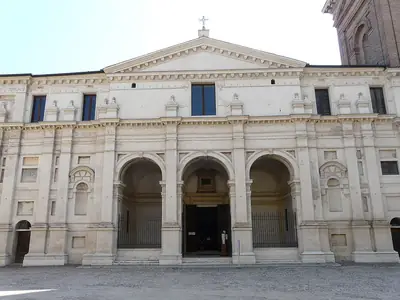
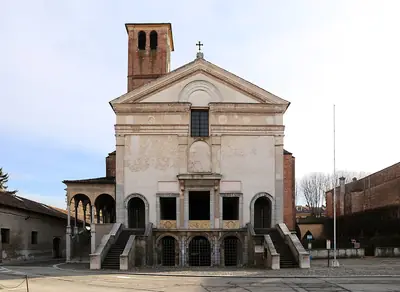
A short distance from Palazzo del Te, San Sebastiano is an Early Renaissance church designed by Leon Battista Alberti. It later became a memorial chapel for the fallen.
The church has an unusual Greek-cross plan, with three matching arms ending in apses around a central vaulted space. Its interior has no partitions, creating an open, centralised design. The crypt was intended as a mausoleum for the Gonzaga family.
The façade is equally distinctive. Rather than using columns, Alberti created what is described as wall architecture, with pilasters set into the surface. The width of the façade matches its height up to the pediment, giving it the geometry of a square.
Casa del Mantegna
Casa del Mantegna is a fifteenth-century building associated with Andrea Mantegna, one of Mantova’s celebrated artists. It was the house and probably the studio that he built and used after Marquis Ludovico III Gonzaga appointed him court painter.
Today, the building hosts temporary exhibitions and serves as the official headquarters of the cultural department of the Province of Mantova.
Basilica of Sant’Andrea
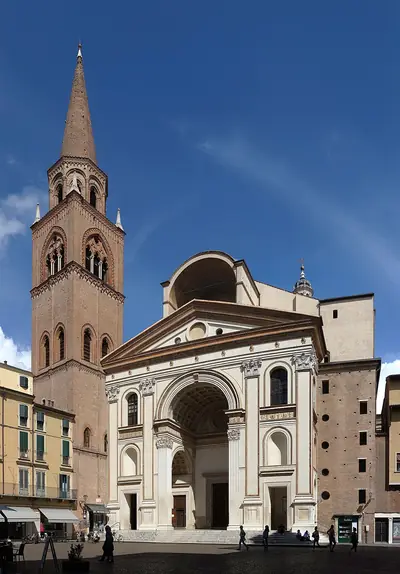
In Piazza Mantegna, the Basilica of Sant’Andrea is the largest church in Mantova and one of the city’s most important Renaissance landmarks. Ludovico III Gonzaga commissioned it, and Leon Battista Alberti designed it. Construction began in 1472 on the site of a Benedictine monastery.
The monastery’s bell tower, dating from 1414, still survives. Sant’Andrea is regarded as one of Alberti’s most complete works and a major achievement of fifteenth-century Renaissance architecture in northern Italy. Later changes and expansions affected the original design, and the basilica was completed 328 years after construction began.
Its crypt contains two reliquaries preserving earth said to be soaked with the blood of Christ, supposedly brought to Mantova by the Roman soldier Longinus. The relic led to the basilica becoming the seat of the Military Order of the Blood of Jesus Christ in 1608.
Casa del Mercante and Piazza delle Erbe
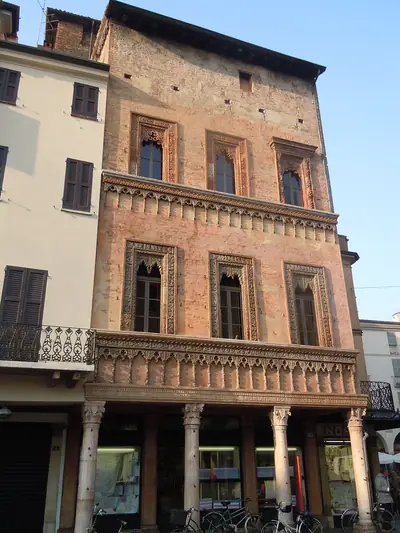
Casa del Mercante, also called Casa di Boniforte da Concorezzo, stands in Piazza delle Erbe, at the corner with Piazza Mantegna. Its terracotta decoration dates from 1455. The house belonged to Giovanni Boniforte da Concorezzo, a merchant originally from Milan.
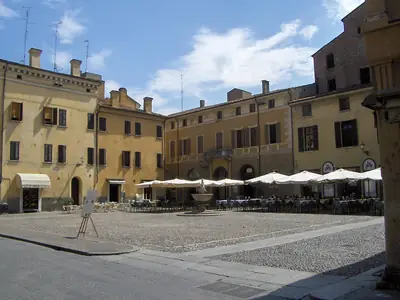
Piazza delle Erbe is one of Mantova’s principal squares. Its name means “Square of the Herbs”, although it was known during the Renaissance as Piazza de Mercadanti, or Merchants’ Square. The buildings around it preserve traces of the urban renewal promoted by Marquis Ludovico Gonzaga from 1470 onward.
The square is also home to a clock tower built from 1470 between Palazzo della Ragione and the Rotonda di San Lorenzo. It was created to house an astronomical clock made by the mathematician and astrologer Bartolomeo Manfredi, a pupil of Vittorino da Feltre.
Palazzo del Massaro and Piazza Broletto
Piazza Broletto is home to Palazzo del Massaro, one of the notable historic buildings in Mantova’s centre. The square forms part of the city’s network of historic streets and spaces, where Renaissance and medieval landmarks appear close together.
Mantova Cathedral
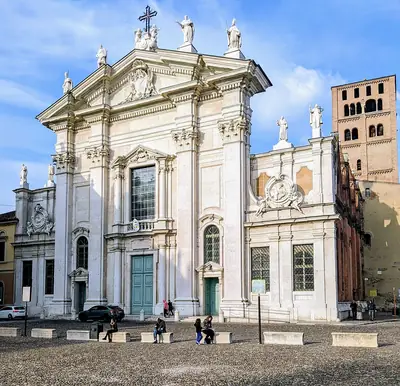
Mantova Cathedral, also known as the Duomo or Cattedrale di San Pietro, stands in Piazza Sordello. It is the city’s principal place of worship and one of the central landmarks of its historic heart.
Since 1940, Mantova Cathedral has been recognised as a national monument. Its position in Piazza Sordello places it close to several of the city’s most important Gonzaga monuments.
Saint George Castle and the Camera degli Sposi
Saint George Castle, or Castello di San Giorgio, forms part of the Ducal Palace complex. It began as a fortified Gonzaga building and later became a noble residence before also being used as a prison.
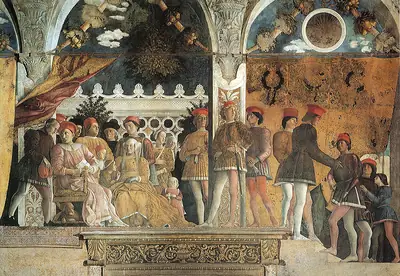
The castle is a rectangular fortress surrounded by a moat, with a large tower at each corner. Three drawbridges once crossed the water. Its northeastern tower contains the Camera degli Sposi, also known as the Camera picta or Painted Chamber.
Andrea Mantegna created the fresco cycle between 1465 and 1474. The paintings use illusion to make the walls appear to open beyond the room, with painted curtains revealing scenes of the Gonzaga family and their court. The chamber turns an enclosed space into an extraordinary painted environment.
Basilica Palatina di Santa Barbara
The Basilica Palatina di Santa Barbara was the Gonzaga family’s Palatine Chapel. This Catholic place of worship is therefore closely connected with Mantova’s ruling dynasty and the wider Ducal Palace complex.
Casa di Rigoletto
Behind Mantova Cathedral in Piazza Sordello, Casa di Rigoletto offers a small but distinctive stop connected with Giuseppe Verdi’s opera Rigoletto. The building was represented in the original stage design for the first performance of the opera, linking it with the theatrical world of Verdi’s work.
Other historic churches and museums
Mantova’s historic centre includes many additional places worth seeking out:
- Santi Gervasio e Protasio was built in the fourteenth century by the Donesmondi family.
- San Francesco was founded by the Franciscan Order in 1304 and consecrated in 1459 by Pope Pius II. Its complex history includes suppression, military use, wartime destruction, and reconstruction in Romanesque and Gothic styles. Original frescoes remain visible, including Saint Francis Receives the Stigmata by Stefano da Verona. The Cappella Gonzaga contains frescoes depicting the life of Saint Louis of Toulouse.
- Santa Maria della Vittoria is a small medieval church in Piazzetta di San Simone. Francesco Gonzaga commissioned it in 1496 to commemorate his claimed victory over the French army of Charles VIII at the Battle of Fornovo.
- Casa Beata Osanna Andreasi, also called Casa Museo della Beata Osanna Andreasi, is a historic palace at 9 Via Pietro Frattini.
- Galleria Storica Vigili del Fuoco presents Italy’s largest exhibition of historic fire service vehicles and memorabilia.
Explore Mantova with a Self-Guided Audio Tour
A Mantova self-guided walking tour lets you explore the city independently while hearing its stories at the places where they happened. Neywo has four walking tours, one bus route, and one bike route in Mantova:
- The Gonzaga Court: Palaces, Castle and Cathedral — a 1.19 km walk lasting 89 minutes, with 12 narrated stops.
- Merchants, Churches and Giulio Romano’s Fish Market — a 2.05 km walk lasting 95 minutes, with 12 narrated stops.
- Palazzo Te, Mantegna and the Southern Quarter — a 2.87 km walk lasting 107 minutes, with 12 narrated stops.
- Lakeside Mantua: Virgil, Gates and the Northern Shore — a 2.4 km walk lasting 74 minutes, with 8 narrated stops.
- Mantua’s Circular Line: Churches, Theatres and Renaissance Squares — a 4.8 km bus route lasting 21 minutes, with 9 narrated stops.
- Ride the Lakes: Palazzo Te, Virgil and the Gonzaga Castle — a 6.7 km bike route lasting 34 minutes, with 8 narrated stops.
Download Neywo and explore Mantova at your own pace. The app tells the story of each place as you reach it, with no group and no schedule. It is a free audio guide for discovering the city independently, whether you choose a walking, bus, or bike route. After Mantova, continue exploring Milan, Brescia, or Bergamo.
Places with an audio guide in Mantova
8 places in Mantova with a Neywo audio guide. Each one starts telling its story as you reach it.
Self-guided tours in Mantova
6 tours in Mantova, free in the Neywo app. Each stop tells its story as you reach it.
- Bike ride
Ride the Lakes: Palazzo Te, Virgil and the Gonzaga Castle
A flat ride on Mantua's cycle lanes between the lakes, from the Gonzaga pleasure villa Palazzo Te to the Belfiore martyrs' monument, the lakeside churches and Virgil's square, ending at the moated Castello di San Giorgio.
San Luigi Gonzaga (Mantua) · Palazzo del Te · Monument to the Belfiore Martyrs · Santi Gervasio e Protasio, Mantua · San Leonardo · Monument to Virgil …
Open this tour: Ride the Lakes: Palazzo Te, Virgil and the Gonzaga Castle - Bus ride
Mantua's Circular Line: Churches, Theatres and Renaissance Squares
Line CC loops around the old town of Mantua, stopping near the Franciscan church of San Francesco, Alberti's Sant'Andrea, Giulio Romano's arcades and two of the city's historic theatres. A cheap ride from one side of the centre to the other, with Palazzo Valentini and Teatro Sociale at the end.
San Francesco, Mantua · Santa Maria della Vittoria · Basilica of Sant'Andrea · Palazzo Andreani · Palazzo del Carmine · Church Santa Paola …
Open this tour: Mantua's Circular Line: Churches, Theatres and Renaissance Squares - Walk
The Gonzaga Court: Palaces, Castle and Cathedral
For four centuries the Gonzaga ruled from Piazza Sordello and Piazza Castello. Walk from the moated Castello di San Giorgio through the palatine basilica and the Ducal Palace, past Rigoletto's house and the cathedral, to the medieval towers and the old gate of the Voltone di San Pietro.
Saint George Castle · Basilica Palatina di Santa Barbara · Palazzo Ducale Mantua · National Archaeological Museum of Mantua · Casa di Rigoletto · Mantua Cathedral …
Open this tour: The Gonzaga Court: Palaces, Castle and Cathedral - Walk
Merchants, Churches and Giulio Romano's Fish Market
Start on Piazza delle Erbe, where merchants once traded beside the oldest church in Mantua, a round Romanesque rotunda below street level. Then thread through lanes of Baroque churches, Giulio Romano's arcaded fish shops and the small piazzas of the old town to finish at the opera house.
Basilica of Sant'Andrea · Casa del mercante Boniforte da Concorrezzo · Rotonda di San Lorenzo · Palazzo Andreani · Santa Maria della Carità, Mantua · Fish shop of Giulio Romano …
Open this tour: Merchants, Churches and Giulio Romano's Fish Market - Walk
Palazzo Te, Mantegna and the Southern Quarter
Follow Mantua's artists south of the centre: Giulio Romano's pleasure villa Palazzo Te, the church that Alberti's follower Luca Fancelli designed, the house of Andrea Mantegna, and a string of small churches and palaces along the quiet streets of the old Gonzaga suburb.
Palazzo del Te · San Sebastiano · Casa del Mantegna · MACA - Mantova Collezioni Antiche · Santo Spirito · Chiesa di Santa Teresa …
Open this tour: Palazzo Te, Mantegna and the Southern Quarter - Walk
Lakeside Mantua: Virgil, Gates and the Northern Shore
Walk north along the lake that surrounds Mantua: Porta Giulia, the only surviving city gate, the museum of Andreas Hofer, then the green Piazza Virgiliana with its monument to the poet Virgil, who was born near the city, and the old church of San Leonardo.
Porta Giulia · Andreas Hofer Mantova Mito Memoria · Santi Gervasio e Protasio, Mantua · Palazzo del Mago · San Leonardo · Piazza Virgiliana …
Open this tour: Lakeside Mantua: Virgil, Gates and the Northern Shore
Walk Mantova with Neywo
Neywo turns Mantova into a self-guided audio tour. Stories arrive as you reach the place they belong to, and the route reshapes when you wander off it.

