What to See in Cagliari, Italy: Free Audio Guide
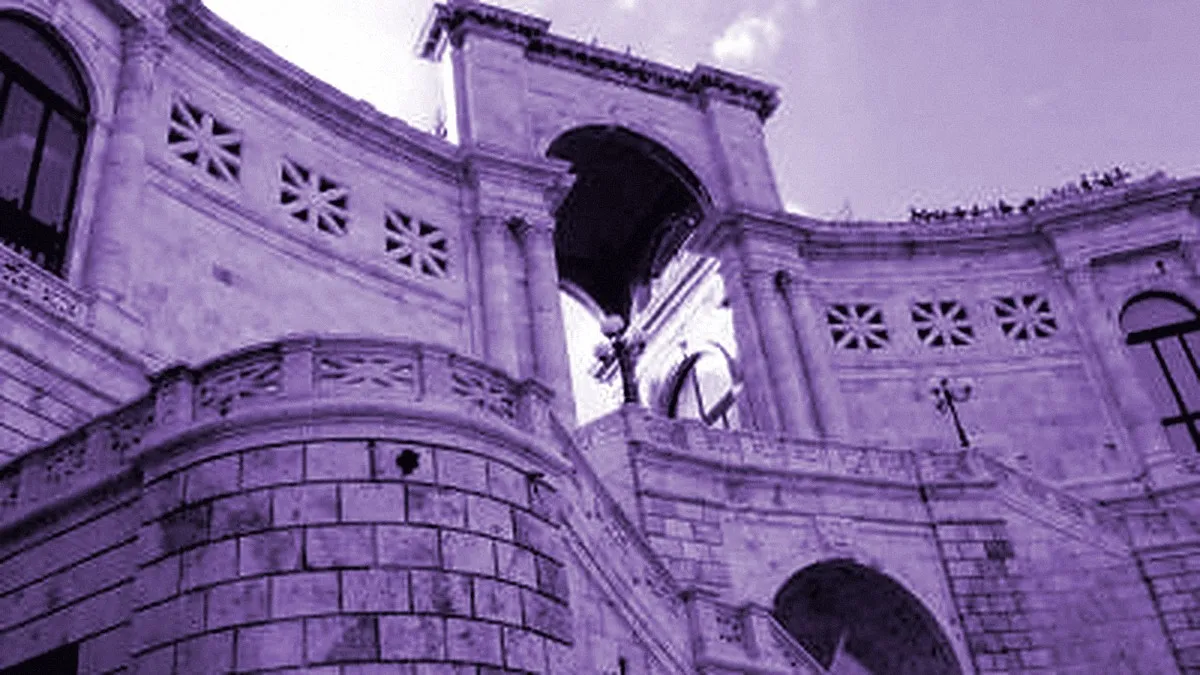
Things to do in Cagliari: historic districts, museums and churches
Cagliari, the capital of Sardinia, is a city of fortified hills, historic palaces, museums and churches. The best things to do in Cagliari include exploring the walled Castello district, discovering Sardinia’s ancient cultures and visiting landmarks that reveal the city’s religious and civic history. Neywo offers a free audio guide for Cagliari with 29 narrated places, so you can explore while the story plays as you arrive at each site.
What to see in Cagliari
Many of the city’s most important sights are concentrated in or around its historic districts. This makes Cagliari especially rewarding to explore on foot, with a route that moves from medieval fortifications to museums, palaces, churches and gardens.
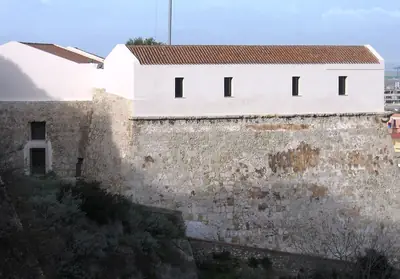
Ghetto
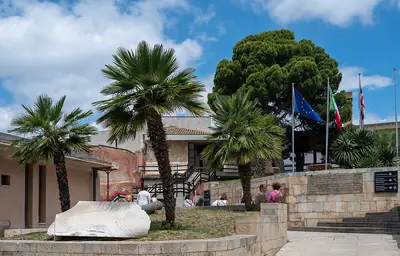
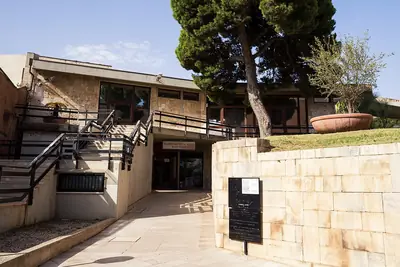
The Ghetto is a cultural and museum centre on the bastion of Santa Croce, between the road of the same name and the Cammino Nuovo. Its entrance is on Via Santa Croce, and the building stands above the boundary walls of the Castello district.
Its present cultural role contrasts with its original purpose. The building was created in 1738 as a military barracks and became the main headquarters of the Dragoni di Sardegna.
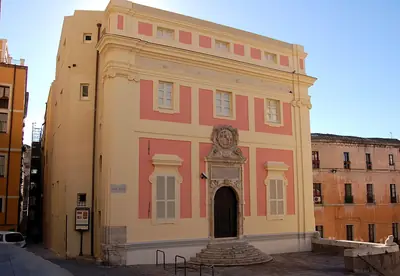
Palazzo di Città
Palazzo di Città has a long municipal history. It served as Cagliari’s seat of government from the Middle Ages until the first years of the 20th century.
Today, the palace also houses permanent collections, including the Fondo Etnografico Manconi Passino, the Fondo Ceramico from the Collezione Ingrao and the Fondo d’Arte Sacra from the Collezione Ingrao.
Palazzo Regio
In the Castello district, Palazzo Regio—also known as the Viceregio—is the former Royal Palace. It was the residence of the representative of the King of Sardinia during Aragonese, Spanish and Savoy rule, and it remains an institutional building as the seat of the Prefecture of the Metropolitan City of Cagliari.
The palace dates back to the 14th century. In 1337, Peter IV of Aragon made it the official seat of the viceroy. Later renovations under the Savoy dynasty shaped much of its present appearance, including the grand staircase designed by the Piedmontese engineers de Guibert and de Vincenti.
Cittadella dei musei and Clemente Susini’s wax anatomical models
The Cittadella dei musei contains one of Cagliari’s most unusual collections: Clemente Susini’s wax anatomical models. The collection is displayed in the Pentagonal Room, reached through the neoclassical arch of the Arsenale and up to the right.
The 23 polychrome anatomical waxes are arranged on 23 wooden boards, protected by showcases and accompanied by captions. They were commissioned from Susini between 1801 and 1805 by the viceroy Carlo Felice, through the anatomy professor Francesco Antonio Boi. The collection offers an exceptionally detailed, and sometimes unsettling, look at medical study.
National Archaeological Museum of Cagliari
For anyone interested in Sardinia’s ancient past, the National Archaeological Museum of Cagliari is one of the city’s key stops. Since 1993, it has been housed in the Cittadella dei musei, in a complex designed by Piero Gazzola and Libero Cecchini.
Its galleries follow a chronological layout. The section dedicated to the Nuragic civilization is particularly important, with small bronze figurines known as bronzetti. These depict warriors, animals and scenes of daily life, providing valuable evidence for understanding a culture for which there are no written records.
The museum also displays remains of the Giants of Mont’e Prama, large stone statues dating from around the 8th century BCE. They represent warriors, archers and boxers and are among the earliest monumental sculptures in the western Mediterranean.
Galleria comunale d’arte
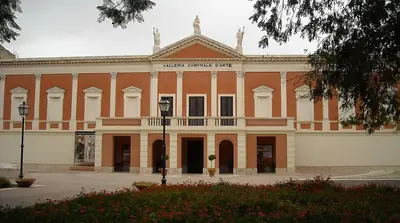
The Municipal Art Gallery of Cagliari, or Galleria comunale d’arte, occupies a historic building within the public gardens at Largo Dessì. It has been the principal home of the city’s civic museums since its inauguration in 1933.
The collection began with works acquired by the Municipality of Cagliari in the early 1930s. Among its notable works are the bronze Bontà and seven original plaster casts by Francesco Ciusa, purchased in 1939. The gallery also contains La madre dell’ucciso from 1907, a room dedicated to Ciusa and a Contemporary Art Collection.
Cagliari Cathedral
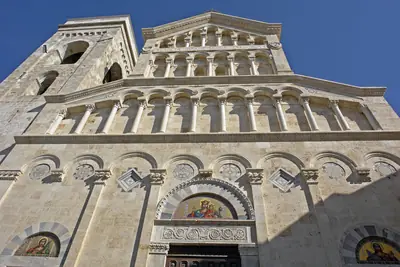
Cagliari Cathedral, dedicated to Saint Mary and Saint Cecilia, is the main religious landmark in the Castello district. Its architecture brings together seven centuries of the city’s history.
The cathedral was built during the 1200s in Pisan-Romanesque style and became a cathedral in 1258. It was renewed according to Baroque standards during the 17th and 18th centuries, while its current façade dates from the 1930s and follows a Neo-Romanesque design inspired by Pisa Cathedral.
Inside, the 12th-century ambo, or pulpit, is one of the important features to look for. The cathedral’s changing styles make it a useful place to see how Cagliari’s religious architecture developed over time.
Torre dell’Elefante
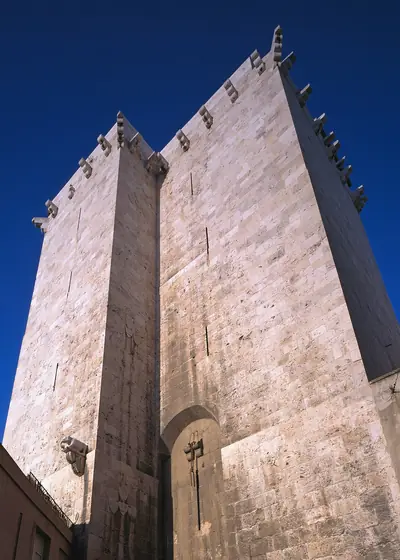
The Torre dell’Elefante is one of Cagliari’s most distinctive medieval monuments. Located in the Castello quarter, it is built from white limestone quarried from Bonaria and follows a Pisan architectural style.
Three sides are made from solid limestone, while the fourth side opens towards Castello. The tower has four floors supported by wooden mezzanines. Its name comes from the small stone elephant projecting from the south-facing wall, a symbol commonly used by the Republic of Pisa. Medieval coats of arms, including those of Pisan castellans, are also carved into the walls.
Castle of San Michele
Castle of San Michele dominates its hill with a quadrangular plan, three towers and a surrounding moat. The north-eastern and south-eastern towers date from the 13th century and are attributed to Pisan workers; the south-western tower dates from the 15th century and is attributed to Aragonese builders.
The castle once included an internal courtyard, rooms for the castellans and rooms for servants. The hill may also have held a Roman temple dedicated to Aesculapius before later religious changes transformed the site.
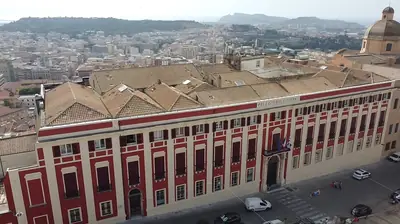
Palazzo Civico
Palazzo Civico, also called Palazzo Bacaredda, is Cagliari’s municipal seat on Via Roma, in the lower part of Stampace. Its early 20th-century design combines an Aragonese Gothic appearance with Liberty-style decoration.
Built from white limestone, the palace faces the port. The municipal headquarters were moved here from Piazza Palazzo in Castello under the guidance of Ottone Bacaredda, when the Marina district was becoming an important cultural and economic centre.
Botanical Garden of Cagliari
The Botanical Garden of Cagliari, or Orto Botanico, belongs to the University of Cagliari and is located on Via Sant’Ignazio da Laconi in Stampace. It combines living plant collections with an archaeological setting.
The garden was inaugurated in 1866 under the direction of Prof. Patrizio Gennari. Its collections are organised into three main sections: Mediterranean plants, succulent plants and tropical plants. The site includes roughly 600 trees and 550 shrubs, making it one of the city’s major green spaces.
Basilica of San Saturnino
In Villanova, Piazza San Cosimo is home to the Basilica of San Saturnino, one of Cagliari’s oldest churches and a place closely associated with the city’s patron.
The basilica follows a Greek-cross plan, with four arms of equal length and a central domed area dating from the 5th to 6th centuries. The current church consists of this domed section and the eastern arm, which has a nave, two aisles and a semicircular apse.
San Michele
San Michele is a Jesuit complex known for its Baroque architecture, sculpture and painting. It is especially important for the way it preserves Baroque and Rococo art in Sardinia.
The façade was completed in 1705 and reflects late Mannerist models. It is arranged in three orders like a large wooden altar, while the church’s octagonal dome is another defining feature of the complex.
Santa Restituta
Santa Restituta in Stampace stands above a crypt whose history reaches from antiquity to the modern era. The hypogeum beneath the 17th-century church was partly natural and partly artificial.
It was first used as a quarry during the late Punic and Roman periods, then as a place of pagan worship and later as storage for amphorae. From the 13th century, it was reused as a Byzantine-Orthodox church. In 1614, the remains of Santa Restituta were found there during campaigns to search for the relics of holy martyrs.
Basilica of Our Lady of Bonaria
The Basilica of Our Lady of Bonaria forms part of the Shrine of Our Lady of Bonaria on the hill overlooking Cagliari and the sea. Pope Pius XI raised the shrine to the status of Minor Basilica in 1926.
The church is entered through a Gothic-style portal recovered from the medieval church of San Francesco in Stampace. Inside, the sanctuary follows a Catalan Gothic design, with a single nave, an ogival vault and three Gothic chapels on the left. The main altar holds the 14th-century wooden statue of the Madonna and Child, known as Our Lady of Bonaria.
Explore Cagliari with a free audio guide
A Cagliari self-guided walking tour is an easy way to connect the city’s historic sights without a group or fixed timetable. Neywo has two walking tours and one bus route in Cagliari, with narration available in 11 languages.
The available routes include:
- A 1.9 km walking tour lasting 93 minutes, with 12 narrated stops, through Castello and its walled upper town.
- A 3 km walking tour lasting 124 minutes, with 15 narrated stops, covering sights including the Botanical Garden, the Roman Amphitheatre, the National Archaeological Museum, Palazzo Regio, Cagliari Cathedral and the Torre dell’Elefante.
- A 5.2 km bus route lasting 22 minutes, with 6 narrated stops, running from the port up into Castello.
Download Neywo and explore Cagliari at your own pace. The app tells the story of each place as you reach it, with no group and no schedule. You can also continue discovering the island with Italy and nearby Sardinian cities such as Iglesias, Carbonia and Alghero.
Places with an audio guide in Cagliari
8 places in Cagliari with a Neywo audio guide. Each one starts telling its story as you reach it.
Self-guided tours in Cagliari
2 tours in Cagliari, free in the Neywo app. Each stop tells its story as you reach it.
- Bus ride
Line 8: From the Port Up Into Castello
A public CTM bus from Via Roma, beside the port, up the hill into the walled Castello quarter. Ride past the Baroque church of San Michele and the Pisan Torre di San Pancrazio, stop by the Ghetto and the Archaeological Museum, and end at the Roman Amphitheatre.
Palazzo Civico · San Michele · Torre di San Pancrazio · Ghetto · National Archaeological Museum of Cagliari · Roman Amphitheatre of Cagliari
Open this tour: Line 8: From the Port Up Into Castello - Walk
Castello: Cagliari's walled upper town
The limestone citadel above the port. Two Pisan watchtowers you can climb, the cathedral, the viceroy's palace, the old Jewish ghetto, and the archaeological museum with Sardinia's bronze-age figurines — plus the anatomical wax models, which are not for everyone.
Botanical garden of Cagliari · Roman Amphitheatre of Cagliari · National Archaeological Museum of Cagliari · Clemente Susini's wax anatomical models · Torre di San Pancrazio · Ghetto …
Open this tour: Castello: Cagliari's walled upper town
Walk Cagliari with Neywo
Neywo turns Cagliari into a self-guided audio tour. Stories arrive as you reach the place they belong to, and the route reshapes when you wander off it.

