Carbonia, Italy: Self-Guided Walking Tour
Things to Do in Carbonia: What to See in Sardinia’s Mining City
Looking for things to do in Carbonia? This city in southwestern Sardinia offers a distinctive combination of industrial heritage, archaeology, religious architecture, and landscapes shaped by the history of Sulcis. Carbonia’s museums and central landmarks reveal how mining and earlier civilizations have influenced the area.
Neywo has a free audio guide for Carbonia with 5 narrated places, available in 11 languages.
What to See in Carbonia
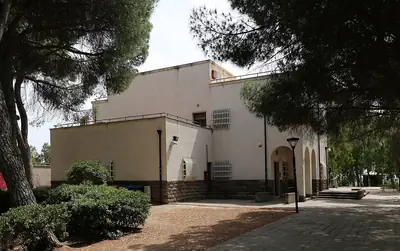
Museo archeologico Villa Sulcis
The Museo archeologico Villa Sulcis brings together the long history of the Sulcis area, from prehistoric times to the Byzantine period. The museum has been housed in Villa Sulcis since 1988, and the building itself has a connection to Carbonia’s mining history: in the 1930s, it was the residence of the director of the city’s mines. It was enlarged and renovated in 2008.
The collection includes finds from several important archaeological sites. Among them are objects from Su Carroppu di Sirri, a prehistoric rock shelter used during the Mesolithic and Neolithic periods. Other exhibits relate to the domus de janas necropolises at Monte Crobu, Cannas di Sotto, and Is Locci Santus, offering insight into pre-Nuragic Sardinia.
The museum also presents material from the archaeological area of Monte Sirai and from the nuraghe of the same name. It is one of the best places to begin understanding the depth of the history surrounding Carbonia.
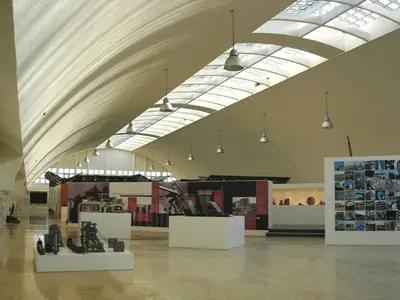
Serbariu Coal Mine Museum
The Serbariu Coal Mine Museum, also known as Museo del Carbone, is located at the former Serbariu mine. The museum focuses on Carbonia’s mining heritage and the role of coal in the development of the city and the Sulcis area.
A visit here adds an important industrial dimension to a trip through Italy. While Villa Sulcis explores the region’s ancient past, the Serbariu museum tells the story of a more recent period, when mining shaped work, community life, and Carbonia’s identity.
San Ponziano Church
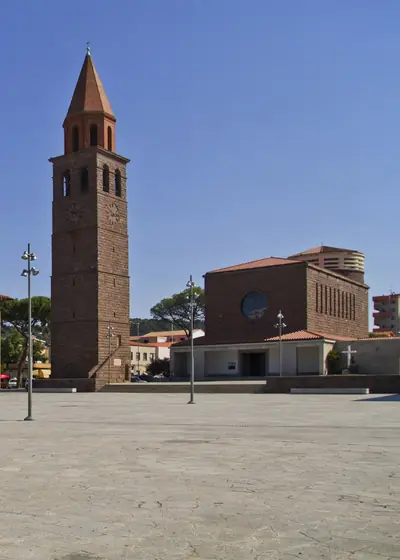
In Piazza Roma, San Ponziano Church stands as Carbonia’s main parish church. Its neoromanesque style gives the central landmark a distinctive appearance, recalling Romanesque architectural forms through a later revival.
The church is a useful stop while exploring the city centre. Its setting in Piazza Roma also helps place Carbonia’s civic and religious spaces within the city’s planned urban character.
Santa Maria di Flumentepido
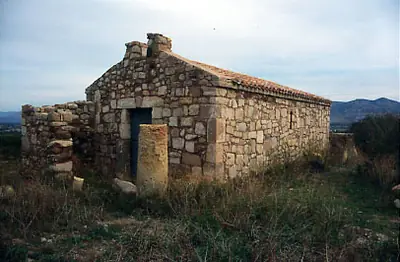
Santa Maria, also known as the Church of Santa Maria di Flumentepido, stands on a small rise in Flumentepido, a hamlet of Carbonia. Its position above the valley gives the church a setting that differs from the more urban landmarks in the city centre.
Both the church and the village take their name from the Rio Flumentepido, the stream running through the valley below. The stream was known in ancient Roman times as Flumen Tepidus, linking the landscape to an older layer of local history.
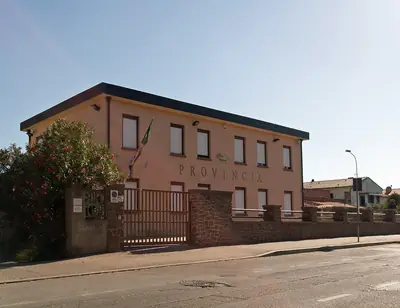
The former Province of Carbonia-Iglesias
The wider Carbonia and Iglesias area was once organized as the Province of Carbonia-Iglesias. Established in 2001 and operational from 2005 to 2016, it included 23 municipalities across Sulcis and Iglesiente, as well as Sant’Antioco, San Pietro, and several smaller islands.
Its two shared capitals, Carbonia and Iglesias, reflected the importance of both cities. The administrative structure later continued through the Province of South Sardinia, created on 4 February 2016 from the former territories of Carbonia-Iglesias and Medio Campidano, together with other municipalities.
Carbonia served as the capital of South Sardinia and was the most populous municipality in its territory. The province was later scheduled for abolition under Sardinia’s 2021 local government reform. Most of its territory subsequently passed to the planned provinces of Medio Campidano and Sulcis Iglesiente, while the remainder went to the Metropolitan City of Cagliari.
This administrative history helps explain the connections between Carbonia, the Sulcis area, and nearby destinations such as Sant’Antioco.
Carbonia’s Industrial and Archaeological Heritage
Carbonia is especially rewarding for travellers interested in the relationship between a place’s ancient history and its modern development. The Museo archeologico Villa Sulcis gathers evidence from prehistoric, pre-Nuragic, Nuragic, and Byzantine periods, while the Serbariu Coal Mine Museum preserves the city’s mining heritage.
Together, these sites show how different layers of history coexist in Sulcis. Religious landmarks such as San Ponziano and Santa Maria di Flumentepido add another perspective, connecting the city’s central spaces and surrounding landscape.
Explore Carbonia with Neywo
There are no scheduled tours or group departures: Neywo’s free Carbonia audio guide includes 5 narrated places, and each story plays as you reach the place, at your own pace. The app lets you explore independently, with no group and no schedule, while narration is available in 11 languages.
Download Neywo and discover Carbonia’s museums, churches, and industrial heritage as you walk.
Places with an audio guide in Carbonia
5 places in Carbonia with a Neywo audio guide. Each one starts telling its story as you reach it.
Walk Carbonia with Neywo
Neywo turns Carbonia into a self-guided audio tour. Stories arrive as you reach the place they belong to, and the route reshapes when you wander off it.

