Things to Do in Catania, Italy: Walking Guide
Things to do in Catania: what to see in Sicily’s historic city
Looking for things to do in Catania? Start in the historic center, where medieval ruins, Baroque churches, museums and volcanic stone reveal the city’s layered past. Beneath Mount Etna, Catania brings together archaeological sites, religious buildings, grand palaces and lively urban streets. Neywo offers a free audio guide for Catania with 54 narrated places.
Catania is part of Sicily, and its character comes from the many civilizations and disasters that have shaped it. Greek, Roman, Byzantine, Arab, Norman and Spanish influences all left their mark, while eruptions from Mount Etna and earthquakes repeatedly transformed the city. The reconstruction that followed the earthquake of 1693 created much of the dark lava-stone and pale-limestone Baroque city seen today.
What to see in Catania
The historic center is compact enough to explore on foot, with many of its most important sights following a route through squares, churches, palaces and archaeological remains.
Catania Cathedral and Piazza del Duomo
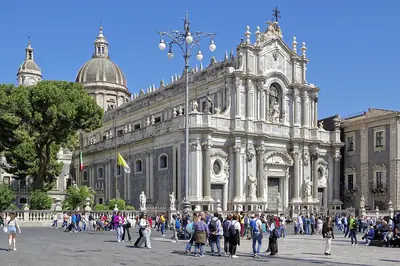
Catania Cathedral is the city’s main Catholic landmark and preserves Norman, Baroque and Neoclassical elements. The first cathedral on this sacred site was completed in the 11th century, but earthquakes and eruptions caused extensive damage, particularly in 1169 and 1693.
The present building was largely shaped in the early 18th century. Giovanni Battista Vaccarini designed the three-tiered façade after the 1693 earthquake, using pale limestone against darker volcanic stone. The broad parvis includes a white balustrade and Carrara-marble statues of saints.
The cathedral stands on Piazza del Duomo, one of the essential places to visit in Catania. The square is also home to the Elephant Fountain, one of the city’s best-known landmarks.
Diocesan Museum and the terraces of Palazzo del Seminario dei Chierici
Next to Catania Cathedral, the Diocesan Museum occupies part of the Palazzo del Seminario dei Chierici. A visit also gives access to the palace terraces and to Porta Uzeda.
From above, two panoramas open across the city. One looks over Piazza del Duomo and the Elephant Fountain, along Via Etnea towards Mount Etna. The other extends across the walls of Carlo V, the Porto di Catania and the Archi della Marina towards Castello Ursino. The museum also provides access to the underground complex of the Terme Achilliane.
Fontana dei Sette Canali
The Fontana dei Sette Canali is described as the oldest fountain in Catania. Set behind an iron fence, it offers a small but distinctive historical stop in the center and appears alongside several major sights on a Catania self-guided walking tour.
Pozzo di Gammazita
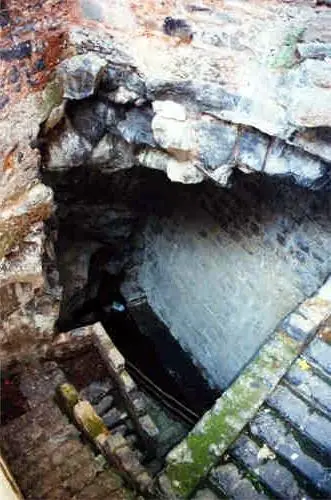
The Pozzo di Gammazita is an archaeological site with a strong connection to local legend. Its story is set during Angevin rule in Sicily and is linked to the War of the Sicilian Vespers, adding a narrative layer to the remains beneath the modern city.
Castello Ursino
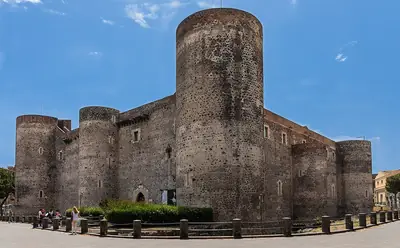
Castello Ursino, also known as Castello Svevo di Catania, was built in the 13th century as a royal castle of the Kingdom of Sicily. Commissioned by King or Emperor Frederick II, it later became the seat of the Sicilian Parliament during the Sicilian Vespers and a residence of Aragonese kings of Sicily, including Federico III.
The castle’s rectangular plan and four large circular corner towers give it a powerful, balanced appearance. It is also one of the few medieval structures in Catania to have survived the earthquake of 1693. Today, the Civic Museum of Catania occupies the castle and presents collections related to the city’s artistic and historical heritage.
Palazzo Biscari
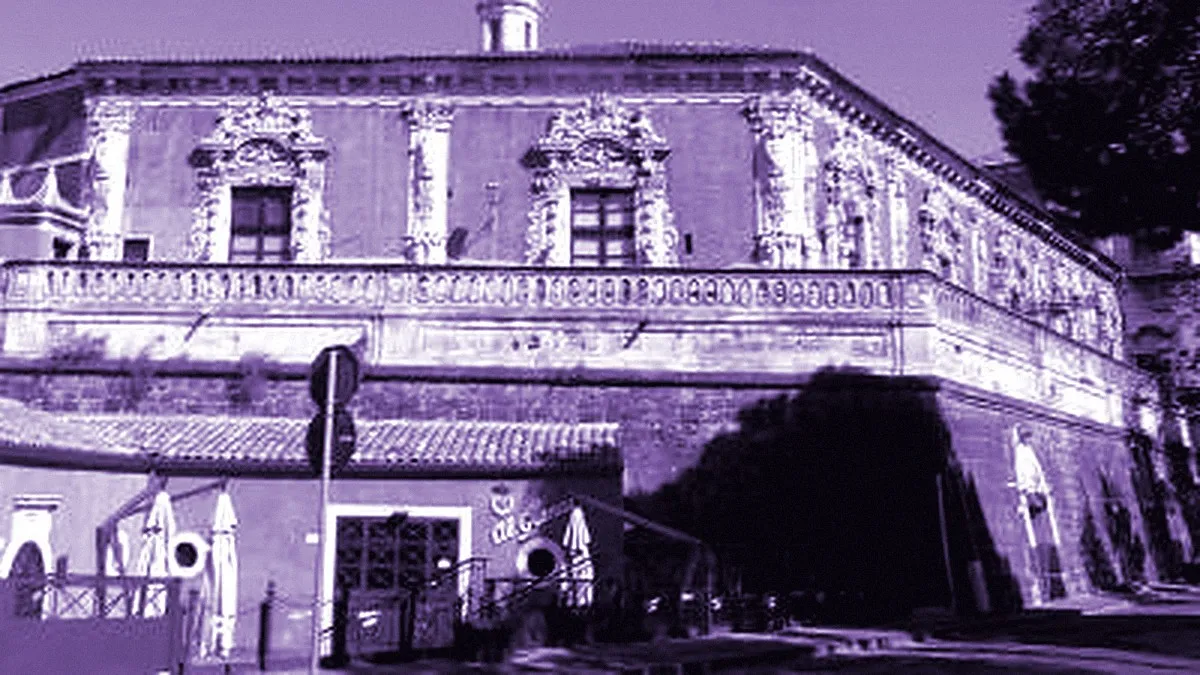
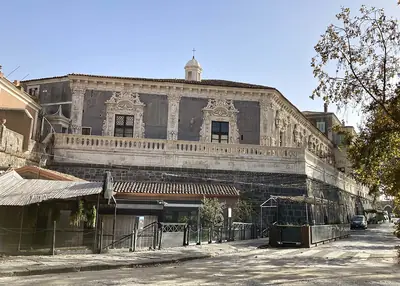
Palazzo Biscari is a monumental private residence known for its highly decorative interiors. Its rooms are open for guided visits and are also used for social and cultural events, making the palace one of the region’s best-known historic residences.
Santissima Trinità
The Chiesa della Santissima Trinità is a late-Baroque complex comprising a church and former monastery known as the Badia. It stands on Via Vittorio Emanuele II, at the corner with Via Santissima Trinità, in the Santissima Trinità district.
Since 2002, the complex has been included in the UNESCO World Heritage serial site “Città tardo barocche del Val di Noto del sud-est della Sicilia.”
Collegio dei Gesuiti
The Collegio dei Gesuiti is an impressive former Jesuit college on Via dei Crociferi, one of Catania’s most scenographic streets. The 18th-century palazzo forms part of the city’s late-Baroque heritage and has been included in the same UNESCO World Heritage serial site since 2002.
Basilica della Collegiata
The Basilica della Collegiata, also known as the Ancient Royal and Eminent Basilica Collegiate of Maria Santissima dell’Elemosina, stands on the west side of Via Etnea. The church was finished in 1794 and is considered an example of Sicilian Baroque.
Its history reaches back to the Middle Ages, when it was first constructed and later elevated to a collegiate church by Pope Eugenius IV. After the earthquake of 1693, it was rebuilt during Catania’s early-18th-century renewal. Angelo Italia’s redesign reoriented it towards Via Uzeda, now Via Etnea.
The façade was created by Stefano Ittar in a late-Baroque style. Six stone columns define the lower level, while statues flank a central window above. A grand staircase with a wrought-iron parapet leads to the entrance.
Museo Belliniano
The Museo Belliniano is dedicated to composer Vincenzo Bellini and occupies the house where he was born on 3 November 1801 and spent the first sixteen years of his life. The building, Palazzo Gravina Cruyllas, faces the church in Piazza San Francesco.
Emilio Greco Museum
The Emilio Greco Museum occupies rooms in Palazzo Gravina Cruyllas and preserves the work of Emilio Greco, a 20th-century Sicilian master known for sensual, abstract depictions of the human form.
The museum was created by Greco and opened in 1994. Its collection includes 150 autograph works dated from 1955 to 1992, including etchings, lithographs and sketches. “25 Farewells” and “Commiati” are among the highlighted works, while classical figures such as Nausicaa, Medea and Sappho connect Greco’s art with ancient mythology.
Casa Museo Giovanni Verga
Casa Museo Giovanni Verga is the former home of one of Italy’s most influential writers. Verga lived in the central Catania apartment during his childhood and for many years with his family.
The museum preserves the original interiors of the second-floor residence. Manuscripts, photographs and personal objects introduce the writer, while the sitting room contains copies of his writings, a sculpted bust of Verga and his father’s death mask. The house was declared a national monument on 11 January 1940 and later restored as a literary museum.
Ipogeo di Sant’Euplio and Santa Casa di Loreto
The Ipogeo di Sant’Euplio is connected with an older church site. The church was definitively destroyed by bombing during the Second World War, but parts of the original building remain, including the transept and the right wall of its single nave.
The Santa Casa di Loreto, also called the Casa di Loreto, is a simple religious building and a quieter stop among Catania’s churches and historic sites.
Museo arte contemporanea Sicilia
The Museo arte contemporanea Sicilia, or MacS, presents contemporary art in a building attributed to Giovanni Battista Vaccarini. Inaugurated in June 2013 after extensive restoration, the museum has permanent collections and exhibitions spread across two floors, with more than 70 works including paintings, sculptures, photography and mixed-media pieces.
Explore Catania with a free audio guide
Neywo turns a visit into a Catania audio guide that follows your movement through the city. The app has 4 walking tours and 1 bus route, with narration available in 11 languages.
The four walks are:
- Piazza Duomo, the elephant and Castello Ursino — 1.14 km, 91 minutes and 12 narrated stops.
- The Greco-Roman theatre and the Bellini museums — 1.21 km, 88 minutes and 12 narrated stops.
- Via Etnea and the Roman amphitheatre — 1.35 km, 77 minutes and 12 narrated stops.
- The Ultimate Catania: Biscari palace to the amphitheatre — 2.82 km, 128 minutes and 11 narrated stops.
There is also Line 504M: the old centre on a ten-minute loop, a 2.4 km bus route lasting 10 minutes with 7 narrated stops.
Download Neywo and explore Catania at your own pace: the app tells the story of each place as you reach it, with no group and no schedule.
Places with an audio guide in Catania
8 places in Catania with a Neywo audio guide. Each one starts telling its story as you reach it.
Self-guided tours in Catania
5 tours in Catania, free in the Neywo app. Each stop tells its story as you reach it.
- Bus ride
Line 504M: the old centre on a ten-minute loop
A city-centre circular that starts at Piazza Stesicoro and its Roman amphitheatre, then runs down Via Etnea and the baroque Via dei Crociferi, past the Santissima Trinità abbey and the Roman theatre, to the Pardo palace by the fish market and the house where Bellini was born. A cheap way to cross the historic centre when your feet need a rest.
Roman amphitheatre of Catania · Via Etnea · Via dei Crociferi · Santissima Trinità · Roman Theatre of Catania · Palazzo Pardo …
Open this tour: Line 504M: the old centre on a ten-minute loop - Walk
Piazza Duomo, the elephant and Castello Ursino
Baroque Catania, rebuilt in black lava after the 1693 earthquake. The cathedral of Sant'Agata, the lava-stone elephant on the square, the fish market fountains, and the Norman castle that the 1669 eruption left inland.
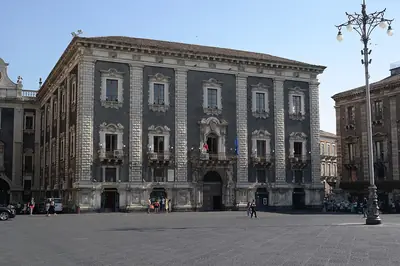
Piazza dell'Università (Catania) · Palazzo San Giuliano, Catania · Badia di Sant'Agata · Catania Cathedral · Diocesan museum (Catania) · Porta Uzeda …
Open this tour: Piazza Duomo, the elephant and Castello Ursino - Walk
The Greco-Roman theatre and the Bellini museums
West of the cathedral, where the Roman theatre and its odeon are wedged in among the houses, with the composer Bellini's birthplace, Verga's apartment and the Jesuit college nearby.
Santa Maria dell'aiuto · Santa Casa di Loreto · Santa Chiara · Casa Museo Giovanni Verga · Museo Belliniano · Emilio Greco Museum …
Open this tour: The Greco-Roman theatre and the Bellini museums - Walk
Via Etnea and the Roman amphitheatre
A short walk up Catania's main street to the amphitheatre exposed at Piazza Stesicoro — only a corner of it is visible, and it held 15,000 people — with the Sant'Euplio hypogeum and the Bellini monument beside it.
Monument to Vincenzo Bellini · Ipogeo di Sant'Euplio · Roman amphitheatre of Catania · Church of San Biagio · Villa Cerami · Via dei Crociferi …
Open this tour: Via Etnea and the Roman amphitheatre - Walk
The Ultimate Catania: Biscari palace to the amphitheatre
Under three kilometres through the black-and-white baroque centre: the Biscari palace, the cathedral and its museum, the market fountains, Castello Ursino, the Bellini museum and the Roman remains.
Palazzo Biscari · Catania Cathedral · Diocesan museum (Catania) · Fontana dei Sette Canali · Pozzo di Gammazita · Castello Ursino …
Open this tour: The Ultimate Catania: Biscari palace to the amphitheatre
Walk Catania with Neywo
Neywo turns Catania into a self-guided audio tour. Stories arrive as you reach the place they belong to, and the route reshapes when you wander off it.

