Things to Do in Cefalù, Italy: Walking Guide
Things to do in Cefalù: a self-guided walk through Sicily’s Norman town
The best things to do in Cefalù include exploring its Norman cathedral, discovering small historic churches and museums, and climbing the Rocca above the town. Set on Sicily’s northern coast, Cefalù brings together medieval streets, religious heritage and dramatic mountain scenery in a compact setting. Neywo offers a free audio guide for Cefalù with 18 narrated places, available in 11 languages.
What to see in Cefalù
Cefalù Cathedral
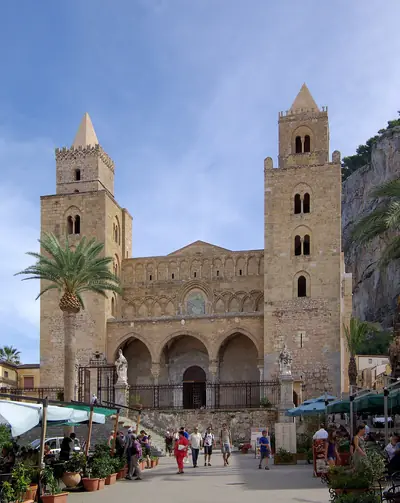
Cefalù Cathedral, also known as the Duomo di Cefalù, is the town’s defining landmark. This Roman Catholic basilica was built between 1131 and 1240, during and after the period of Norman rule in Sicily. Its construction was completed during the Swabian period.
The cathedral combines Romanesque forms with Sicilian Norman and Byzantine features. Twin towers and a strong entrance structure give it a fortress-like appearance. Inside, the thick walls include an ambulatory that reveals how the design changed during construction. The three roofs also belong to different periods and use different building techniques.
Tradition says that King Roger II vowed to build the cathedral after surviving a storm and reaching Cefalù’s beach. Another interpretation presents it as a dynastic church and a powerful statement of Norman presence. Since 1941, the cathedral has been recognized as a UNESCO World Heritage site as part of the Arab-Norman Palermo and the Cathedral Churches of Cefalù and Monreale.
Museo Mandralisca
The Museo Mandralisca preserves the broad collection assembled by Baron Enrico Pirajno di Mandralisca, whose home still contains the objects he gathered during his lifetime. It is the only museum in Cefalù, and its archive also documents the history of the museum and its foundation.
The collection ranges widely. Ancient objects include ceramics dating from the Bronze Age to the fourth century BC, as well as coins from the Greek city-states of Sicily. One particularly striking piece is a fourth-century BC red-figure crater decorated with a satirical scene of a fish seller.
Cefalù’s churches
Cefalù’s historic center contains a series of smaller religious buildings, each adding to the character of the old town. Immacolatella, Purgatorio—also known as the Church of Santo Stefano—and Chiesa della Santissima Annunziata are all part of this network of local places of worship.
Santa Maria d’Itria, also known as the Church of Itria, stands a few steps from the town’s other historic sights. San Sebastiano, Santa Maria al Borgo, Santa Oliva and San Pasquale offer further stops for visitors interested in Cefalù’s religious heritage.
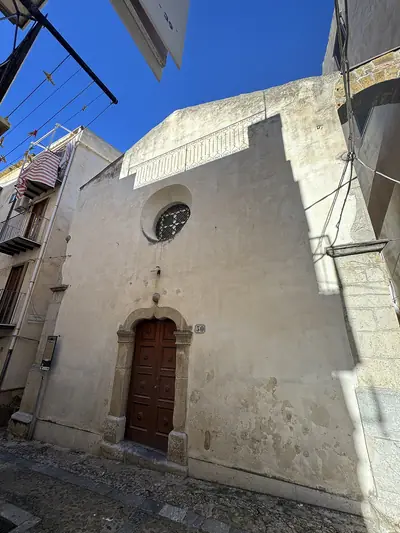
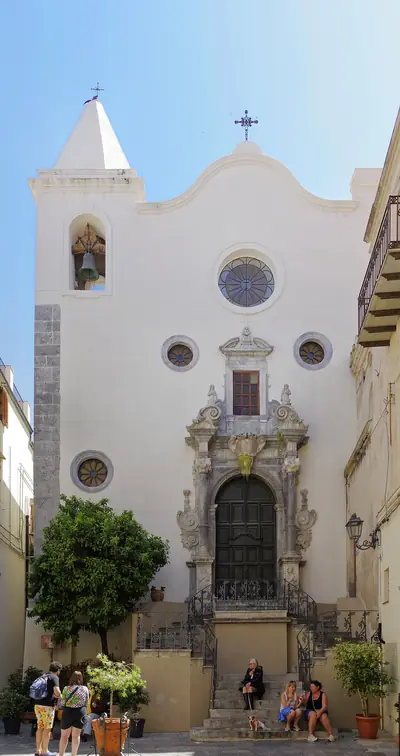
Chiesa di San Biagio stands near Cefalù’s Medieval Washhouse, on the north side of Via XXV Novembre. Its history combines two earlier chapels: one dedicated to Saint Crispin and founded in 1580, and another dedicated to Saint Blaise, or San Biagio, dating from 1502. The two churches belonged to the Martino family and were later united.
The small building has a simple gabled façade, a pedimented doorway and a broad arched window. Its compact interior is decorated with stucco mouldings. Two columns mark the entrance, while a small room at the back contains the altar.
Osterio Magno
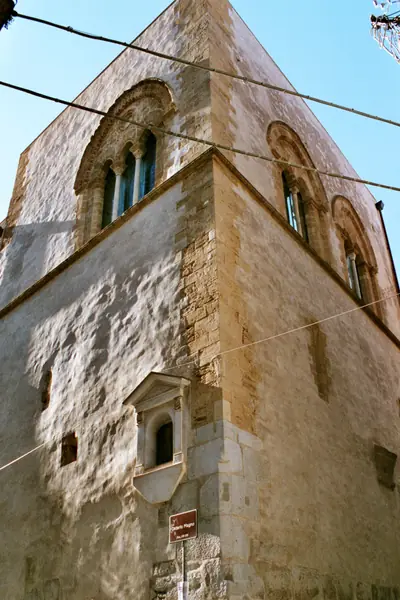
Osterio Magno is a historic fortified palace in Cefalù. Its sturdy appearance makes it one of the notable buildings to look for while walking through the town.
Town hall of Cefalù
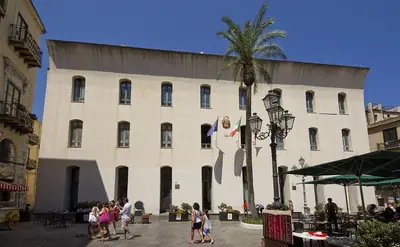
Cefalù’s town hall occupies the former Monastery of Santa Caterina. The building therefore has a double identity: it serves as a municipal palace while preserving its earlier monastic history.
Rocca di Cefalù
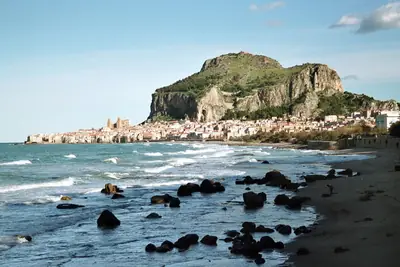
The Rocca di Cefalù rises above the town as a distinctive rocky landmark. Known in the Cefalù dialect as “u castieḍḍu,” it reaches 268 metres and provides a dramatic setting for the historic center below.
The Rocca is also featured in the traditional marionette theatre of Sicily. At the Teatro dei pupi di Angelo Sicilia, visitors can discover the Opera dei Pupi, one of the island’s best-known forms of storytelling.
Abbey of Thelema
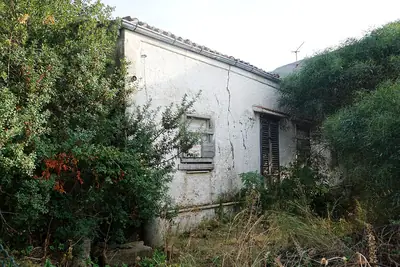
In the hills beyond Cefalù, the small house known as the Abbey of Thelema became a spiritual center in 1920, when Aleister Crowley and Leah Hirsig transformed the villa into a temple for their community. Crowley, Hirsig and other followers lived there for about three years under rules they had created themselves.
The project was intended to become a Collegium ad spiritum sanctum. It eventually failed because of difficulties financing the community and managing communal life. Local residents and authorities also became suspicious of the rituals and drug use. After the death of a British student, Raoul Loveday, in 1923, the Italian government expelled Crowley from Italy.
Some of Crowley’s murals survived, at least in part. In 1955, filmmaker Kenneth Anger found and filmed some of them for Thelema Abbey.
Sanctuary of Gibilmanna
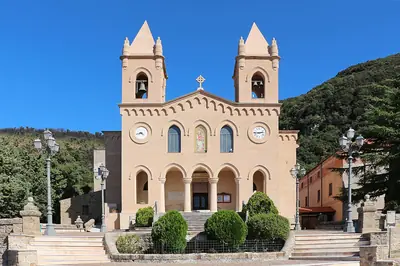
High above Cefalù, on the western slopes of Pizzo Sant’Angelo in the Madonie mountains, the Sanctuary of Gibilmanna stands at about 800 metres above sea level. Dedicated to the Blessed Virgin Mary, it has a history connected with Benedictine, Norman and Capuchin religious communities.
According to tradition, Pope Gregory the Great founded a Benedictine monastery here in the sixth century. The monastery later declined during Arab rule, although hermits continued to care for the church. After the Norman conquest, it was rebuilt, and in 1228 the church became a priory.
The Capuchin order took charge in 1535 and built a small monastery beside the church. A larger replacement church was completed in 1623 and consecrated in 1625. Its façade was renewed in a Neo-Gothic style in 1907 after the portico collapsed. Inside, a Byzantine-style fresco of the Madonna and Child was moved from the old church into a side chapel, which also preserves a statue of the Madonna and a Byzantine crucifix from the earlier building.
A Cefalù self-guided walking tour with Neywo
Neywo’s free audio guide lets you explore Cefalù without joining a group or following a fixed timetable. The app tells the story of each place as you reach it, at your own pace, so you can walk independently and stop when you want.
There are two walking tours in Cefalù:
- Crowley’s Villa, the Rock and the Norman Duomo: 2.84 km, 108 minutes and 12 narrated stops.
- Behind the Duomo: Churches and the Baron’s Collection: 0.72 km, 42 minutes and 5 narrated stops.
Together, the tours cover landmarks including the Abbey of Thelema, the Rocca di Cefalù, Cefalù Cathedral, Museo Mandralisca, the town hall, Osterio Magno and several historic churches. The full Cefalù audio guide contains 18 narrated places, with narration available in 11 languages.
Download Neywo and explore Cefalù at your own pace
Download Neywo to explore Cefalù with a free audio guide that accompanies you as you walk. Choose one of the two walking tours, reach each stop when you are ready and listen to its story directly in the app—no group and no schedule.
Cefalù is part of Sicily, in Italy. For more ideas elsewhere on the island, you can also explore Erice, Agrigento or Messina.
Places with an audio guide in Cefalù
8 places in Cefalù with a Neywo audio guide. Each one starts telling its story as you reach it.
Self-guided tours in Cefalù
2 tours in Cefalù, free in the Neywo app. Each stop tells its story as you reach it.
- Walk
Crowley's Villa, the Rock and the Norman Duomo
Start at the villa where Aleister Crowley founded his Abbey of Thelema in 1920, then look up at the 268-metre Rocca that guards the town. Walk down into the old centre to the Norman cathedral that Roger II is said to have vowed in a storm, the Mandralisca museum and a string of small churches along the lanes.
Abbey of Thelema · Rocca di Cefalù · Cefalù Cathedral · Santissimo Sacramento · Museo Mandralisca · Town hall of Cefalù …
Open this tour: Crowley's Villa, the Rock and the Norman Duomo - Walk
Behind the Duomo: Churches and the Baron's Collection
A short loop through the quiet northern lanes around Cefalù's Norman cathedral. Visit three small churches tucked behind the Duomo and end at the Museo Mandralisca, where a Baron's private collection holds a famous portrait by Antonello da Messina.
Cefalù Cathedral · Santa Oliva · Santa Maria d'Itria · San Sebastiano · Museo Mandralisca
Open this tour: Behind the Duomo: Churches and the Baron's Collection
Walk Cefalù with Neywo
Neywo turns Cefalù into a self-guided audio tour. Stories arrive as you reach the place they belong to, and the route reshapes when you wander off it.

