Visiting Trento, Italy: Top Sights on Foot
Things to Do in Trento: History, Frescoes and Alpine Fortifications
Trento is a historic city in northern Italy, known for its cathedral, Renaissance palaces, painted façades, medieval castle and mountain setting. From Roman archaeological remains in the centre to Austro-Hungarian forts in the surrounding hills, there are plenty of things to do in Trento for visitors interested in history and architecture. Neywo’s free audio guide for Trento covers 191 narrated places, helping you discover the city as you walk.
What to See in Trento’s Historic Centre
Trento Cathedral and Piazza Duomo
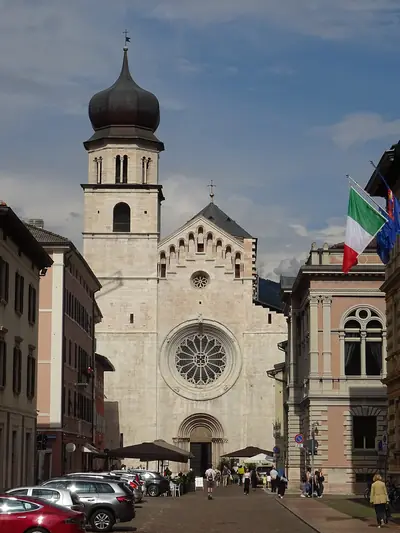
Trento Cathedral, known locally as the Dòm, stands on Piazza Duomo and is the seat of the Archdiocese of Trento. Its history reaches back to the 4th century, when Saint Vigilius founded a cemetery basilica for the martyrs of Anaunia.
The present cathedral largely comes from a reconstruction begun by Prince-Bishop Federico Vanga in the early 13th century and continued into the 16th century. This long building history explains its Romanesque-Gothic character. Beneath the current floor, the remains of the original Paleochristian basilica are preserved. Outside, look for the rose windows on the façade and north transept.
The square is also a good place to notice Trento’s decorated urban landscape. Its buildings include colourful Renaissance façades and the city’s famous Fountain of Neptune.
Casa Balduini
On the western side of Piazza Duomo, Casa Balduini dates from the 14th century and has the oldest exterior decoration in Trento. Its façade offers a glimpse of the city’s medieval appearance and is easy to include while exploring the square.
Renaissance palaces along the city streets
Trento’s historic centre is filled with palaces that reflect the city’s role as a religious, political and commercial centre. Palazzo Firmian, commissioned by the Firmian family toward the end of the 15th century, is one of the city’s notable Renaissance buildings.
Other historic residences include Palazzo Larcher Fogazzaro, Palazzo Calepini and Palazzo Lodron. They are quieter points of interest than the cathedral or castle, but together they show how much of Trento’s history is embedded in its streets.
Palazzo Salvadori, on Via Manci, is one of the finest examples of Renaissance civil architecture in the city. It is also considered one of Trento’s first Renaissance-style secular buildings.
Palazzo Del Monte
Palazzo Del Monte stands at the corner of Via del Suffragio and Via San Marco, in the area historically known as the Cantone. The building was completed in the early 16th century, probably between 1505 and 1515.
Its main portal has a marble arch resting on capitals decorated with monstrous dolphins. The façades also feature triple-lancet and double-lancet windows, columned balconies and stone pilasters. Its position reflects the historical importance of Via del Suffragio, which led towards the old port on the Adige near the northern entrance to the city.
Teatro Sociale
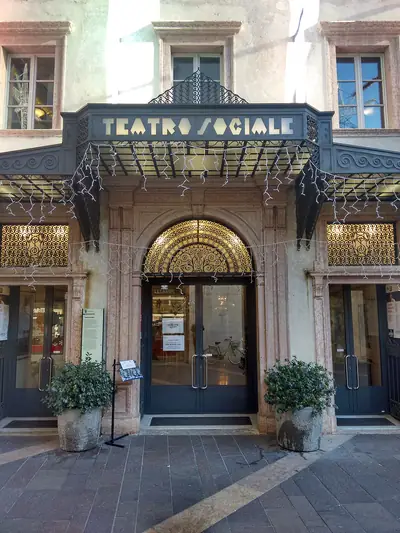
Teatro Sociale occupies part of the Palazzo del Conte Tommaso Festi. This historic theatre adds a cultural stop to a walk through the centre and illustrates the role of palaces as settings for performances and gatherings as well as private residences.
Buonconsiglio Castle
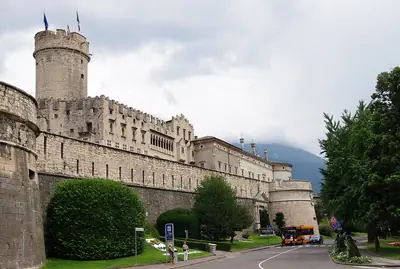
Buonconsiglio Castle is one of Trentino’s most important landmarks. For almost six centuries, from the 13th century to the late 18th century, it served as the residence of the Prince-Bishops of Trento. Its walls enclose buildings from several different periods rather than a single uniform structure.
The oldest section, Castelvecchio, is dominated by a cylindrical tower. The Renaissance Magno Palazzo, or Great Palace, added another major layer to the complex. The castle’s connection with the Council of Trent gives it particular importance in European religious history.
Inside Torre Aquila, the Aquila Tower, the Cycle of the Months is one of Italy’s notable late-medieval secular fresco cycles. It is one of the essential stops for anyone deciding what to see in Trento.
Roman Tridentum and the City’s Religious Heritage
Trento began as the Roman settlement of Tridentum, established in the 1st century BC beside an important route across the Alps. Parts of its streets, walls, buildings and drainage systems survive beneath the modern centre.
The archaeological underground area of Sas reveals this earlier city, while the Roman villa of Orpheus offers another view of Trento’s Roman past. The Early Christian Church on Doss Trento recalls the city’s later religious history, and Santa Maria Maggiore church is closely associated with the historic centre and the Council of Trent.
The city’s religious architecture also includes Saint Lawrence church, Saint Mark church, Saints Peter and Paul church and the former convent of the Hermit Friars of Saint Augustine. These places form part of the layers of sacred and civic history found between Trento’s streets and squares.
Doss Trento and the Adige
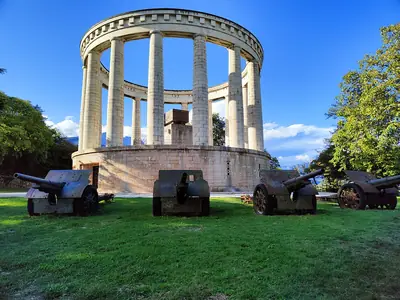
Doss Trento rises above the city and provides a setting for several historically significant sites. The hill is home to Cesare Battisti’s mausoleum, designed by Ettore Fagiuoli and completed in 1935. It was inaugurated on May 26 that year, when Battisti’s remains were transferred from the city cemetery to the hilltop monument.
Nearby, the Museo Nazionale Storico degli Alpini and the Early Christian Church add further historical context. Across the river, Piedicastello includes the Gallerie Piedicastello, Saint Apollinaris church and Porta Santa Margherita.
The Adige is also part of Trento’s urban story. Palazzo delle Albere, included on Neywo’s route along the river, connects the historic city with a different architectural period and setting.
Austro-Hungarian Forts Around Trento
The hills and valleys around Trento contain several fortifications that formed part of the Austro-Hungarian Fortress of Trento, known in German as the Festung Trient.
Forte Bus de Vela
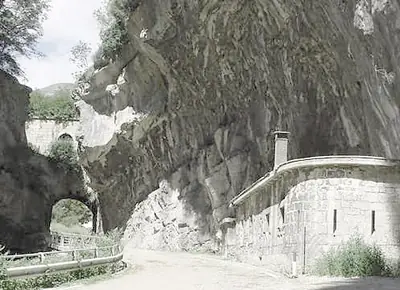
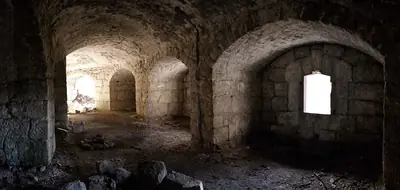
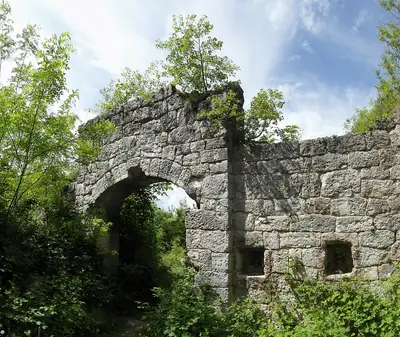
About four kilometres west of Trento, Forte Bus de Vela—also called the Fort of Cadine—stands in the narrow Bus de Vela gorge. Built between 1860 and 1862, it was designed as a roadblock between Trento and Cadine. Its position meant that the route could not simply be bypassed.
The fort carried three 9-centimetre M75/4 cannons aimed towards Cadine, two 8-centimetre barbette cannons and numerous rifle embrasures. Its west-facing armoured door is one of the details that shows how strongly the position was defended.
Forte Roncogno
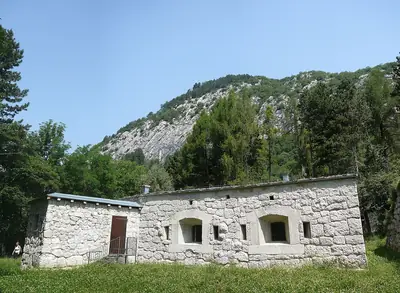
Forte Roncogno, or the Roncogno Battery, was built between 1879 and 1881 on the slopes of Monte Celva near the Cimirlo pass. Its purpose was to block an advance towards Trento from the Valsugana valley.
The limestone battery has a distinctive horseshoe shape and was linked by trenches to the Cimirlo battery higher on Monte Celva. An internal cistern and other rooms supported the position during a prolonged siege.
Forte Brusafer and Forte Doss Fornas
Forte Brusafer, also known as Brusaferro, belonged to the same network of Austro-Hungarian fortifications along the Italian border.
Opposite the Brussa ferro battery in Valsorda, Forte Doss Fornas was constructed between 1878 and 1880. It was among the last fortifications built in the Trentino style, using stone from the surrounding area. Its armament changed over time, and the battery eventually included an observation turret and eight 15-centimetre M78 guns aimed towards Vigolo Vattaro. An armoured rotating observation dome was added in 1898.
Explore Trento with Neywo
Neywo offers five walking tours, one bus route and one bike route in Trento, with narration available in 11 languages. The walks range from 0.74 to 2.36 kilometres and last between 80 and 96 minutes; the bus route covers 9.7 kilometres in 42 minutes, while the bike route covers 3.1 kilometres in 16 minutes. Together, the tours include narrated stops at the cathedral, Buonconsiglio Castle, Doss Trento, the city’s palaces, towers, churches and riverfront.
Download Neywo and choose the route that suits your day: follow the historic centre, discover the castle quarter, explore Doss Trento and the Adige, or travel through the city by bus or bike. The app tells the story of each place as you reach it, at your own pace, with no group and no schedule.
Trento is part of Trentino-South Tyrol, in Italy. If you are exploring the region further, you can also compare it with Riva del Garda or Pinzolo.
Places with an audio guide in Trento
8 places in Trento with a Neywo audio guide. Each one starts telling its story as you reach it.
Self-guided tours in Trento
7 tours in Trento, free in the Neywo app. Each stop tells its story as you reach it.
- Bike ride
Along the Adige: Torre Verde to Palazzo delle Albere
Ride the river path through Trento on the Adige cycle route, from the church of Saint Martin and the medieval Torre Verde past the church of Sant'Apollinare to the Renaissance villa-fortress of Palazzo delle Albere beside the MUSE science museum. Flat, easy and mostly car-free.
Saint Martin church · Torre Verde · Saint Apollinaris church · Palazzo delle Albere
Open this tour: Along the Adige: Torre Verde to Palazzo delle Albere - Bus ride
Towers and Castles on Line 8: From Mattarello to the Adige
Trento's main north-south urban line starts in the village of Mattarello, beside its castle tower, and rides into the city past the Torrione Madruzziano, the De Gasperi monument and the Buonconsiglio Castle to the riverside Torre Verde and on to the church of Saint Martin. Frequent service on a regular city fare.
Saint Leonard church · Torre Franca Castle · Saint Cajetan of Thiene church · Chiesa del Sacro Cuore · Blessed Sacrament church · Torrione …
Open this tour: Towers and Castles on Line 8: From Mattarello to the Adige - Walk
Piazza Granda: Prince-Bishops, Frescoes and the Town Hall
Start at the oldest frescoed house in the city and the Romanesque-Gothic Dòm, where the prince-bishops lived next door, then drift through the square the locals call Piazza Granda. Follow the frescoed and diamond-studded Renaissance palaces of Via Belenzani and the old streets around it to the seat of today's city government. Everything is within a few hundred metres, so linger.
Casa Balduini · Trento Cathedral · Fontana del Nettuno · Tridentine Diocesan Museum · Torre Civica (Trento) · Cazuffi house …
Open this tour: Piazza Granda: Prince-Bishops, Frescoes and the Town Hall - Walk
Roman Tridentum to Renaissance Via Manci
Begin with a Renaissance palace and a twelfth-century church, then go down beneath Piazza Battisti to the Roman street, wall and sewer of ancient Tridentum. Climb back into Renaissance and baroque Trento along Via Manci: the palaces of Salvadori and Trentini, the Palace of the Devil, a theatre hidden inside a noble residence, and Mazzoni's 1934 post office.
Palazzo Firmian · Saint Anne church · Negri tower house (Trento) · Piazza Cesare Battisti · Archaeological underground area of Sas · Palazzo Salvadori …
Open this tour: Roman Tridentum to Renaissance Via Manci - Walk
Hercules on the Walls: The Castle Quarter
Start at the statue of Trento's statesman De Gasperi and walk the streets where Maximilian I was honoured as the German Hercules, past the Lodron and Del Monte palaces and the old convents of the Borgo Nuovo. Then climb to the castle where the prince-bishops ruled for six centuries and see the Eagle Tower's medieval Cycle of the Months, and finish by the Torre Verde on the Adige.
Monument to Alcide De Gasperi · Palazzo Lodron · Saints Peter and Paul church · Palazzo Del Monte · Saint Mark church · Former convent of the Hermit Friars of Saint Augustine …
Open this tour: Hercules on the Walls: The Castle Quarter - Walk
Poets, Jesuits and the Council: From the Station to Santa Maria Maggiore
Start at the Jesuit college that became a barracks and a library, then stroll through Piazza Dante's busts and monuments, including the Dante statue that once defied Habsburg rule. Pass the Torre Vanga and the Torre della Tromba and end where the Council of Trent held its final sessions in 1562-63, at Santa Maria Maggiore.
Collegio dei Gesuiti · Monument to Eusebio Kino · Monument to Dante in Trento · Piazza Dante · Monument to Luigi Negrelli · Palazzo della Provincia Autonoma di Trento …
Open this tour: Poets, Jesuits and the Council: From the Station to Santa Maria Maggiore - Walk
Doss Trento, Piedicastello and the River Adige
Cross the Adige to the Doss Trento hill with its early Christian church and the mausoleum of Cesare Battisti, then follow the river through the Piedicastello galleries, Roman Trento's gate and villa, the Austro-Hungarian ossuary and the Renaissance villa-fortress of Palazzo delle Albere.
Museo Nazionale Storico degli Alpini · Early Christian Church on the Doss Trento · Cesare Battisti's mausoleum · Gallerie Piedicastello · Saint Apollinaris church · Porta Santa Margherita …
Open this tour: Doss Trento, Piedicastello and the River Adige
Walk Trento with Neywo
Neywo turns Trento into a self-guided audio tour. Stories arrive as you reach the place they belong to, and the route reshapes when you wander off it.

