Pisa, Italy: Self-Guided Walking Tour
Things to Do in Pisa: What to See Beyond the Leaning Tower
Pisa is a Tuscan city shaped by medieval maritime power, Romanesque and Gothic architecture, university life, and the River Arno. The Leaning Tower is its best-known landmark, but Pisa is worth exploring for its cathedral square, riverside palaces, museums, churches, and historic bridges. Neywo has a free audio guide for Pisa with 187 narrated places, available in 11 languages.
Part of Tuscany and the wider heritage of Italy, Pisa is compact enough to explore on foot while offering far more than a quick visit to its most famous monument.
What to see in Pisa
Piazza dei Miracoli and Pisa Cathedral
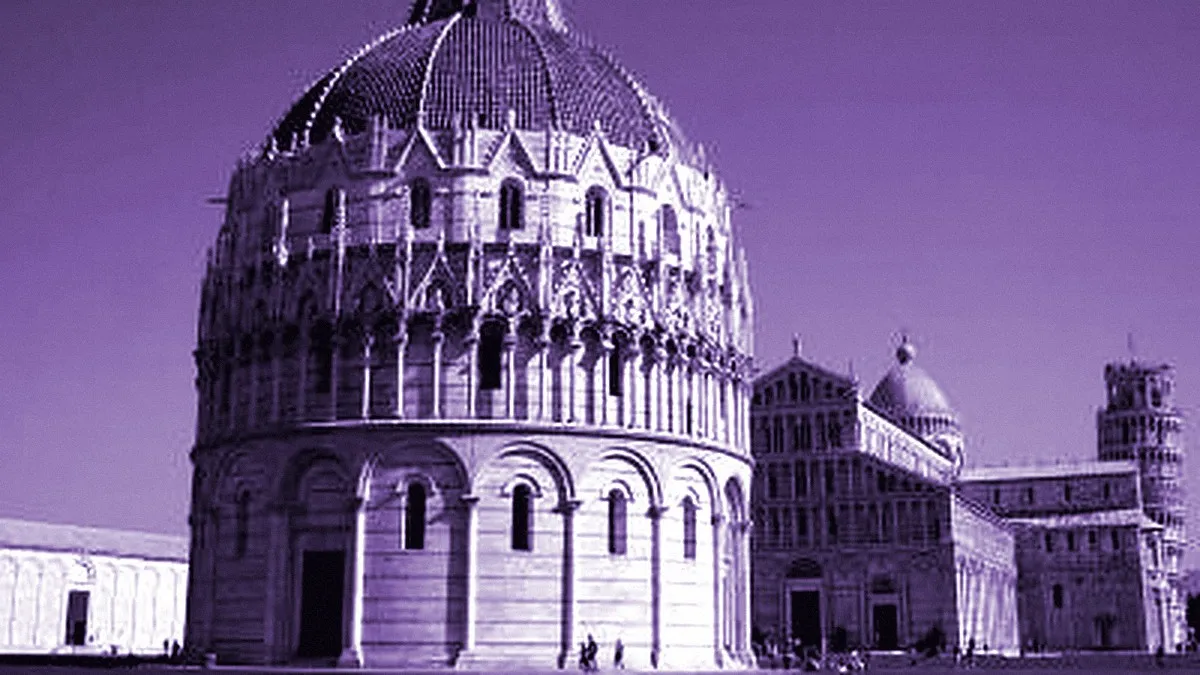
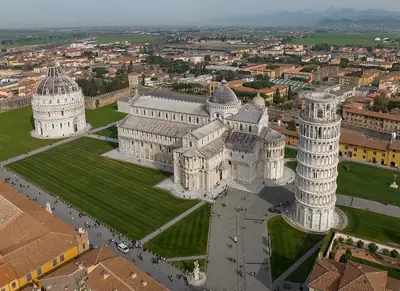
Begin with Piazza dei Miracoli, also known as the Square of Miracles. Enclosed by medieval walls and spread across a broad green lawn, the square brings together Pisa’s most important monuments in a carefully balanced architectural composition. Its white marble buildings, arcades, circular forms, and vertical lines create one of Europe’s most recognizable historic spaces. The square has been a UNESCO World Heritage Site since 1987.
At its centre stands Pisa Cathedral, officially the Primatial Cathedral of Santa Maria Assunta. Construction began in 1064 and was completed in 1092; the cathedral was consecrated in 1118. It is a major example of Pisan Romanesque architecture, a style associated with the wealth and international connections of Pisa’s medieval maritime republic.
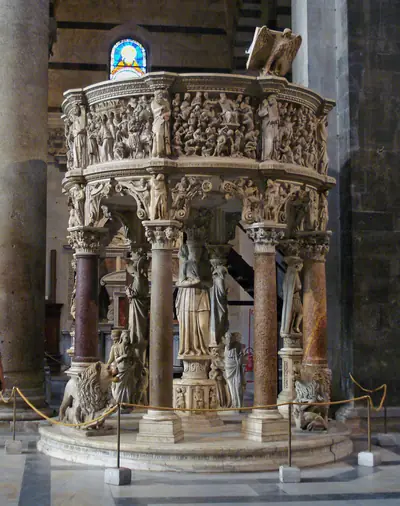
The white marble façade is decorated with four rows of open galleries and small round arches. Its design combines Romanesque elements with Byzantine and Islamic influences. Inside, one of the highlights is the pulpit created by Giovanni Pisano between 1302 and 1311.
The Leaning Tower of Pisa
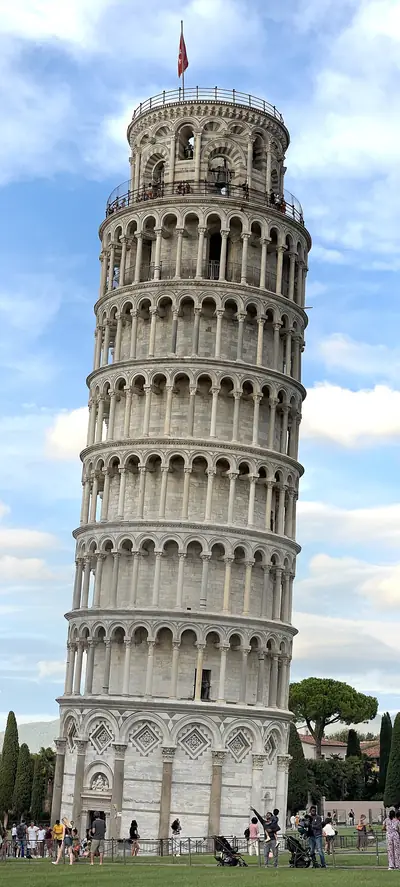
The Leaning Tower is the freestanding bell tower of Pisa Cathedral and the city’s most famous symbol. Built between 1173 and 1372, it began to lean while construction was still underway because its foundations settled into soft, sandy soil. Attempts to correct the problem produced the tower’s subtle curve as the upper levels were built.
The tower is about 57 metres tall and weighs an estimated 14,500 tonnes. Its eight levels of open galleries are supported by slender marble columns, giving the structure a surprisingly light appearance. The seven bells hang in the belfry at the top.
The tower’s inclination once reached 5.5 degrees by 1990; it currently measures 3.97 degrees from the vertical. Look at it from different points around the square to appreciate how the upper floors shift away from the line of the base.
Knights’ Square and the statue of Cosimo I
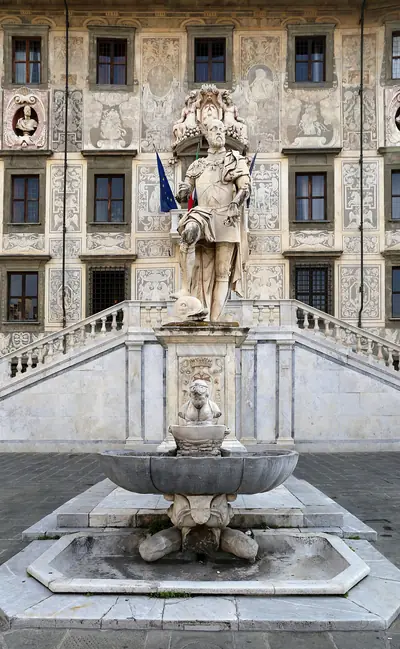
Knights’ Square offers a different view of Pisa’s history. In its centre stands a bronze statue of Cosimo I de’ Medici, Grand Duke of Tuscany. Commissioned in 1596 by his son Ferdinand I and created by Pietro Francavilla, the statue shows Cosimo wearing the robes of Grand Master of the Knights of Saint Stephen.
He is depicted subduing a dolphin, a symbol of domination over the sea. The fountain in front of the pedestal was also designed by Francavilla and includes a shell-shaped basin with two grotesque monsters.
Behind the statue rises the Palazzo della Carovana, also known as the Palace of the Knights. Giorgio Vasari built it in 1564 for the Order of the Knights of Saint Stephen, founded by Cosimo de’ Medici in 1561 to fight Ottoman pirates in the Mediterranean.
Santa Maria della Spina
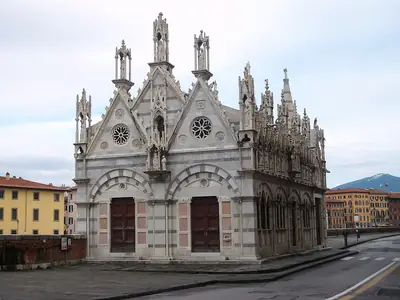
On the left bank of the Arno, the small church of Santa Maria della Spina stands out for the richness of its decoration. Built entirely in marble, it is one of Pisa’s finest examples of Gothic architecture, with pinnacles, carved niches, sculpted figures, and delicate rose windows.
The church was originally built around 1230 in the Pisan Gothic style and enlarged after 1325. It was first called Santa Maria di Pontenovo, after a nearby bridge that later collapsed. Its current name refers to a relic believed to be a thorn from Christ’s Crown of Thorns, brought to the church in 1333.
In 1871, the building was dismantled and reconstructed at a higher level to protect it from water infiltration from the Arno. The restoration changed parts of the structure and became controversial.
Palazzo Blu and the Arno waterfront
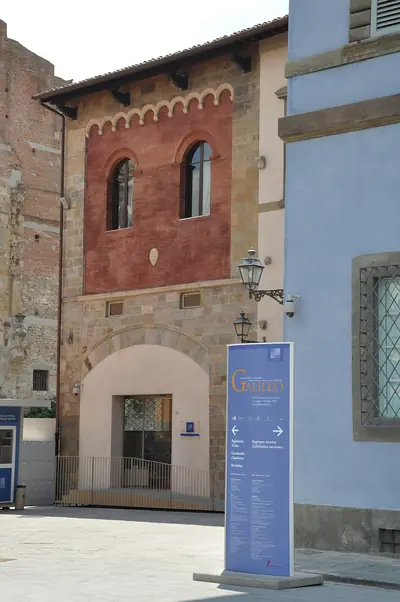
Palazzo Blu is a former aristocratic palace on Lungarno Gambacorti. Its bright blue façade gives the building its name, while the interior now hosts temporary exhibitions and cultural activities. The palace occupies the Palazzo Giuli Rosselmini Gualandi and neighbouring Palazzo Casarosa, both restored by Fondazione Pisa.
The site has been occupied since at least the 11th century. During a later restoration, workers uncovered the distinctive blue colour on the façade, attributed to the taste of the Russian owners who acquired the palace in the 18th century.
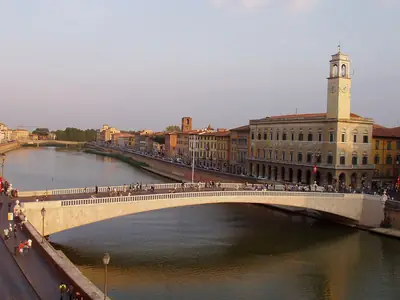
The Arno waterfront also leads towards the Ponte di Mezzo, the Middle Bridge, at roughly the centre of Pisa’s historic centre. The bridge connects Piazza Garibaldi in the northern Tramontana district with Piazza XX Settembre on the southern side, where the Palazzo Pretorio, town hall, and Logge di Banchi stand.
The current bridge was completed in 1950 after its predecessor was destroyed by bombing in 1944. It is made of reinforced concrete covered with pale Verona stone and stretches for about 89 metres across a single wide arch. Marble spheres from the earlier bridge remain at its four corners, while a Pisan cross set into the pavement marks the symbolic centre of the crossing.
Palazzo Pretorio
Close to the Ponte di Mezzo and the Logge di Banchi, Palazzo Pretorio is a medieval building on the Lungarno Galilei. It formerly housed Pisa’s municipal library, before the collection was moved to the Le Piagge area.
Its position makes it a useful landmark when walking between the river, the bridge, and the historic centre.
The National Museum of San Matteo
The National Museum of San Matteo occupies a former 13th-century convent on the banks of the Arno. Its collection includes paintings and sculptures from Pisa and Tuscany dating from the 12th to the 17th century.
The building itself combines a Romanesque Pisan-style façade facing the river with a more classical appearance on the entrance side. Inside, the collection of 12th- and 13th-century paintings from the Pisan area reflects the city’s importance as a centre of Italian painting until the early 13th century.
One of the highlights is a tempera panel of Saint Paul painted by Masaccio in 1426. It is the only surviving panel from an altarpiece commissioned for a chapel in Santa Maria del Carmine. The museum also contains archaeological objects, including an early Christian sarcophagus.
San Paolo all’Orto
San Paolo all’Orto means Saint Paul in the Garden. This Romanesque church was built in 1086, and its grey-and-white marble façade is decorated with arches, oculi, lozenges, carved flowers, leaves, animal heads, and lion grotesques.
The building served as a priory and home of the Order of Augustinian Sisters between the 12th and 15th centuries. Its bell tower has been rebuilt several times, with the current version dating from the 17th century. Inside, the single nave and two aisles retain frescoes and sinopias, while the church now also functions as a cultural venue.
Pisa’s university and specialist museums
Pisa’s academic character can be seen in its university museums. The Egyptian Collections of the University of Pisa, on Via San Frediano, bring together ancient Egyptian antiquities and form part of the University of Pisa’s museum system.
The university also houses the Paleontological and Palaeoethnological Collections, with prehistoric artefacts and fossil remains. Together, these collections add an archaeological and scientific dimension to the city’s better-known medieval monuments.
The Domus Mazziniana explores the life and legacy of Giuseppe Mazzini. The building, formerly known as Casa Rosselli-Nathan, was where Mazzini lived under a false name from 6 February 1872 until his death on 10 March of the same year. It was declared a National Monument in 1910 and joined the network of Historical Institutes of national interest in 2002.
San Pietro a Grado
About seven kilometres west of Pisa’s city centre, the Church of Saint Peter a Grado stands near the site of a vanished port of the ancient Pisan Republic. Tradition holds that Saint Peter landed here in Italy from Antioch in 44 AD.
The church has an unusual design, with two apses facing each other and no façade. Archaeological excavations have revealed early Christian buildings built over Roman structures, later replaced by a larger church during the early medieval period. Its layered history makes it one of the most distinctive churches in the area.
Explore Pisa with a self-guided audio tour
A Pisa self-guided walking tour lets you explore the city without joining a group or following a fixed schedule. Neywo offers four walking tours, one bus route, and one bike route in Pisa:
- The Square of Miracles: Marble, Bells and Galileo — 1.67 km, 109 minutes, 12 narrated stops.
- Knights, Clocks and Medici Power: Piazza dei Cavalieri — 1.49 km, 83 minutes, 12 narrated stops.
- Along the Arno: The Thorn, the Blue Palace and the Middle Bridge — 1.79 km, 98 minutes, 12 narrated stops.
- Medici Arsenals and the Old Cathedral on the River — 2.06 km, 84 minutes, 11 narrated stops.
- Line 21: From the Square of Miracles to the Arno — a 6.4 km bus route lasting 27 minutes, with 9 narrated stops.
- Walls and Gates: Cittadella to Porta Nuova — a 1.2 km bike route lasting 6 minutes, with 4 narrated stops.
Download Neywo and explore Pisa at your own pace. The app tells the story of each place as you reach it, with no group and no schedule, making it easy to connect the Leaning Tower and Piazza dei Miracoli with the Arno, university quarter, museums, churches, and historic streets.
Places with an audio guide in Pisa
8 places in Pisa with a Neywo audio guide. Each one starts telling its story as you reach it.
Self-guided tours in Pisa
6 tours in Pisa, free in the Neywo app. Each stop tells its story as you reach it.
- Bike ride
Walls and Gates: Cittadella to Porta Nuova
A short, easy ride along the northwest edge of the old city on bike lanes. Start at the medieval Cittadella fortress by the Arno, pass the university science museum and the engineering school, and finish at the Porta Nuova gate, a few minutes from the Leaning Tower.
Cittadella Vecchia · Museum of Physics Instruments of Pisa · Scuola Reale di Ingegneria · Porta Nuova
Open this tour: Walls and Gates: Cittadella to Porta Nuova - Bus ride
Line 21: From the Square of Miracles to the Arno
A local bus that leaves the cathedral square, passes the Porta Nuova gate and runs along the Arno to the middle bridge. Ride it to see the Royal Palace, Palazzo Grassi and San Matteo museum, and end at the Cittadella Nuova park.
Museo Storico delle Aviotruppe · Campo santo · Porta Nuova · Royal Palace National Museum, Pisa · Ponte di Mezzo · Palazzo Grassi …
Open this tour: Line 21: From the Square of Miracles to the Arno - Walk
The Square of Miracles: Marble, Bells and Galileo
Pisa's Piazza dei Miracoli holds a cathedral, a baptistery, a bell tower that famously leans and a cemetery built around holy soil. Walk the lawn in a loop, listen for the story of Galileo's pendulum and see how the same soft ground tilted every monument.
Porta San Ranierino · Piazza Arcivescovado · Museo dell'Opera del Duomo · Palazzo dell'Opera della Primaziale Pisana · Putti fountain · Piazza del Duomo, Pisa …
Open this tour: The Square of Miracles: Marble, Bells and Galileo - Walk
Knights, Clocks and Medici Power: Piazza dei Cavalieri
Piazza dei Cavalieri was the stage of the Knights of Saint Stephen, a Medici order of sea-going warriors. Walk around the square's palaces and the knights' church, then wander to the university church of San Frediano and the Egyptian collection.
Knights' Square · Statue of Cosimo I · Santo Stefano dei Cavalieri · Palazzo della Canonica · Palazzo dell'Orologio (Pisa) · Palazzo del Consiglio dei Dodici …
Open this tour: Knights, Clocks and Medici Power: Piazza dei Cavalieri - Walk
Along the Arno: The Thorn, the Blue Palace and the Middle Bridge
Follow the Arno from the tiny Gothic jewel of Santa Maria della Spina to Ponte di Mezzo, the bridge that splits Pisa in two. Then turn into the arcades of Borgo Stretto, with its market square, noble club and old church.
Royal Palace National Museum, Pisa · Santa Maria della Spina · Palazzo Alliata · Palazzo Blu · Ponte di Mezzo · Palazzo Pretorio …
Open this tour: Along the Arno: The Thorn, the Blue Palace and the Middle Bridge - Walk
Medici Arsenals and the Old Cathedral on the River
The west end of the old city was Pisa's shipyard. See the ancient Roman ships found in the Medici Arsenals, the medieval fortress, the city gate and the Duomo Vecchio on the Arno bank.
Porta a Mare · Torre guelfa · Cittadella Vecchia · Museum of Computing Instruments · Museo delle Navi Antiche · S. Vito …
Open this tour: Medici Arsenals and the Old Cathedral on the River
Walk Pisa with Neywo
Neywo turns Pisa into a self-guided audio tour. Stories arrive as you reach the place they belong to, and the route reshapes when you wander off it.

