Things to Do in Arezzo, Italy: Walking Guide
Things to Do in Arezzo: What to See in Tuscany’s Historic Art City
Arezzo is a Tuscan city known for its medieval streets, important churches, and exceptional Renaissance art. The city is especially worth visiting for Piero della Francesca’s frescoes, its museums, historic palaces, and the layers of history gathered around its hilltop center. Neywo offers a free audio guide to Arezzo with 66 narrated places, available in 11 languages.
Part of Tuscany in central Italy, Arezzo offers a rewarding alternative to the region’s better-known destinations. Its artistic heritage is substantial, but the city’s sights are close enough to explore on foot, moving between churches, museums, archaeological remains, and elegant historic buildings.
What to See in Arezzo
Basilica of San Francesco and Piero della Francesca’s frescoes
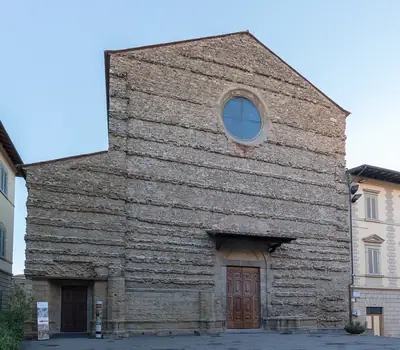
The Basilica of San Francesco is one of Arezzo’s essential sights. Its exterior is relatively modest, but inside the Bacci Chapel contains the Legend of the True Cross, a celebrated fresco cycle by Piero della Francesca, completed in the mid-fifteenth century.
The scenes are noted for their luminous colours, geometric clarity, and serene figures. The church was elevated to the rank of minor basilica by Pope Pius XII in 1955 and continues to serve both as an active place of worship and a state museum.
Beneath the basilica, the Area Archeologica del Sottosagrato preserves ancient remains discovered below the church. Together, the archaeological area and the Bacci Chapel reveal two very different layers of Arezzo’s history.
Piazza Grande and Palazzo Pretorio
Piazza Grande is one of the defining spaces of Arezzo’s historic centre and a natural point of reference while exploring the city. Nearby, Palazzo Pretorio is a prestigious historic building in the heart of Arezzo.
The square and its surrounding architecture help convey the character of the medieval city, where churches, palaces, and public spaces form a compact urban landscape.
Arezzo Cathedral
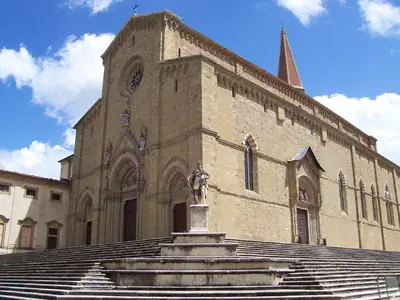
Arezzo Cathedral, officially the Cathedral of Saints Peter and Donato, stands at the summit of the hill where the city was founded. The site was important long before the present building: it was occupied by an early Christian church and was likely the location of the ancient city acropolis.
The cathedral became the seat of the combined diocese of Arezzo-Cortona-Sansepolcro in 1986. Before that, from 1203 onward, it served as the cathedral of the diocese of Arezzo.
San Domenico
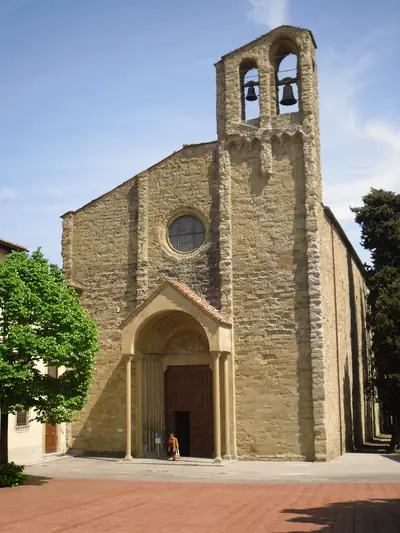
The Church of San Domenico stands in the piazza of the same name. It is one of the churches that gives Arezzo’s historic centre its distinctive religious and architectural character.
In April 1960, Pope John XXIII declared San Domenico a minor basilica, recognising its importance to the city.
Casa Vasari
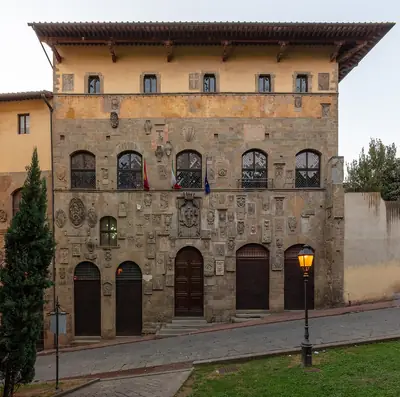
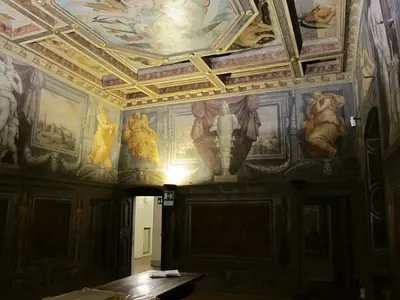
Casa Vasari, on Via XX Settembre, was the family home of one of the Renaissance’s notable figures. Its frescoed rooms were decorated by Vasari himself, offering a rare opportunity to see his work in a private setting rather than in a public commission.
For visitors interested in Renaissance art and architecture, the house adds a more personal dimension to Arezzo’s artistic heritage.
Casa museo Ivan Bruschi
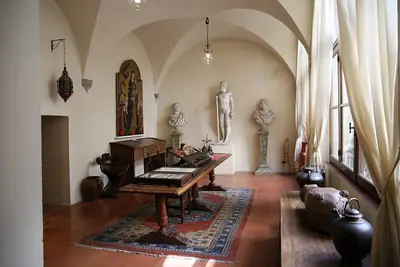
On Corso Italia, Casa museo Ivan Bruschi occupies a distinctive position in the centre of Arezzo. The museum house is one of Tuscany’s notable museum institutions and forms part of the city’s cultural route through historic buildings and collections.
Mudas Museum – Museo Diocesano di Arezzo
The Mudas Museum, Arezzo’s Diocesan Museum of Sacred Art, is housed in the Palazzo Vescovile, the historic Bishop’s Palace. The museum was founded in 1963 and opened to the public in 1985 before moving to its current home in 2011.
Its collection spans seven centuries, from the twelfth to the nineteenth century. Paintings, sculptures, goldsmith work, and liturgical furnishings come from Arezzo Cathedral and churches across the diocesan territory. The palace, which has served as the bishop’s residence for centuries, provides an appropriate setting for these works.
National Museum of Medieval and Modern Art
The National Museum of Medieval and Modern Art is housed in Palazzo Bruni-Ciocchi. Its collection covers the period from the Early Middle Ages through the nineteenth century and includes paintings, sculptures, maiolica ceramics, and decorative arts.
It is one of the most useful places to visit in Arezzo for understanding the breadth of the region’s artistic production beyond a single artist or monument.
Gaio Cilnio Mecenate State Archaeological Museum
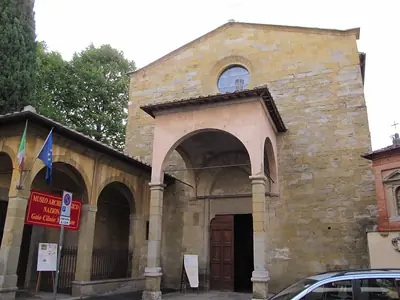
The Gaio Cilnio Mecenate State Archaeological Museum is the most important archaeological museum in Arezzo. It is housed in the former Church of San Bernardo, now the setting for the city’s archaeological collections.
The museum is managed by Italy’s Ministry of Culture. Its location in a historic church creates a strong connection between Arezzo’s architectural past and the ancient objects displayed inside.
Santa Maria delle Grazie
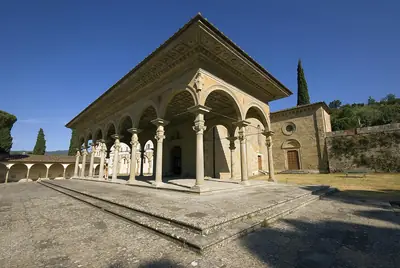
Santa Maria delle Grazie is regarded as one of Arezzo’s important churches. It forms part of the city’s wider collection of religious buildings, alongside the cathedral, San Francesco, and San Domenico.
Its inclusion in the route beyond the most famous central landmarks makes it a worthwhile stop for visitors exploring more of Arezzo’s ecclesiastical heritage.
The Old Cathedral at Colle del Pionta
About one kilometre southwest of Arezzo’s current cathedral, Colle del Pionta is known locally as the Duomo Vecchio, or Old Cathedral. The archaeological site marks the exact location of Arezzo’s first cathedral.
During the early Middle Ages, the hill was the centre of both ecclesiastical and civil power, governed by the city’s bishop-counts. It offers a different perspective on Arezzo’s origins and on the development of the city beyond its present centre.
Other museums and historic places
Arezzo’s cultural landscape also includes the Museo Aziendale della Gori & Zucchi, known as the Uno A Erre Museum, and the Museo dei Mezzi di Comunicazione, the city’s Museum of Communication Media.
The Province of Arezzo extends from the Apennine mountains towards the Val di Chiana, with rolling hills, medieval towns, and fertile valleys. For travellers staying longer in eastern Tuscany, the province provides a broader setting for understanding the city and its surrounding territory.
Explore Arezzo with a Self-Guided Walking Tour
Neywo’s Arezzo audio guide includes four walking tours, with a total of 35 narrated stops across the routes:
- From Piero’s Frescoes to the Medici Fortress: 1.56 km, 81 minutes, 10 stops.
- Vasari’s Quarter and the Chimera’s Birthplace: 1.57 km, 75 minutes, 10 stops.
- Saints, Palaces and Roman Arezzo: 2.43 km, 85 minutes, 10 stops.
- Hills Beyond the Walls: Pionta and Saione: 2.5 km, 64 minutes, 5 stops.
The routes connect many of the city’s key sights, including San Francesco, Piazza Grande, Arezzo Cathedral, Casa Vasari, San Domenico, the National Museum of Medieval and Modern Art, the archaeological museum, and the Old Cathedral.
Download Neywo and explore Arezzo with a self-guided walking tour. The app tells the story of each place as you reach it, at your own pace, with no group and no schedule. It is a practical way to discover the city’s churches, museums, palaces, and archaeological sites while following a route that suits your visit.
Places with an audio guide in Arezzo
8 places in Arezzo with a Neywo audio guide. Each one starts telling its story as you reach it.
Self-guided tours in Arezzo
4 tours in Arezzo, free in the Neywo app. Each stop tells its story as you reach it.
- Walk
From Piero's Frescoes to the Medici Fortress
Climb through the spine of Arezzo's old town: start at the basilica that guards Piero della Francesca's True Cross frescoes, wander through a Jesuit brick church and a contemporary theatre, stop on the sloping medieval Piazza Grande where the Giostra del Saracino is jousted, and finish up on the cathedral hill and the Medici fortress with its rooftop views over the Arno valley.
San Francesco, Arezzo · Sant’Ignazio · San Pier Piccolo · Casa museo Ivan Bruschi · Santa Maria della Pieve · Piazza Grande …
Open this tour: From Piero's Frescoes to the Medici Fortress - Walk
Vasari's Quarter and the Chimera's Birthplace
The northern side of town belongs to Giorgio Vasari, the painter who invented art history, and to the Etruscans: a bronze Chimera was dug up here in 1553. Walk from San Domenico to Vasari's frescoed house, past oratories, museums and Baroque stucco churches, and end at the historic Teatro Petrarca.
San Domenico, Arezzo · Casa Vasari · Santa Maria a Gradi · Oratorio dei santi Lorentino e Pergentino · National Museum of Medieval and Modern Art, Arezzo · La Chimera …
Open this tour: Vasari's Quarter and the Chimera's Birthplace - Walk
Saints, Palaces and Roman Arezzo
A loop through the lower old town: the Misericordia church on the Via Sacra, the state archaeological museum in a former church, and a string of small medieval churches and palaces around Piazza Grande, ending at Santa Croce.
Santissima Trinità · San Giovanni Battista a Sargiano · Gaio Cilnio Mecenate State Archaeological Museum · Sant'Agostino · San Michele · San Gemignano …
Open this tour: Saints, Palaces and Roman Arezzo - Walk
Hills Beyond the Walls: Pionta and Saione
Leave the centre for the places where Arezzo began: the Colle del Pionta, site of the city's first cathedral and the seat of its bishop-counts, and the old pastureland district of Saione with its frescoed twelfth-century church.
Palazzo del Governo · Old Cathedral · Chiesa di Sant'Antonio abate a Saione · Chiesa di San Francesco Stigmatizzato in Saione · Santa Maria delle Grazie church
Open this tour: Hills Beyond the Walls: Pionta and Saione
Walk Arezzo with Neywo
Neywo turns Arezzo into a self-guided audio tour. Stories arrive as you reach the place they belong to, and the route reshapes when you wander off it.

