Things to Do in Pistoia, Italy: Walking Guide
Things to Do in Pistoia: What to See in the Historic Centre
Pistoia is a Tuscan city of Romanesque churches, historic palaces, museums and compact streets centred on Piazza del Duomo. It is worth visiting for the way its religious, civic and artistic heritage comes together in a walkable historic centre, with further museums and estates to discover beyond it. Neywo has a free audio guide for Pistoia with 103 narrated places.
Part of Tuscany and often explored alongside better-known Tuscan destinations, Pistoia offers a concentrated introduction to the region’s history and art. The city’s main sights are close enough to connect on foot, while several museums and collections give you reasons to look beyond the central square.
What to see in Pistoia
Piazza del Duomo and Pistoia Cathedral
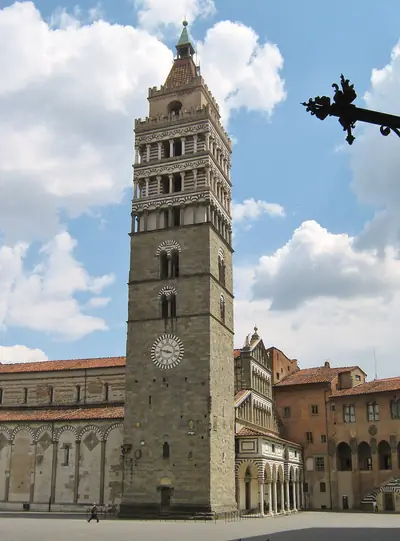
Begin in Piazza del Duomo, the centre of Pistoia’s religious and civic life. The square brings together Pistoia Cathedral, its bell tower, the San Giovanni in Corte Baptistery and former civic buildings.
Pistoia Cathedral, also known as the Cathedral of San Zeno, is the city’s principal Catholic place of worship and the seat of the bishop of the Diocese of Pistoia. Probably built in the tenth century, it has a Romanesque façade modelled on those of San Bartolomeo and Sant’Andrea. Marble statues of Saint Zeno and Saint Jacopo stand at the two ends of the gable.
Inside, the cathedral has three naves, a raised presbytery and a crypt. Centuries of alterations were followed by restoration work intended to return the building to its earlier forms. The cathedral was raised to the status of a minor basilica in 1965.
San Giovanni in Corte Baptistery
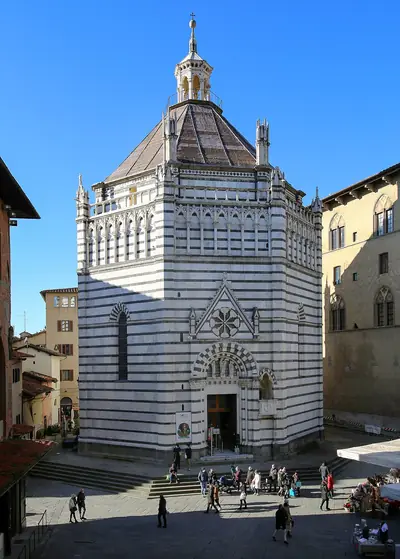
The San Giovanni in Corte Baptistery, or Battistero di San Giovanni in Corte, stands in Piazza del Duomo and is one of Pistoia’s defining religious landmarks. Its position makes it a natural part of any first walk through the historic centre, alongside the cathedral and bell tower.
Palazzo degli Anziani and the Civic Museum of Pistoia
The Palazzo degli Anziani houses the Civic Museum of Pistoia, also known as the Museo Civico. It is the city’s first and most important museum institution, with a collection devoted to ancient art.
The museum is one of several cultural sites gathered behind and around the cathedral. Its setting in a historic civic building helps connect Pistoia’s artistic heritage with the institutions that shaped the city.
Church of Sant’Andrea and Giovanni Pisano’s pulpit
The Church of Sant’Andrea, or Pieve di Sant’Andrea, dates back to the eighth century and remains the seat of the parish of Sant’Andrea. Its most celebrated feature is the pulpit by Giovanni Pisano.
Pisano signed the pulpit in 1301. The work gives this Romanesque church one of its most distinctive interiors and is one of the essential stops for anyone interested in what to see in Pistoia.
Basilica of Our Lady of Humility
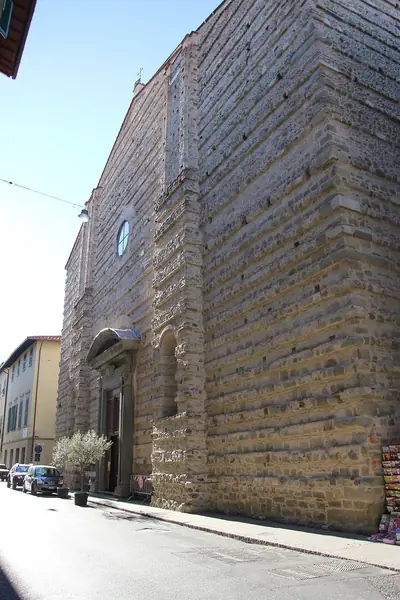
The Basilica of Our Lady of Humility, also known as the Basilica della Madonna dell’Umiltà, is dedicated to the Virgin Mary. Consecrated in 1582, it is both a minor basilica and an important place of Marian devotion.
Its most striking feature is the great sixteenth-century dome. It measures about twenty-five metres across and rises fifty-nine metres high, making it a major element of Pistoia’s skyline.
San Bartolomeo in Pantano
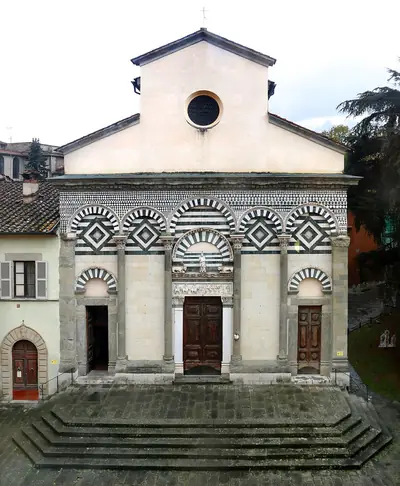
San Bartolomeo in Pantano is an eighth-century church dedicated to Saint Bartholomew the Apostle. Its name recalls the landscape that once surrounded it: “Pantano” means marshy ground and refers to an area that became muddy after the course of the Brana stream was moved in the fourteenth century.
The church is close to several other historic sites in eastern Pistoia and fits naturally into a longer walk through the city’s religious heritage.
Museo dello Spedale del Ceppo
The Museo dello Spedale del Ceppo occupies the former city hospital, founded in the thirteenth century. The institution remained Pistoia’s city hospital until 21 July 2013, when it was replaced by the new Ospedale San Jacopo in the southern part of the city.
The name “Ceppo” is explained by two traditions. One tells of a tree stump that miraculously blossomed in winter and an apparition of the Madonna directing Antimo and Bendinella to the site where the hospital should be founded. Another links the name to a hollow chestnut stump used to collect offerings.
Museums, palaces and collections
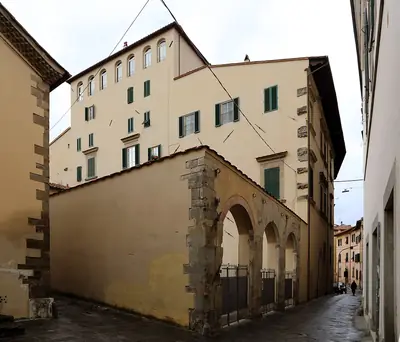
Pistoia’s historic centre includes several smaller or more specialised cultural institutions. Palazzo Sozzifanti, also known as Palazzo Buontalenti, is a historic palace, while Casa-Studio Fernando Melani is a house-museum where home and studio come together.
The Centro di Documentazione Giovanni Michelucci is an archival institution associated with a group of collections that includes the Diocesan Museum and the Museum of Embroidery. The Diocesan Museum presents sacred art in Pistoia. In Rospigliosi Palace, the Museo Clemente Rospigliosi displays precious furniture and furnishings, along with paintings, most of them from the seventeenth century. The Museum of Embroidery presents embroidered works from the seventeenth through the twentieth century, as well as the tools and techniques used in Pistoia’s traditional embroidery.
The Ex Oratorio di San Desiderio is another part of the city’s architectural heritage. Since December 2014, it has been managed by Italy’s Ministry of Cultural Heritage and Activities through the Polo museale della Toscana, an institution that became the Direzione regionale Musei in December 2019.
Fattoria di Celle
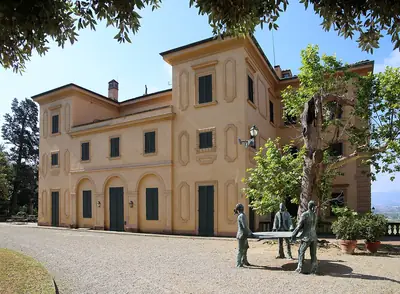
Outside the city, in the area of Santomato, Fattoria di Celle—also called the Gori Collection or Villa di Celle—combines a fifteenth-century villa with a collection of contemporary art. Since the second half of the twentieth century, the estate has been home to the Gori Collection.
Many works were created specifically for the villa and its park. Their relationship with the landscape is central to the experience, and the estate is considered one of the most important examples of Land Art in Italy.
Ghiacciaia della Madonnina
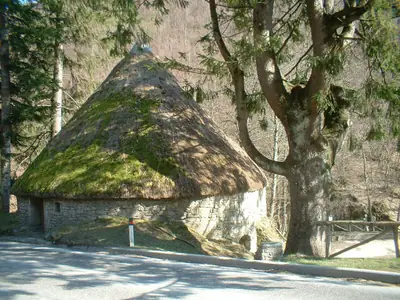
The Ghiacciaia della Madonnina, also known as the Ecomuseo della Montagna Pistoiese, belongs to a museum institution in Tuscany. It offers another perspective on the territory around Pistoia and broadens a visit beyond the city’s churches, palaces and art collections.
Fondazione Pistoiese Jorio Vivarelli
The Fondazione Pistoiese Jorio Vivarelli includes the Casa-studio Vivarelli on Via di Felceti. The building is an interesting example of twentieth-century architecture in Tuscany and adds a modern layer to Pistoia’s cultural landscape.
A Pistoia self-guided walking tour with Neywo
Neywo offers four walking tours and one bus route in Pistoia. The walks range from 0.5 km and 50 minutes to 2.93 km and 102 minutes, with between 8 and 12 narrated stops. The bus route covers 2.5 km in 11 minutes and includes 7 stops.
The tours focus on different sides of the city:
- Piazza del Duomo: 1.12 km, 86 minutes and 12 stops, including the baptistery, cathedral, civic palaces, Piazza della Sala and San Giovanni Fuoricivitas.
- Giovanni Pisano’s pulpit and Vasari’s dome: 1.95 km, 94 minutes and 12 stops, including the Basilica of Our Lady of Humility, Casa-Studio Fernando Melani and the Church of Sant’Andrea.
- The flowering stump: Ospedale del Ceppo and eastern Pistoia: 2.93 km, 102 minutes and 12 stops, including the former hospital, San Bartolomeo in Pantano and Fortezza Santa Barbara.
- Museums and palaces behind the cathedral: 0.5 km, 50 minutes and 8 stops, including the Civic Museum, Centro di Documentazione Giovanni Michelucci and Palazzo Sozzifanti.
- The city shuttle past Pistoia’s pulpit and hospital: a 2.5 km bus route lasting 11 minutes, with 7 stops.
Download Neywo and explore Pistoia at your own pace. The app tells the story of each place as you reach it, with no group and no schedule. Narration is available in 11 languages, making it a practical Pistoia audio guide for exploring the city independently. When you continue through Tuscany, you can also discover Pisa, Siena or Montecatini Terme.
Places with an audio guide in Pistoia
8 places in Pistoia with a Neywo audio guide. Each one starts telling its story as you reach it.
Self-guided tours in Pistoia
5 tours in Pistoia, free in the Neywo app. Each stop tells its story as you reach it.
- Bus ride
Linea 3: the city shuttle past Pistoia's pulpit and hospital
A frequent city bus that runs from the western car park into the old centre and Piazza Dante. Ride it from the bishop's new palace and the dome of the Madonna dell'Umiltà to Sant'Andrea with its Pisano pulpit, the Ospedale del Ceppo, Palazzo Manni, the Misericordia and the Tau convent, with no hill to climb.
Palazzo Vescovile Nuovo · Basilica of Our Lady of Humility · Church of Sant' Andrea · Museo dello Spedale del Ceppo · Palazzo Manni · Misericordia …
Open this tour: Linea 3: the city shuttle past Pistoia's pulpit and hospital - Walk
Piazza del Duomo: where Pistoia's bishops and magistrates faced each other
Start in the great square where the cathedral and baptistery face one another, with the bishops' palace, the old magistrates' palace and the town hall around them. Then drift through the market squares of Sala and Ortaggio to the Romanesque church of San Giovanni Fuoricivitas, the Tau convent that houses a sculptor's museum and a noble palace and two small churches.
San Giovanni in Corte Baptistery · Palazzo dei Vescovi · Pistoia Cathedral · Palazzo degli Anziani · Palazzo Pretorio · Piazzetta dell'Ortaggio …
Open this tour: Piazza del Duomo: where Pistoia's bishops and magistrates faced each other - Walk
Giovanni Pisano's pulpit and Vasari's dome
West of the cathedral lies the Pistoia of pilgrims and wool workers. Walk from the theatre and the music museum to the great dome of the Madonna dell'Umiltà and Sant'Andrea, home to Giovanni Pisano's signed pulpit, then through small churches whose names recall guilds and Jesuits.
Teatro Manzoni · Museo della Musica e delle Percussioni · Basilica of Our Lady of Humility · Santa Maria degli Angeli · Casa-Studio Fernando Melani · San Francesco …
Open this tour: Giovanni Pisano's pulpit and Vasari's dome - Walk
The flowering stump: Ospedale del Ceppo and eastern Pistoia
Follow the legend of a flowering tree stump to the Ospedale del Ceppo, then walk through the eastern quarter past the marshy-ground church of San Bartolomeo, Palazzo Manni and the Poor Clares, and end at the Fortezza Santa Barbara, the Medici-era fortress of the town.
Ospedale del Ceppo · Underground Pistoia · Santa Maria delle Grazie · San Lorenzo · San Bartolomeo in Pantano · Palazzo Manni …
Open this tour: The flowering stump: Ospedale del Ceppo and eastern Pistoia - Walk
Museums and palaces behind the cathedral: civic, diocesan and embroidery collections
A short, dense loop through the streets around Piazza del Duomo. Visit the civic museum in the town hall, the bishops' old palace and cathedral museum, the Rospigliosi collections of sacred art and Pistoia embroidery, and the palaces of bankers and noble families that line Via San Matteo and Via Roma.
Palazzo Bracciolini delle Api · Civic Museum of Pistoia · Centro di Documentazione Giovanni Michelucci · Palazzo Sozzifanti · San Leone · Palazzo della Cassa di Risparmio di Pistoia e Pescia …
Open this tour: Museums and palaces behind the cathedral: civic, diocesan and embroidery collections
Walk Pistoia with Neywo
Neywo turns Pistoia into a self-guided audio tour. Stories arrive as you reach the place they belong to, and the route reshapes when you wander off it.

