Visiting San Gimignano, Italy: Top Sights on Foot
Things to Do in San Gimignano: Towers, Squares and Medieval Streets
San Gimignano is a medieval hill town in Tuscany, famous for its surviving towers, historic squares and remarkably preserved townscape. Its UNESCO-listed historic centre brings together Romanesque churches, civic palaces, museums and views across the Tuscan valleys. Neywo has a free audio guide for San Gimignano with 48 narrated places.
What to See in San Gimignano
The Historic Centre and Piazza del Duomo
The Historic Centre of San Gimignano has been recognized as a UNESCO World Heritage Site since 1990. Its towers, civic spaces and medieval buildings preserve the character of the town’s historic heart.
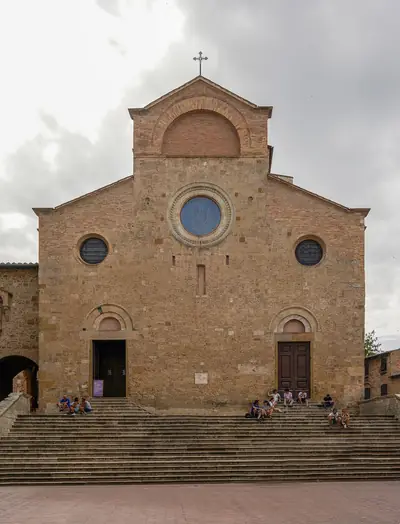
Piazza del Duomo was the focus of religious and political life in the Middle Ages. It remains one of the town’s most important squares, surrounded by the Collegiate Church of Santa Maria Assunta, the Palazzo Comunale and other historic buildings.
The Palazzo Comunale, also known as the Palazzo del Popolo, has housed the civic authority since the thirteenth century. Built over an earlier structure in the late 1290s and enlarged during the fourteenth century, it combines a stone lower level with brick above. Inside, frescoes by Memmo di Filippuccio, Lippo Memmi and other artists decorate the former town hall, including the Council Hall, known as the Hall of Dante.
Collegiate Church and Museum of Religious Art
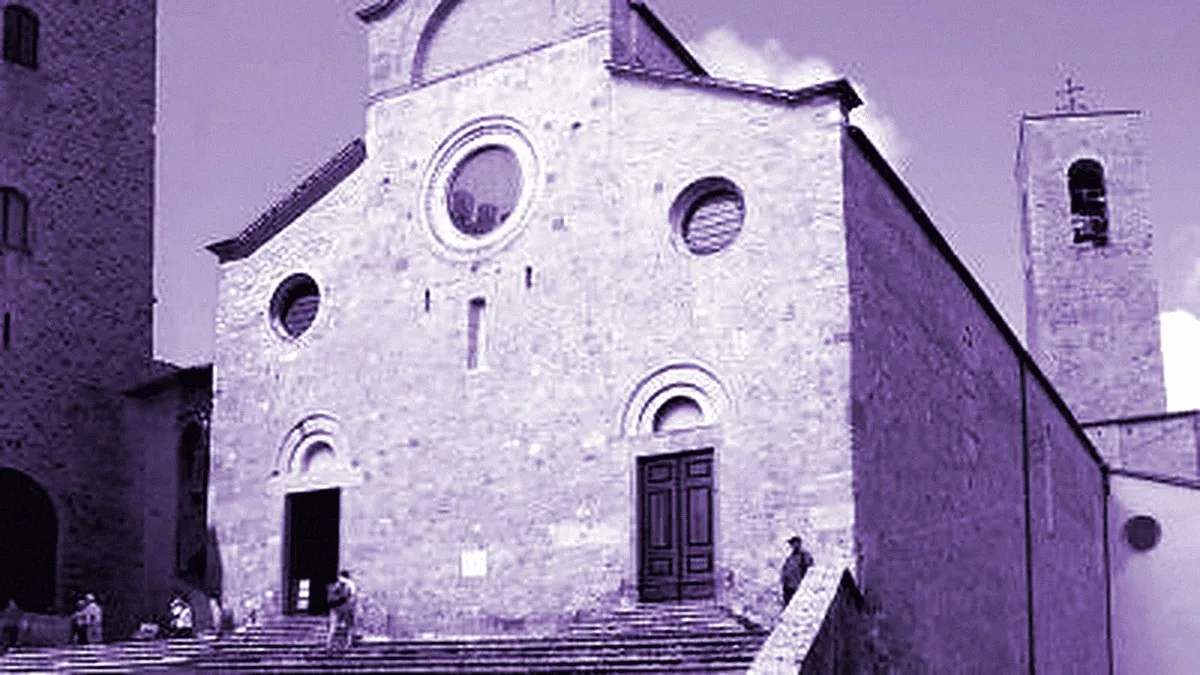
The Collegiate Church of Santa Maria Assunta is San Gimignano’s principal Catholic place of worship and a minor basilica. Consecrated in 1148, it was enlarged in the fifteenth century under the direction of Giuliano da Maiano.
Its Romanesque interior has three aisles divided by columns. Frescoes cover the walls and vaults, with scenes from the Old and New Testaments, the life of Christ and the Last Judgement. The artists represented include Lippo Memmi, Bartolo di Fredi, Domenico Ghirlandaio, Benozzo Gozzoli and Taddeo di Bartolo.
In nearby Piazza Pecori, the Museum of Religious Art occupies the former dormitory of the chaplains. Its collection comes from the possessions of the Collegiate Church and has been preserved as a museum since 1930.
Palazzo del Podestà and the Loggia del Comune
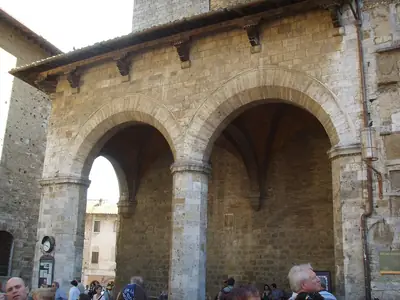
The Palazzo del Podestà, or Old Palace of the Podestà, is one of San Gimignano’s oldest government buildings. It began in the twelfth century and took its present form through rebuilding in 1239 and further expansion in 1337. The building’s lower section is in stone, while the upper part is in brick, and Guelph-style battlements finish the roofline.
The palace’s Clock Tower, also called the Podestà Tower, rises to roughly 52 metres, making it the second tallest tower in the city after Torre Grossa. After the podestà moved to a newer residence, the tower was used as a prison.
Campatelli Tower and House
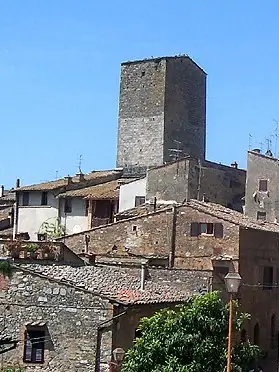
On Via San Giovanni, Campatelli Tower and House combines a medieval tower with an eighteenth-century residence. The tower was built against the house in the twelfth century and reaches 28 metres. It is one of the fourteen towers that survive in San Gimignano.
The Campatelli family, a family of entrepreneurs, owned the building. Inside, preserved furnishings, decorations, paintings and personal mementos recreate the atmosphere of a prominent Tuscan family home during the nineteenth and twentieth centuries.
Across Via San Giovanni stands Torre dei Cugnanesi, another surviving tower. Dating from the thirteenth century, it is one of the tallest in the city and forms part of a defensive complex beside the Arco dei Becci.
SanGimignano1300
On Costarella Street, south of Piazza del Duomo, SanGimignano1300 uses a detailed scale model to show the town during its medieval golden age. The model represents San Gimignano as it appeared in the year 1300, including all 72 of the city’s original towers.
Made entirely from clay and painted in natural hues, the model covers 27 square metres. It offers a vivid way to understand the town before the Black Death arrived in Europe in 1349, after which the towers began to crumble and the population declined.
Rocca di Montestaffoli
A short climb from Piazza del Duomo leads to the Rocca di Montestaffoli, a hilltop fortress surrounded by olive trees. Built in 1353 by the Florentine administration of San Gimignano, it commanded views across the Elsa Valley and the surrounding area.
Duke Cosimo de’ Medici ordered the fortress demolished in 1555, leaving the shell that stands today. Paths wind through small gardens and olive trees, and a medieval well occupies the centre of the park. A staircase leads to a corner tower with especially broad views over San Gimignano and the valleys below. The site is also used for summer performances, concerts and contemporary art exhibitions.
Porta San Giovanni and Madonna dei Lumi
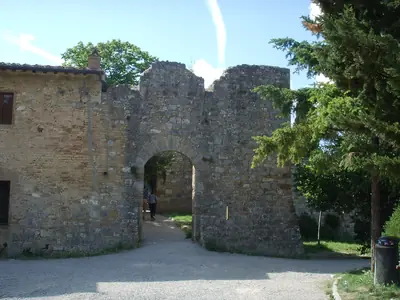
Porta San Giovanni is the principal gateway into San Gimignano and the southern entrance to the town. Built in 1262 along the old pilgrims’ route from Siena, it has a tall Sienese arch and a surviving sentry station above it.
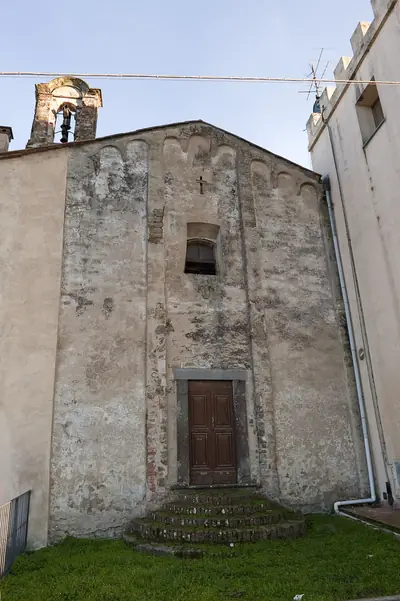
Beside the gate stands the small Church of Madonna dei Lumi, built in 1601 to a design by the local architect Francesco Panzini. Part of its central nave was demolished in 1922 when the adjacent street was widened, but the bell tower and the aisle beneath it remain. A staircase leads to the nearby Madonna Square, recalling the church’s original structure.
San Bartolo
Just outside San Gimignano’s first medieval walls, San Bartolo is a quiet Romanesque church dating from 1173. Tradition holds that it once served as the Jerusalemite Hospital of Saint Matthew along the Pilgrim’s Way to Rome.
Its façade has two levels of five partly blind arcades, with details influenced by the schools of Lucca and Pisa. Inside, the church has a single nave, a wooden truss roof and a simple interior. Notable works include a fifteenth-century Florentine wooden crucifix and painted lunettes.
Vernaccia Wine Experience
At the Museo del Vino Vernaccia di San Gimignano, wine provides an introduction to the culture and heritage of the town. Also known as the Vernaccia di San Gimignano Wine Experience, La Rocca or “the Fortress”, the centre presents more than two hundred Vernaccia di San Gimignano DOCG and Riserva labels over time.
The experience also includes regional reds and rosés, Vin Santo and Chianti DOCG. Vernaccia di San Gimignano DOCG is a white wine made from the Vernaccia grape in and around San Gimignano. It became the first Italian wine to receive DOC status in 1966 and was upgraded to the higher DOCG designation in 1993.
Galleria Continua
Galleria Continua brings contemporary art into San Gimignano’s historic setting. The gallery offers a contrast to the town’s medieval architecture and traditional religious and civic collections.
Religious Sites Beyond the Centre
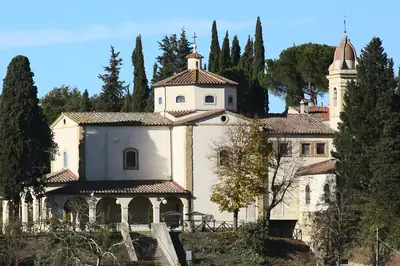
Several places around San Gimignano extend the town’s cultural landscape beyond its central streets. At Pancole, the Sanctuary of Maria Santissima Madre della Divina Provvidenza stands along the hill route of the Via Francigena.
The former Abbey of the Holy Sepulchre and Saint Mary at Elmi, also known as Badia a Elmi, occupies a stretch of the Francigena route through the valley. Dedicated to the Holy Sepulchre, it was an important stop for pilgrims travelling toward Jerusalem.
Santa Maria Assunta a Monte Oliveto Minore, or the Monte Oliveto Convent, is a church and monastery complex in the Monteoliveto area, near Santa Lucia. The ruined Church of Saints Frediano and Giovanni stands within the settlement of Castelvecchio, in the municipality of San Gimignano.
Explore San Gimignano with Neywo
Neywo offers a San Gimignano self-guided walking tour experience through two walking routes. The walks cover 0.84 km in 80 minutes and 1.59 km in 72 minutes, with 22 narrated stops in total.
The first route focuses on the town’s towers, squares and palaces, including Campatelli Tower, Palazzo del Podestà, SanGimignano1300 and Rocca di Montestaffoli. The second follows pilgrims, gates and frescoes through quieter quarters, with stops including San Bartolo and the Museo del Vino Vernaccia di San Gimignano.
The app tells the story of each place as you reach it, at your own pace, with no group and no schedule. Narration is available in 11 languages. Download Neywo and explore San Gimignano while the town’s history unfolds around you.
Places with an audio guide in San Gimignano
8 places in San Gimignano with a Neywo audio guide. Each one starts telling its story as you reach it.

Self-guided tours in San Gimignano
2 tours in San Gimignano, free in the Neywo app. Each stop tells its story as you reach it.
- Walk
Manhattan of the Middle Ages: Towers, Squares and Palaces
In 1300 San Gimignano bristled with 72 towers built by rival families. Walk up the old pilgrim road from Porta San Giovanni to the twin squares of Cisterna and Duomo, past the surviving stone giants, and finish on the ruined Medici fortress above the town.
Madonna dei Lumi · Ex Chiesa di San Francesco · Via San Giovanni · Campatelli tower · Palazzo Razzi · Museo di Criminalogia Medioevale …
Open this tour: Manhattan of the Middle Ages: Towers, Squares and Palaces - Walk
Pilgrims, Gates and Frescoes: San Gimignano's Quiet Quarters
Leave the crowds of the main squares for the churches and gates along the Via Francigena. Follow hospital walls, Romanesque portals and Benozzo Gozzoli's Augustine cycle to Porta San Matteo, then come back down medieval Via San Matteo to the Vernaccia wine museum and the small ornithological museum in a deconsecrated church.
San Lorenzo al Ponte · Porta delle Fonti · Chiesa di San Jacopo al Tempio · Spedale di Santa Fina · Santa Chiara · Sant'Agostino …
Open this tour: Pilgrims, Gates and Frescoes: San Gimignano's Quiet Quarters
Walk San Gimignano with Neywo
Neywo turns San Gimignano into a self-guided audio tour. Stories arrive as you reach the place they belong to, and the route reshapes when you wander off it.

