What to See in Grosseto, Italy: Free Audio Guide
Things to Do in Grosseto: What to See in the Historic Centre
Looking for things to do in Grosseto? The capital of southern Tuscany is a historic city in the Maremma, known for its preserved defensive walls, important museums and welcoming central squares. Its compact centre brings together medieval and Renaissance heritage, Italian art, archaeology and the everyday atmosphere of a Tuscan city. Neywo has a free audio guide for Grosseto with 115 narrated places, available in 11 languages.
As you explore Tuscany, Grosseto makes a rewarding stop between the region’s art cities and the landscapes of the Maremma. These are the main places to include in your visit.
What to see in Grosseto
Grosseto’s historic walls and six bastions
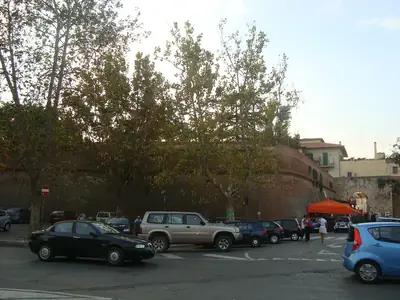
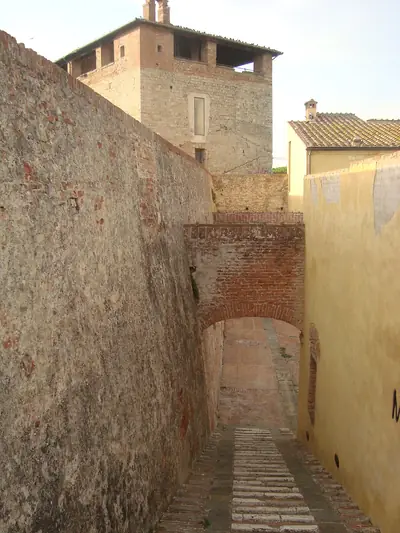
The city walls are among Grosseto’s defining landmarks. Six bastions form the historic defensive enclosure, creating a circuit around the old town and revealing how Grosseto was organized as a fortified Medici outpost.
The walls are especially interesting because several sections retain their individual historical character. At the northwestern corner, Bastione Garibaldi stands near Porta Nuova; it was formerly known as Baluardo delle Monache. Nearby, Bastione Rimembranza, once the San Francesco bulwark, marks the northern part of the circuit.
At the northeastern point, Bastione Fortezza formed part of the fortified citadel. It connects with Bastione Maiano, formerly known as Baluardo delle Palle, at the southeastern corner. From there, the fortifications continue towards Bastione Cavallerizza, beside Porta Vecchia. This bastion was once called Baluardo dell’Oriolo.
On the southwestern side, Bastione Molino a Vento, also known as Bastione Mulino a Vento, lies near Porta Corsica. Its former name was Baluardo di San Michele, while a fountain with a wild boar gave it the local nickname Cinghialino, meaning “little wild boar”.
Piazza Dante and Canapone
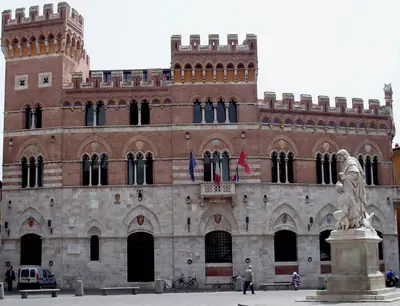
Piazza Dante is Grosseto’s main square and one of the best places to understand the civic heart of the city. At its centre stands Canapone, a marble monument honouring Leopold the Second, Grand Duke of Tuscany.
The monument recalls the Grand Duke’s reforms in the Maremma, including work connected with public health, land reclamation and infrastructure. “Canapone” is the local nickname for the sculpture, referring to the Grand Duke’s light-coloured hair; canapo means coarse flax.
The square is also bordered by Palazzo Aldobrandeschi, known as Palazzo della Provincia. Designed by Lorenzo Porciatti in a Gothic Revival style and completed in 1903, it remains the seat of Grosseto’s provincial government. Its name refers to the Aldobrandeschi family and to the former belief that their medieval castle had stood on this site.
Grosseto Cathedral and Piazza del Duomo
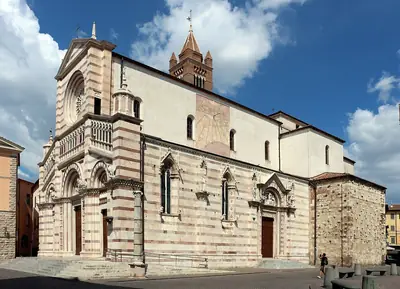
Next to Piazza Dante, Piazza del Duomo takes its name from Grosseto Cathedral, or the Cattedrale di San Lorenzo. Dedicated to Saint Lawrence, it is the cathedral of the Diocese of Grosseto, the city’s most important Catholic place of worship and an Italian national monument.
The square is surrounded by several significant buildings, while Corso Carducci begins at its northern side. At the northern end, the Palazzo Comunale houses Grosseto’s municipal government, council and administrative offices.
A short distance away in Piazza Dante, the Colonna dei Bandi is a white marble Roman column. Its predecessor was used for public announcements in the city’s main square, but it was lost during urban redevelopment in 1846. The present column, installed in 1966, dates from the second century AD.
Museo archeologico e d’arte della Maremma
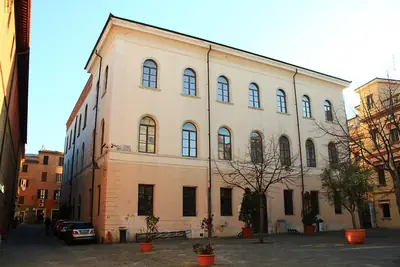
The Museo archeologico e d’arte della Maremma occupies the former courthouse, or Ex palazzo del Tribunale, on the southern side of Piazza Baccarini. The building hosted the museum from 1975, after previously serving as Grosseto’s civil courthouse.
The collections cover an exceptionally long period, from the Paleolithic to the late Middle Ages, with particular attention to the Etruscan and Roman eras. The museum began in 1860, when Canon Giovanni Chelli founded it as a section of the Chelliana Library. It became municipal property in 1865 and was established as an independent museum in 1955.
The museum also includes a section dedicated to the Museum of Sacred Art of the Diocese of Grosseto, founded in 1933. This makes the former courthouse an important place for discovering both the archaeology and the religious art of the Maremma.
Chiesa dei Bigi and Museo Collezione Gianfranco Luzzetti
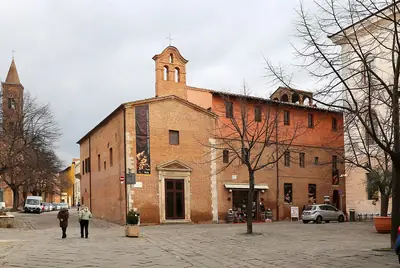
Near Piazza Baccarini and Strada Vinzaglio, the former Chiesa dei Bigi forms part of Museolab Città di Grosseto. The small church was attached to the old Clarissan convent and was once known as Santa Chiara, and earlier as the church of the Annunciation.
Its architecture combines late Renaissance and Baroque features. The church was deconsecrated at the beginning of the twentieth century and now provides a setting for cultural activities and events. Its left side also partly defines Piazza dell’Indipendenza, opposite the nearby Church of San Francesco.
The former seventeenth-century Clarissan convent houses the Museo Collezione Gianfranco Luzzetti, opened on 22 December 2019. Its collection includes paintings and sculptures from the Italian Renaissance, Baroque and Neoclassical periods, with part of the display presented inside the former church.
Museo di storia naturale della Maremma
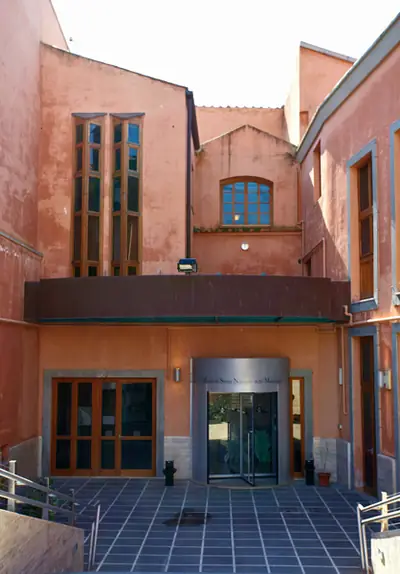
Around Piazza della Palma, the Museo di storia naturale della Maremma explores the natural heritage of the Grosseto area. Fossils and minerals trace the geological evolution of the Maremma, while interactive displays and dioramas present its biological development and varied ecosystems.
The museum was founded in 1971 by the naturalist Giuseppe Guerrini, president of the Gruppo Speleologico Maremmano. Since 2002, it has occupied the former Vittorio Emanuele nursery school, a nineteenth-century building between Piazza della Palma and Strada Corsini. The museum was completely renewed in 2009, creating the interactive arrangement visible today.
Museo di storia locale Ildebrando Imberciadori
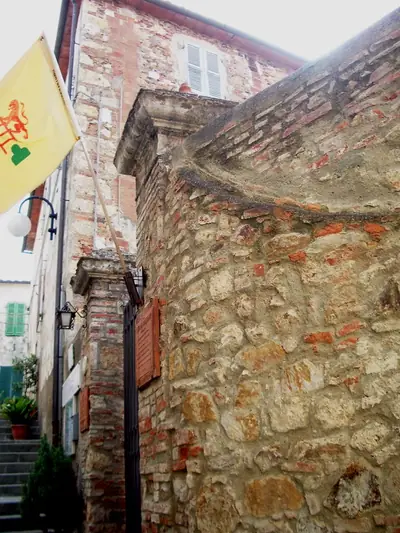
In Montepescali, within the municipal area of Grosseto, the Museo di storia locale Ildebrando Imberciadori offers a closer look at the traditions and history of the local community. Also known as the Ildebrando Imberciadori Ethnographic Museum, it preserves archaeological evidence and documents covering the Etruscan period, the Roman age, the Middle Ages and the later Medici and Lorraine periods.
Tino di Moscona
Above Grosseto, Tino di Moscona is an ancient hilltop fortification with a massive circular enclosure. Its stone walls contain two separate entrance gates, an underground chamber and the remains of an ancient Roman cistern.
The eastern side preserves traces of a medieval settlement. The hill’s history extends further back: Villanovian finds, including jewellery kept in funerary urns, were discovered here.
Explore Grosseto with a self-guided walking tour
A Grosseto self-guided walking tour is an easy way to connect the city’s museums, squares, churches and fortifications without following a group. Neywo offers two walking tours in Grosseto:
- Chains Square and the Heart of Grosseto: 1.24 km, 73 minutes and 11 narrated stops, including Piazza del Sale, the Museo di storia naturale della Maremma, Palazzo Aldobrandeschi, Piazza Dante, Canapone, Grosseto Cathedral, the Museo archeologico e d’arte della Maremma, Museolab Città di Grosseto and San Francesco.
- Six Bastions: The Medici Walls of Grosseto: 2.37 km, 79 minutes and 9 narrated stops, covering Bastione Garibaldi, Bastione Rimembranza, Bastione Fortezza, Bastione Maiano, Porta Vecchia, Bastione Cavallerizza, Porta Corsica and Bastione Molino a Vento.
Download the Neywo audio guide for Grosseto
Download Neywo to explore Grosseto at your own pace. The app tells the story of each place as you reach it, with no group and no schedule. Choose between the two walking tours, or use the guide’s 115 narrated places to build your own route through the historic centre, the walls and the Maremma surroundings. You can also continue discovering Italy and nearby Tuscan cities such as Livorno, Pisa or Arezzo.
Places with an audio guide in Grosseto
8 places in Grosseto with a Neywo audio guide. Each one starts telling its story as you reach it.
Self-guided tours in Grosseto
2 tours in Grosseto, free in the Neywo app. Each stop tells its story as you reach it.
- Walk
Chains Square and the Heart of Grosseto
Enter through the Salt Square, then reach Piazza Dante, the Chains Square, where a marble Grand Duke watches over the cathedral and the provincial palace. Finish with Etruscan finds, a Renaissance art collection and a Franciscan church, all inside the Medici walls.
Piazza del Sale · Museo di storia naturale della Maremma · San Giovanni Battista · Palazzo Aldobrandeschi · Piazza Dante · Canapone …
Open this tour: Chains Square and the Heart of Grosseto - Walk
Six Bastions: The Medici Walls of Grosseto
Walk the hexagon of brick walls that Florence's Medici dukes built around the town. Pass the six bastions, the medieval Porta Vecchia and the gate that faces Corsica, and look for the little wild boar fountain that gave one bastion its nickname.
Bastione Garibaldi · Bastione Rimembranza · Bastione Fortezza · Bastione Maiano · Porta Vecchia · Bastione Cavallerizza …
Open this tour: Six Bastions: The Medici Walls of Grosseto
Walk Grosseto with Neywo
Neywo turns Grosseto into a self-guided audio tour. Stories arrive as you reach the place they belong to, and the route reshapes when you wander off it.

