Visiting Lucca, Italy: Top Sights on Foot
Things to Do in Lucca: What to See in Tuscany’s Walled City
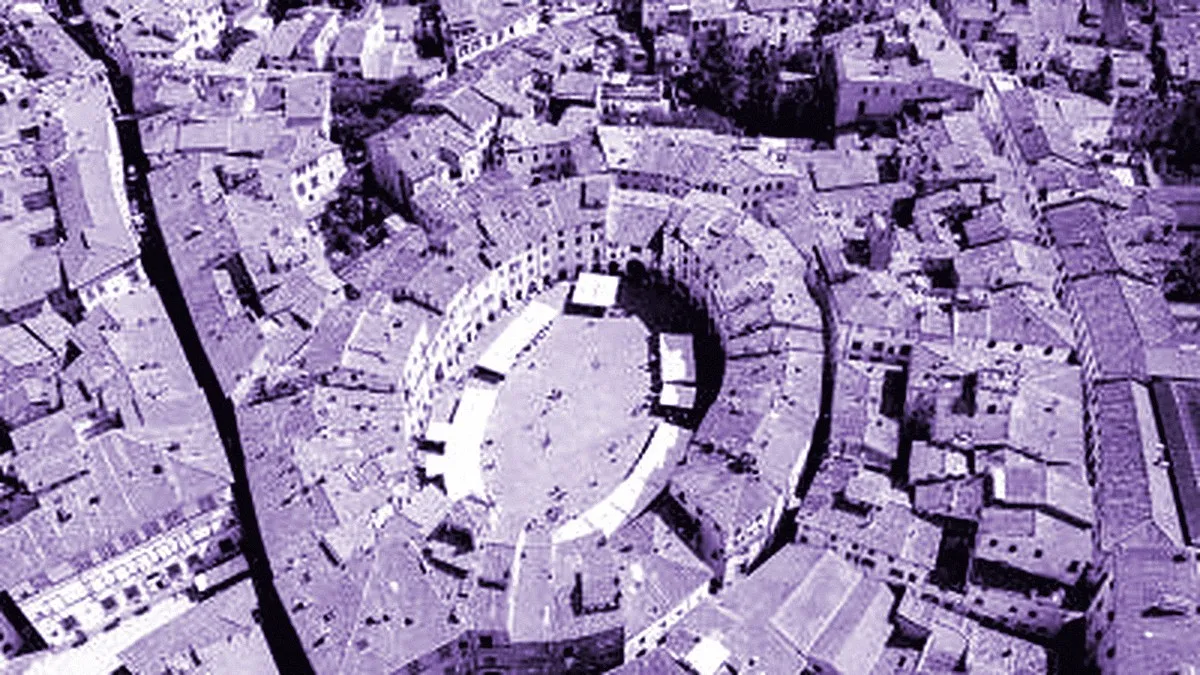
Lucca is a historic city in Tuscany, Italy, known for its Renaissance walls, Romanesque churches, palaces, museums, and musical heritage. Its compact center brings together Roman, medieval, Renaissance, and later history, making it an especially rewarding city to explore on foot. Neywo offers a free audio guide for Lucca with 173 narrated places.
What to See in Lucca
Lucca Cathedral
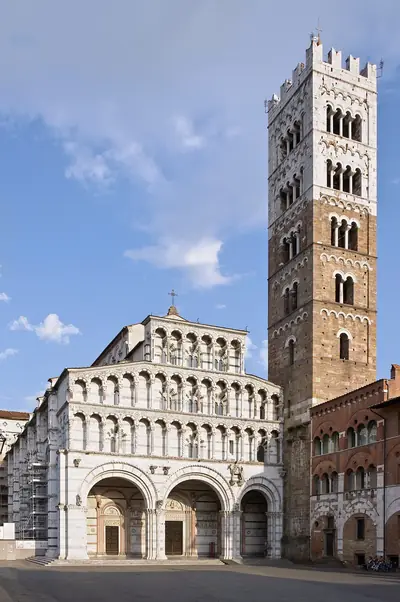
Lucca Cathedral, also called San Martino Cathedral or the Duomo di Lucca, is the city’s cathedral and the seat of the Archbishop of Lucca. Its richly carved marble façade combines sculpture and inlaid decoration, while three large arches support three rows of galleries.
The bell tower stands to the right of the façade, with a square base and five levels of windows. The building is mainly Tuscan Romanesque, although later work introduced Gothic elements in the apse and transept. Inside, the cathedral follows a Latin-cross plan with three naves.
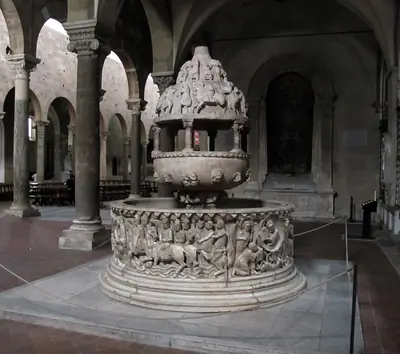
Basilica of San Frediano and its baptismal font
The Basilica of San Frediano is one of Lucca’s oldest Catholic places of worship and gives Piazza San Frediano its strong Romanesque character. Its history reaches back to the sixth century, when Fredianus—an Irish pilgrim who became bishop of Lucca in 560—is credited with its construction.
The church was rebuilt in 1112 and reconsecrated by Pope Eugene III in 1147. Its façade has three portals, blind arches, a loggia, and a central window that replaced an earlier mosaic of the Ascension of Christ. Inside, columns and round arches separate the nave and aisles beneath a wooden truss ceiling.
Ducal Palace
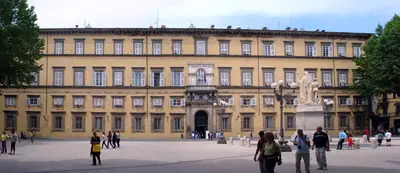
In Piazza Napoleone, the Ducal Palace, or Palazzo Ducale, reflects Lucca’s long political and artistic history. It occupies the site of the former Fortezza Augustan and has been repeatedly transformed since the medieval period.
The building became the headquarters of Lucca’s government after earlier fortified residences on the site were altered or dismantled. Bartolomeo Ammannati redesigned the façade in 1578, Francesco Pini added the right wing in 1728, and Lorenzo Nottolini later enriched the interiors with a monumental staircase and a gallery of statues.
Giardino di Palazzo Pfanner
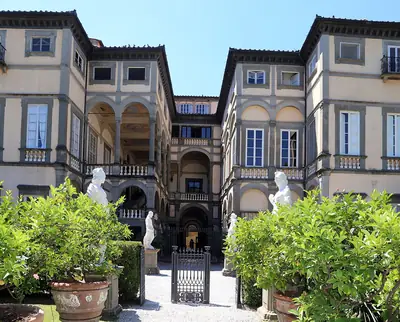
The garden of Palazzo Pfanner stretches between the palace’s monumental staircase and its Lemon House. Its formal layout includes a large octagonal basin surrounded by marble statues of the ancient gods of Olympus, together with palms, pines, yews, magnolias, roses, geraniums, and two bamboo groves.
Filippo Juvarra created the garden in the eighteenth century in the Italian garden style, inspired by the gardens around Florence’s Pitti Palace. The palace itself dates to 1667 and was originally known as Palazzo Controni. Its external staircase and loggia are among its notable architectural features.
Palazzo Guinigi
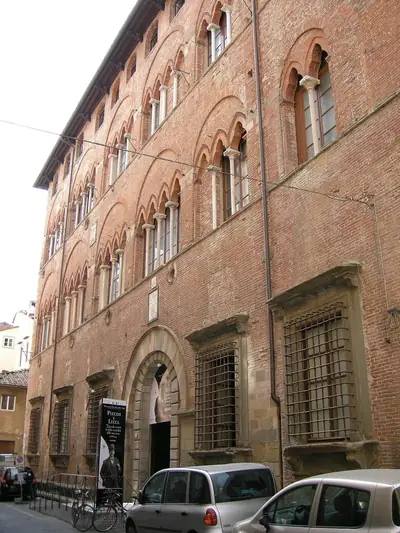
Palazzo Guinigi stands between Via Sant’Andrea and Via Guinigi and forms part of Lucca’s distinctive architectural landscape. It is also associated with the nearby Guinigi Tower, one of the city’s best-known historic landmarks.
Palazzo Mansi National Museum
Palazzo Mansi is one of Lucca’s principal art museums. The former Baroque palace preserves aristocratic interiors alongside collections of paintings, tapestries, and later regional art.
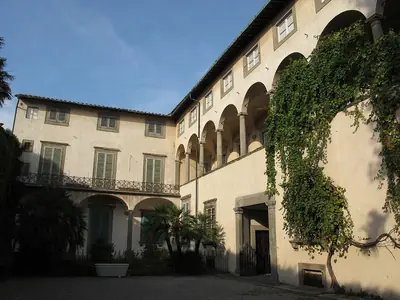
The complex began in 1616, when Ascanio Mansi brought several earlier tower houses together. Between 1686 and 1691, Raffaello Mansi commissioned Raffaello Mazzanti to transform the building. Inside, the richly decorated bridal chamber, the frescoed 1688 Music Hall, and the Neoclassical Hall of Mirrors show the changing tastes of the palace’s owners.
Casa del Boia
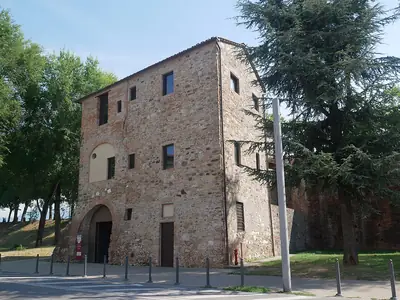
Museum La Casa del Boia occupies a historic building beside Lucca’s fortifications, near the San Salvatore bastion and an old semicircular tower. Its name means “Executioner’s House” and refers to the professional executioner who lived there from 1826.
Tommaso Jona, brought from Rome, lived in the house until 1846. He was followed by Benedetto Paltoni, who stayed for only a few years before the abolition of the death penalty ended this chapter of the building’s history. The house and the adjacent fortifications remain part of the same historic setting.
Convento di San Nicolao Novello
The former Convent of San Nicolao Novello is now home to the Natural History Collection of Liceo Machiavelli. Founded in 1332 for the Augustinian nuns of Santa Maria della Croce, the complex was rebuilt during the sixteenth and seventeenth centuries.
Its surviving cloister and traces of decoration reveal the convent’s earlier character. The former church is closed for worship but preserves an altar by Domenico Martinelli, with Ionic columns, a curved pediment, and volutes.
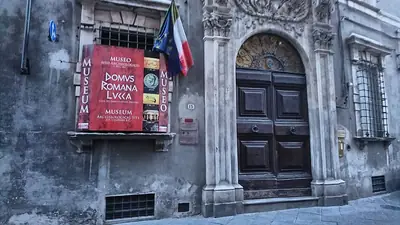
Domus Romana
Domus Romana, also known as Domus Romana Lucca or Casa del Fanciullo Sul Delfino, offers a glimpse into Lucca’s Roman heritage. Another historic building in the area is Palazzo Sardini, now known as Palazzo Minutoli Tegrimi.
Santissima Trinità and the Ragghianti Foundation
The Fondazione Centro Studi sull’arte Licia e Carlo Ludovico Ragghianti is located in San Micheletto. Nearby, Santissima Trinità is a Renaissance-style church completed in 1595 and originally associated with the Barnabite order of nuns.
Its façade, attributed to Bartolommeo Ammannati or his followers, uses rusticated pilasters and obelisks along the roofline. Inside, the single hall is covered by a barrel vault, and the decoration developed between 1595 and 1721.
Giacomo Puccini’s birthplace and monument
A bronze monument to Giacomo Puccini stands in Piazza Cittadella, showing the composer seated with a cigarette in his hand. The square has had several names, including Piazza di Poggio and Piazza del Grano, before taking its present name.
In Corte San Lorenzo, the Museo Casa Natale di Giacomo Puccini occupies the house where Puccini was born on December 22, 1858, and spent his formative years. The museum preserves original furnishings, personal possessions, and material connected with his musical work. Puccini’s local legacy also appears at Teatro del Giglio and in the city’s cathedral connections.
Lucca’s other museums
Several further museums reveal different aspects of the city’s history. MUR, the Museo del Risorgimento, focuses on the Risorgimento. The Museo Barsanti e Matteucci forms part of Lucca’s wider group of historical museums, alongside MUST, the Museo della Città di Lucca, and the Museo Storico della Liberazione.
At Piazza San Romano, the former Lorenzini barracks housed the Museo del fumetto e dell’immagine, also known as the Museo Italiano del Fumetto e dell’Immagine. The Zecca di Lucca, or Mint Museum, presents the story of money and the institution responsible for minting coins in the name of the city.
Explore Lucca with a self-guided audio tour
Neywo’s Lucca audio guide includes four walking tours, one bus route, and one bike route, with narration available in 11 languages. The four walks range from 1.76 to 2.84 km and take between 92 and 96 minutes, with 12 narrated stops each.
The bus route covers 2.4 km in 10 minutes and has six stops. The bike route follows a 3.3-km circuit of Lucca’s walls, gates, and bastions in 16 minutes, with 10 narrated stops.
Download Neywo and choose the route that suits your plans:
- Discover Puccini’s Lucca on a 1.78-km walk with 12 stops.
- Explore Roman Lucca, including the amphitheatre area, San Frediano, and palaces, on a 1.76-km walk.
- Visit villas, gardens, gates, and museums in East Lucca on a 2.35-km walk.
- Follow the ramparts, bastions, gates, and wall underground on a 2.84-km walk.
- Take the 2.4-km bus route around the walls.
- Cycle the 3.3-km ring of gates and bastions.
The app tells the story of each place as you reach it, at your own pace, with no group and no schedule. For more travel ideas in the region, continue to Pisa or Florence, or explore more of Italy.
Places with an audio guide in Lucca
8 places in Lucca with a Neywo audio guide. Each one starts telling its story as you reach it.
Self-guided tours in Lucca
6 tours in Lucca, free in the Neywo app. Each stop tells its story as you reach it.
- Bike ride
Around Lucca on Its Walls: The Ring of Gates and Bastions
Cycle the tree-lined top of Lucca's Renaissance walls, the most famous bike ride in Tuscany. Roll past bastions, white-marble Porta Elisa, the old Executioner's House and the gates of the north and west, with the rooftops of the old town on one side and the plain on the other.
Porta San Pietro · Baluardo San Colombano · City walls of Lucca · Porta Elisa · Via Francigena Entry Point - Museum La Casa del Boia · Porta San Jacopo …
Open this tour: Around Lucca on Its Walls: The Ring of Gates and Bastions - Bus ride
Bus 4: Around the Walls from Santa Gemma to the South Gate
Autolinee Toscane bus 4 loops around the eastern and southern edge of Lucca's walls. Ride from the sanctuary of Saint Gemma past the white marble Porta Elisa, the church of San Micheletto and the Colombano bastion to San Girolamo and Palazzo Bertolli.
Sanctuary of Santa Gemma, Lucca · Porta Elisa · San Micheletto · Baluardo San Colombano · San Girolamo · Palazzo Bertolli
Open this tour: Bus 4: Around the Walls from Santa Gemma to the South Gate - Walk
Puccini's Lucca: From the Duomo to the Tower with Trees
Start at the marble Cathedral of San Martino and walk through the Lucca that formed the composer Puccini: his theatre, his birth house square and the Piazza San Michele on the Roman forum. End by the Torre delle Ore and the Guinigi Tower, whose rooftop is crowned with oak trees.
Lucca Cathedral · Museo della Cattedrale · Santi Giovanni e Reparata · Teatro del Giglio · Ducal Palace, Lucca · Museo-casa natale di Giacomo Puccini …
Open this tour: Puccini's Lucca: From the Duomo to the Tower with Trees - Walk
Roman Lucca: Amphitheatre Square, San Frediano and Palaces
Begin in the oval Piazza dell'Anfiteatro, built on a Roman arena, then walk to the Romanesque basilica of San Frediano and the garden of Palazzo Pfanner. Continue through Baroque churches to the silk merchants' Palazzo Mansi and the Renaissance basilica of San Paolino.
Piazza dell'Anfiteatro · Piazza San Frediano · Basilica of San Frediano · Palazzo Pfanner · Sant'Agostino, Lucca · Domus Romana …
Open this tour: Roman Lucca: Amphitheatre Square, San Frediano and Palaces - Walk
East Lucca: Villas, Gardens and Gates
Leave the crowds for Lucca's quieter east side: the sanctuary of Saint Gemma, the white marble Porta Elisa, the Executioner's House, the Gothic Villa Guinigi museum and the great Franciscan church, then the villa gardens, the Nottolini fountain and the botanic garden tucked inside the walls.
Sanctuary of Santa Gemma, Lucca · Porta Elisa · Via Francigena Entry Point - Museum La Casa del Boia · Villa Guinigi National Museum · Church of San Francesco · Villa Bottini …
Open this tour: East Lucca: Villas, Gardens and Gates - Walk
The Ramparts: Gates, Bastions and the Wall Underground
Lucca's Renaissance walls are the only complete circuit left in Italy. Walk the southern and western stretch: a bastion with a tower, the south gate, the cellars inside the walls and the grand and humble gates that let the city breathe.
Lucca railway station · Baluardo San Colombano · San Girolamo · Porta San Pietro · Basement of the city walls · Palazzo Bertolli …
Open this tour: The Ramparts: Gates, Bastions and the Wall Underground
Walk Lucca with Neywo
Neywo turns Lucca into a self-guided audio tour. Stories arrive as you reach the place they belong to, and the route reshapes when you wander off it.

