Visiting Perugia, Italy: Top Sights on Foot
Things to do in Perugia: the best places to see in Italy’s Umbrian capital
Perugia is a historic hilltop city in the heart of Umbria, known for its Etruscan gates, medieval streets, Renaissance art and monumental squares. The best things to do in Perugia range from exploring the underground remains of Rocca Paolina to admiring the Fontana Maggiore and discovering museums housed in aristocratic palaces and former convents. Neywo offers a free audio guide for Perugia with 99 narrated places.
As the capital of Umbria, Perugia makes a rewarding base for exploring the region, alongside destinations such as Assisi, Spello and Orvieto.
What to see in Perugia
Perugia’s historic center brings together layers of Etruscan, Roman, medieval, Renaissance and modern history. These are some of the most important places to include when exploring the city.
Rocca Paolina
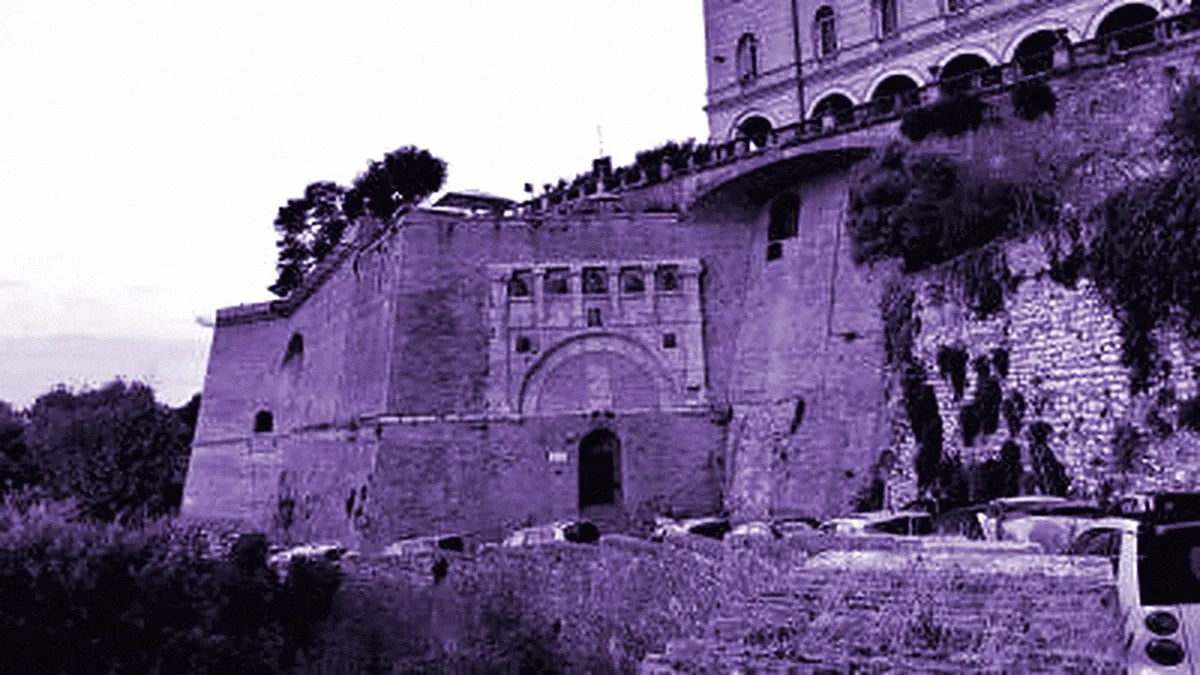
Rocca Paolina is one of the most atmospheric places to visit in Perugia. The surviving foundations and walls of the fortress now form an underground passage through the city.
The fortress was built after the Salt War of 1540, when Perugia refused to pay the papal salt tax. Pope Paul III ordered a much larger stronghold on Colle Landone, designed by Antonio da Sangallo the Younger. Entire districts were demolished to make room for it, including the houses of the Baglioni family.
Although the fortress was largely destroyed after Italian unification in 1860, its surviving brick walls still incorporate Gothic doorways from the houses absorbed into the structure. The remains along Via Indipendenza and the eastern bastion on Via Marzia reveal how dramatically the fortress reshaped Perugia.
Piazza IV Novembre and the Fontana Maggiore
Piazza IV Novembre is at the heart of Perugia’s historic center. Its defining monument is the Fontana Maggiore, built in 1275 by Fra Bevignate da Cingoli to celebrate the arrival of water uphill from Monte Pacciano through a pressurized conduit and a new aqueduct.
The fountain consists of two concentric polygonal marble basins made from stone brought from Assisi. A bronze cup crowns the monument, supporting a group of nymphs pouring out water. The lower basin has twenty-five mirrors divided into pairs of panels depicting the signs of the Zodiac, while the upper basin features twenty-four statues representing saints, mythological figures and biblical characters.
The fountain stands alongside two other major landmarks: Perugia Cathedral and the Palazzo dei Priori. Together, they make the square an essential starting point for discovering the city.
Perugia Cathedral
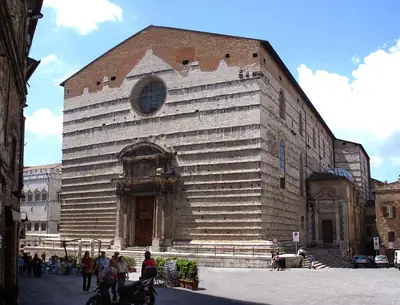
Perugia Cathedral stands on Piazza IV Novembre beside the Fontana Maggiore. Its setting places it at the center of the city’s monumental and civic life, close to the Palazzo dei Priori and the National Gallery of Umbria.
The square is particularly valuable for seeing how Perugia’s religious, political and artistic history comes together in a single urban space. From here, Corso Vannucci leads through the historic center toward further museums and Renaissance interiors.
National Gallery of Umbria
Inside the Palazzo dei Priori, the National Gallery of Umbria presents the region’s artistic heritage from the thirteenth to the nineteenth century. Its permanent collection is arranged chronologically, allowing visitors to follow the development of Italian art from the Middle Ages through the Renaissance and beyond.
The collection occupies forty exhibition rooms across two floors, with additional space for temporary exhibitions. Its history began in the mid-sixteenth century with the Perugian Academy of Drawing. Artworks entered state ownership over the following centuries, particularly after the suppression of religious houses during the Napoleonic period and after Italian unification. The collection found a permanent home in the palace in 1878 and took its current name in 1918.
Collegio del Cambio and the Chapel of San Giovanni Battista
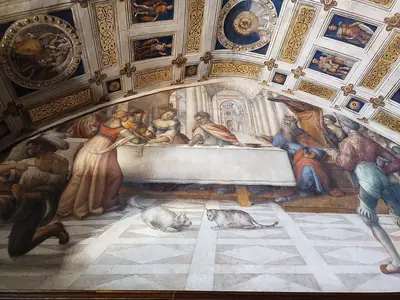
Also inside the Palazzo dei Priori, the Collegio del Cambio was established between 1452 and 1457 as the headquarters of Perugia’s Money Changers’ Guild. It combined practical business with ambitious Renaissance decoration.
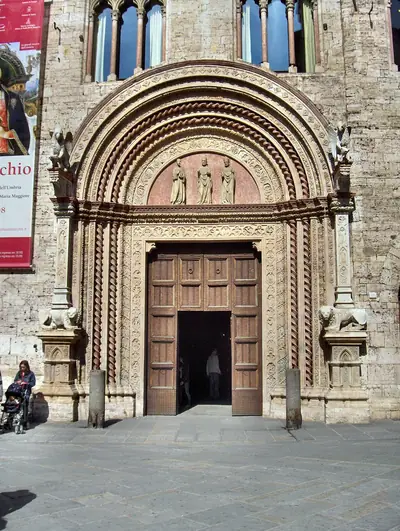
The entrance door was designed by Lodovico di Antonibo and carved by Antonio da Mercatello in 1501. Inside, wooden furnishings attributed to Domenico del Tasso are decorated with grotesque motifs. More than 550 coin weights, dating from the fifteenth to the nineteenth centuries, offer a glimpse into the city’s banking history.
The Chapel of San Giovanni Battista forms part of this richly decorated setting, where the guild’s commercial role was connected with painting, sculpture and ceremonial interiors.
Casa Museo Palazzo Sorbello
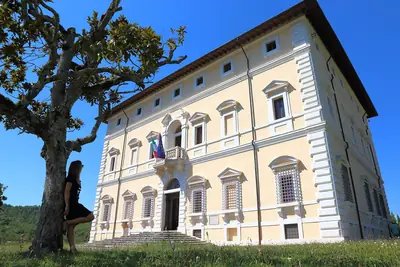
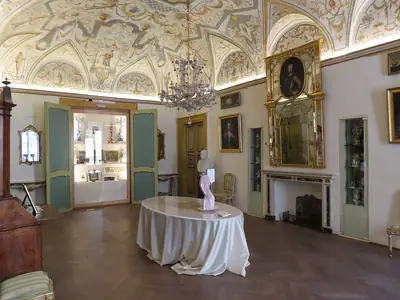
In Piazza Piccinino, Casa Museo Palazzo Sorbello occupies the former residence of the Bourbon di Sorbello family. The palace was built in the sixteenth century and acquired by the Marchesi Bourbon di Sorbello in 1780.
Its rooms preserve the atmosphere of eighteenth- and nineteenth-century aristocratic life, with frescoed vaulted ceilings, chandeliers, historic furnishings, books, landscapes and portraits. The entrance is especially unusual: its exterior is paved with wooden parquet made from turkey oak. The blocks helped soften the sound of carriage wheels and may be the only example of this type of flooring in Umbria.
National Archaeological Museum of Umbria
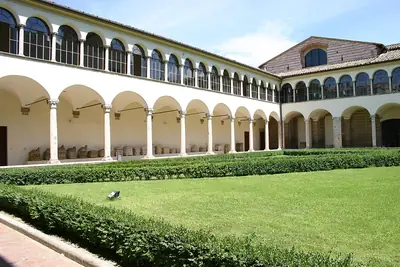
The National Archaeological Museum of Umbria, or MANU, is housed in the former convent of San Domenico in Piazza Giordano Bruno. Its collections cover the archaeological heritage of Umbria from prehistory through the Roman period.
The complex is arranged around two cloisters, while galleries on two floors display the collections. The Etruscan and Roman Lapidarium includes funerary cinerary urns, memorial stones and marble slabs bearing Latin inscriptions, alongside architectural sarcophagi, sculpted sarcophagi and stone markers once used to identify tombs.
The buildings began as a thirteenth-century church and changed function over the centuries, including periods as barracks during the Napoleonic era and after Italian unification. Since 1948, the complex has housed the National Archaeological Museum.
Arco di Sant’Ercolano
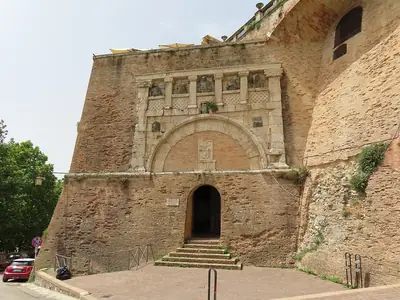
The Arco di Sant’Ercolano, beside the Stairs of Sant’Ercolano, began as part of Perugia’s Etruscan walls in the second half of the third century BC. It was one of seven gates giving access to the ancient settlement.
The original rounded arch was modified during the Middle Ages and replaced by the pointed arch visible today. The gateway was also known as Porta Cornea, Porta Berarda, Porta dei Comitoli and Porta del Leone. The last name refers to the thirteenth-century lion relief associated with the Guelph faction.
Arco dei Gigli
Arco dei Gigli is one of the openings in Perugia’s Etruscan walls and is also known as the Porta del Sole and the Arco dei Montesperelli. The present arch was rebuilt during the Middle Ages.
Its connection with Porta Sole reflects the history of Perugia’s fortifications and its highest hill, known as the Hill of the Sun. The name was also remembered by Dante Alighieri in the Paradiso. The area later became a military citadel, which was demolished after a popular uprising in 1376.
Cassero di Porta Sant’Angelo
At the end of Corso Garibaldi, the Cassero di Porta Sant’Angelo forms part of Perugia’s medieval defensive walls. It is described as the largest of the city’s medieval gates and the only surviving gate of the original five that pierced the walls.
The pointed arch is topped by crenelated battlements, machicolations and stone brackets. Two slots show how the drawbridge was operated, although the bridge was later replaced by a masonry structure. The gateway once stood beside a moat, which was filled in during the early twentieth century.
Palazzo della Penna
At the foot of Rocca Paolina, the Civic Museum of Palazzo della Penna brings together Roman remains, historic rooms, modern installations and changing exhibitions. The palace incorporates parts of the Roman Marzio Amphitheatre, dating from the first century AD, as well as medieval walls and streets.
Its architecture combines Renaissance and Neoclassical elements. Inside, a helical staircase designed by Franco Minissi links the three floors. The museum also presents the work of Gerardo Dottori and other Umbrian Futurists.
POST and Fuseum
Near the Etruscan Arch and Grimana Square, Centro della Scienza P.O.S.T. is an interactive center devoted to science and technology. Its Exhibit Area contains seventeen installations exploring subjects including sound, light and optical illusions. A Photo Gallery presents temporary exhibitions, while the Activity Classroom offers hands-on learning.
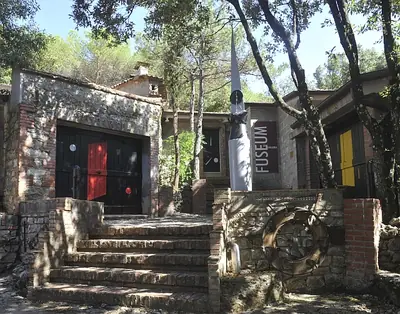
Fuseum, meanwhile, is a house museum dedicated to the work of artist Brajo Fuso. It connects his art with the setting associated with his life and work.
Villa del Colle del Cardinale and Santa Maria di Valdiponte
Outside the central streets, Villa del Colle del Cardinale is a summer residence set on a hill above the Caina valley, at the foot of the western ridge of Mount Tezio. Cardinal Fulvio della Corgna commissioned it around 1576 as a suburban summer residence, with a design by architect Galeazzo Alessi.
Near Montelabate, Santa Maria di Valdiponte is an ancient Benedictine monastic complex more commonly known today as Abbazia di Montelabate.
Explore Perugia with a self-guided audio tour
A Perugia self-guided walking tour is an easy way to connect the city’s gates, palaces, museums and churches without joining a group. Neywo has four walking tours and one bus route in Perugia, with narration available in 11 languages:
- Perugia’s Medieval Heart: From Fortress to Fountain — 1.54 km, 78 minutes and 10 narrated stops.
- Gates of Etruscan Perusia — 2.64 km, 87 minutes and 10 narrated stops.
- Saints, Students and the Sant’Angelo Quarter — 2.26 km, 81 minutes and 10 narrated stops.
- Borgo San Pietro: Dominicans, Garibaldi and Medieval Gardens — 1.79 km, 58 minutes and 7 narrated stops.
- Line Q2: Etruscan Gates to the Templar Church — a 5.4 km bus route lasting 23 minutes, with 7 narrated stops.
Download Neywo and explore Perugia with its free audio guide. The app tells the story of each place as you reach it, at your own pace, with no group and no schedule.
Places with an audio guide in Perugia
8 places in Perugia with a Neywo audio guide. Each one starts telling its story as you reach it.
Self-guided tours in Perugia
5 tours in Perugia, free in the Neywo app. Each stop tells its story as you reach it.
- Bus ride
Line Q2: Etruscan Gates to the Templar Church
A regular Busitalia city bus that climbs from the Etruscan walls and the medieval Porta di Santa Susanna to the Romanesque church of San Benedetto and the Money Changers' hall on Corso Vannucci. It then rolls north past Santa Maria di Monteluce and the Templar church of San Bevignate to the hilltop castle of Monterone. Buy a ticket at a tabaccheria or on the bus and ride one direction, Montegrillo toward Collestrada.
City wall of Perugia · Porta di Santa Susanna · San Benedetto · Collegio del Cambio · Santa Maria di Monteluce · San Bevignate …
Open this tour: Line Q2: Etruscan Gates to the Templar Church - Walk
Perugia's Medieval Heart: From Fortress to Fountain
Climb from the underground ruins of the Rocca Paolina up Corso Vannucci to the Fontana Maggiore, the symbol of the city. Visit the Money Changers' hall painted by Perugino, the Priors' Palace, an Etruscan well and Raphael's fresco, then pass through the Etruscan Arch that Augustus restored.
Rocca Paolina · Palace of the Province · Palazzo Baldeschi al Corso · Palazzo del Capitano del Popolo · Collegio del Cambio · National Gallery of Umbria …
Open this tour: Perugia's Medieval Heart: From Fortress to Fountain - Walk
Gates of Etruscan Perusia
Perugia was an Etruscan city long before it was Italian. Follow its walls and gates from Porta Marzia and the Arch of Sant'Ercolano past Romanesque churches, a medieval tower and the oldest dated frescoes in the city to the western gates and the double ring of Etruscan and medieval walls.
Arco di Sant'Ercolano · Porta Marzia · Porta Eburnea · Santo Spirito · San Prospero, Perugia · Porta di Santa Susanna …
Open this tour: Gates of Etruscan Perusia - Walk
Saints, Students and the Sant'Angelo Quarter
Walk through the northern quarter of Perugia: the Franciscan church and the jewel-like facade of San Bernardino, the university founded in 1308, a Renaissance monastery and one of the oldest Christian buildings in Italy. End among the gardens and cloisters of the hillside.
Oratory of San Bernardino · San Francesco al Prato church · University of Perugia · Palazzo Murena · Church of St. Augustine · Monastero di Santa Caterina …
Open this tour: Saints, Students and the Sant'Angelo Quarter - Walk
Borgo San Pietro: Dominicans, Garibaldi and Medieval Gardens
Leave the old centre along Corso Cavour to the quarter of San Pietro. Visit the Umbrian archaeological museum in a Dominican convent, the basilica of San Domenico, the Romanesque gate of San Pietro and a medieval herb garden, finishing at the burial place of Perugia's first bishop.
Monument to Giuseppe Garibaldi · Museo archeologico nazionale dell'Umbria · San Domenico · Saint Peter's City Gate · Church of St. Agata · Frontone Gardens …
Open this tour: Borgo San Pietro: Dominicans, Garibaldi and Medieval Gardens
Walk Perugia with Neywo
Neywo turns Perugia into a self-guided audio tour. Stories arrive as you reach the place they belong to, and the route reshapes when you wander off it.

