What to See in Vicenza, Italy: Free Audio Guide
Things to Do in Vicenza: What to See in Palladio’s City
The best things to do in Vicenza are concentrated around the Renaissance buildings of Andrea Palladio, from the Basilica Palladiana and Teatro Olimpico to the villas and hilltop sanctuary beyond the historic center. The city’s UNESCO-listed architectural heritage, museums, gardens and viewpoints make it a rewarding place to explore on foot. Neywo offers a free audio guide for Vicenza with 110 narrated places.
Vicenza is in Veneto, between some of northern Italy ’s best-known cities. Its historic center is shaped by Palladio’s work, but the city is more than a collection of grand palaces: quiet loggias, churches, museums and everyday streets all contribute to its character.
What to see in Vicenza
Basilica Palladiana and Piazza dei Signori
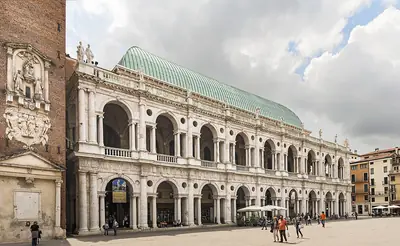
The Basilica Palladiana is one of Vicenza’s defining landmarks, standing on Piazza dei Signori. Palladio added the elegant sixteenth-century marble loggias around the earlier Gothic Palazzo della Ragione rather than demolishing the original structure. The Gothic building remains visible above the shops, creating a striking contrast with the Renaissance arches.
The loggia also contains one of the earliest examples of what became known as the Palladian window, a design that later influenced architecture far beyond Vicenza. Today, the building’s main hall hosts art and architecture exhibitions across three independent exhibition spaces.
Opposite the Basilica is Palazzo del Capitaniato, also known as the Loggia Bernarda. Palladio designed it in 1565, and it was built between 1571 and 1572. Together, the two buildings create one of the city’s most harmonious Renaissance ensembles. The interior includes the Sala Bernarda, the seat of the city council, decorated with frescoes by Giovanni Antonio Fasolo and ornamental work by Lorenzo Rubini.
Casa Pigafetta and Casa Cogollo
Two smaller palaces add detail to a walk through central Vicenza. Casa Pigafetta, on Via Pigafetta, was completed in 1481. The date remains carved in stone above a ground-floor window, offering a small but tangible connection with the city’s Renaissance past.
On Corso Palladio, Casa Cogollo is attributed to Palladio and forms part of the UNESCO World Heritage Site dedicated to Vicenza’s Palladian monuments. It is sometimes called the House of Palladio, but it was never the architect’s home. The building was commissioned for the notary Pietro Cogollo, who was asked to remodel the façade of his fifteenth-century house as part of the city’s improvement.
Teatro Olimpico
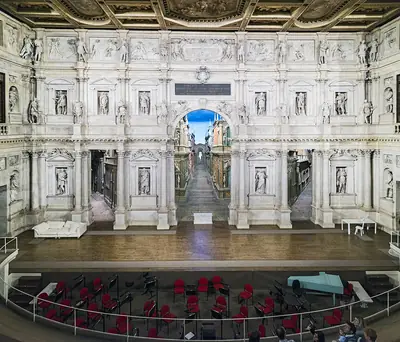
The Teatro Olimpico is Palladio’s final design and one of the most important places to visit in Vicenza. Construction began in 1580, the year Palladio died, and the theatre was inaugurated on March 3, 1585. It was commissioned by the Accademia Olimpica, a learned society founded in Vicenza in 1555 for performances of classical comedies.
The theatre was built inside an existing medieval complex and is considered the first covered permanent theatre of the modern era. Its most remarkable feature is the surviving trompe-l’œil scenery designed by Vincenzo Scamozzi for the opening performance. The painted and constructed streets appear to recede towards a distant horizon, creating an extraordinary illusion of depth. The Roman-style stage backdrop, or scaenae frons, is made from wood and stucco finished to resemble marble. The theatre continues to host performances and concerts.
Palazzo Chiericati Art Gallery
At the end of Corso Palladio, Piazza Matteotti is home to Palazzo Chiericati. Palladio designed the Renaissance palace in 1550 as a residence for the counts Chiericati, and construction began in 1551. The building was completed at the end of the seventeenth century.
Since 1855, it has housed Vicenza’s civic museum. Its permanent collection includes paintings from the late twelfth through the seventeenth centuries, with particular emphasis on Vicentine and Venetian art. The civic collection also includes sculpture, prints, drawings, coins, textiles and toys, gathered through acquisitions and donations.
Palazzo Leoni Montanari
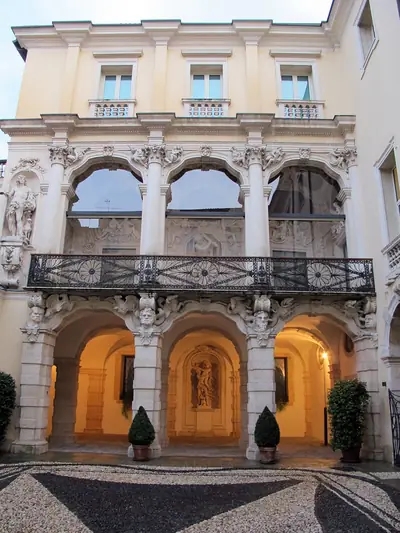
Palazzo Leoni Montanari is a late Baroque palace on Contrà San Corona. Dating from 1678, it now houses the Gallerie d’Italia in Vicenza, an exhibition space owned by Intesa Sanpaolo.
The museum combines eighteenth-century Venetian painting with a collection of ancient Russian icons. The contrast between the colourful Venetian canvases and the icons makes the palace one of Vicenza’s more distinctive museum experiences.
Museo di Santa Corona and the Diocesan Museum
The Museo di Santa Corona occupies the former Dominican convent and its cloisters beside the church of Santa Corona. Opened in 1991, it brings together natural history and archaeology collections in the heart of the historic center.
The Diocesan Museum is housed in the Palazzo Vescovile, the historic Bishop’s Palace overlooking Piazza del Duomo, a short distance from the Cathedral of Santa Maria Annunciata. The palace was originally built towards the end of the twelfth century and expanded over time; its present appearance mainly reflects renovations in the nineteenth century and after the Second World War. The museum traces the artistic and cultural history of the local Church through its artworks.
Loggia Valmarana and the Salvi gardens
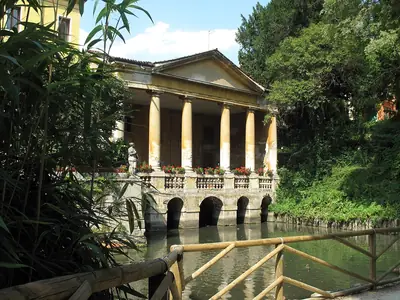
The Loggia Valmarana sits among the greenery of the Salvi, or Valmarana Salvi, gardens near the walls of Piazza Castello. The gardens were inaugurated in 1592 by Leonardo Valmarana, closed to the public soon afterwards and reopened in 1909.
The loggia was probably built in 1591 by a student of Palladio for Gian Luigi Valmarana, who intended it as a meeting place for intellectuals and academics. Statues and two Palladian-style loggias give this compact public garden its quiet appeal.
Arco delle Scalette and Monte Berico
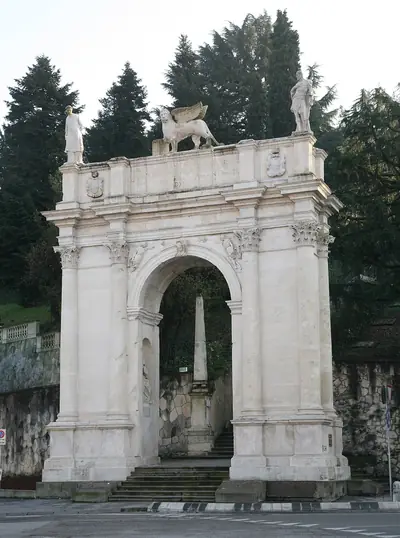
The Arco delle Scalette marks the beginning of the route climbing towards the Sanctuary of the Madonna di Monte Berico. The ceremonial arch stands in Piazzale Fraccon and is generally attributed to Palladio, with a design dating to around 1575. It was built in 1595, about fifteen years after Palladio’s death, for the Venetian captain Giacomo Bragadin.
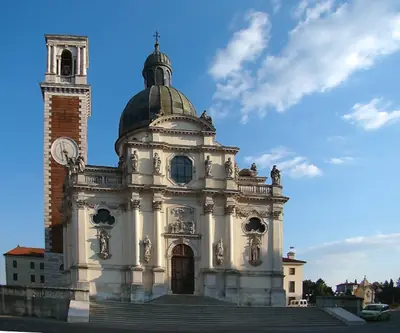
At the top of Monte Berico, the Sanctuary of the Madonna di Monte Berico overlooks Vicenza. The complex brings together two churches: a fourteenth-century Gothic church and a Baroque basilica added in the second half of the seventeenth century. Pope Pius X raised the sanctuary to the rank of minor basilica in May 1904.
In front of the sanctuary, Piazzale della Vittoria has a broad terrace with views across Vicenza, the northern part of the province and the Vicentine Prealps.
Villa Almerico Capra, La Rotonda
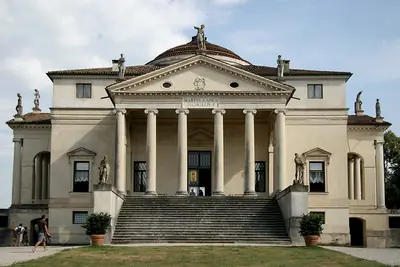
Just outside the center, Villa Almerico Capra—better known as La Rotonda—is Palladio’s most famous villa. Paolo Almerico commissioned its design in 1566 and 1567. After his death, the Capra brothers acquired the building and brought in Vincenzo Scamozzi, who completed it in 1605.
La Rotonda is organized around a perfectly symmetrical central plan, with four identical porticoes facing in four directions. Its dome, inspired by ancient Roman temples, was an influential feature during the Palladian movement of the eighteenth century, when villas inspired by La Rotonda appeared in England and America.
Villa Trissino
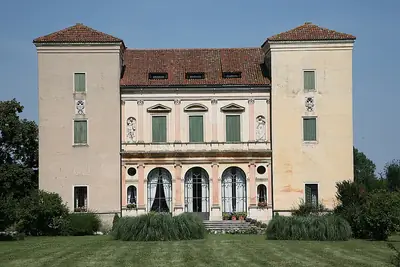
In the Cricoli area outside the center, Villa Trissino is a sixteenth-century patrician villa associated by tradition with Andrea Palladio. It belonged to Gian Giorgio Trissino, a sixteenth-century humanist scholar, and is considered part of the Palladian architectural tradition.
It should not be confused with the other Villa Trissino at Sarego, about 20 kilometers away, an incomplete building designed by Palladio for Ludovico and Francesco Trissino.
Explore Vicenza with a self-guided audio tour
For a Vicenza self-guided walking tour, Neywo lets you explore without joining a group or following a fixed schedule. The app tells the story of each place as you reach it, at your own pace, with narration available in 11 languages.
Vicenza has three walking tours, one bus route and one bike route:
- The Palladio Trail: Palaces of Corso Palladio — a 1.57 km walk lasting 104 minutes, with 12 narrated stops.
- Up Monte Berico: Sanctuary, Frescoes and La Rotonda — a 3.13 km walk lasting 83 minutes, with 5 stops.
- Palladian Palaces, Hidden Loggias and Quiet Churches — a 2.28 km walk lasting 86 minutes, with 10 stops.
- Bus 1 Across Vicenza: From Palazzo Leoni Montanari to the Olympic Theatre — a 13.8 km bus route lasting 59 minutes, with 7 stops.
- Cycling the Old Borgo: From Santa Caterina to the Scalette — a 4.5 km bike route lasting 22 minutes, with 4 stops.
Download the free Neywo audio guide and discover Vicenza’s palaces, museums, churches, villas and viewpoints as you move through the city. Each story starts when you arrive at the place, so you can explore at your own pace, with no group and no schedule.
Places with an audio guide in Vicenza
8 places in Vicenza with a Neywo audio guide. Each one starts telling its story as you reach it.
Self-guided tours in Vicenza
5 tours in Vicenza, free in the Neywo app. Each stop tells its story as you reach it.
- Bike ride
Cycling the Old Borgo: From Santa Caterina to the Scalette
Follow the cycle lanes from the Borgo Berga district at the foot of the Berici hills through the walled centre to the Arco delle Scalette, the arch that starts the stairway to Monte Berico. Small Renaissance and Baroque churches line the way.
Santa Caterina in Porto · Arco delle Scalette · San Rocco · Santa Croce
Open this tour: Cycling the Old Borgo: From Santa Caterina to the Scalette - Bus ride
Bus 1 Across Vicenza: From Palazzo Leoni Montanari to the Olympic Theatre
A regular city bus that crosses the historic centre and the neighbourhoods beyond the river. Ride it past Palazzo Leoni Montanari, the Palladian loggia in the Salvi gardens, the Romanesque basilica of Santi Felice e Fortunato, a rare octagonal oratory, a late Gothic palace and the Olympic Theatre.
Palazzo Leoni Montanari, Vicenza · Loggia Valmarana · Basilica dei Santi Felice e Fortunato (Vicenza) - Facade · Oratorio delle Zitelle · San Giuliano · Palazzo Regaù …
Open this tour: Bus 1 Across Vicenza: From Palazzo Leoni Montanari to the Olympic Theatre - Walk
The Palladio Trail: Palaces of Corso Palladio
Vicenza made the architect Andrea Palladio and Palladio made Vicenza. Walk the city's spine from the cathedral dome he designed to the Basilica wrapped in his marble loggias, then past his palaces and the Olympic Theatre, the oldest surviving stage set in the world, to the gallery at the end of Corso Palladio.
Vicenza Cathedral · Casa Pigafetta · Piazza dei Signori, Vicenza · Basilica Palladiana · Palazzo del Capitaniato · Palazzo Thiene …
Open this tour: The Palladio Trail: Palaces of Corso Palladio - Walk
Up Monte Berico: Sanctuary, Frescoes and La Rotonda
Climb the 192 steps of the Scalette from the Arco delle Scalette to the pilgrimage sanctuary on Monte Berico and its panoramic terrace. Then follow the lane down to the Tiepolo-frescoed Villa Valmarana ai Nani and finish at La Rotonda, the most imitated villa in architectural history.
Arco delle Scalette · Santuario della Madonna di Monte Berico · Piazzale della Vittoria · Villa Valmarana ai Nani · Villa Almerico Capra (La Rotonda)
Open this tour: Up Monte Berico: Sanctuary, Frescoes and La Rotonda - Walk
Palladian Palaces, Hidden Loggias and Quiet Churches
Step off Corso Palladio into the western quarter. See palaces by Palladio and his pupil Scamozzi, the Bishop's Palace museum, a Palladian loggia hidden in the Salvi gardens, a Baroque loggia by Longhena and Palladio's only complete church design in the city.
Palazzo Valmarana · Palazzo Trissino al Duomo · Diocesan Museum of Vicenza · Palazzo Thiene Bonin Longare · Palazzo Porto in Piazza Castello · Loggia Valmarana …
Open this tour: Palladian Palaces, Hidden Loggias and Quiet Churches
Walk Vicenza with Neywo
Neywo turns Vicenza into a self-guided audio tour. Stories arrive as you reach the place they belong to, and the route reshapes when you wander off it.

