Orvieto, Italy: Self-Guided Walking Tour
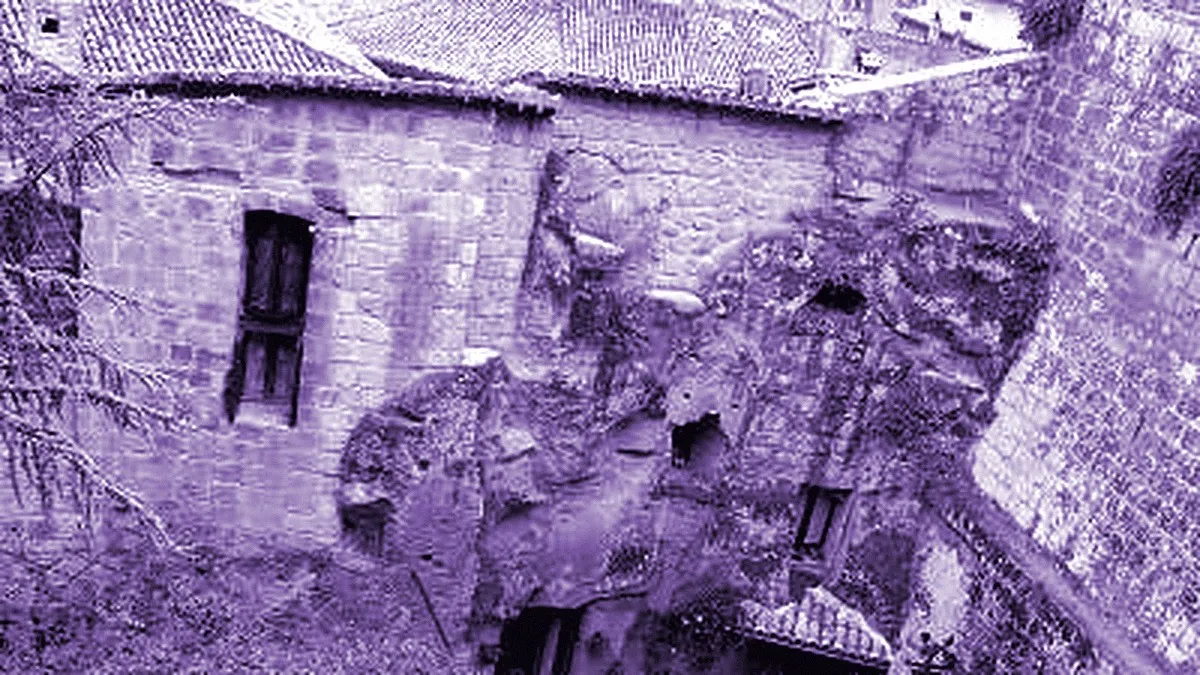
Things to Do in Orvieto: What to See in Italy’s Cliffside City
The best things to do in Orvieto include exploring its Gothic cathedral, Etruscan museums and necropolises, Renaissance engineering, and historic churches. Built on a high tufa plateau above the Paglia Valley, this Umbrian city brings together layers of Etruscan, medieval and Renaissance history in a compact setting. Neywo has a free audio guide for Orvieto with 51 narrated places, available in 11 languages.
What to See in Orvieto
Orvieto’s historic center is shaped by the volcanic rock beneath it and by the civilizations that settled here. These are some of the most important places to include in an Orvieto itinerary.
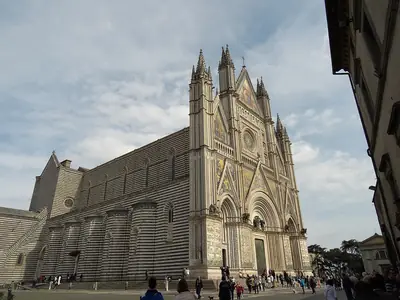
Orvieto Cathedral
The Duomo di Orvieto, also known as the Cathedral of Santa Maria Assunta, is one of Central Italy’s great Gothic and Romanesque masterpieces. Its façade combines marble sculpture, mosaics and three bronze doors, creating an elaborate visual narrative of biblical scenes, saints and decorative patterns.
Above the entrance, the radiant mosaic known as the Golden Lily, or Rose Window, places Christ at the center among angels, prophets and apostles. Construction began in 1290 on the orders of Pope Nicholas the Fourth, replacing two earlier churches on the square. The cathedral developed over several centuries, bringing together different phases of Gothic design.
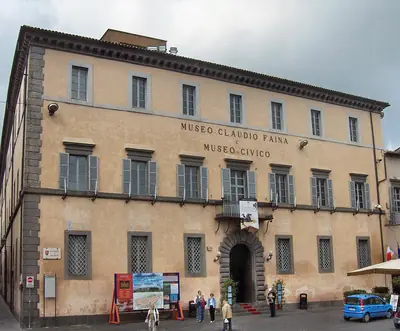
Museo Claudio Faina
Housed in Palazzo Faina, the Museo Claudio Faina introduces Orvieto’s Etruscan heritage through pottery, sculptures, jewelry and funerary objects. The collection began as a private collection in 1864 and traces the origins, development and decline of Etruscan civilization.
Replicas of Etruscan tombs help visitors understand ancient burial customs and beliefs. Nearby, the Museo dell’Opera del Duomo continues the city’s artistic story with works dating from the thirteenth century onward, including sculpture, religious art, decorated terracotta and goldsmiths’ work.
Museo archeologico nazionale di Orvieto
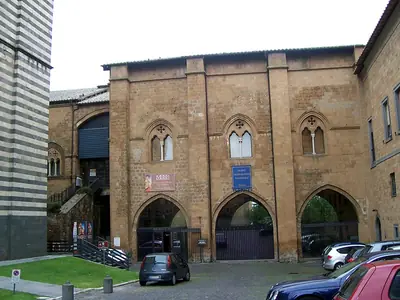
The National Archaeological Museum of Orvieto occupies the ground floor of a historic papal palace near the cathedral. The palace dates from the late thirteenth century and is one of three Papal Palaces close to the Duomo.
Since its inauguration in 1982, the museum has displayed archaeological discoveries from local investigations and excavations. Among its notable holdings are frescoes removed from the Golini tombs in Porano and transferred there from the Archaeological Museum of Florence.
Pozzo di San Patrizio
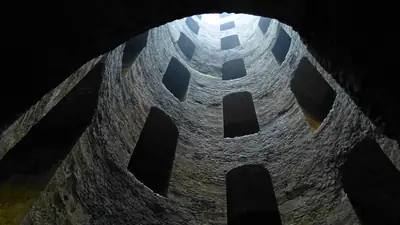
The Pozzo di San Patrizio is one of Orvieto’s most remarkable Renaissance engineering projects. Pope Clement VII commissioned the well after the Sack of Rome, seeking a dependable water supply in case the city faced a siege. Antonio da Sangallo the Younger designed it, and construction took place between 1527 and 1537.
Its distinctive double-helix plan consists of two separate spiral staircases winding around a central cylindrical core. This arrangement allowed pack animals to descend with water vessels and return without meeting traffic coming the other way. The well reaches approximately 53 metres underground, making its scale especially striking.
Fortezza Albornoz
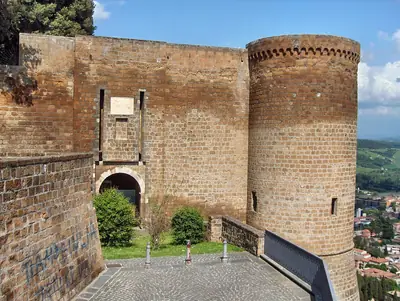
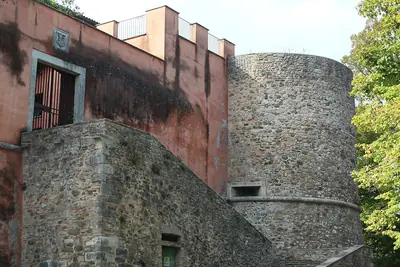
At Piazza Cahen, Fortezza Albornoz—also called Rocca di Albornoz—now contains Orvieto’s principal public gardens. Its surviving walls and tower stand on the eastern edge of the historic center, where the cliff provided a naturally strong defensive position.
Cardinal Egidio Albornoz commissioned the fortress in 1364, and the military architect Ugolino di Montemarte designed it. The Rocca was partly destroyed in 1389, rebuilt in 1413 under Francesco I Orsini and attacked again the following year by Ladislaus the Magnanimous, King of Naples. Later additions included a circular tower and other works completed in 1450 under Bernardo Rossellino. From the fortress, views extend across the Paglia River valley and the surrounding countryside.
Necropoli Etrusca del Crocifisso del Tufo
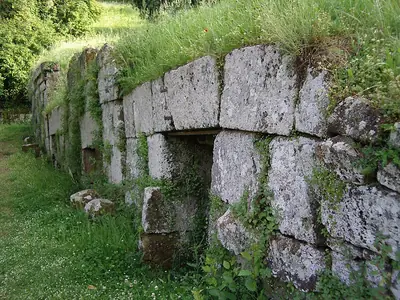
At the base of Orvieto’s cliff, the Necropoli Etrusca del Crocifisso del Tufo preserves an unusually organized Etruscan burial site. A pedestrian path connects it with the walkway around the cliff.
The necropolis reached its greatest extent between the middle of the sixth and the middle of the fifth century BC. More than two hundred chamber tombs line burial streets in a regular, grid-like arrangement. Built from blocks of tuff, the rectangular tombs were generally intended for individual family units. Names were engraved above the entrances, while stelae marked the tombs from outside.
Fanum Voltumnae
At Campo della Fiera, below Orvieto’s cliff, excavations begun in 2000 uncovered a vast sanctuary complex identified by most modern scholarship with the Fanum Voltumnae. The site is associated with the ancient Etruscan shrine dedicated to the deity whom Latin sources call Voltumna.
This was not a single temple but a sacred area with buildings and spaces serving different functions. The sanctuary’s history after the Roman conquest of Velzna in 264 BC remains debated: some scholars believe its religious use continued into late antiquity, while others propose a break or the transfer of its federal role elsewhere.
Chiesa di San Francesco
The Church of San Francesco stands in Piazza Febei, at the highest point of Orvieto’s tufa rock. The Franciscans established themselves here as early as 1216, giving the church a direct connection with the long presence of the Franciscan friars in the city.
Cappella Petrucci and San Domenico
Beneath the high altar of San Domenico is the Cappella Petrucci, a monumental family burial chapel designed by Michele Sanmicheli and built between 1516 and 1518. It is arranged as three spaces reached by two symmetrical stairways, with niches placed along the diagonal axes in a design inspired by ancient Roman mausoleums.
The chapel forms part of San Domenico, whose construction began in 1233, only a few years after the death of Saint Dominic. Later renovations to the church, carried out around the 1570s, significantly altered the chapel’s original structure.
Palazzo Gualterio
Facing the Torre del Moro, Palazzo Gualterio occupies the corner between Via de’ Gualtieri, Piazza Filippo Antonio Gualterio, Via del Duomo and Corso Cavour. The Gualterio family had the palace remodelled according to an initial design by Sangallo, with later work by Simone Mosca.
The building was decorated with stucco and frescoes. After the palace passed to the Banco di Roma, its art objects were moved to the civic museum and to rooms in the Palazzo Comunale.
Other places to notice around Orvieto include San Lodovico in Piazza de’ Ranieri, as well as Palazzo Clementini, Palazzo Crispo-Marsciano, Castello di Corbara and Castello di Prodo.
Explore Orvieto with a Free Audio Guide
A free walking tour in Orvieto is easy to follow with Neywo. The app has three walking tours covering the cathedral, museums, underground sites, churches, fortifications and Etruscan heritage:
- Orvieto’s golden cathedral and the city beneath it: 1.97 km, 91 minutes and 11 narrated stops.
- Orvieto from the funicular: a fortress, a famous well and a Renaissance crypt: 1.94 km, 61 minutes and 6 narrated stops.
- Etruscan Orvieto: wells, tombs and the edge of the rock: 0.64 km, 31 minutes and 4 narrated stops.
Neywo tells the story of each place as you reach it, at your own pace, with no group and no schedule. Download the app to explore Orvieto independently, then continue discovering Umbria and the rest of Italy with the same approach.
Places with an audio guide in Orvieto
8 places in Orvieto with a Neywo audio guide. Each one starts telling its story as you reach it.
Self-guided tours in Orvieto
3 tours in Orvieto, free in the Neywo app. Each stop tells its story as you reach it.
- Walk
Orvieto's golden cathedral and the city beneath it
The heart of Orvieto in one loop. Start on Piazza Duomo with the Etruscan collections, the glittering Gothic cathedral and the Faina museum, then drop into the tuff caves carved under the town. Climb to the Franciscans and the horseshoe-shaped Mancinelli theatre, pass the medieval Palace of the Captain of the People, and cross Republic Square, with its town hall, Sant'Andrea and a twelve-sided tower, to end at the Pozzo della Cava, a 36-metre well dug into Etruscan caves.
Museo archeologico nazionale di Orvieto · Orvieto Cathedral · Museo Claudio Faina · Orvieto subterranea · Chiesa di San Francesco · Teatro Comunale Mancinelli …
Open this tour: Orvieto's golden cathedral and the city beneath it - Walk
Orvieto from the funicular: a fortress, a famous well and a Renaissance crypt
Ride the funicular up to Piazza Cahen and take the cliff-top side of Orvieto. Walk into the Albornoz fortress gardens for the valley view, descend the double-helix staircases of St Patrick's Well that a pope ordered built in fear of a siege, then work your way back through Servite and Dominican churches to the Franciscans on the highest point of the rock.
Stazione FS · Pozzo di S. Patrizio · Fortezza Albornoz · Church of Santa Maria dei Servi · Cappella Petrucci · Chiesa di San Francesco
Open this tour: Orvieto from the funicular: a fortress, a famous well and a Renaissance crypt - Walk
Etruscan Orvieto: wells, tombs and the edge of the rock
The western rim of the cliff, where Orvieto is oldest. Visit a Renaissance well dug into Etruscan caves, a church built where a temple of Jupiter is believed to have stood, and a 2,500-year-old city of the dead laid out in a grid along the tuff cliff.
Pozzo della Cava · Madonna del velo · Chiesa di San Giovenale · Necropoli Etrusca del Crocifisso del Tufo
Open this tour: Etruscan Orvieto: wells, tombs and the edge of the rock
Walk Orvieto with Neywo
Neywo turns Orvieto into a self-guided audio tour. Stories arrive as you reach the place they belong to, and the route reshapes when you wander off it.

