What to See in Padua, Italy: Free Audio Guide
Things to Do in Padua: What to See in the City
The best things to do in Padua include discovering Giotto’s frescoes, historic churches, grand squares, scientific landmarks, and one of the world’s oldest academic botanical gardens. The city’s compact centre brings together art, religion, scholarship, and civic history in a route that is easy to explore on foot. Neywo offers a free audio guide for Padua with 140 narrated places.
What to See in Padua
Scrovegni Chapel
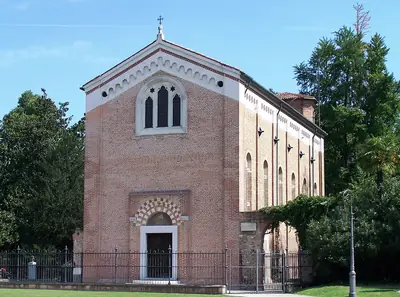
The Scrovegni Chapel, or Cappella degli Scrovegni, is one of Padua’s defining artistic landmarks. Giotto completed its extraordinary fresco cycle around 1305, helping to transform the history of mural painting in the fourteenth century.
The chapel’s interior is almost entirely covered with painted surfaces, including a vault painted in deep blue. The scale of the decoration is remarkable: around 700 square metres of the chapel are painted, while the nave measures nearly 30 metres long.
Basilica of Saint Anthony of Padua
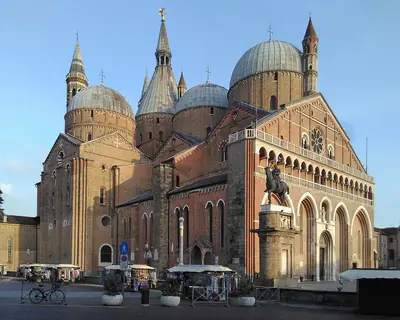
The Basilica of Saint Anthony of Padua, known locally as Il Santo, is one of the city’s principal Catholic places of worship and one of the largest churches in the world. It is also one of the most revered Christian sanctuaries, attracting more than six and a half million pilgrims each year.
The basilica has a strong connection with Donatello. His equestrian monument to Gattamelata stands in nearby Piazza del Santo, while the church contains bronze works including a crucifix, statues, and relief panels later placed on the high altar designed by Camillo Boito.
Orto Botanico di Padova
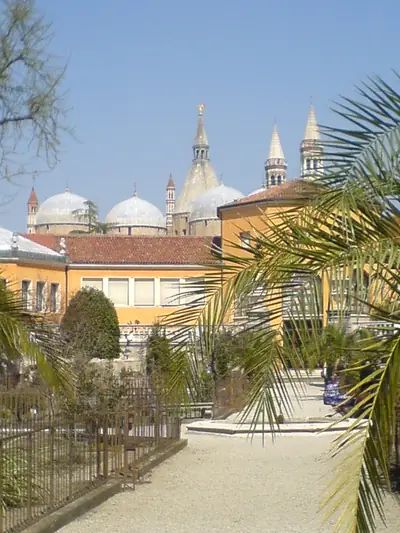
The Orto Botanico di Padova, or Padua Botanical Garden, was founded in 1545 by the Venetian Republic. It is the world’s oldest academic botanical garden still in its original location.
Located in Padua’s historic centre near Prato della Valle, the garden is operated by the University of Padua and owned by the Italian government. Its grounds cover about 2.2 hectares, or 22,000 square metres, and its historic design has changed little over time.
Prato della Valle
Prato della Valle is one of Padua’s most impressive public spaces and one of the largest squares in Italy and Europe. Its elliptical layout surrounds Isola Memmia, a green central island of about 20,000 square metres.
A small canal circles the island, fed by the Alicorno canal. Around the water runs a double ring of statues, with the outer ring measuring about 572 metres in circumference. The configuration seen today dates from the end of the eighteenth century.
Palazzo della Ragione
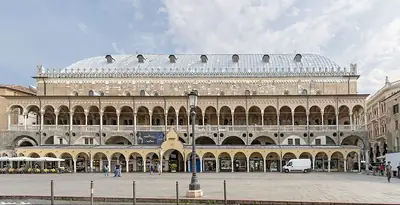
Palazzo della Ragione is the great civic building known locally as il Salone, or “the big hall”. For centuries, it combined Padua’s administration and courts with a covered market.
The upper hall measures about 80 metres long, 27 metres wide, and almost 40 metres high. Its wooden ceiling resembles an inverted ship’s hull. The building’s lower section existed by 1166, while the palace was built between 1218 and 1219. Giovanni degli Eremitani later added the portico and loggias and gave the roof its characteristic form.
The palace originally contained frescoes by Giotto. After a fire in 1420, the cycles were recreated. They form part of Padua’s UNESCO World Heritage inscription for its fourteenth-century fresco cycles, added in 2021.
Padua Cathedral
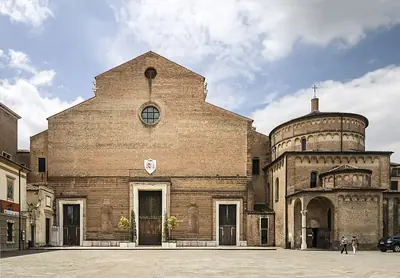
Padua Cathedral, or the Duomo di Padova, stands in Piazza Duomo beside the bishop’s palace. Dedicated to the Assumption of the Virgin Mary, it is the city’s principal Catholic place of worship, the seat of its bishop, and a minor basilica.
The Diocese of Padua has been based on this site since at least the fourth century. The present building is the third cathedral here. Its Renaissance construction began in 1551 and continued until 1754, although the façade remained unfinished. The long building history explains the combination of earlier Paduan traditions and later Renaissance design.
Santa Maria dei Servi
On Via Roma, Santa Maria dei Servi is a fourteenth-century church associated with the Servants of Mary and still governed by the Servite Order. It is now a parish church within the vicariate of the Cathedral Basilica of Santa Maria Assunta.
The church’s principal artistic highlight is a wooden crucifix attributed to Donatello. Santa Maria dei Servi is also connected with the nearby churches of San Canziano and San Luca.
Santa Sofia
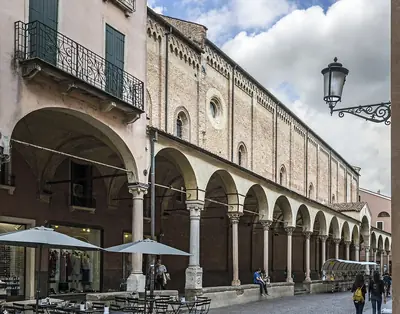
Santa Sofia is considered the oldest surviving Roman Catholic church structure in Padua. Its history reaches back to the early Middle Ages and to earlier remains beneath the site, including third- and fourth-century pagan remains and a presumed Mithraeum.
The Romanesque façade, built between 1106 and 1127, combines stone and brick. The semicircular apse may be older. Today, the relatively bare interior makes it easier to appreciate the church’s early medieval origins and its place in Venetian Romanesque architecture.
Piazza Antenore and the Tomb of Antenor
Piazza Antenore lies in the city centre, close to the university. Its principal monument is the Tomb of Antenor, a raised sarcophagus protected by a pyramidal cover.
The monument was created for remains believed to belong to Antenor, the Trojan warrior and legendary founder of Padua. Nearby stands the funerary monument of Lovato de’ Lovati, the notary, poet, and judge who identified the remains as Antenor’s. Later scientific analysis identified them as those of a warrior from late antiquity, but the tomb continues to express Padua’s legendary origins.
Porta Liviana
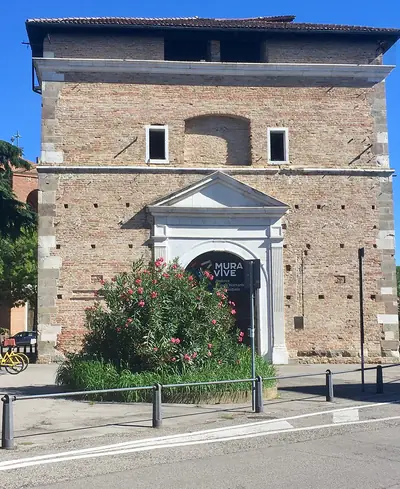
Also known as Porta Pontecorvo, Porta Liviana is one of Padua’s historic gateways. It formed part of the city’s sixteenth-century walls and marked an important entrance. Construction began shortly after the siege of Padua in 1509, during the War of the League of Cambrai, and was completed in 1517.
La Specola
The Astronomical Observatory of Padova occupies the former main tower of Castelvecchio, known as the Torlonga. The medieval tower dates from the fourteenth century and rises 49.59 metres, or 53.30 metres including its lightning-rod antenna.
The site became an astronomical observatory in 1767, beginning as a university research cabinet. Reaching the top involves 252 steps. Since 2001, La Specola has been part of the National Institute for Astrophysics, or INAF.
Padua’s Museums
Padua’s museums add further layers to the city’s history. Across from the Scrovegni Chapel, Palazzo Zuckermann forms part of the Civic Museums of Padua. Built between 1912 and 1914 for the industrialist Erico Zuckermann, it later served as the city’s main post office.
The Museum of Applied and Decorative Arts occupies the ground and first floors, with craftworks dating from the medieval period through the late nineteenth century. The second floor houses the Museo Bottacin, known especially for its numismatic collections.
In the Mandria area, the Veneto Toy Museum is housed within the Civitas Vitae multifunctional centre and focuses on toys and childhood.
Arcella Sanctuary and Abbey of Santa Giustina
The Sanctuary of Arcella, also called Sant’Antonino, preserves the cell where Saint Anthony died on June 13, 1231. It is one of the city’s most important places connected with the saint’s life.
Near Prato della Valle, the Abbey of Santa Giustina is an immense religious complex whose basilica measures about 122 metres long and 82 metres wide. The church was first built in the sixth century, while the present basilica resulted from a major early-modern reconstruction. Its interior includes works associated with Paolo Veronese, Sebastiano Ricci, Luca Giordano, and the Corbarelli family.
Explore Padua with a Self-Guided Audio Tour
Neywo turns Padua into a self-guided walking tour: the app tells the story of each place as you reach it, at your own pace, with no group and no schedule. Its narration is available in 11 languages.
The Padua audio guide includes:
- 5 walking tours, ranging from 1.4 to 2.28 km and lasting 77 to 105 minutes, with 10 to 12 narrated stops each.
- 1 bus route, covering 13.9 km in 60 minutes, with 12 narrated stops.
- 1 bike route, covering 6.8 km in 34 minutes, with 5 narrated stops.
The walks explore Giotto, Galileo, the Scrovegni Chapel, the Basilica of Saint Anthony, Donatello, the cathedral, Padua’s oldest churches, the Jewish heritage of the city, Prato della Valle, and the botanical garden. The bus route connects historic landmarks across Padua, while the bike route follows the city walls from Esapolis to Porta Liviana.
Download Neywo and explore Padua with a free audio guide that lets you discover the city’s churches, squares, museums, frescoes, and scientific landmarks at your own pace.
Padua is one of the cultural highlights of Veneto, in the north of Italy. It also makes a useful base for discovering nearby cities such as Venice, Vicenza, and Verona.
Places with an audio guide in Padua
8 places in Padua with a Neywo audio guide. Each one starts telling its story as you reach it.
Self-guided tours in Padua
7 tours in Padua, free in the Neywo app. Each stop tells its story as you reach it.
- Bike ride
Ride the Walls: Insects to Gates
A cycle-lane ride along the south of the city, from the insect museum Esapolis past the Capuchin sanctuary of San Leopoldo Mandic to the Renaissance gates of Porta Santa Croce and Porta Liviana.
Esapolis · Sant'Agostino, Padua · Santuario di San Leopoldo Mandić · Porta Santa Croce · Porta Liviana
Open this tour: Ride the Walls: Insects to Gates - Bus ride
Bus 6 Through Padua's Historic Heart
Busitalia line 6 runs through the old centre past the Carmine, the Scrovegni Chapel and Santa Sofia, then by the university's Palazzo Liviano and the Palazzo della Ragione to the Tomb of Antenor. A cheap way to link Padua's sights.
Teatro Maddalene · Basilica del Carmine · Porta Savonarola · Sant'Antonio Abate · San Fermo's church · Scrovegni Chapel …
Open this tour: Bus 6 Through Padua's Historic Heart - Walk
Giotto, Galileo and the Café Without Doors
Start with Giotto's blue-vaulted masterpiece at the Scrovegni Chapel and the Eremitani next door, then follow the path of Padua's students and professors. Coffee at the legendary Pedrocchi, the university of Galileo and Copernicus, the tomb of a Trojan hero and the vast market halls around the Ragione.
Palazzo Zuckermann · Scrovegni Chapel · Church of the Eremitani · Porta Altinate · Piazza Garibaldi · Pedrocchi Café …
Open this tour: Giotto, Galileo and the Café Without Doors - Walk
Il Santo: Pilgrims, Donatello's Rider and the Franciscans
Visit the pilgrim basilica of Saint Anthony and Donatello's bronze rider, then explore the chapels, oratory and museum around Piazza del Santo. Begin with the Franciscan church of Saint Francis and the Renaissance loggia of Alvise Cornaro.
Church of Saint Francis the Greater · MUSME · Santa Caterina complex · Loggia e Odeo Cornaro · Equestrian statue of Gattamelata · Basilica of Saint Anthony of Padua …
Open this tour: Il Santo: Pilgrims, Donatello's Rider and the Franciscans - Walk
Clocks, Cathedral and the Stars
From Piazza dei Signori's astronomical clock to the lords' palace of the Carrara family, then to the cathedral and a baptistery covered in frescoes. End at the medieval tower where Padua has watched the stars since 1767.
Piazza dei Signori, Padua · Torre dell'Orologio, Padua · Piazza Capitaniato · Museo di Scienze Archeologiche e d'Arte · Reggia Carrarese · Padua Baptistery …
Open this tour: Clocks, Cathedral and the Stars - Walk
The Ghetto and Padua's Oldest Church
Find Donatello's wooden crucifix at Santa Maria dei Servi, then step into the historic Jewish quarter and its Baroque synagogue. Walk on to an octagonal Renaissance church and the oldest church in Padua, built over an ancient Roman site.
Teatro Ruzante · Chiesa di Santa Maria dei Servi · Museo della Padova Ebraica · Padua Synagogue · San Canziano · Scuola di San Rocco …
Open this tour: The Ghetto and Padua's Oldest Church - Walk
The Great Meadow and Europe's Oldest Botanical Garden
Stroll south to Europe's oldest botanical garden and the abbey of Santa Giustina. Finish at Prato della Valle, a vast oval square ringed by statues and a canal, and the palaces that frame it.
Porta Liviana · Padova botanical garden · Abbey of Santa Giustina · Prato della Valle · Palazzo Zacco · Palazzo Grimani …
Open this tour: The Great Meadow and Europe's Oldest Botanical Garden
Walk Padua with Neywo
Neywo turns Padua into a self-guided audio tour. Stories arrive as you reach the place they belong to, and the route reshapes when you wander off it.

