Things to Do in Assisi, Italy: Walking Guide
Things to Do in Assisi: What to See in the Umbrian Hill Town
The best things to do in Assisi include visiting the Basilica of San Francesco, exploring the Roman remains around Piazza del Comune, and following the story of Saint Francis and Saint Clare through the town and surrounding hills. Assisi is a historic hill town in Umbria, where Roman monuments, medieval churches, museums and peaceful Franciscan sites come together in a compact landscape. Neywo has a free audio guide for Assisi with 57 narrated places.
What to See in Assisi
Basilica of San Francesco d’Assisi
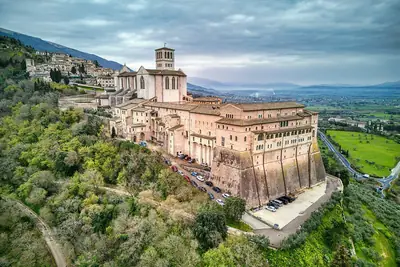
The Basilica of San Francesco d’Assisi is the mother church of the Franciscan Order and one of Italy’s most important pilgrimage sites. Construction began in 1228, two years after Francis’s death, at the wish of Pope Gregory IX. Francis’s mortal remains have rested in the crypt beneath the altar since 1230.
The building is distinctive because it rises directly from the hillside and contains two complete churches, one above the other. The Lower Church is darker and more intimate, while the complex, together with the adjoining Sacro Convento, forms the unmistakable silhouette of Assisi. The basilica and other Franciscan sites in the area were inscribed on the UNESCO World Heritage list in 2000.
The adjoining Treasure Museum of the basilica of Saint Francis in Assisi occupies two halls in the North Palace of the Sacro Convento. Its collection combines sacred art and liturgical treasures with works from the Frederick Mason Perkins collection, donated to the Conventual Franciscan Friars.
Piazza del Comune and the Temple of Minerva
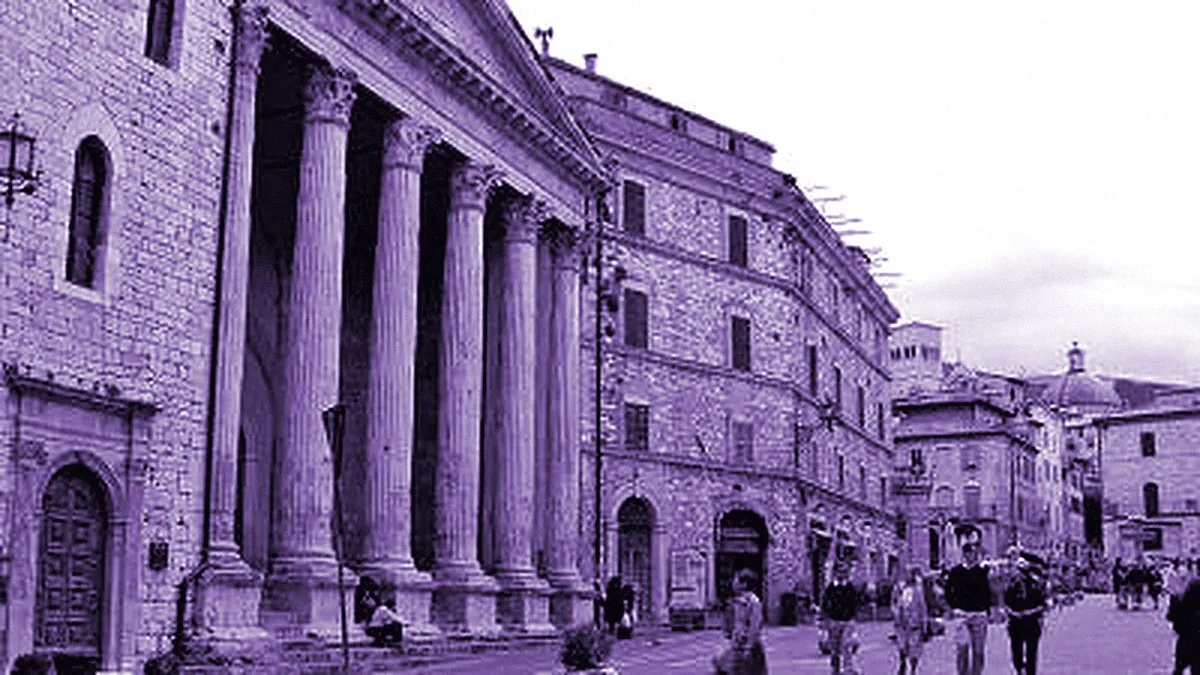
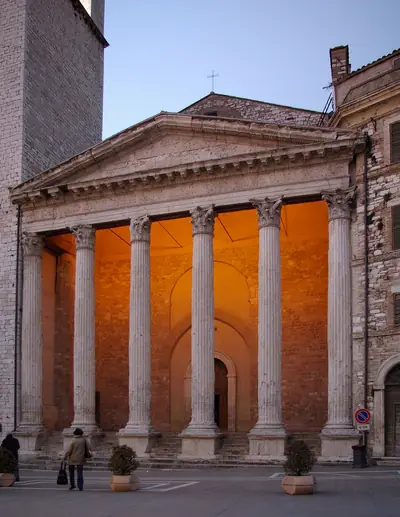
At the heart of Assisi, Piazza del Comune brings the town’s Roman and medieval layers together. Its most striking monument is the Temple of Minerva, one of the best-preserved Roman temples in the world.
The temple dates from the Augustan era, around 30 BC. Six fluted Corinthian columns stand on high square plinths, supporting the entablature and pediment. Despite its traditional name, the temple was probably dedicated to Hercules: a votive inscription to Hercules was found at the site.
In 1539, the building was consecrated as the church of Santa Maria sopra Minerva. The exterior remained almost unchanged, but the interior was transformed in the Baroque period, with ornate cornices, a golden altar and a painting by Giorgetti.
Beneath and beside the square, the Museo Civico e Foro Romano reveals more of Assisi’s ancient history. The underground route passes through the crypt of the former church of San Niccolò and continues beneath the piazza. Finds include fragments of statues, pillars, busts and cinerary urns from the Roman and Etruscan periods. Current scholarship suggests the chambers may have formed a sacred sanctuary connected to the Temple of Minerva rather than the city’s actual forum.
Assisi Cathedral
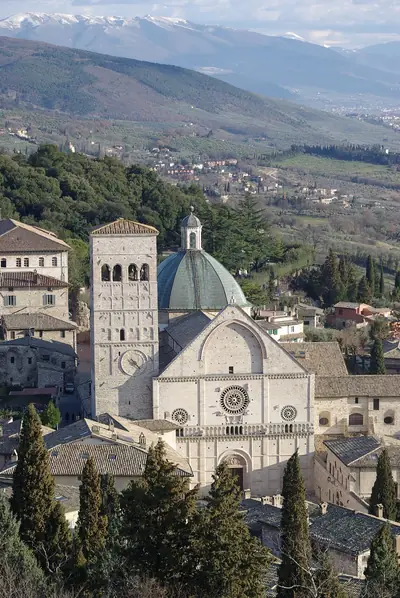
The Cathedral of San Rufino is Assisi’s principal church and has been the spiritual centre of the city for centuries. The present Romanesque structure was consecrated in 1253, while the crypt and bell tower date from an earlier church built around 1029.
Its three-tiered Umbrian façade is especially notable for the Romanesque carving around the main portal. Red marble lions flank the entrance, while the stonework includes lilies, foliage, human faces, birds, winged crocodiles and griffins. The lunette above the door contains a domestic scene in which a child is being nursed by stern-looking parents.
The Assisi Diocesan Museum lies just beneath the piazza beside the cathedral. Founded in 1941 by Bishop Giuseppe Placido Niccolini, it preserves artworks from the Cathedral and several confraternity oratories. The collection contains about three hundred pieces, with a hundred displayed across nine sections. Its crypt includes fragments from earlier churches, ancient frescoes, part of a Roman wall and a third-century Roman sarcophagus associated with Saint Rufinus.
Basilica di Santa Chiara
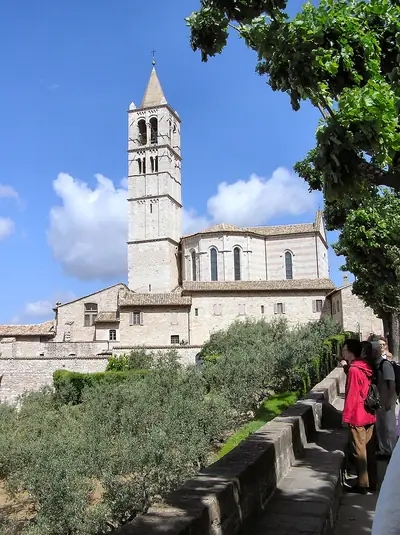
The Basilica di Santa Chiara stands in a broad open square, recognisable by its pink-and-white striped façade, central rose window and strong buttress arches. The church was consecrated in 1265 and is dedicated to Clare, who was born into nobility in 1194 before rejecting her family’s marriage plans and joining Francis.
Francis cut off Clare’s hair, and she exchanged her fine clothing for a simple habit. She later founded the Order of Poor Ladies, now known as the Order of Saint Clare. The basilica occupies the site of the former Church of Saint George, where Francis attended school and where he was later canonized.
San Damiano
South of the centre, San Damiano sits among olive groves and cypresses overlooking the Spoleto Valley. The church is closely connected with the decisive moments of Francis’s life. In 1205, while praying here, he heard a voice from the crucifix telling him to “repair my house.”
Francis later brought Clare to San Damiano, where she established her community of Poor Clares and lived until her death. Near the end of his life, Francis returned while ill and nearly blind and composed the Canticle of the Sun here.
The church has a simple, ancient appearance: a hut-shaped façade, a small portico with three round arches and a rose window. Inside, a single nave with pointed barrel vaults leads towards a deep apse.
Eremo delle Carceri
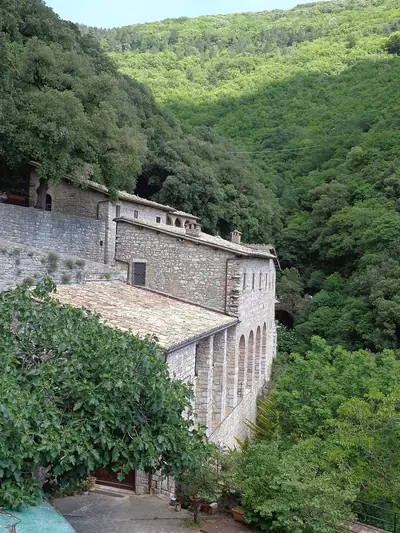
A few kilometres above Assisi, in a steep gorge on Monte Subasio, the Eremo delle Carceri is surrounded by oak woods at nearly 800 metres. Francis and his first followers came here to withdraw from the world, using natural caves that had already attracted hermits in the earliest Christian centuries.
The complex grew around these caves. At its centre is the Oratorio Primitivo, traditionally identified as the cell where Francis slept and prayed. The hermitage combines natural surroundings, small religious buildings and the memory of Franciscan retreat in a setting far removed from the streets of the town.
Basilica of Santa Maria degli Angeli
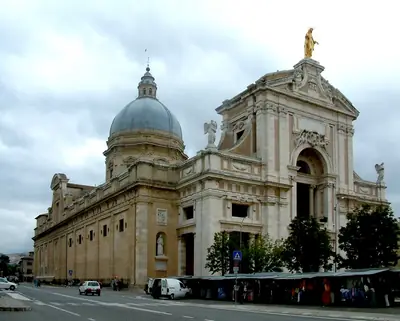
At the foot of the hill, the Basilica of Santa Maria degli Angeli dominates the plain with its large dome. The enormous church was built to protect a much smaller structure: the Porziuncola, or “Little Portion,” a humble ninth-century chapel at its centre.
The Porziuncola is one of the key places in the story of Francis. Here, in the early 1200s, he prayed, understood his vocation, renounced his wealthy upbringing and welcomed Clare and the first friars. The chapel is also associated with the Pardon of Assisi, a tradition of forgiveness for those who enter it.
The Museo di Santa Maria degli Angeli and the Museo Missionario Indios are also in the lower part of Assisi. The latter, known as MUMA, presents the Amazon through the experiences of Capuchin missionaries, the Ticuna people and the Rio Solimões. Its interactive and multimedia design was created when the museum reopened in 2011.
More museums and historic churches
Assisi’s smaller collections add detail to the city’s larger religious and archaeological story. Santa Maria delle Rose is a historic religious building in the centre, while the Museo della Scuola explores the city’s educational heritage.
The Galleria d’Arte Contemporanea belongs to the Pro Civitate Christiana’s Osservatorio Cristiano, a cultural centre designed by architect Pina Ciampani in 1961. Its collection includes paintings, original graphics, sculptures, antiques and marble table tops, as well as a section devoted to the Italian painter and sculptor Norberto Proietti.
Explore Assisi with a Self-Guided Audio Tour
An Assisi self-guided walking tour is a practical way to connect the town’s churches, museums and Roman remains without following a group. Neywo offers four walking tours in Assisi, with routes ranging from 0.81 to 5.67 km, lasting from 54 to 106 minutes and including a total of 29 narrated stops.
The walks cover different sides of the city:
- Francis’s Hill: The Basilica and the Road into Town — 1.1 km, 61 minutes, 8 stops.
- Roman Temple, Town Hall and the House Where Francis Was Born — 0.81 km, 54 minutes, 8 stops.
- Clare, Rufinus and the Fortress above Assisi — 2.52 km, 80 minutes, 8 stops.
- The Valley Below: Porziuncola and the Hovel of Rivotorto — 5.67 km, 106 minutes, 5 stops.
Download Neywo and explore Assisi at your own pace. The app tells the story of each place as you reach it, with no group and no schedule. Narration is available in 11 languages, so you can walk from the Basilica of San Francesco to the Roman Temple, San Damiano, the cathedral and the valley below while the city’s history unfolds around you.
Assisi also makes a useful base for discovering more of Italy, with nearby Umbrian destinations including Perugia, Orvieto and Spello.
Places with an audio guide in Assisi
8 places in Assisi with a Neywo audio guide. Each one starts telling its story as you reach it.
Self-guided tours in Assisi
3 tours in Assisi, free in the Neywo app. Each stop tells its story as you reach it.
- Walk
Francis's Hill: The Basilica and the Road into Town
Start where Saint Francis is buried. Walk through the two-storey basilica with its Giotto-era frescoes, the pilgrims' piazza and the statue of the young knight turning back to Assisi. Then follow the old road down past a Benedictine abbey and the town's picture gallery.
Treasure Museum of the basilica of Saint Francis in Assisi · Basilica of San Francesco d'Assisi · Lower Basilica of San Francesco · Piazza Inferiore di San Francesco · Equestrian statue of Francis of Assisi · Pinacoteca Comunale …
Open this tour: Francis's Hill: The Basilica and the Road into Town - Walk
Roman Temple, Town Hall and the House Where Francis Was Born
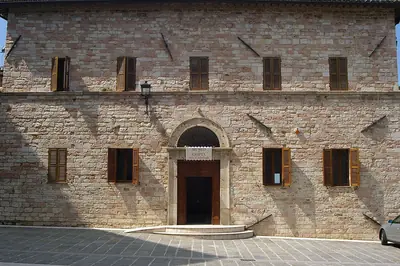
A short loop around Piazza del Comune. See a 2,000-year-old Roman temple, the medieval measuring stones, an underground Roman sanctuary and the stable where Francis is said to have been born. A good hour and a half of layered history in a few streets.
Santo Stefano · Museo Civico e Foro Romano · Temple of Minerva · Misure campione · Palazzo dei Priori · Museo della Memoria …
Open this tour: Roman Temple, Town Hall and the House Where Francis Was Born - Walk
Clare, Rufinus and the Fortress above Assisi
Begin outside the walls at San Damiano, where Francis heard his calling and Clare spent her life. Climb through the pink-and-white striped Santa Chiara and the cathedral of San Rufino, then up past the Roman amphitheatre to the two fortresses with the best view in Umbria.
San Damiano · Basilica di Santa Chiara · Assisi Diocesan Museum · Roman Catholic Diocese of Assisi-Nocera Umbra-Gualdo Tadino · Assisi Cathedral · Roman theatre …
Open this tour: Clare, Rufinus and the Fortress above Assisi
Walk Assisi with Neywo
Neywo turns Assisi into a self-guided audio tour. Stories arrive as you reach the place they belong to, and the route reshapes when you wander off it.

